SWAT TEAM
A paramilitary police unit used where the bourgeois ruling class deems that the ordinary high level
of police violence is insufficient to subdue or kill the masses. The acronym ‘SWAT’ is short for
“Special Weapons and Tactics”, which really means military-type weapons and tactics including machine
guns, grenades, and armored vehicles.
“Early one morning a team of heavily armed police officers burst into the
home of Eugene Mallory, an 80-year old retired engineer in Los Angeles county. What happened
next is unclear. The officer who shot Mr. Mallory six times with a submachine gun says he was
acting in self-defense—Mr. Mallory also had a gun, though he was in bed and never fired it.
Armed raids can be confusing: according to an investigation, the policeman initially believed
that he had ordered Mr. Mallory to ‘Drop the gun’ before opening fire. However, an audio
recording revealed that he said these words immediately after shooting him. Mr. Mallory died.
His family are suing the police.
“Such tragedies are too common in
America. One reason is that the police have become more militarized. Raids by Special Weapons
and Tactics (SWAT) units used to be rare: according to Peter Kraska of Eastern Kentucky
University there were only about 3,000 a year in the early 1980s. Now they are routine:
perhaps 50,000 a year....
“Some of the uses to which SWAT teams
are put defy belief. In Maryland paramilitary police have been sent to break up illegal
poker games; in Iowa, to arrest people suspected of petty fraud; in Arizona, to crack down
on cockfighting.
“American courts tend to smile on SWAT
tactics. They have ruled that police may enter a home without knocking if announcing their
presence might give a criminal a chance to destroy evidence...
“Having armed men burst into one’s
home is terrifying. Startled citizens may assume they are being burgled—the ‘flashbang’
grenades that SWAT teams toss in to (temporarily) blind and deafen their targets tend to
add to the confusion. Some people shoot back, with tragic consequences. Radley Balko, a
campaigning journalist, has identified more than 50 innocent civilians who have been killed
in SWAT raids.
“Two factors have pushed the American
police to militarize. First, thanks to the ‘war on terror’, there is plenty of money available
for weapons. Between 2002 and 2011 the Department of Homeland Security handed out a whopping
$35 billion in grants to state and local police. In addition, the Pentagon supplies surplus
military hardware to police forces at virtually no cost. That is why the quiet little town
of Keene, New Hampshire has an armored personnel carrier called a BearCat, which the local
police chief said might be used to protect its pumpkin festival.
“... the militarization of American law
enforcement is alarming. The police are not soldiers. Armies are trained to kill the enemy;
the police are supposed to uphold the law and protect citizens. They should use the minimum
force necessary to accomplish those goals.”
—“Law enforcement in the United States:
Armed and Dangerous”, Economist, March 22, 2014, p. 14.
[The Economist is a British
ruling class magazine, and like all bourgeois ruling classes they see the “need” for
ever-more powerful police forces to protect the rich and their property, and to try to keep
the masses from rebelling. But the fascist-like continuing militarization of the police in
the U.S. is too much even for them! Even so, they also try to perpetuate the ruling-class
myth that the police in this society exist to “protect citizens”. —S.H.]
“SWATTING”
The highly vicious, and extremely dangerous, activity of purposely falsely informing the police
that some serious criminal activity is in progress at a certain location (even though no such
thing is going on) so that police SWAT teams will be sent to the location prepared to attack with
lethal force. This is the sort of thing that extreme racists or fascists have sometimes done “as
a joke”. It has already led to some police murders of innocent people.
See also:
DOXING
“The prank known as ‘swatting’ is not only costly—taking up law enforcement’s
time and resources to investigate false reports—but it can have disastrous consequences for
the prank’s target as well.
“Take 20-year-old Tyran Dobbs of Ellicott
City, Maryland, for example. According to WJLA-TV, five months ago a Howard County Police SWAT
team descended upon his apartment building. In the incident, Dobbs was shot with a rubber
bullet in the face and has had to endure surgeries as a result.
“It turns out Dobbs did nothing wrong.
He had been ‘swatted.’”
—Liz Klimas, “‘Swatting’ Prank Ends
Horribly for Victim—and He Has the Injury to Prove It”, July 16, 2015. Online at:
http://www.theblaze.com/news/2015/07/16/swatting-prank-ends-horribly-for-victim-and-he-has-the-injury-to-prove-it
[Notice that this news report in the bourgeois media is quite concerned that police
“resources” may be wasted and doesn’t even think to condemn the police for barging into homes
and blasting away at innocent people when they have no real evidence whatsoever against them.
—Ed.]
“Police in Wichita [Kansas] shot an unarmed man to death at his home last week
while responding to a false report of a hostage situation phoned in by a prank caller in Los
Angeles. Andrew Finch, a 28-year-old father of two, was shot after he went outside to investigate
suspicious noises, only to find his home surrounded by officers ordering him to put his hands up.
An officer opened fire when Finch didn’t immediately comply, believing that he was reaching for
a weapon. It’s believed to be the first fatal incident of ‘swatting,’ in which hoaxers report
false crimes in hopes of getting a SWAT team deployed to someone’s house. Some reports have
suggested a dispute in the online video game Call of Duty was behind the hoax, with one
player falsely listing Finch’s address as his own. Tyler Barriss, 25, who was arrested in
California for making the prank call, has served jail time for false bomb threats.”
—The Week, “The U.S. at a glance”, January 12, 2018, p. 8.
SWEEZY, Paul Malor (1910-2004)
Paul Sweezy was an influential American Marxist political economist and in 1949 the co-founder
(along with the Marxist historian, Leo Huberman) of the important publication for the American
Left, Monthly Review. Along with Paul Baran and Harry
Magdoff he formed the core of the “Monthly Review school”
of semi-Marxist political economy centered around that magazine.
Sweezy was born in New York City, the son of a
bank executive. He attended an elite prep school, Phillips Exeter Academy and then Harvard
University where he graduated in 1931. He then spent a year at the London School of Economics
where he was first exposed in a serious way to Marxist economic ideas. He returned to Harvard as
a graduate student, where one of his professors was Joseph Schumpeter.
He received his doctorate in 1937, and then began teaching economics at Harvard. During World
War II he was a member of the research and analysis division of the Office of Strategic Services
(forerunner to the CIA), where one of his jobs was in effect to spy on the British
government! (U.S. imperialism was already thinking very seriously about the contention among
the victors in the war for the control of the world that would ensue after it ended.)
In 1942 Sweezy published one of his most
important books, The Theory of Capitalist Development, which summarized Marxist economic
ideas (though with a partially Keynesian interpretation), and argued for what its opponents
call an “underconsumptionist” theory of capitalist
economic crises. This was one of the first books in English to extensively deal with a number
of important topics in Marxist political economy, including the so-called
“transformation problem”.
In 1966 there appeared another important book,
Monopoly Capital, by Sweezy and Paul Baran. This
put forth the theory that modern monopoly capitalism is inherently prone to
stagnation. However, a lot of the argument in that book is actually
about how the capitalists can overcome (at least to a large degree and for a long time)
this tendency. The authors say this can be done through massive corporate waste, through
enormously intensified marketing, through a special focus on military production for the
government, through innovation and new industries, and through the massive build-up of debt of
all kinds (consumer, business and government debt). That last point is the most central, and
does not receive sufficient emphasis in the book. Moreover, it seems to me that their position
here is somewhat between that of Keynes and Marx. Sweezy and Baran seemed to grant the
capitalists too much in the way of an ability to permanently forestall another great depression,
and even—it seems at times—to grant them too much ability to forestall the lesser difficulty of
“stagnation” that they talked about. That is, they did not seem to fully understand that
Keynesian deficits, consumer debt, etc., themselves have definite limits and must fail
in the end, and they may not have realized just how serious this would become for capitalism.
Today, in early 2009, we are already getting a glimmer of the fact that for the capitalists,
the real problem is not just a “tendency toward stagnation”, but something far, far worse: the
inevitability of a prolonged, intractable economic depression.
Politically, Sweezy and Magdoff (who became
co-editor of Monthly Review after Huberman’s death) generally improved their outlook
over time. While initially enamored by Fidel Castro and the Cuban Revolution, they later
developed a more cautious attitude. As time went on they became more appreciative of Mao and
the great Chinese Revolution. However, like most Marxists of their generation they found it
hard to completely break with the triumphant revisionism of the Soviet Union. Sweezy was one
of those who used to talk about “actually existing
socialism” in the USSR, meaning that with all its actual faults, it should still be viewed
as “socialism”. (At least from the mid-1950s on this was definitely not the case!)
The articles that Sweezy and Magdoff themselves
wrote for MR were in general much better than many of the articles they accepted for
the magazine as its editors. While some of those articles were also quite good, there were also
quite a number of others supporting revisionist “Euro-Communism”, reformist politics, and the
like. Late in his life Sweezy admitted that their magazine should also have played a much
greater role in helping to create a new revolutionary proletarian party in the U.S. Interestingly,
after Sweezy and Magdoff died, and under its new editor, John Bellamy Foster, MR seemed
to further improve, at least initially. But then it also seriously stumbled over their complete
inability to recognize that after Mao’s death China soon became a capitalist country again.
See also:
Monopoly Capital (the book).
SWIDDEN AGRICULTURE
A swidden is a temporary agricultural plot produced by cutting back and burning the existing
vegetation. Typically a series of different crops are then planted from one year to the next,
and when the land is exhausted for agricultural use it is allowed to return to its original
forest or vegetation for a prolonged period.
Thus swidden agriculture is also known as
slash-and-burn agriculture. This is an ancient form of agriculture which traditionally did
little harm to the environment over the long run because the vegetation or forest cover in a
region was allowed to fully recover before being slashed and burned again. However, in the
capitalist era it has become more common for slash-and-burn methods to spread to wider and
wider areas, and to no longer allow the land and forests to recover to their prior condition
at all. This is resulting in massive environmental damage to the world, and the capitalist
system—far from stopping this horrendous damage—has been increasingly promoting it.
“Shifting cultivation was still being practiced as a viable and stable
form of agriculture in many parts of Europe and east into Siberia at the end of the 19th
century and in some places well into the 20th century. In the Ruhr in the late 1860s a
forest-field rotation system known as Reutbergwirtschaft was using a 16 year cycle
of clearing, cropping and fallowing with trees to produce bark for tanneries, wood for
charcoal and rye for flour (Darby 1956, 200). Swidden farming was practiced in Siberia
at least until the 1930s, using specially selected varieties of “swidden-rye”.... In
Eastern Europe and Northern Russia the main swidden crops were turnips, barley, flax,
rye, wheat, oats, radishes and millet. Cropping periods were usually one year, but were
extended to two or three years on very favorable soils. Fallow periods were between 20
and 40 years.... In Finland in 1949, Steensberg ... observed the clearing and burning of
a 60,000 square meter swidden 440 km north of Helsinki. Birch and pine trees had been
cleared over a period of a year and the logs sold for cash. A fallow of alder (Alnus)
was encouraged to improve soil conditions. After the burn, turnip was sown for sale and
for cattle feed. Shifting cultivation was disappearing in this part of Finland because
of a loss of agricultural labor to the industries of the towns. Steensberg ... provides
eye-witness descriptions of shifting cultivation being practiced in Sweden in the 20th
century, and in Estonia, Poland, the Caucasus, Serbia, Bosnia, Hungary, Switzerland,
Austria and Germany in the 1930s to the 1950s.
“That these agricultural practices
survived from the Neolithic into the middle of the 20th century amidst the sweeping
changes that occurred in Europe over that period, suggests they were adaptive and in
themselves, were not massively destructive of the environments in which they were
practiced.” —From the Wikipedia entry for Swidden Agriculture (accessed 3/7/12). [The
article goes on to argue that it was not agricultural practices by themselves which
had led to the disappearance of most European forests.]
SYKES-PICOT CARVE-UP
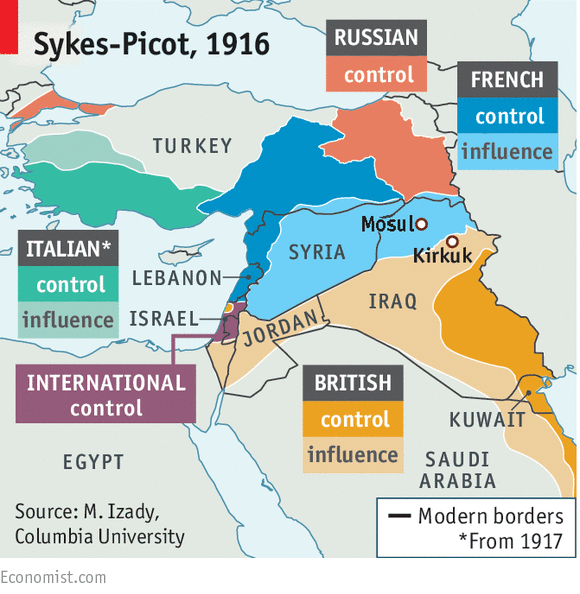 The drastic and disastrous initial carving up of the Ottoman Empire by the British and French
imperialists near the end of World War I. This was done entirely to promote the predatory
interests of the British, French, Italian and Russian imperialists, and without any regard
for the interests of the peoples in the regions they were carving up. And it has led to
constant wars and social disasters ever since. It is the greatest single proof of the general
rule that imperialist intervention in other countries “virtually always makes things worse”.
The reason, of course, is simple: that intervention is being done to advance their own
exploitative capitalist interests, and not at all the interests of the local peoples.
The drastic and disastrous initial carving up of the Ottoman Empire by the British and French
imperialists near the end of World War I. This was done entirely to promote the predatory
interests of the British, French, Italian and Russian imperialists, and without any regard
for the interests of the peoples in the regions they were carving up. And it has led to
constant wars and social disasters ever since. It is the greatest single proof of the general
rule that imperialist intervention in other countries “virtually always makes things worse”.
The reason, of course, is simple: that intervention is being done to advance their own
exploitative capitalist interests, and not at all the interests of the local peoples.
In the discussion below, the important British
ruling class magazine, the Economist, itself
now admits that the Sykes-Picot Carve-Up has proven to be a continuing disaster for the Middle
East and the world, and has helped lead to a great many additional imperialist interventions
and wars:
Unintended Consequences: The Sykes-Picot carve-up led
to a century of turbulence
THE MODERN FRONTIERS of the Arab
world only vaguely resemble the blue and red grease-pencil lines secretly drawn on a map
of the Levant in May 1916, at the height of the first world war. Sir Mark Sykes and
François Georges-Picot were appointed by the British and French governments respectively
to decide how to apportion the lands of the Ottoman empire, which had entered the war on
the side of Germany and the central powers. The Russian foreign minister, Sergei Sazonov,
was also involved. The war was not going well at the time. The British had withdrawn
from Gallipoli in January 1916 and their forces had just surrendered at the siege of Kut
in Mesopotamia in April.
Still, the Allies agreed that
Russia would get Istanbul, the sea passages from the Black Sea to the Mediterranean and
Armenia; the British would get Basra and southern Mesopotamia; and the French a slice in
the middle, including Lebanon, Syria and Cilicia (in modern-day Turkey). Palestine would
be an international territory. In between the French- and British-ruled blocs, large
swathes of territory, mostly desert, would be allocated to the two powers’ respective
spheres of influence. Italian claims were added in 1917.
But after the defeat of the
Ottomans in 1918 these lines changed markedly with the fortunes of war and diplomacy (see
map). The Turks, under Kemal Pasha Ataturk, pushed foreign troops out of Anatolia. Mosul
was at first apportioned to France, then claimed by Turkey and subsequently handed to
Britain, which attached it to the future Iraq. One reason for the tussle was the presence
of oil. Even before the war, several Arab territories—Egypt, north Africa and stretches
of the Arabian Gulf—had already been parceled off as colonies or protectorates.
Even so, Sykes-Picot has become a
byword for imperial treachery. George Antonius, an Arab historian, called it a shocking
document, the product of “greed allied to suspicion and so leading to stupidity”. It was,
in fact, one of three separate and irreconcilable wartime commitments that Britain made
to France, the Arabs and the Jews. The resulting contradictions have been causing grief
ever since.
In the end the Arabs, who had been
led to expect a great Hashemite kingdom ruled from Damascus, got several statelets
instead. The Maronite Christians got greater Lebanon, but could not control it. The Kurds,
who wanted a state for themselves, failed to get one and were split up among four countries.
The Jews got a slice of Palestine.
The Hashemites, who had led an Arab
revolt against the Ottomans with help from the British (notably T.E. Lawrence), were
evicted from Syria by the French. They also lost their ancestral fief of the Hejaz, with
its holy cities of Mecca and Medina, to Abdel Aziz bin Saud, a chieftain from the Nejd,
who was backed by Britain. Together with his Wahhabi religious zealots, he founded Saudi
Arabia. One branch of the Hashemites went on to rule Iraq, but the king, Faisal II, was
murdered in 1958; another branch survives in a little kingdom called Transjordan, now
plain Jordan, hurriedly partitioned off from Palestine by the British.
Israel, forged in war in 1948, fought
and won more battles against Arab states in 1956, 1967 and 1973. But its invasion of
Lebanon in 1982 was a fiasco. The Palestinians, scattered across the Middle East, fought a
civil war in Jordan in 1970 and helped start the one in Lebanon in 1975. Syria intervened
in 1976 and did not leave Lebanon until forced out by an uprising in 2005. More than two
decades of “peace process” between Israel and Palestine, starting with the Oslo accords of
1993, have produced an unhappy archipelago of autonomous areas in the Israeli-occupied West
Bank and Gaza Strip.
Morocco marched into the western
Sahara when the Spanish departed in 1975. The year after Iran’s Islamic revolution of 1979,
Iraq started a war that lasted eight years. It then invaded Kuwait in 1990, but was evicted
by an American-led coalition.
The Suez Canal and vast oil reserves
kept the region at the forefront of cold-war geopolitics. France and Britain colluded with
Israel in the war against Egypt in 1956 but were forced back by America. Yet America soon
became the predominant external power, acting as Israel’s main armorer and protector.
After Egypt defected from the Soviet camp, America oversaw the Egyptian-Israeli peace treaty
of 1979. It intervened in Lebanon in 1958 and again in 1982. American warships protected oil
tankers in the Gulf during the Iran-Iraq war. And having pushed Iraq out of Kuwait in 1991,
America stayed on in Saudi Arabia to maintain no-fly zones over Iraq. In response to
al-Qaeda’s attacks on Washington and New York in September 2001, America invaded Afghanistan
in the same year and then Iraq in 2003.
“Lots of countries have strange borders,”
says Rami Khouri of the American University of Beirut. “Yet for Arabs, Sykes-Picot is a
symbol of a much deeper grievance against colonial tradition. It is about a whole century in
which Western powers have played with us and were involved militarily.”
—“Special Report: The Arab World”,
Economist, May 14, 2016, p. 5.
SYNDICALISM
The view that workers can overthrow capitalism simply through a powerful labor movement, and that
no revolutionary political party is necessary to organize and lead such a revolution. Moreover,
syndicalists believe that these labor unions will form virtually the entire framework of the economic
organization of society after this revolution, and that no workers’ political party or
government will be necessary, not even during any socialist transition period. Thus syndicalism is
actually a variety of anarchism, and is also often referred to as anarcho-syndicalism.
This doctrine and movement was fairly widespread and popular within the European labor movement in
the late 19th century, and was also represented by the Industrial Workers of
the World (IWW) organization in the U.S., which still exists as a miniscule organization (with
a less certain ideology).
Something that most syndicalists are loath to talk
about is precisely how their conception of a “socialist” society would function after the revolution.
Each factory would be run by its workers, true. But how would the national (or world) economy be
organized and coordinated?! And how would goods be distributed to people? Since there would be no
revolutionary party and no government, it could not be done through those institutions. That leaves
only one possibility: a market system. Even after the revolution workers would continue
indefinitely to be paid wages, and all factories and workplaces (even though supposedly run by workers)
would produce goods to sell on the market. In short, what syndicalists are really talking about is
the pipedream of market socialism, which—if it could even
be made to work at all—would inevitably decay back into ordinary capitalism. As Marx demonstrated,
capitalism arises out of the commodity form and commodity markets.
See also:
Georges SOREL,
Richard WOLFF
“Revolutionary syndicalism—a petty bourgeois semi-anarchist
trend that appeared in several parts of Western Europe at the close of the [19th]
century. The Syndicalists repudiated working-class political struggle, the leading role
of the party and proletarian dictatorship, believing that the trade union (syndicates)
could overthrow capitalism without a revolution, through a workers’ general strike, and
take over control of the economy. Lenin pointed out that ‘revolutionary syndicalism in
many countries was a direct and inevitable result of opportunism, reformism, and
parliamentary cretinism’. (LCW 13:166)” —Note 50, Lenin, SW 1.
SYNDICALISM and SOCIAL DEMOCRACY BLENDS
Many supposedly “left” social democrats combine aspects of syndicalism with their social-democratic
form of liberalism. That is, they imagine that if they somehow manage for the state to take over
ownership and joint control of the big corporations, along with the workers at those corporations, that
this sort of thing might be a wonderful socialist system, apparently even if there were no actual change
in which social class rules society overall! Under this fantasy it is not necessary to fight and
overthrow the bourgeoisie; merely to buy out some or all of them!
“Radicals must advocate not just controlling the monopolies but taking over the
monopolies. If the public controlled the top 1,000 corporations, that would put about 60 percent
of the whole economy in our hands. The public corporations’ board of directors could be appointed,
half by a democratically elected Congress, half by workers in the local enterprises. These boards
could keep prices stable, employ everyone, and return the profits for public use.” —Howard
Sherman, “Inflation, Unemployment, and Monopoly Capital”, Monthly Review, March 1976. [This
specific comment was also reprinted in MR, March 2026, p. 14, apparently because the editors
of this supposedly “socialist” magazine think it is so wise! —Ed.]
SYNGMAN RHEE (1875-1965)
[Family name is Rhee.]
The first “president” (actually dictator) of South Korea, who was chosen and put into office by the United
States intelligence agency, the OSS. His lacky regime started the Korean War by attacks on the North,
undoubtedly with the encouragement and support of the U.S., if not outright at their direction.
“The United States’ Office for Strategic Services (OSS), the predecessor to the CIA,
selected Dr. Syngman Rhee, a Korean dissident who had resided in the United States for 25 years, for
the presidency of the new American-established Korean government. Rhee was previously impeached by the
Provisional Government of Korea for misuse of power, and while his vision for the peninsula closely
aligned with Western interests, he had little standing in the country itself. The Princeton educated
politician was strongly pro-American and pro-Western, a devout Christian and a staunch anti-communist.
He was considered an ideal candidate by head of the United States Pacific Command General MacArthur to
head a new Korean government, and was flown to Tokyo from his home in Washington D.C. to meet with the
General in mid-October 1945 before being dropped in Seoul on MacArthur’s personal plane. The CIA’s
personality assessment of Rhee had described him as having ‘devoted his whole life’ to ‘the ultimate
objective of controlling that country [Korea]. In pursuing this end he has shown few scruples about
the elements which he has been willing to utilize for his personal advancement, with the important
exception that he has always refused to deal with communists … Rhee’s vanity has made him highly
susceptible to contrived flattery or self-seeking interests in the U.S. and Korea. His intellect is a
shallow one, and his behavior is often irrational and even childish.’”
—A. B. Abrams, The Immovable Object: North
Korea’s 70 Years at War with American Power (2020), p. 168.