“MODERN MONETARY THEORY” (MMT)
A new trend within bourgeois economics which has arisen since the Great
Recession of 2007-9. This is a new acceptance of having much larger and more permanent
government budget deficits to try to keep the capitalist economy from falling into seriously
worsening crisis. It is therefore a much intensified commitment by many bourgeois economists
and politicians to strongly promote and continually expand Keynesian
deficit financing year after year. They falsely believe that this policy can be continued
indefinitely into the future, and that if this is handled “properly”, no serious negative
consequences (such as run-away inflation) will ever develop. Formal open support for MMT is
strongest among “left” Democrats (i.e., those who call themselves “socialists” or
“social democrats”), but wide de facto support also comes
from a much broader range of politicians, including President Trump and other Republicans, at
least while their party holds office.
This so-called Modern Monetary Theory goes well
beyond what Keynes himself imagined was necessary, namely, just a very temporary period of
government deficits to pull a capitalist economy out of a recession (or depression), which would
then supposedly “prime the pump” and allow the economy to
continue functioning well entirely on its own without any further deficits needed. Keynes even
thought that small budget surpluses could then be accumulated to make up for the previous
deficits. But Keynes’s nostrum has proven to be totally inadequate in dealing with the ever
more powerful underlying overproduction forces
building up over time. Because they don’t know what else to do, the theorists of MMT have come
to believe that Keynesian budget deficits must instead not only continue indefinitely, but even
that the annual deficits must be gradually expanded. So “Modern Monetary Theory” does go way
beyond Keynes; it might even be considered to be a theory of what might be called
Ultra-Keynesianism!
The U.S. Federal Government deficits required
to end the Great Recession (at least as far as the bourgeoisie is concerned) topped $1 trillion
a year at the beginning of the Obama administration. These annual deficits were gradually
reduced to a “mere” multi-hundred billion dollars per year. But the economy has remained so
weak that new tax cuts and new fiscal stimulation have been required which pushed the deficit up
over $1 trillion again for 2019. These annual trillion dollar-plus federal deficits are now
going to continue indefinitely. [See: “Budget Office Projects a Decade of
Trillion-Dollar Deficits”, New York Times, Jan. 29, 2020.]
This situation seriously worries many of the more
traditional bourgeois economists, though the new MMT proponents try to pooh-pooh the dangers.
During the 1970s-1980s the Keynesian-inspired management of the U.S. economy led to double-digit
inflation, and it took a major painful recession to wring that out of the economy. It is hard to
imagine that inflation won’t become a serious problem once again if government deficits continue
to expand uncontrollably. And should another recession become necessary to once again defeat
run-away inflation, it is worth remembering that recessions are now getting much more dangerous.
The Great Recession (2007-9) came very close indeed to becoming an outright depression as bad or
worse than that of the 1930s. Moreover, the methods used to ward off recessions or depressions
are the very same ones as those used to try to end them. If all the deficit “ammunition”
available is used up in a futile attempt to ward off a new depression then there will be little
or nothing left that can be done to try to end it once it starts.
The Covid-19
Pandemic of 2020-?, and the U.S. government economic response to it, requires us to add
another paragraph here: The truly colossal federal stimulus deficits already run during the
first two years of the Pandemic, totaling around $6 trillion, have led to some very serious
inflation already, topping an annual rate of 7% in December 2021, the highest since 1982. This
has completely surprised and shocked many bourgeois economists, including the so-called “Nobel
Prize” winner Paul Krugman, who seem to have at least tacitly accepted the dogmas of “Modern
Monetary Theory”. Once begun, this inflationary burst may continue for a while (for “supply chain
interruptions” and “inflationary psychology” reasons), even if government deficits are cut way
back. But it seems that MMT might already have taken a very serious blow to its reputation with
its first serious attempt at implementation! —S.H.
MONOPOLY — Broad Vs. Narrow
A narrow monopoly is a company which is the sole supplier of one single commodity. A broader
monopoly is a company that is the sole supplier of a large number of items, including
perhaps, some which are not very closely related, and/or which is the only distributor of
those many items, etc. This is clarified in the comment by capitalist media billionaire,
Ted Turner, in the quote below.
“Every Company Strives to Take the Risks out of Capitalism
“Every company wants to grow, crush
competitors, and minimize risks. If it can avoid the sheriff, every company lusts to
become a monopoly. This truism is not peculiar to the digital age, but was clearly
enunciated by a former media baron, Ted Turner: ‘You need to control everything. You
need to be like Rockefeller with Standard Oil. He had the oil fields, and he had the
filling stations, and he had the pipelines and the trucks and everything to get the gas
to the stations. And they broke him up as a monopoly. You want to control everything.
You want to have a hospital and a funeral home, so when the people die in the hospital
you move them right over to the funeral home next door. When they’re born, you got ’em.
When they’re sick, you got ’em. When they die, you got ’em.’ He smiled and added, ‘The
game’s over when they break you up. But in the meantime you play to win. And you know
you’ve won when the government stops you.’” —Ken Auletta, Googled: The End of the
World as We Know It, (NY: Penguin, 2010), pp. 354-355.
[However, only in a handful of
the very most egregious cases does the government actually break up monopolies these
days. And oligopolies are just fine with the
ruling class today—since the owners of these oligopolies are the core of the
modern ruling bourgeoisie. —Ed.]
MONOPOLY — Recent Intensification in the U.S.
Marx pointed out long ago that over time the level of monopoly in a capitalist economy
inevitably tends to increase. And despite the more or less unenforced anti-monopoly laws
that officially exist in the United States, in recent decades this intensification of
monopolies in industry after industry has continued, and even speeded up. In the chart
below we see this quite clearly in the increasing market shares of the top two corporations
in specific industries, for the present (2018) as compared with the early 2000s. Notice that
there are increasing monopoly concentrations in almost all industries, though in a small
number of cases there may be short-term declines in concentration, usually very small.
Combined U.S. Market Share of the Top Two Corporations in Various Industries
[Industries with the most intense new concentration toward monopoly at the top.] |
| Industry |
Early 2000s |
Now (2018) |
% Points Change |
| Home Improvement |
42% |
81% |
+39 |
| Shipbuilding |
22% |
61% |
+39 |
| Private Prisons |
19% |
55% |
+36 |
| Tobacco |
52% |
83% |
+31 |
| Drug Stores |
30% |
60% |
+30 |
| Mattress Mfg. |
35% |
60% |
+25 |
| Craft Stores |
38% |
59% |
+21 |
| Airlines |
22% |
40% |
+18 |
| Car Rentals |
35% |
50% |
+15 |
| Industrial Laundry |
33% |
48% |
+15 |
| Meat Processing |
21% |
34% |
+13 |
| Credit Rating Industry |
22% |
34% |
+12 |
| Truck and Bus Mfg. |
53% |
62% |
+9 |
| Railroads |
48% |
57% |
+9 |
| Amusement Parks |
60% |
68% |
+8 |
| Credit Cards |
26% |
34% |
+8 |
| Movie Theaters |
36% |
40% |
+4 |
| Aircraft Mfg. |
51% |
49% |
-2 |
| Pesticide Mfg. |
49% |
47% |
-2 |
| Outdoor Ads |
38% |
36% |
-2 |
| Tire Mfg. |
70% |
46% |
-24 |
Source: David Leonhardt, “The Monopolization of America”, New York Times,
Nov. 26, 2018. Percentage figures estimated from a graphic representation.
“Early 2000s” ranges from 2002 to 2007, depending on data availability. |
Similar comparative data for most other American industries is not yet available, although
the anti-monopolist reformist organization Open Markets Institute is trying to gather it. For
the data in the above chart only the situation in tire manufacturing is a real outlier from
basic trends. In some U.S. industries the increase in the percentage of monopoly
concentration in recent years is small, but only because the degree of monopoly was already so
high in the first place! With smartphone operating systems, for example, the top two corporations
(Google and Apple) had 79% of the market in 2012, but 99% of the market by 2018. Although
comparative historical data is hard to come by for many industries, the current or recent
situation may be known. In beer, for example, 66% of the American market was owned by just two
companies (InBev and Miller-Coors) in 2017; in candy, 60% of the market was owned by Hershey and
Mars corporations in 2017. In the vast e-Commerce industry, Amazon now controls at least half
the market all by itself.
In world capitalism, and especially within the
United States, there is less and less competition and ever more monopoly.
MONOPOLY CAPITAL (1966 Book)
This is an influential book written by Paul M. Sweezy and
Paul Baran, and published in 1966. There are widely differing
opinions as to just how correct and important this book is. John
Bellamy Foster, who is now the editor of the magazine Sweezy co-founded,
Monthly Review, talks about the book in rather glowing
terms:
“The appearance in 1966 of Monopoly Capital by Baran and
Sweezy (published two years after Baran’s death) represented a turning point in
Marxian economics. Although described by the authors themselves as a mere
‘essay-sketch’, it rapidly gained widespread recognition as the most important
attempt thus far to bring Marx’s Capital up to date, as well as providing
a formidable critique of prevailing Keynesian orthodoxy.
“Where Sweezy himself was
concerned, Monopoly Capital reflected dissatisfaction with the analysis of
accumulation and crisis advanced in The Theory of Capitalist Development
[his book from 1942]. His earlier study had been written when mainstream economics
was undergoing rapid change due to the Keynesian ‘revolution’ and the rise of
imperfect competition theory. Thus, he had provided a detailed elaboration of both
Marx’s theory of realization crisis (or demand-side constraints in the accumulation
process), and of work by Marx and later Marxian theorists on the concentration and
centralization of capital. As with mainstream theory, however, these two aspects
of Sweezy’s analysis remained separate; and hence he failed to develop an adequate
explanation of the concrete factors conditioning investment demand in an economic
regime dominated by the modern large enterprise. It was essentially this critique
of Sweezy’s early efforts that was provided by Josef Steindl in Maturity and
Stagnation in American Capitalism (1952: 243-6), who went to show how a more
unified theory could ‘be organically developed out of the underconsumptionist
approach to Marx’ based on Michal Kalecki’s model of capitalist dynamics, which
had connected the phenomenon of realization crisis to the increasing ‘degree of
monopoly’ in the economy as a whole.
“In fact, it was out of this
argument, as outlined by Steindl, that the underlying framework for Baran and
Sweezy’s own contribution in Monopoly Capital was derived. Thus, they
suggested that Marx’s fundamental ‘law of the tendency of the rate of profit to
fall’ associated with accumulation in the era of free competition, had been
replaced, in the more restrictive competitive environment of monopoly capitalism,
by a law of the tendency of the surplus to rise (defining surplus as the gap, at
any given level of production, between output and socially necessary costs of
production). Under these circumstances, the critical economic problem was one of
surplus absorption. Capitalist consumption tended to account for a decreasing
share of capitalist demand as income grew, while investment was hindered by the
fact that it took the form of new productive capacity, which could not be
expanded for long periods of time independently of final, wage-based demand.
Despite the fact that there was always the possibility of new ‘epoch-making
innovations’ emerging that would help absorb the potential economic surplus, all
such innovations—resembling the steam engine, the railroad and the automobile
in their overall effect—were few and far between. Hence Baran and Sweezy
concluded that the system had a powerful tendency toward stagnation, largely
countered thus far through the promotion of economic waste by means of ‘the sales
effort’ (including its penetration into the production process) and military
expenditures, and through the expansion of the financial sector. All such
‘countervailing influences’ were, however, of a self-limiting character and could
be expected to lead to a doubling-over of contradictions in the not too distant
future.” —John Bellamy Foster, “Paul Malor Sweezy”, in John Eatwell, et al., eds.,
The New Palgrave: Marxian Economics (1990), p. 352-3.
However, to my eyes much of this seems to be unnecessary and even downright
wrong. Yes, there is a more fully coherent “underconsumptionist” approach (or
overproductionist approach, I would prefer to say) than Sweezy put forward in his
1942 book, and it comes straight out of Marx himself. The problem, it seems to me, is
that not only in 1942, but also in this 1966 book Monopoly Capital there
is an unnecessary and incorrect adulteration of Marx with Keynesian conceptions. Thus
contrary to Foster’s comment that this book provides “a formidable critique of prevailing
Keynesian orthodoxy”, I would say the book has still not sufficiently broken
with Keynesianism!
The basic problem with capitalism is
that it does not pay the workers enough to buy back all that they produce for the
capitalists. The capitalists themselves can for a long while spend a large part of the
surplus value they extract from the workers in building new factories and buying more
machinery. And for a fairly long while they can still sell the output from these new and
old factories by granting credit to the workers and by having the government borrow money
from the rich (or else simply print up money) to buy weapons, military supplies, and
other commodities. In other words, the continual and ever-faster expansion of debt can
keep the system working for quite a while. But eventually this massive credit bubble
must pop, and then—according to Marx—the only thing that can clear the ground for
a new expansion is the destruction of all the old excess capital, including that
massive overhang of excess factories and machinery that was artificially built up during
the long credit boom. This is really pretty much all there is to it, and no Keynesian
conceptions at all are necessary to further explicate the situation.
It is true that Sweezy and Baran were
right to point out mechanisms such as wastefulness, innovation, and so forth, as ways
which to a degree help keep the system going for a while. But these are quite secondary
to the main thing, the expansion of the consumer and government credit bubbles.
That is the place to focus one’s attention! And when this giant credit bubble
pops it is totally inadequate to say that there will then be
stagnation; actually there will then be
long-term and intractable economic depression!
So while there are indeed some things of
interest in the book Monopoly Capital, and some valid points, overall it still
seems to me to be a Keynesian-influenced down-playing of how central and how serious the
economic contradictions really are within the capitalist system. —S.H.
See also:
STAGNATION THESIS
MONOTHEISM
A form of religion, often viewed by biased contemporaries as a “higher stage” of religion, in
which the doctrine holds that there is only a single God, rather than
many gods (as in polytheism, such as among the ancient Greeks and Romans). It is usually
said that Judaism, Christianity and Islam are monotheistic religions, while Hinduism is not.
However, the claim that Christianity, at least, is a monotheistic religion is essentially
erroneous. First there is the totally incoherent notion of the “Trinity” among most Christians,
that God is both a single god, while simultaneously being also three separate entities
(“Father, Son [Jesus], and Holy Ghost”). Second, there is the claim that the “Devil” exists,
who is in effect an evil god (though an inferior one). Finally, many Christians, including the
largest group of them—the Roman Catholic Church—hold that there also exists the “Mother of God”
[Mary], angels, and saints (humans raised to minor god-like status), all of which are claimed
to have certain god-like attributes such as immateriality and immortality, and are said to
“answer prayers”, and so on and so forth.
When people look at the world, even though
mostly with a lack of scientific comprehension, they see multiple forces and agencies at work,
and both good and evil, and it is very difficult for them to consistently fit these perceptions
into the religious doctrine that one, and only one, supernatural god exists. For these
reasons it may well be that virtually no religion is truly monotheistic, strictly speaking.
MONSANTO CORPORATION
“Monsanto, the giant biotech corporation, owns the key genetic traits
in more than 90 percent of the soybeans planted by farmers in the United States and
80 percent of the corn. Its monopoly grew out of a carefully crafted strategy. It
patented its own genetically modified seeds, along with an herbicide that would kill
weeds but not soy and corn grown from its seeds. The herbicide and herbicide-resistant
seeds initially saved farmers time and money. But the purchase came with a catch that
would haunt them in the future: The soy and corn that grow from those seeds don’t
produce seeds of their own. So every planting season, farmers have to buy new seeds.
In addition, if the farmers have any seeds left over, they must agree not to save and
replant them in the future. In other words, once hooked, farmers have little choice
but to become permanent purchasers of Monsanto seed. To ensure its dominance, Monsanto
has prohibited seed dealers from stocking its competitors’ seeds and has bought up
most of the remaining seed companies.
“Not surprisingly, in less than
fifteen years, most of America’s commodity crop farmers have become dependent on
Monsanto. The result has been higher prices far beyond the cost-of-living rise. Since
2001, Monsanto has more than doubled the price of corn and soybean seeds. The average
cost of planting one acre of soybeans increased 325 percent between 1994 and 2011,
and the price of corn seed rose 259 percent. Another result has been a radical decline
in the genetic diversity of the seeds we depend on. This increases the risk that
disease or climate change might wipe out entire crops for years, if not forever. A
third consequence has been the ubiquity of genetically modified traits in our food
chain.
“At every stage, Monsanto’s
growing economic power has enhanced its political power to shift the rules to its
advantage, thereby adding to its economic power. Beginning with the Plant Variety
Protection Act of 1970, and extending through a series of court cases, Monsanto has
gained increased protection of its intellectual property in genetically engineered
seeds. It has successfully fought off numerous attempts in Congress and in several
states to require labeling of genetically engineered foods or to protect biodiversity.
It has used its political muscle in Washington to fight moves in other nations to
ban genetically engineered seed.
“To enforce and ensure dominance,
the company has employed a phalanx of lawyers. They’ve sued other companies for patent
infringement and sued farmers who want to save seed for replanting. Monsanto’s lawyers
have also prevented independent scientists from studying its seeds, arguing that such
inquiries infringe the company’s patents. You might think Monsanto’s overwhelming
market power would make it a target of antitrust enforcement. Think again. In 2012,
it succeeded in putting an end to a two-year investigation by the antitrust division
of the Justice Department into Monsanto’s dominance of the seed industry.
“Monsanto has the distinction of
spending more on lobbying—nearly $7 million in 2013 alone—than any other big
agribusiness. And Monsanto’s former (and future) employees frequently inhabit top
posts at the Food and Drug Administration and the Agriculture Department, they staff
congressional committees that deal with agricultural policy, and they become advisors
to congressional leaders and at the White House. Two Monsanto lobbyists are former
congressman Vic Fazio and former senator Blanche Lincoln. Even Supreme Court justice
Clarence Thomas was at one time an attorney for Monsanto. Monsanto, like any new
monopoly, has strategically used its economic power to gain political power and used
its political power to entrench its market power.”
—Robert Reich, former Secretary
of Labor in the U.S. government, in his book Saving Capitalism (2015), pp.
34-36. [Being a liberal reformer, Reich thinks it is both necessary and somehow
possible to end this sort of monopoly controlled government without actually
overthrowing capitalism, and in order to “save it”. —Ed.]
MONTHLY REVIEW
An influential semi-socialist magazine in the United States, established by
Paul Sweezy and Leo Huberman in 1949. After Huberman died,
Harry Magdoff became a co-editor with Sweezy, and since
Sweezy and Magdoff both died, it has been edited by John Bellamy
Foster. Generally the best articles in the magazine are by the editors themselves, but—as
editors—they have long had an unfortunate general tendency to open up their pages to a
great many reformist and social democratic trends of thought. Still, there are also many
useful and informative articles in the magazine.
We consider MR to be only a “semi-socialist”
magazine, because—for one thing—the editors have never had an entirely clear idea what genuine
socialism even is! This is evidenced by their failure to clearly understand that the Soviet
Union was no longer socialist from the Khrushchev era until its demise in 1991.
Similarly, the MR editors have been unable to recognize that neither Cuba nor China (since the
death of Mao) are really socialist countries, at least not in the MLM sense of the word. (See
my short essay on this, “What Is Socialism?” (Dec. 2014), at:
https://www.massline.org/Politics/ScottH/WhatIsSocialism.pdf —S.H.)
“I would not call China capitalist. Major economic heights are nationally
owned and centrally planned. In addition, competition between private firms are not the
determinants of the economy’s laws of motion. (The latter is a key feature of a capitalist
society.) Nevertheless, the changes that have been taking place do increasingly take on features
of a capitalist society, plus being part of a trend moving more and more toward a society
resembling capitalism.” —Harry Magdoff, in a letter to Isabel Crook, Dec. 3, 2002, published
in Monthly Review, March 2021, p. 57.
[In the introduction to that letter, the
current MR editor, John Bellamy Foster, says that Magdoff “saw China as a postrevolutionary
society, neither socialist nor capitalist, but also having shifted in the direction of the
latter.” And in Foster’s own “Notes from the Editor” (p. 62) he states something similar to
this characterization as his own view: “China, ... which is neither entirely capitalist nor
entirely socialist.” So here we have a view of what “socialism” is which is so vague and
amorphous (and actually bourgeois social democratic!) that individual countries might even be
simultaneously both socialist and capitalist, or perhaps in some “no man’s land” in between the
two! In contrast, the Marxist-Leninist-Maoist definition of socialism is quite clear and
straightforward. Three conditions must hold: 1) Politically the country must be socialist: i.e.,
the working class must actually be in control; 2) Economically, the basic law must be “From each
according to their ability, to each according to their labor.”; and 3) The society must be in a
genuine transformation process away from capitalism and towards communism. Magdoff and
Foster seem to pay attention only to the economic criteria, and even that they have
basically wrong. They focus mainly on the question of state ownership of industry and seem to
have never heard of such a possibility as state capitalism!
Moreover they seem totally blind to the fact that China is now also a major capitalist-imperialist
country. Instead they put forth their silly notion of China as a “postrevolutionary society” which
is either “both socialist and capitalist” or else neither the one nor the other. What a
pathetic liberal analysis! (See the above mentioned essay, “What is Socialism?”, for more on
this from an MLM perspective.) —S.H.]
MONTHLY REVIEW SCHOOL
This is not a formal school, but a loose collection of political economists centered
around the Monthly Review magazine (see above). Most of these economists are quite
eclectic in their views and are especially strongly influenced
by Keynes and Keynesianism to one
degree or another, as well as by Marx. While some of the economic views and comments by Paul
Sweezy and the others associated with the MR School are interesting and worth consideration,
it should never be forgotten that their overall perspective is an attempted blending of Marxism
with bourgeois political economy of the Keynesian variety.
See also:
MONOPOLY CAPITAL (Book),
STAGNATION THESIS,
Paul SWEEZY,
Paul BARAN,
Harry MAGDOFF,
John Bellamy FOSTER
“Nothing that has been said should be taken as belittling the importance
of Keynes’ work. Moreover, there has been no intention to imply that Marxists ‘know it all’
and have nothing to learn from Keynes and his followers. I have no doubt that Keynes is the
greatest British (or American) economist since Ricardo, and I think the work of his school
sheds a flood of light on the functioning of the capitalist economy. I think there is a great
deal in Marx—especially in the unfinished later volumes of Capital and in the Theorien
über den Mehrwert [Theories of Surplus Value]—which takes on a new meaning and
fits into its proper place when read in the light of the Keynesian contributions. Moreover, at
least in Britain and the United States, the Keynesians are far better trained and equipped
technically (for instance in the very important sphere of gathering and interpreting statistical
data) than Marxist economists, and as matters now stand there is no doubt which group can learn
more from the other.” —Paul Sweezy, “John Maynard Keynes”, Science and Society magazine,
Fall 1946, p. 404. (Written shortly after the death of Keynes in April 1946.)
[This promotion of Keynesian economics
within Marxism, and the blending of the two together, has characterized the Monthly Review
School from the start. It shows the severe limits and possibilities for this trend of thought.
—S.H.]
MOON — Capitalism On
“[T]he original race [to the moon] was seen as a crucial test of
whether capitalism or central planning was the better economic system (though NASA’s
effort was probably the most centrally planned civilian operation in the history of
the United States).” —“The New Space Race”, The Economist, Jan. 20, 2018,
p. 15.
“A return to the moon could also inspire the next generation and
advance technology just as Apollo did—but do so in a sustainable, stepwise manner.
The taxpayer needs to see a return on investment for this endeavor and not only in
technology development. For example, a spacecraft-refueling depot orbiting the
moon—supplied with fuel refined from lunar resources, privately operated and selling
its products to various space agencies—is one commercial on-ramp to bring the moon
into our economic sphere of influence.” —Clive Neal, “A Return to the Moon is
Crucial”, Scientific American, July 2016, p.8.
[The capitalists have not even
quite finished destroying the Earth, and yet they are already looking to extend their
system of exploitation and environmental destruction to the moon and then to other
planets! —S.H.]
“[It was a] Good week for Manifest destiny, after U.S. Army
Secretary Dan Driscoll, speaking to Fox News about the military’s ability to handle
simultaneous deployments, claimed to have ‘talked to an astronaut yesterday who’s on
the moon, who’s a soldier.’ As of press time, neither NASA nor the Pentagon had
confirmed an active U.S. military presence on the moon.” —The Week
magazine, June 27, 2025, p. 5. [For reference (as of July 7, 2025): A total of 12
Apollo astronauts have walked on the moon, all of them in the years 1969-1972.]
[Which, we wonder, is more alarming:
The fact that the current head of the U.S. Army is so ignorant and out of touch with
reality that he doesn’t know that there hasn’t been any human beings on the moon for
more than 50 years; or the apparent determination of American imperialism to annex
the moon and turn it into yet another U.S. military base?! —Ed.]
MORALITY — As Viewed by Different Classes
[To be added... ]
“But how do things stand today? What morality is preached to us today?
There is first Christian-feudal morality, inherited from earlier religious times; and
this is divided, essentially, into a Catholic and a Protestant morality, each of which
has no lack of subdivisions, from the Jesuit-Catholic and Orthodox-Protestant to loose
‘enlightened’ moralities. Alongside these we find the modern-bourgeois morality and
beside it also the proletarian morality of the future, so that in the most advanced
European countries alone the past, present and future provide three great groups of
moral theories which are in force simultaneously and alongside each other. Which, then,
is the true one? Not one of them, in the sense of absolute finality; but certainly
that morality contains the maximum elements promising permanence which, in the present,
represents the overthrow of the present, represents the future, and that is proletarian
morality.
“But when we see that the three
classes of modern society, the feudal aristocracy, the bourgeoisie and the proletariat,
each have a morality of their own, we can only draw the one conclusion: that men,
consciously or unconsciously, derive their ethical ideas in the last resort from the
practical relations in which they carry on production and exchange.” —Engels,
Anti-Dühring, MECW 25:86-87.
MORTGAGE — Fifty Year
A proposed new mortgage program which will require interest payments stretching out 50
years before the loan is finally, finally! paid off and the house actually becomes
yours. In the middle parts of the 20th century most mortgages in the U.S. were for much shorter
periods, and commonly for 15 years. However, for many decades now the most common mortgages have
been for 30 years. And that is bad enough; it means that most working class and even “middle
class” people with a mortgage loan are very lucky to completely pay it off before their retirement
years arrive. However, the prices of houses in relation to workers’ incomes keeps going up,
especially during the long developing economic crisis which first started in much of the world in
a limited way in 1973 and has since gradually become worse.
Taking out one of the proposed new 50-year
mortgages would come close to guaranteeing that the home will actually never fully belong to
you. And meanwhile you will really be working even more for the bank than you are for
yourself! For an idea of how bad the idea of 50-year mortgages are for borrowers, see the article
below from the New York Times.
“When President Trump proposed the introduction of a 50-year mortgage, he
challenged a bedrock of the American housing market and financial system. He also revealed
how desperate the administration is to lower prices for consumers. On ‘The Daily,’ the host
Michael Barbaro asked Conor Dougherty, who covers housing and development for The
Times, to explain what’s attractive about the idea and its potential drawbacks.” [An
edited and partially rewritten excerpt follows:]
The basic gist is the cost of the
home would be spread out over 50 years instead of 30 years. Let’s say you’re buying a
$500,000 house at current mortgage rates, and you put down 20 percent. Your monthly payment
would go from about $2,500 for a 30-year to about $2,200 for a 50-year.
The problem is it looks like it saves
you money. [In our example] you’re going to end up paying about $500,000 in interest with
a 30-year mortgage. You basically pay for the house twice—once for the actual house and
again for the bank’s profit. But with a 50-year mortgage you’re going to end up paying
about $900,000 in interest (because it involves paying interest for 20 additional years).
So even if you do survive that long, you end up paying almost 3-times the actual cost
of the house!
—Adapted from the New York
Times, “Listen In” excerpt, November 18, 2025, p. 2.
MOTION (Change of Position)
From the standpoint of classical physics, motion is a simple thing. Motion just means that an
object (whether it be an electron, an atom, or a multitude of such particles making up a
large conglomerate object such as a rock, a baseball, or a planet) changes its location (with
respect to other objects) over time. Thus, if a car is heading from east to west, the measure
of its average velocity during some interval (and hence the overall motion of the car
during that interval) is the direction and distance traveled from one given point to another
specific point divided by the time it takes to go from the first point to the second. And its
instantaneous velocity, or velocity at a given instant or
point in time, is defined as the limit of the average velocity in ever smaller intervals
around the point of time in question. All this is elementary, and straightforward, and causes
no serious conceptual difficulties once the mathematical concept of a
limit is understood.
Thus the quantitative aspects of motion on
the macro level, in the sense of the simple change of position of an ordinary object over time,
are fairly easy to understand. (But see also:
NEWTON’S THREE LAWS OF MOTION) However, to
deeply comprehend what is actually physically happening at a sub-atomic level when an object
physically moves may well be a much more complicated thing, which perhaps as yet no one understands.
What does it mean physically at the sub-atomic level for an object to move at all?
Does it make any sense to ask what it means to move from one spot “to the very next spot”? Or are
space and time absolutely continuous (in reality and not just conceptually) so that there
is no such thing as two minimally adjacent locations and two minimally adjacent moments of time?
The answers to these questions still seem to be unclear and unsettled. There are scientific
theories that maintain that the “Planck length” (10-20 of the diameter of a single
proton) is the smallest distance which is meaningful in physics. If this is really the case, then
motion might perhaps consist of a series of jumps each of which is some discrete number of “Planck
lengths”. And presumably to really clarify what motion ultimately is, we would have to be able to
say precisely what happens physically (to some object and to space itself) when the object
traverses one or more Planck lengths. Or putting it all another way, can we be absolutely sure we
understand exactly what motion is unless we are sure what space (or space-time) itself is, whether
or not it is discrete or continuous at some super-tiny level, and how space and particles interact
at that level?
Philosophically, the point is not really to engage
in speculation about quantized space (or space-time), but simply to point out that from a
philosophical perspective it is still possible to be puzzled about what space and motion actually
are. Motion, in the sense of simple change of position, may or may not turn out to be the totally
simple thing that it is assumed to be in everyday common sense, or that it is represented to be in
introductory physics classes.
MOTION — Dialectics Of
Motion, in the general Marxist philosophical sense, refers not simply to the change of position
of one piece of matter, but to any type of change since all change involves motion of one sort
or another. As has so often been said, the world consists of matter in motion. The concept of
motion in this abstract dialectical sense may indeed be one of the deepest philosophical
categories to explore.
Engels wrote that “motion, as applied to matter, is
change in general.” [Engels: Dialectics of Nature, Moscow, 1974, p. 247.] But if “motion”,
in the context of dialectics, just means change, then why not simply use the word “change”
(or perhaps even better, change and development) instead of the somewhat vaguer word “motion”?!
Well, we can indeed use the word “change” if we want, and that is something that many of us now prefer
to do in place of this abstract and dated-sounding term “motion”. But we also have to recognize that
many of the terms used in philosophy, even in the latest and most up-to-date Marxist-Leninist-Maoist
philosophy, were created long ago, and to read and understand older discussions we have to also
understand the older terminology. Moreover, oftentimes the older terminology remains the most common
in contemporary usage, for reasons of tradition. This is even true of the word “contradiction” itself
despite the fact that the word “opposition” would actually be better and less confusing term today in
many discussions of dialectics.
“To be ignorant of motion is to be ignorant of Nature.” —Aristotle, quoted in
Dava Sobel, Galileo’s Daughter, (NY: Penguin, 2000), p. 30.
“Motion in the most general sense, conceived as the mode of existence, the
inherent attribute, of matter, comprehends all changes and processes occurring in the universe,
from mere change of place right up to thinking. The investigation of the nature of motion had
as a matter of course to start from the lowest, simplest forms of this motion and to learn to
grasp these before it could achieve anything in the way of explanation of the higher and more
complicated forms. Hence, in the historical development of the natural sciences we see how
first of all the theory of simplest change of place, the mechanics of heavenly bodies and
terrestrial masses, was developed; it was followed by the theory of molecular motion, physics,
and immediately afterwards, almost alongside of it and in some places in advance of it, the
science of the motion of atoms, chemistry. Only after these different branches of the knowledge
of the forms of motion governing non-living nature had attained a high degree of development
could the explanation of the processes of motion representing the life process be successfully
tackled.” —Engels, Dialectics of Nature (1873-1882), “Basic Forms of Motion”, MECW 25:362.
“The concept of motion, too, is important for all of modern science, including
physics and Marxist-Leninist philosophy. As a result of scientific generalization from the
history of cognition, from the achievements of social and natural sciences by Marxist
philosophers, it has been proved that matter and motion are inseparately linked, that motion
is the form of matter’s being. Engels wrote: ‘Matter without motion is just as inconceivable
as motion without matter.’ [Anti-Dühring, Moscow, 1975, p. 76.] Matter has never
existed without motion and cannot so exist.
“Even in antiquity, the philosophers of
India, China and Greece made a number of brilliant guesses to the effect that the objective
world is in motion, undergoes change and development, that motion is an inalienable property of
everything that exists, an attribute of matter. Heraclitus’ dicta on motion (everything flows,
everything changes, there is nothing immovable), on opposites and their role in nature’s
changes, make an exceptionally strong impression even today. Marx, Engels and Lenin considered
Heraclitus a brilliant spokesman of the spontaneous dialectic of the ancient Greeks. Engels, for
example, stressed that, according to Heraclitus, everything is in a continual process of
emergence and disappearance.
“The materialists of the 17th and 18th
centuries, especially La Mettri, Diderot and Helvetius, made a major contribution to the
doctrine of motion, repeatedly asserting that matter is unthinkable without motion, that motion
is matter’s mode of existence.
“Hegel has a special place in the
elaboration of the doctrine of motion. Though on an idealist basis he overcame the metaphysical
and mechanistic limitations of his predecessors’ ideas on motion and showed that contradictions
are the source of all motion; he discovered and gave philosophical generalization to the most
general laws of motion.
“Marx and Engels, in creating dialectical
materialism, showed that ‘motion, as applied to matter, is change in general’ [Engels:
Dialectics of Nature, Moscow, 1974, p. 247.] Motion is the unity of opposites: of the
absolute and the relative, of stability and changeability, of discontinuity and continuity.
Motion is the unity of opposites—change and rest."
—V. S. Gott, This Amazing, Amazing,
Amazing, but Knowable Universe, (Moscow: Progress, 1977 [original Russian ed. 1974]), pp.
50-51. Gott was a Soviet philosopher of science.
“[T]he question is not whether there is movement, but how to express it
in the logic of concepts.” —Lenin, “Conspectus of Hegel’s Book Lectures on the History
of Philosophy” (1915), LCW 38:256.
“Motion itself is a contradiction: even simple mechanical change of
position can only come about through a body being at one and the same moment of time
both in one place and in another place, being in one and the same place and also not in
it. And the continuous origination and simultaneous solution of this contradiction is
precisely what motion is.” —Engels, Anti-Dühring (1878), MECW 25:111.
[Here I must disagree with Engels
and the old Hegelian way of expressing all this. Motion (movement in position) is indeed
a dialectical contradiction, but is not a logical contradiction. That is,
while there are opposing forces at work which lead to movement, the moving thing is,
at any one instant, and from the point of view of formal logic, not actually both
in one specific place and simultaneously not in that one place! The world consists
of dialectical contradictions, not of formal logical contradictions. Hegel and other
idealists confused and blended the two conceptions, and—unfortunately—Engels and other
Marxists have, on occasion, themselves done the same thing. In part this was due to the
undeveloped, confused and idealist state of the presentation of calculus in their day.
(See: “Engels’s Confusion of Logical contradiction with Dialectical Contradiction”
(Nov. 19, 2018), online at:
https://www.massline.org/Philosophy/ScottH/Dialectics/Engels'sConfusionOfLogicalContradictionWithDialecticalContradiction-181119.pdf
) However, it is also possible that some sensible physical interpretation of what it
might mean for a body to be “in one and the same place” and also “not be in it” may someday
be put forward, either within quantum mechanics or in some other conceptual framework. In
other words, what appears on the surface here to be a logical contradiction might conceivably
yet turn out to be a high-level characterization of some deep physical process. What a
fascinating result that would be! Even so, it would still not actually be a real logical
contradiction. —S.H.]
MOUFAWAD-PAUL, Joshua
Joshua Moufawad-Paul (henceforth “JMP”) is a (purported) Marxist-Leninist-Maoist academic at
York University in Toronto, Canada, who also administers the
“MLM Mayhem!” website.
While JMP has written extensively in defense
of MLM and has dispelled various misunderstandings and outright lies about it, his books and
articles suffer from being written in pretentious and high-sounding language (something
upheld as a feature rather than a flaw among many academic “Marxists”), and are obviously
written to appeal to a petty-bourgeois academic audience much more than to the broad masses
of people. It is of course often necessary to write documents directed at people who are
well-versed in Marxist terminology, especially when discussing theoretical points of debate
and correct political line, but if one’s writings are only ever directed at “people in the
know”, there is something amiss, and it is rather striking that JMP hardly ever writes in
a way that is really comprehensible to the masses of people. And even many people who
are well-versed in the terminology and special categories of the revolutionary
science of Marxism will often find it difficult to wade through much of what he writes,
given that the terminology he uses is an eclectic mish-mash from different schools of
philosophy. This is symptomatic of much of academic “Marxism”, and is by itself an important
qualifier to JMP’s claim of being an authentic Maoist.
Perhaps most gratuitously, he has also
embraced the “universality of protracted peoples
war”, a position that is quite common among Maoists today but that can only be sustained
by diluting PPW of its specific concrete content that distinguishes it from other
revolutionary strategies. In order to contend that PPW is an appropriate strategy applicable
to an advanced capitalist country such as Canada, JMP essentially washes out the difference
between the general (the “protracted process” of the Russian Revolution) and the particular
(the protracted military struggle which is specific to PPW). That both the Russian
and Chinese revolutions were protracted processes does not in any way actually lead
to the conclusion that the former is an example of PPW. Of course, these revolutions did
indeed share many aspects (including, importantly, the presence and essential role of armed
struggle, which nevertheless took on a qualitatively much greater role in the Chinese case),
but this does not at all mean that they were “basically the same”.
Unfortunately, some Maoists, partly motivated
by petty-bourgeois impetuosity and adventurism, are unwilling to bother with investigations
that properly identify the general, universal aspects of past revolutionary struggles and
their relation to the specific aspects that are not universal. These people proclaim their
“Maoism” by taking one of Mao’s contributions to revolutionary theory (namely, PPW and its
successful implementation in China), and then dogmatically and mechanically applying it to
all contexts. Mao himself urged against viewing PPW as an appropriate strategy to be used
everywhere and at all times, and instead clearly explained why Marxism-Leninism needs to be
creatively applied in the particular conditions of a particular country. In doing this, he
analyzed the differences between Russia and China and correctly concluded that the “October
Road” of urban insurrection, which was appropriate in Russia, was not appropriate in China.
Despite the appalling set-back suffered by the Communist Party of China when they did try to
implement urban insurrection, many “Marxist-Leninists”, particularly
Trotskyists, have persisted in denouncing Mao and the
Chinese communists whom he led for “deviating” from the “proper” October Road strategy! This
error is just as dogmatic and idealist as the one made by JMP and other enthusiasts of the
universality of PPW. JMP’s dogmatic rejection of tailoring tactics and strategy to the
concrete conditions and washing out the differences between the general and the particular
is doubly ironic given his own denunciation of dogmatism and his strong urging to
avoid treating MLM like a set of religion.
(It should be noted that he does at least
acknowledge the rift within MLM over the universality of PPW and does not claim that
adopting the affirmative stance is required for one to be a Maoist; he claims that
the universality of PPW is “only a hypothesis at this stage”. However, this “reasonable”
position itself contains an element of obfuscation: it distracts people from seeing MLM as
an evolving science which requires serious investigation before coming to a
hypothesis, and instead allows for clearly erroneous ideas to be brought forward which are
then meant to be “put to the test”! This irresponsible stance is a major abdication of the
responsibility to not waste everyone’s time with erroneous formulations that will have
harmful consequences for revolutionary struggles.)
JMP writes that he “upholds the legacy” of
the Red Brigades and other urban guerilla/focoist groups in of the 1970s and 80s. While
acknowledging that focoism and armed propaganda/urban guerilla
warfare are not the same as PPW, one must question why he “upholds the legacy” of such
obviously wrong tendencies. When assessing someone like Che
Guevara, Maoists can certainly uphold and pay tribute to his courage and selfless
devotion as things to emulate, but this cannot be a substitute for an objective evaluation
of what is also wrong in Guevarism as a revolutionary strategy. Upholding the
sincerity and courage of a particular personality or even group or movement does not at
all mean crediting their particular approach to revolution. JMP simply states that he
“upholds the legacy” of armed revisionism without qualifying just what he means by this.
This betrays a sort of liberalism on his part. The inadequacy of the strategies of urban
terrorism and armed propaganda, which largely corresponded in their general outlook with
the aims of focoism, was already known to and correctly criticized by Lenin, who saw that
the Russian anarchists and their line of “propaganda by the deed” would not and could not
“shock” the masses into revolutionary action. Likewise, sweeping claims about the
applicability of PPW to the advanced capitalist countries, where the state is able to
deploy its armed forces in literally a matter of hours to any part of the country to put
down threats to “social stability” (bourgeois rule), is petty-bourgeois adventurism and
juvenile posturing (indeed, it is an example of
“left-wing” phrase mongering of precisely
the sort that Mao fought against).
Given the consistency of these deviations
among JMP and some other self-styled “Maoists”, one can conclude that they are not really
grasping the essence of the theory and practice they claim to be promoting. To summarize:
they uphold the “universality” of a strategy which clearly has no such universality; they
blur the distinction between the general and the particular in their evaluation of an
appropriate revolutionary strategy, thus adopting the error of dogmatism; they “uphold the
legacy” of groups following a strategic line that did nothing to advance the cause of
revolution, let alone succeed in seizing state power (except in the rather lucky break of
the Cuban Revolution); and their writings are crammed with pretentious and purposely (one
must assume) difficult-to-penetrate language designed to give their musings an air of
profundity.
Arguably, such
posturing stances are born of an emotional desire to
“jump-start” and seek short-cuts to revolution, but this itself betrays yet another
shortcoming: not wanting to patiently engage with the masses and their concrete struggles,
and seeing such things as a nuisance or a “waste of time”, as though Maoists are “above”
such things (the masses, by implication, must therefore be “beneath” the exertions of
these “Maoists”). This anti-people attitude is a dead-end, and those who subscribe to it
will invariably discover this on those occasions when they do come into contact with the
masses and do try to promote revolutionary ideas; such encounters will be painfully
awkward, not least because the masses will correctly perceive the condescending overtones
of phrase-mongering “rescuers”, swooping down from their academic ivory towers and issuing
fancy sounding proclamations about “Gonzalo thought” and other as-yet indecipherable
phrases to workers awash in bourgeois culture and who mostly lack even a rudimentary
understanding of revolutionary politics. The self-proclaimed “Maoist revolutionaries”, in
turn, will become frustrated, demoralized and resentful when the masses “just don’t get
it”, and will ultimately feel “betrayed” by the masses and even denounce them as “unworthy”
of the “brilliant” theoretical “contributions” they were ungratefully bestowed with — yet
in still another dialectical twist, it is actually the masses who are “getting” it a whole
lot more than they are!
Even the name of JMP’s website, “MLM
Mayhem!”, betrays a kind of petty-bourgeois outlook tinged with notions of bravado and
adventurism, as though the point of MLM is to “fuck shit up” or to engage in random
philosophical musings on the Internet (what, after all, is the point of including
the word “mayhem” in the name of a website that purports to develop and synthesize
scientific theory for guiding the masses towards revolutionary action? What actual
role can “mayhem” play in this?). Too many communists and progressive people,
especially youth who are attracted to the vulgar aesthetic appeals of bourgeois culture,
reduce MLM to something akin to a commercial brand which they swear allegiance to because
it is “cool” but which they have little time for in terms of concretely investigating and
practicing it. —L.C.
See also:
“Protracted People’s War is Not a Universal Strategy for Revolution”, by the Mass
Proletariat organization, Jan. 19, 2018, online at:
https://bannedthought.net/USA/MassProletariat/2018/MP-UniversalityOfPPW-180119.pdf
This extensive article provides a careful and scientific MLM critique of the “universality
of PPW” thesis, and includes a section specifically criticizing JMP on this and on some other
of his erroneous views.
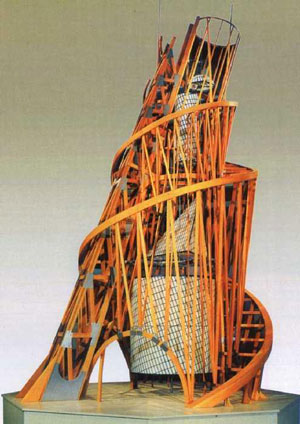 A proposed ultra-modernistic monument by the Constructivist
artist and architect Vladimir Tatlin. He constructed a 6 meter high model which was exhibited
in Moscow in 1920, but the proposed 400 meter version—higher than the Eiffel Tower!—was never
built. This design became very famous worldwide among those enthusiastic about abstract modern
art.
A proposed ultra-modernistic monument by the Constructivist
artist and architect Vladimir Tatlin. He constructed a 6 meter high model which was exhibited
in Moscow in 1920, but the proposed 400 meter version—higher than the Eiffel Tower!—was never
built. This design became very famous worldwide among those enthusiastic about abstract modern
art.