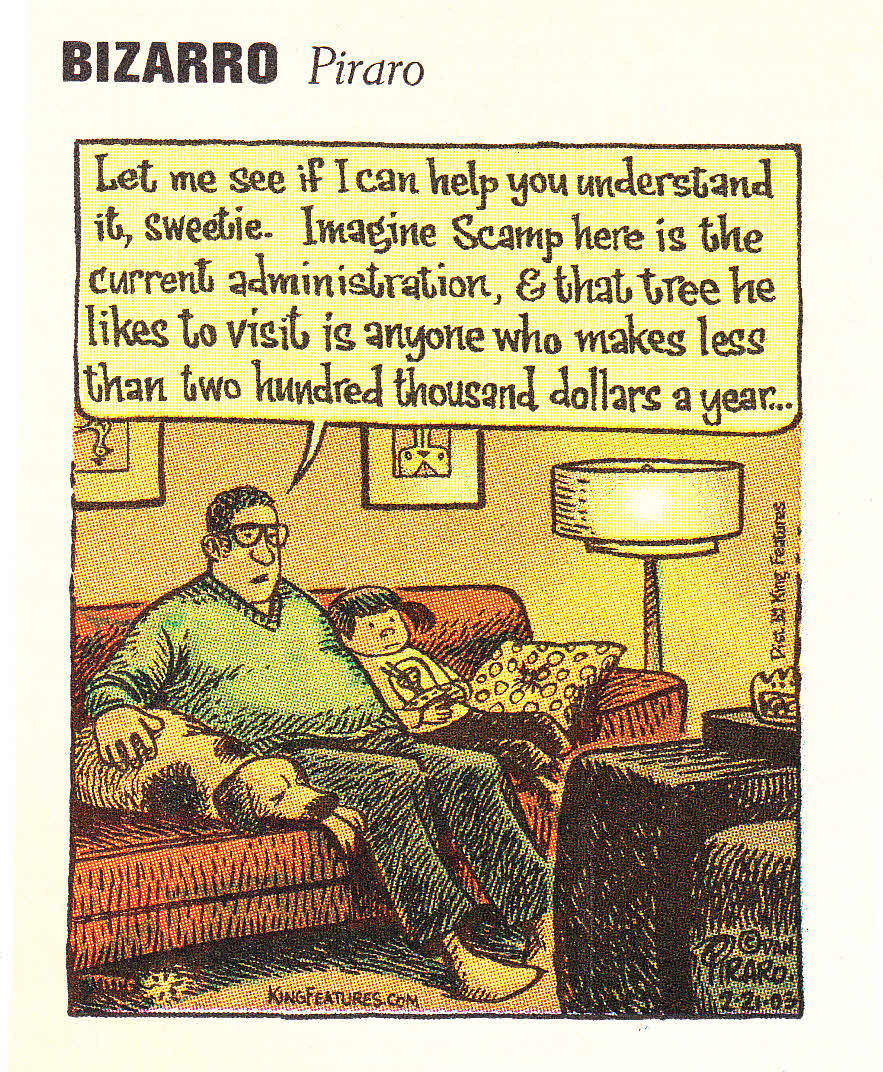
 In the Bizarro cartoon at the right, a father attempts to explain the current bourgeois political system
to his young daughter.
In the Bizarro cartoon at the right, a father attempts to explain the current bourgeois political system
to his young daughter.POGROM
An organized massacre of defenseless people, usually for racist reasons. More specifically,
this often referred to such an attack on Jews in Russia, Poland, or other European countries
during the 19th and early 20th centuries.
POINTLESS TASKS
There is a surprising amount of truly pointless tasks being done in modern capitalist workplaces.
Anyone who has worked for a large American corporation can confirm this. Whole armies of workers
are focused on trying to trick people into buying products, most of which they don’t want or need,
and which in any case are grossly overpriced and of low quality. Whole areas of work, such as
lawyers, most bankers, most police, most levels of management of production in factories, and so
forth could simply be done away with in a rational society (socialism). Under capitalism so much
of the “work” that actually exists is indeed truly pointless—or even worse than that—actually
harmful to the people’s interests! The reason for this is obvious: under capitalism production is
for profits for the rich, and not in order to satisfy the real needs or interests of working
people.
“Sisyphus, king of Corinth, was condemned for all eternity to push a boulder
up a hill, only to watch it roll down again. David Graeber, an anthropologist, thinks that
many modern workers face the same fate today, forced to perform pointless tasks, or ‘bullshit
jobs’, as his new book calls them. [Bullshit Jobs: A Theory (2018)]
“Mr. Graeber defines a bullshit job as
one ‘that is so completely pointless, unnecessary or pernicious that even the employee cannot
justify its existence’, though they may have to pretend that they believe in it. This
definition, and indeed much of the book, combines two categories of roles. In the first are
jobs that Mr Graeber tends to think are socially worthless, such as corporate lawyers or
investment bankers. (Some of those workers may take an equally dim view of the utility of
anthropologists.) In the second group are jobs where employees find themselves with little
or nothing to do and, worse, must still look as if they are frantically busy.
“What is his evidence? The author places
a lot of faith in anecdotes and a couple of opinion surveys which found that only 37-40% of
workers in Britain and the Netherlands felt they ‘made a meaningful contribution to the
world.’...
“In any case, the contention that many
of us are wasting much of our time at work is hardly a new one. C. Northcote Parkinson coined
the idea that ‘work expands to fill the time available’ in an essay in The Economist
in 1955, adding that ‘there need be little or no relationship between the work to be done and
the size of the staff to which it may be assigned.’ The futility of many middle-class jobs is
also an old theme, being the plot driver of the 1970s British sitcom ‘The Good Life’....
“Both meaningless job titles and mindless
tasks seem to have proliferated. A study by Gary Hamel and Michele Zanini, two management
theorists, estimated that there are nearly 24 million corporate ‘bureaucrats’ in America, or
about one for every 4.7 workers. Reassigning them to more productive tasks could give the
American economy a $3 trillion boost, they reckon.
“Mr. Graeber constructs some elaborate
theories as to why this problem has arisen. He suggests that automation in recent decades did
cause mass unemployment but that society conspired to create a bunch of illusory jobs to
disguise the fact. He also argues that while executives in the Reagan/Thatcher era prided
themselves on how many low-level workers they could lay off, they then hired lots of management
flunkies to enhance their status. And he postulates that it is all part of a system of social
control, in which young people are loaded up with debt and then pushed into meaningless jobs
in order to pay it off, thereby keeping them docile.... [The Economist, however,
discounts these theories, which offend bourgeois sensibilities. —Ed.]
“Instead, the problem lies in the nature
of a services company. In a factory, you can count the widgets made each day, which limits the
the scope for bullshit. In a service business, it is harder to monitor the quality and quantity
of output. Like the old quip about advertising, executives may know that half of their workers’
time is wasted, but not which half.
“In response to this lack of knowledge,
executives create a host of targets, and hold a lot of meetings to try to understand what is
going on. As Messrs Hamel and Zanini put it, ‘A growing percentage of employee time gets
consumed in efforts to keep the organization from collapsing under the weight of tis own
complexity.’ ... Parkinson nailed the issue six decades ago: ‘Officials make work for each
other.’” —“Bartleby: Not working properly”, The Economist, June 2, 2018, p. 56.
[The bourgeoisie, including its
ideologists such as The Economist magazine, try to discount a lot of what is obvious
to workers at their corporations, about the wastefulness and absurdity of much of the “work”
being done there. But they still have to admit that there is a lot of truth to all this. And
indeed, under socialism or communism, where the workers themselves run enterprises in the
interests of the people, vast amounts of bullshit work could simply be entirely eliminated,
including most or all of many “professions”, such as corporate lawyers, investment bankers,
not to mention the enormous hoards of sales people and other liars and confidence men in the
field of “marketing”. More generally, if the workers run industry and if all production is
for the purpose of serving the interests of the people, then those doing “pointless work”
will themselves finally have every reason to make this known and to help get rid of that
useless and wasted effort. —Ed.]
POL POT REGIME [in Cambodia]
A brutal peasant nationalist regime which came to power in Cambodia in April 1975 and was
overthrown by invading Vietnamese troops in January 1979. Although often quite erroneously
called a “Maoist” movement and regime, it was nothing of the kind, and never claimed to
be.
Far from seeking to build an urban proletariat
and put the working class in power, the Pol Pot regime emptied out the cities and attempted
(with little success) to create a rural peasant socialist utopia. It used the harshest methods,
and killed a very large number of people (though claims by anti-communist ideologists in the
West of the number of deaths were grossly exaggerated and included hundreds of thousands of
people who were actually killed by the massive U.S. bombing of the country during the Vietnam
War, and the accompanying starvation and chaos).
For an extensive summation of the Pol Pot
regime from a Maoist point of view see: “Condescending Saviors: What Went Wrong with the Pol
Pot Regime”, by F.G., A World to Win, #25 (1999), online at:
https://www.bannedthought.net/International/RIM/AWTW/1999-25/PolPot_eng25.htm
POLAND — German Imperialist Invasion Of (1939)
[Notes of Hitler’s remarks:]
“A life and death struggle... The
destruction of Poland has priority. The aim is to eliminate active forces, not to reach
a definite line.... I shall give a propagandist reason for starting the war, no matter
whether it is plausible or not. The victor will not be asked afterwards whether he told
the truth or not. When starting or waging a war, it is not right that matters, but
victory. Close your hearts to pity. Act brutally. Eighty million people [Germans] must
obtain what is their right. Their existence must be made secure. The stronger man is
right. The greatest harshness.” —Notes taken in Berchtesgaden of Hitler’s speech to
military commanders on Aug. 22, 1939, just before the Nazi attack on Poland. Quoted in
J. Noakes & G. Pridham, eds., Nazism, 1919-1941: A Documentary Reader, vol. 3
(1991), p. 743.
POLES OF A CONTRADICTION
“[W]e find upon closer investigation that the two poles of an antithesis, positive and negative, e.g., are as inseparable as they are opposed, and that despite all their opposition, they mutually interpenetrate.” —Engels, Anti-Dühring (1878), MECW 25:23.
THE POLEMIC ON THE GENERAL LINE OF THE INTERNATIONAL COMMUNIST MOVEMENT
This is a famous, and extremely important, collection of criticisms of Soviet revisionism in
the Khrushchev era that was published in early 1965 by the People’s Publishing House in Peking
(Beijing). Its major contents were: “A Proposal
Concerning the General Line of the International Communist Movement”, issued by the Central
Committee of the Communist Party of China on June 14, 1963; and 10 major articles written by the
editorial departments of Renmin Ribao [People’s Daily] and the CCP theoretical
journal Hongqi [Red Flag]:
1. “The Origin and Development of the Differences
Between the Leadership of the C.P.S.U. and Ourselves”
2. “On the Question of Stalin”
3. “Is Yugoslavia a Socialist Country?”
4. “Apologists of Neo-Colonialism”
5. “Two Different Lines on the Question of War and Peace”
6. “Peaceful Coexistence—Two Diametrically Opposed Policies”
7. “The Leaders of the C.P.S.U. Are the Greatest Splitters of Our Times”
8. “The Proletarian Revolution and Khrushchev’s Revisionism”
9. “On Khrushchev’s Phony Communism and Its Historical
Lessons for the World”;
10. “Why Khrushchev Fell”
These polemics had a major impact on revolutionaries
all around the world, and helped people understand the true nature of Khrushchev and Soviet revisionism.
All the separate sections of this book are available online on the “From Marx to Mao” site at:
http://www.marx2mao.com/Other/PGLtc.html
and in the Marxist Internet Archive at:
http://www.marxists.org/history/international/comintern/sino-soviet-split/index.htm
POLICE — Attitudes of the Masses Towards
In all capitalist countries a considerable part of the people fear and hate the police. Why? Because
the police exist to protect the rich and their property, and to lord it over and harass the lower
classes. Of course, in some countries the hatred of the police is much more widespread than others.
Generally the poorer and more exploited and oppressed the people are, the worse the police are, and
the more the people justifiably hate them. The police also tend to concentrate the racism, sexism,
anti-immigrant, and other reactionary attitudes typical of the ruling class. Only in rich imperialist
countries do large sections of the population look upon the police favorably. Even then, there is
also plenty of fear and hatred only slightly below the surface. And the police everywhere know this
quite well—which further intensifies their anti-people attitude.
“Gag law: Police are trying to use Spain’s public security law to fine a woman for carrying a bag in Madrid bearing the initials A.C.A.B., which they interpreted to stand for ‘All Cops Are Bastards’ and not ‘All Cats Are Beautiful,’ as was written on the bag. A spokesman said [that] the type and coloring of the lettering are traditionally associated with the insult to police. The fine was proposed under 2015 legislation that was nicknamed the ‘gag law’ and criticized by journalists and rights groups.” —San Francisco Chronicle, May 25, 2016, p. A2.
POLICE — Origin of in the United States
In high school civics classes they may lie to you and tell you that the origin of police forces
in the United States was merely a rational response by an enlightened citizenry to the universal
requirements of people living together. But what’s the real story? Actually police forces have
not always existed. They pretty much came into existence for the purpose of intimidating slaves
and the poor, and for protecting the private property of the rich. Therefore the police only
came into existence once there already were slaves and poor and exploited people who the
rich needed to suppress! Even so, it may be surprising to some to learn a few of the particulars
about the actual ugly story of how the police came to be, from their early days as patrols
intimidating slaves and recapturing runaway slaves; for protecting the business property of the
rich in the cities; and for suppressing strikes by workers. Amazingly enough, even the following
brief article from the very bourgeois magazine, Time, hints at the gist of this real
story:
“When President John F. Kennedy named the week of May 15 as National
Police Week, he noted that law enforcement had been protecting Americans since the
nation’s birth. But in fact, the U.S. police force is not so old.
“In colonial times, the closest
analog was usually a volunteer night watch. Watchmen got a bad rap for drinking on duty,
so when towns tried mandatory service, citizens would often pay someone else to serve
instead—‘ironically, a criminal or a community thug,’ says Gary Potter, a crime
historian at Eastern Kentucky University. The best early example of organized policing
is one today’s officers might prefer not to see as a comparison point: slave patrols,
the first of which was formed in the Carolina colonies in 1704.
“Police forces as we would recognize
them now date to the mid-19th century, the first having been created in 1836 in Boston.
As the city’s commerce boomed, businesses campaigned to transfer the cost of a permanent
property-protecting force to the citizenry, arguing that it was for the collective good.
Other major U.S. cities followed suit, prompted in part by the rise of organized labor
and the arrival of waves of immigrants. Those made anxious by such changes called for
law and order. But the rise of political machines and then Prohibition opened police
forces up to new kinds of corruption.
“It was later, in Kennedy’s
lifetime, that a movement took hold to professionalize the U.S. police force, which
ultimately enabled the system we have in place today.” —Olivia B. Waxman, Time
magazine, May 29, 2017, p. 19. [One thing this summary leaves out is that this
growing “professionalization” of the police has also come to mean its ever-increasing
militarization. —Ed.]
POLICE — Racism of in the U.S.
Anybody with any social awareness and sense whatsoever knows that the police departments in the
United States are, with few if any exceptions, extremely racist.
There have even been, just in the past few years, a very large number of killings of unarmed
African-Americans in particular by racist white cops. Nobody knows for sure just how many such
racist murders by cops there have been, because the ruling class has been systematically hiding
this information. Only now is a database being created to gather this data for just some of the
police departments in the U.S. (See: Erika Hayasaki, “Police Racism: A Search
for Answers”, Spring 2015, online at:
http://blueprint.ucla.edu/feature/police-racism-search-for-answers/.)
Whatever the exact number of racist police
murders, studies have consistently shown that police departments practice routine racism in
their extremely common stops and frisks of Blacks and other minorities, and in their grossly
disproportionate numbers of arrests and beatings of them. America remains racist to the core,
and its brutal racist police departments are the worst of all.
See also:
STOP AND FRISK
“He was just black in the wrong place.” —Valerie Castile, after her son
Philando was fatally shot by a police officer during a routine traffic stop in Falcon
Heights, Minnesota in July 2016, Time magazine, Dec. 19, 2016, p. 17. [Philando
Castile was carrying a weapon (for which he had a valid permit) and told the cop that he
was armed. He was shot when he attempted to reach for his identification papers to show
the cop. Philando’s girlfriend, Diamond Reynolds, and her young daughter were also in the
car when the cop began firing into it, but fortunately he missed them. Ms. Reynolds filmed
the event and explained why she did so: “Because I know that the people are not protected
against the police. I wanted to make sure if I died in front of my daughter that people
would know the truth.” Because there was this irrefutable evidence of what occurred from
both Ms. Reynolds’ filming and that of the cop’s own dashboard camera, the cop was then
charged with manslaughter. Nevertheless, as is usual with such cases in the so-called
justice system in the U.S., in the trial he was still found “innocent”. (The cop was,
however, fired after the trial—which in itself is highly unusual.) In response to that
outrageous verdict Valerie Castile stated “The fact in this matter is that my son was
murdered, and I’ll continue to say murdered.” This police murder sparked a national outrage
in the U.S., but racist murders by police in this country have gone on ever since police
departments came into existence, and still continue, with little indication that the ruling
class will ever voluntarily stop committing them. (The information here is taken from AP
press reports in the San Francisco Chronicle, 5/31/17, p. A6; 6/7/17, p. A12; and
6/17/17, p. A7. —Ed.)]
An African-American journalist, Otis
Taylor, Jr., wrote about this same case: “It keeps happening.
“A black or brown person gets killed
by police, and there are no consequences. There is no justice.
“Allow me to point to this week’s Exhibit
A. Watch the video of Philando Castile being shot and killed by Jeronimo Yanez, a police
officer in Minnesota.
“After Yanez approached his car,
Castile, a black man, informed Yanez that he had a firearm, a gun he was lawfully registered
to carry. Yanez told Castile not to reach for the gun, and Castile said he wasn’t.
“Yanez yelled, ‘Don’t pull it out!’
“The gun Castile had remained in his
pocket, but Yanez still fired seven—seven—shots. As Castile moaned and as his white
T-shirt began turning crimson, Castile’s girlfriend, Diamond Reynolds, who along with her
4-year-old daughter were passengers in the car, live-streamed the aftermath of the shooting
on Facebook.
“On June 16 [2017], Yanez, who said he
had feared for his life, was acquitted of manslaughter and two counts of endangering Reynolds
and her daughter.
“To recap, a man who politely disclosed
that he was licensed to carry a gun and who was complying with orders was killed in front of
his family because a police officer became frightened out of his wits. By black skin.”
—Otis R. Taylor, Jr., “Police fears of
black skin grant virtual license to kill”, S.F. Chronicle, June 23, 2017, p. D1.
POLICE — Role of in Capitalist Society
A police department or agency is an organization in any political state
(or “government”), at any organizational level—national, regional or local—whose primary purpose is
to protect the ruling class and their continued rule, through the means of whatever violence on their
part is “necessary”. They are either always armed, or occasionally (in a few countries) unarmed, but
who can quickly become armed if need arises. They may have, on occasion, other auxiliary duties,
such as traffic control, but by far their most important and central purpose is to protect the rule
of one social class or another. In capitalist society this means that their primary and most essential
task is to safeguard the rich, their property, and their exploitative system of capitalist class
rule.
Not all police agencies are actually called “police”.
The Federal Bureau of Investigation (FBI), for example is one of a many
national police forces that the ruling class in the United States has.
See also:
“Are Cops Really That Bad?”, a letter by S. H. (Nov. 24, 2001), online at:
https://www.massline.org/Philosophy/ScottH/copsbad.htm
POLICE CHASES
Chases of “suspects” by the police, often at very high speeds and in a dangerously reckless manner, who
are presumably attempting to capture someone who they think may have committed a crime, though often only
a very minor one. Such pursuits are often viewed by individual police officers in bourgeois society as
exciting opportunities in which all their usual partial restraints can be cast aside, regardless of the
serious dangers this creates for the public.
“A record number of people are dying in police chases throughout the United States,
data released by the federal government this month shows. The 577 deaths resulting from vehicle
pursuits made 2022 the deadliest year since the National Highway Traffic Safety Administration, or
NHTSA, began tracking these fatalities more than four decades ago. The number represent an increase
of 8% from 2021, and a nearly 40% jump since 2019.
“Yet the 2022 data — the most recent the agency
has made available — is still an undercount. “Fast and Fatal,” a Chronicle investigation published
in February, found that the federal government has failed to accurately track or curb pursuit
fatalities despite the mounting death toll from these chases, the majority of which begin over
nonviolent crimes, traffic violations or no crime at all.” —Susie Neilson and Jennifer Gollan,
“Police Chases Led to Record Fatalities”, San Francisco Chronicle, April 14, 2024, p. A1.
POLICE MURDER AND BRUTALITY (in the U.S.)
[To be added...]
See also:
COINTELPRO: FBI’s War on Black America (1989) [high quality 50 min. documentary
video by Denis Mueller & Deb Ellis, apparently no longer available online].
POLICE SANTRASH BIRODHI JANASADHARANER COMMITTEE (PSBJC)
See: PEOPLE’S COMMITTEE AGAINST POLICE ATROCITIES
(PCAPA)
POLIO
A serious infectious disease affecting children especially, which can leave them crippled or
even kill them. There are highly effective vaccines which could eliminate this disease from
the entire world, and until recently came close to doing so. But the job was not completed,
because of religious opposition to vaccines in some countries, and because of the indifference
of most capitalist ruling classes to the welfare of people in other countries. And now the
disease is spreading to new countries once again.
“Polio seemed close to eradication a couple of years ago, but new cases have sprung up in dozens of countries this year, including in Papua New Guinea, which was declared polio-free 25 years ago.” —New York Times, “Trump Budget Erases Money for Crucial Global Vaccination Programs”, June 5, 2025.
POLITBURO
Short for “political bureau”; the leading body within the Central Committee in the
organizational structure of many large communist parties. Within the politburo there
is sometimes a sub-group known as the Standing Committee of the Politburo, which has
even higher authority.
“POLITICAL CLASS, The”
A common term in contemporary bourgeois “political science”
(so-called!) and in the ruling class media for those people who are actively involved in
electoral politics and associated activity (such as lobbying and pro-bourgeois political
indoctrination) within a bourgeois democracy, and
who therefore also follow bourgeois political developments closely. Thus, the political
class in the United States mostly consists of those people who strongly side with one of
the dominant ruling class political parties (the Republicans or the Democrats) and imagine
that it is desperately important that the party they support defeat the other one. In other
words, the “political class” is that group of people who take bourgeois politics seriously. A
large part of the masses are not really part of the “political class”, even if many of them
are occasionally tricked into voting for a bourgeois candidate. Similarly, genuine Marxists
and the more proletarian class conscious people on the left, who understand the inherent deceit
of the bourgeois democratic system and know that society cannot be significantly changed by
“working within the system”, have consciously excluded themselves from the bourgeois “political
class”. Social democrats and
revisionists, however, are definitely part of the bourgeois
“political class”.
POLITICAL ECONOMY
The subject which is more commonly known as just “economics” in bourgeois society. We
Marxists follow Marx and Engels in calling this subject political economy because we
wish to stress the actual political nature of economics. The fact is that under capitalism
(and also under all earlier forms of class society) the socioeconomic system inherently
involves both the economic exploitation and the political oppression of one social class by
another.
In the days before Marx, even bourgeois
economists (such as Adam Smith and David Ricardo) typically called their subject political
economy; they did not try to hide its political nature (though they did ignore or hide its
exploitative nature—to the degree that they were even capable of understanding this
themselves). However, for a century or more now, modern bourgeois economists have sought to
also deny or hide even the essential political nature of the whole subject of economics!
Some of them still do talk about “political economy”, but usually only as a very specialized
peripheral aspect of economics, namely that sector of it which is devoted to “the art of
managing public finances”, the establishment of government policies related to the economy,
and so forth.
Therefore, most of what is called “political
economy” today is actually very different from, and opposed to, Marxist political
economy.
“Political economy, in the widest sense, is the science of the laws governing the production and exchange of the material means of subsistence in human society.” —Engels, Anti-Dühring (1877), Part II, chapter I, first sentence, MECW 25:135. Online at: http://www.marxists.org/archive/marx/works/1877/anti-duhring/ch13.htm
“I still stick to my old idea that after Marx you can drag in non-Marxian political economy only for the purpose of fooling philistines, even if they are ‘highly civilized’ philistines.” —Lenin, “Interview with Arthur Ransome, Manchester Guardian Correspondent”, Second Version (circa Nov. 1, 1922), LCW 33:408.
POLITICAL ECONOMY — and Mathematics
Mathematics is of considerable use in political economy as it is in most areas of science. However,
many laws and principles of scientific (Marxist) political economy are not really mathematical in the
sense that F=ma is in physics, even if mathematical examples and considerations help establish
them. Consider, for example, the inevitability of overproduction
crises under the capitalist mode of production. How do we know that this law of Marxist political
economy is true? Of course the endless recurrence of such crises under capitalism is empirical
evidence that it is true (despite the regular claims by benighted bourgeois economists that previous
crises were simply due to government mistakes and that therefore “they need never happen again”).
But we know that this law is true theoretically because we understand that human labor
working on the products of nature is the source of value; that workers are not (and cannot be)
paid wages which equal the value they produce through their labor; that the workers, therefore,
cannot possibly buy back all that they produce; that allowing workers and other consumers to go into
ever deeper debt to buy the things they otherwise cannot afford will only work until the debt bubble
grows too big and collapses in a financial crisis; and that the capitalists, who abscond with the
remaining value produced by the workers (surplus value), though
they live luxuriously and wildly build up their productive capital way beyond what is required to meet
all possible market demand, themselves must ultimately run out of things to do with all their
mountains of profits! This elementary and straight-forward argument, based on a correct
understanding of how capitalism actually works, is what leads to the scientific conclusion that
capitalist overproduction crises are inevitable. Is there any mathematics involved in this argument?
Not much, beyond the simplest arithmetic.
Of course more math may be required to establish or
illustrate some other laws and principles in scientific political economy. But it remains true that
most such laws and principles come from logical argument based on the understanding of how capitalism
actually works.
It is only in bourgeois
economics where mathematization has really run wild and taken over the subject, even to the point
of replacing observation and common sense with mathematical obfuscation. This began with the
marginalist revolution of the late 1800s, which tried to redefine
value and/or prices based—not on the socially necessary labor times expended to produce a commodity—but
rather on the cost of producing one more commodity of the given kind (i.e., production at the “margin”).
When mathematized, this concept talks about the current rate of costs to produce commodities, and
therefore uses the differential calculus. While this mathematics is still rather simple, at least in
concept, calculus is nevertheless at a higher level of mathematics than arithmetic and algebra. Does
this make marginalist economics more “scientific”? No it does not! The mathematics is at a higher
level, but its use does not reflect reality. Mathematics is only of use in science when it
helps describe the real world. Employing more mathematics when it is not needed, or is even entirely
inappropriate, only distorts reality. When mathematics is used to do this it is actually
anti-scientific. Since the advent of marginalist theory, bourgeois economics has gradually,
but continually, become ever more mathematical and ever less relevant to understanding capitalism
as it actually works. Over time, bourgeois economics has become ever more extremely mathematical and
at the same time (and partly because of this inappropriate mathematics) ever more ridiculous. —S.H.
See also:
Alfred MARSHALL
“Even though nothing in economics follows strict mathematical rules, there
are notable tendencies which are produced by the inner springs of capitalism.” —Harry
Magdoff, “A Note on the Communist Manifesto”, in Monthly Review, vol. 50,
#1, May 1998; reprinted in vol. 71, #3, p. 117.
[This is a fascinating comment! The
first part is profoundly true: virtually “nothing in economics follows strict mathematical
rules”. It is important to bring out exactly why this is the case, something which
has not so far been adequately done. However, the second part of Magdoff’s comment, and
especially the broader implication that Marxist political economy merely discusses
“tendencies” and never inevitable and completely valid scientific laws, is incorrect. It
goes way too far. There are many absolutely true principles of the political economy of
capitalism which are not mere “tendencies”, including the fact of exploitation through the
extraction of surplus value and the inevitability of overproduction crises. “Tendencies” is
the wrong word here. Most laws and principles of genuinely scientific political economy are
not mere “tendencies”. —S.H. (See also:
SCIENTIFIC LAWS—As Mere Tendencies)
POLITICAL EDUCATION (Of the Working Class)
“The question arises, what should political education consist in? Can it be confined to the propaganda of working-class hostility to the autocracy? Of course not. It is not enough to explain to the workers that they are politically oppressed (any more than it is to explain to them that their interests are antagonistic to the interests of the employers). Agitation must be conducted with regard to every concrete example of this oppression (as we have begun to carry on agitation round concrete examples of economic oppression). Inasmuch as this oppression affects the most diverse classes of society, inasmuch as it manifests itself in the most varied spheres of life and activity—vocational, civic, personal, family, religious, scientific, etc., etc.,—is it not evident that we shall not be fulfilling our task of developing the political consciousness of the workers if we do not undertake the organization of the political exposure of the autocracy in all its aspects? In order to carry on agitation round concrete instances of oppression, these instances must be exposed (as it is necessary to expose factory abuses in order to carry on economic agitation).” —Lenin, “What Is To Be Done?” (1902), LCW 5:400-401.
POLITICAL ISLAM
Islamic movements which are in name religious but which in reality have mostly come into
being for political purposes, and specifically for the central political purpose of
struggling against foreign imperialist intervention in their own countries and in the
rest of the Muslim world. Osama bin Laden’s organization, al Qaeda, for example, “is an
Islamic fundamentalist terrorist organization whose central purpose is to end the American
occupation of the Arabian Peninsula”, as the conservative bourgeois American political
scientist Robert Pape noted in his book Dying to Win: The Strategic Logic of Suicide
Terrorism (2005), p. 51.
The basic reason why Political Islam has
arisen is that the established governments in Islamic countries (even if they were led by
Muslims), and the reformist secular movements against imperialism in those countries, have
been failures in their very weak opposition to foreign intervention. Neither
comprador governments nor reformist secular organizations
and parties (even if they falsely called themselves “Communist”) have led effective
struggles against imperialism. And the smaller and more genuinely revolutionary and
militant Communist organizations that have come into existence in some countries have, so
far, either failed to connect up with the broad masses, or else have been suppressed by
reactionary governments. In this situation many nationalists, especially those of a
petty-bourgeois background, in Middle Eastern and other Islamic countries have begun
building anti-imperialist political organizations under the protective cover of Islam.
The model for this approach was actually
fostered, if not outright created, by the American CIA with
its campaign to arm and
support al Qaeda and other Islamic political forces in Afghanistan in their successful
struggle to force out the social-imperialist Soviet
forces in the 1980s. Once that was accomplished al Qaeda and other groups (which continue
to come into existence) turned their attention to the biggest foreign imperialist monster
operating in Islamic countries, the United States itself.
It is interesting that so many of the huge
problems that American and other imperialist powers face in the world today are examples of
“blowback” from their own inept efforts to maintain control
of the world and its resources. However, in general, we revolutionary Marxists cannot
support political Islam because, in addition to attacking U.S. and other imperialist forces,
most of these groups also attack and frequently murder many individuals among the masses.
So the task of genuine Marxists in these countries is to try to organize the masses there
to fight for their own interests and to struggle against all their enemies—foreign
or domestic. How they do that, and what temporary truces or alliances they may need to
make, will depend on their specific situations.
POLITICAL LANGUAGE — Of the Bourgeoisie
The political language of the capitalist ruling class is designed to hide what it means;
that is, it is designed to lie, or at least to seriously mislead. Almost no bourgeois
politician ever clearly and openly says what he really means.
“‘Political language’, wrote George Orwell, ‘is designed to make lies
sound truthful and murder respectable, and to give an appearance of solidity to pure
wind.’ No leader will admit to having had people tortured, but Dick Cheney [U.S.
Vice-President under George W. Bush] did say: ‘I was and remain a strong proponent of
our enhanced interrogation program.’—which means the same thing. Notice how, as Orwell
put it, ‘A mass of Latin words falls upon the facts like soft snow, blurring the outlines
and covering up the details.’
“Wars sound horrible in plain
English, so they have always generated a smokescreen of euphemism. ‘Kinetic action’ means
‘killing people’. ‘Collateral damage’ means ‘killing people accidentally’. Politicians
typically use the word ‘kill’ only to describe what our enemies do to us, not what we do
to them. In a speech in May explaining his drone warfare policy, for example, Barack
Obama spoke of ‘lethal, targeted action against al-Qaeda and its associated forces’. As
Orwell said, when ‘certain topics are raised, the concrete melts into the abstract.’”
—The “Lexington” column, “The War
of the Words”, in the British ruling class magazine, The Economist, July 13, 2013,
p. 32.
POLITICAL LYNCHINGS
See: LYNCHINGS—Political
“POLITICAL MARXISM”
A term used by one small segment of contemporary American academic Marxism to describe their
views on historical materialism, and their general point of view and approach. The founders
of this school of thought are Robert Brenner and Ellen Meiksins Wood. They are described as
focusing on the “social history of political theory”, and spend a lot of space talking about
topics such as globalization, precapitalist societies, liberalism, civil society, and such,
with little connection to any active revolutionary movements in the world. It is hard to point
to any new, significant or genuinely Marxist ideas that this trend has come up with.
POLITICAL POWER
“Every Communist must grasp the truth, ‘Political power grows out of the barrel of a gun.’” —Mao, “Problems of War and Strategy” (Nov. 6, 1938), SW2:224.
“The basic problem of a revolution is the problem of political power. The possession of political power means the possession of everything; the loss of it means the loss of everything.” —Mao, Aug. 13, 1967, SW 9:417.
“All proletarian revolutionaries unite and fight for political power against the handful of capitalist roaders in authority.” —Mao, Aug. 17, 1967, SW 9:417.
POLITICAL PROGRAMME
See:
PROGRAMME [Political]
POLITICAL PROTEST — Bourgeois “Cure” For
“In 1970, neuroscience research showing that the amygdala, a deep region of the brain, was associated with emotion lay behind a proposal of neurosurgeon Vernon Mark and psychiatrist Frank Ervin. They proposed to ‘cure’ ghetto rioters and revolutionary black prisoners by removing the offending brain region. [V.H. Mark & F.R. Ervin, Violence and the Brain (Harper and Row, 1970)] According to these advocates some 5-10 per cent of Americans (that is, African Americans) would ‘benefit’ from such psychosurgical procedures. Yet the racist infamy of Tuskegee [where the U.S. Public Health Service purposely did not treat hundreds of African American men infected with syphilis in order to watch the course of the developing disease as it step-by-step destroyed these human beings] and even this latest gross promise of psychosurgery as a means of pacifying the ghettos were met with silence from the custodians of the ethics of biomedical research and patient care, the American Medical Association.” —Hilary & Steven Rose, Genes, Cells and Brains (2014), p. 104. [Their description of the horrifying and utterly despicable racist medical experiments by the U.S. government at Tuskegee is on the previous page.]
POLITICAL SCIENCE
Ideally, the scientific study of governments, who creates and controls them, who they serve;
and of political behavior, activities, processes, organizations, views, goals, and such. From
the MLM point of view, none of this can possibly be done in a scientific manner unless it is
done from a proletarian class perspective. If it is done from the perspective of any
exploiting class (such as the capitalist class) it must of necessity constantly distort, lie
and be essentially dishonest, in order to hide, or else try to justify, the ongoing exploitation
and oppression by that social class. Since 98% of what is called “political science” at
American universities is written and taught from this bourgeois perspective, and thus amounts
to pro-capitalist-imperialist indoctrination, it is not just anti-scientific—it is downright
sinister.
See also:
“The POLITICAL CLASS”
“Until someone has read, studied, understood and/or at least come to basically agree with Lenin’s great work State and Revolution, it has to be said that they know virtually nothing about any genuine political science of the present era.” —Scott’s painfully obvious conclusion, #12.
POLITICAL STUDY
[To be added... ]
See also:
REPEATED STUDY
POLITICAL WORK
See:
POSITIVE AND NEGATIVE,
WORK (Political Work by Revolutionaries)
POLITICIANS — Bourgeois
“When a politician is in opposition, he is an expert on the means to some end, and when he is in office, he is an expert on the obstacles to it.” —G. K. Chesterton
POLITICS — Bourgeois
In the Bizarro cartoon at the right, a father attempts to explain the current bourgeois political system
to his young daughter.
“I believe in the division of labor. You send us to Congress; we pass laws under which you make money ... and out of your profits, you further contribute to our campaign funds to send us back again to pass more laws to enable you to make more money.” —U.S. Senator Boies Penrose (Republican-Pennsylvania), 1896. Quoted in The Nation, July 21/28, 2003, p. 3.
POLITICS and ECONOMICS
“It is strange that we should have to return to such elementary
questions, but we are unfortunately forced to do so by Trotsky and Bukharin. They have
both reproached me for ‘switching’ the issue, or for taking a ‘political’ approach,
while theirs is an ‘economic’ one. Bukharin even put that in his theses and tried to
‘rise above’ either side, as if to say that he was combining the two.
“This is a glaring theoretical
error. I said again in my speech that politics is a concentrated expression of
economics, because I had earlier heard my ‘political’ approach rebuked in a manner
which is inconsistent and inadmissible for a Marxist. Politics must take precedence
over economics. To argue otherwise is to forget the ABC of Marxism.” —Lenin, “Once
Again on the Trade Unions, the Current Situation and the Mistakes of Trotsky and
Bukharin” (Jan. 25, 1921), LCW 32:83.
“POLITICS IN COMMAND”
[To be added... ]
POLL TAX
A tax which must be paid in order to vote in an election. The 24th Amendment to the U.S.
Constitution, which was formally ratified on January 23, 1964, abolished poll taxes in the
United States.
In an earlier era the ruling class had not
yet perfected its near complete control of the outcome of elections via its ownership of
both the media and virtually all the prominent politicians (through large “campaign
donations” and in other ways). In that older situation it was more important to keep the
poorest people from voting at all. The poll tax was one method of doing that. But
bourgeois democracies have become much more
sophisticated in how they control society and elections in the modern era. Crude methods
such as poll taxes are not generally “necessary” any more in order to keep the rich in
power, nor even in order to keep the white racists in power in the American Southeast.
POLLUTION
See also topics below.
“On average, an American man puts 85 man-made chemicals into his body every
day, while an American woman takes in nearly twice that amount.”
—“Unintended Consequences”, New
York Times, June 13, 2021, p. 3. [The sources of these chemicals include foods and
beverages, cosmetics, drugs (legal and illegal), the air we inhale, the water we drink or
wash ourselves with, and even just the various solid things in the environment that we come
in incidental contact with, such as our clothing and our furniture. —Ed.]
POLLUTION — Of the Air
See:
AIR POLLUTION,
CHINA—Air Pollution In,
FLYGSKAM
POLLUTION — Of the Oceans
Among the many divers kinds of pollution that the capitalist system has been inflicting on
the world is the ever worsening pollution of the oceans. This takes many forms, such as
frequent oil spills; purposeful discharge of vast amounts of untreated sewage into the oceans;
enormous amounts of agricultural runoff which is very harmful to the oceans; and the ever
greater accumulation of floating pieces of plastic in the oceans (including the Mid-Pacific
Gyre of plastic and other debris which is now larger than the state of Texas). Since
corporations make greater profits by hiding or ignoring ocean and other sorts of pollution,
there is little incentive under the capitalist system to do anything about this continually
worsening problem. Bourgeois economists even tacitly admit this, by terming such very negative
consequences to the environment as mere “externalities” to
capitalist production.
See also:
PLASTIC POLLUTION
“The 2010 Deepwater Horizon explosion in the Gulf of Mexico, the worst oil spill in United States history, killed 11 people and released an estimated 4.9 million barrels into the sea.” —“Oil Leak Far Worse than Owner Says, New Study Shows” (about yet another oil spill), New York Times, June 26, 2019.
“For nearly five decades, more than 200,000 barrels of radioactive waste
were dumped in the icy depths of the northeast Atlantic. Today, no one knows precisely
where these barrels are located, or what kind of state they are in. On June 15, [2026] a
French-led team of scientists will set sail from Brittany in a bid to map the barrels and
assess their impacts on surrounding marine ecosystems.
“It had long been considered a safe
way to dispose of radioactive waste. For nearly five decades, tens of thousands of tonnes
of waste – sealed in watertight barrels of asphalt and cement – were dumped in
international waters. Although the practice is now banned, between 1946 and 1993, 14
European countries – including France and the UK – carried out dumping operations at more
than 80 locations in the Arctic, Atlantic and Pacific. In the northeast Atlantic, home to
the most concentrated stretch of this radioactive marine waste, some 200,000 barrels lie
at a depth of 4,000 metres.
... “‘This is a reflection of a
particular period in history. At the time, we were in the midst of the rapid development
of the nuclear industry and nuclear weapons. States communicated very little. Even today,
we have very little information,’ said Patrick Chardon, a research engineer at the Clermont
Auvergne Physics Laboratory (LPCA) and a specialist in the effects of radioactivity on the
environment.” —France24; re-posted by Adam Tooze’s “Chartbook” website,
Jan. 18, 2026.
POLYARCHY
A conception of how bourgeois “democracy” actually
works. This term was introduced by the prominent American bourgeois “political scientist”
Robert Dahl in his book Polyarchy: Participation and Opposition (1971). Dahl claimed
that polyarchy is the only “realistic” form of democracy possible in modern society. Under
this reactionary conception it is actually impossible to have genuine rule by the people
(which was the original Greek meaning of the word ‘democracy’); instead, bourgeois democracy
is reduced almost entirely to having competitive elections where the “serious” candidates
virtually always represent one or another group of “elites”
(i.e., sections of the ruling class). Candidates are deemed “serious” when they receive large
campaign donations and (in large part because of these huge donations from the rich) serious
attention and promotion by the bourgeois media sufficient to win significant voter interest
and support.
While ideological representatives of the
bourgeoisie put forward polyarchy as the way that “modern democracy must work”, there are
also strong critics of polyarchy on the left. One prominent Marxist-influenced critic is
William I. Robinson, especially in his book Promoting Polyarchy: Globalization, US
intervention, and hegemony (1996). (See quotations below.) Robinson emphasizes that the
“democracy promotion” which the U.S. supposedly engages in around the world (especially in
the “Third World”) is essentially phony because what the U.S.
rulers mean by “democracy” is merely polyarchy. Moreover, the polyarchic regimes that
the U.S. promotes, and often helps set up in other countries, make it easy for U.S.
imperialism to control those countries (through the promotion of local
compradors, for example) and thus easier for the imperialists
to extract wealth from those countries—all while maintaining the pretense that they really
do support genuine democracy around the world!
Marxist-Leninists view bourgeois democracy
as actually being one of the two primary forms that the
dictatorship of the bourgeoisie takes
(the other form being fascism). We follow Mao in viewing
genuine democracy as meaning the people having real collective control over their own lives.
Bourgeois democracy for us is clearly essentially fraudulent, with the real control of
people’s lives and society as a whole, including via their phony elections, virtually
entirely in the hands of the capitalist ruling class or else local representatives of
foreign imperialism. For us polyarchy is a travesty of true democracy.
“What US policymakers mean by ‘democracy promotion’ is the promotion
of polyarchy, a concept which developed in US academic circles closely tied to
policymaking community in the United States in the post-World War II years (the word
was first coined by Robert Dahl). Polyarchy refers to a system in which a small group
actually rules and mass participation in decision-making is confined to leadership
choice in elections carefully managed by competing elites. The pluralist assumption is
that elites will respond to the general interests of majorities, through polyarchy’s
‘twin dimensions’ of ‘political contestation’ and ‘political inclusiveness,’ as a
result of the need of those who govern to win a majority of votes. It is theoretically
grounded in structural-functionalism—and behind it, the positivist focus on the
separate aspects and the external relations of things—in which the different spheres
of the social totality are independent, each performing systems maintenance functions
and externally related to each other in a larger Parsonian ‘social system.’ Democracy
is limited to the political sphere, and revolves around process, method and procedure
in the selection of ‘leaders.’ This is an institutional definition of
democracy....
“The concept of polyarchy is an
outgrowth of late nineteenth and early twentieth-century elite theories developed by
Italian social scientists Gaetano Mosca and Vilfredo Pareto. ...[T]hese theories were
developed to legitimize the rapid increase in the concentration of wealth and political
power among dominant elites, and their ever-greater control over social life, with the
rise of corporate capitalism.... In the later part of their careers, Mosca went on to
argue that ‘democratic’ rather than fascist methods are best suited to defend the
ruling class and preserve the social order, whereas Pareto went on to embrace fascism
as the best method....
“The institutional definition
embodied in polyarchy came to substitute, at the level of mainstream Western social
science, the classic definition of democracy....
“In its Parsonian-Schumpeterian
version, the polyarchic definition of democracy is equated with the stability of the
capitalist social order.” —William I. Robinson, Promoting Polyarchy: Globalization,
US intervention, and hegemony (1996), pp. 49-51.
“As an essentially contested concept, polyarchy competes with concepts
of popular democracy.... POLYCRISIS “Hand-wringing in Davos [At the World Economic Forum] “[T]here are some attempts to conceptualize the multiple crises of this conjuncture.
Here the concept of polycrisis is gaining ground. It articulates the multiplication of crises, their
entanglement with each other, their acceleration in scale, time, and space, and the emergence of
impacts irreducible to particular factors. However, instead of following the logic of this trajectory,
it tends to back away and asserts an absence of common causes or solutions. It not only displays a
resistance to organizing concepts, but actively embraces ambiguity and declares systemic analysis
impossible. This produces a breakdown of meaning that intensifies the crisis of meaning. For Adam
Tooze, for example, the crises are disparate but interact in such a way that the whole is even more
overwhelming than the sum of the parts. These multiple sources of systemic risk amplify each other,
bring a diversity of challenges but without a single dominant contradiction or source of tension or
dysfunction. POLYNESIA [Geographic Region] PONZI SCHEME POOR, The “You cannot sift out the poor from the community. The poor are
indispensable to the rich.” —Henry Ward Beecher (1813-1887), a Protestant preacher, in
his book Proverbs from Plymouth Pulpit. POOR PEASANT “POP” PSYCHOLOGY “Psychological information drawn from personal and social experience constitutes
prescientific psychological knowledge. It may be rather broad in scope helping to a
certain extent understand the behavior of the surrounding people and providing a correct
reflection of reality within certain limits. On the whole, however, such knowledge lacks system,
depth, conclusiveness and for that reason cannot provide a solid foundation for pedagogical,
medical, organizational and other humanistic activities that should be based on scientific,
i.e., objective and authentic knowledge of the human mind making it possible to prognosticate an
individual’s behavior under expected conditions.” —Psychology: Student’s Library,
(Moscow: Progress, 1989), p. 8. POPPER, Karl (1902-1994) POPULISM “Leftwing populism is historically different from socialist or social
democratic movements. It is not a politics of class conflict, and it doesn’t necessarily
seek the abolition of capitalism. It is also different from a progressive or liberal
politics that seeks to reconcile the interests of opposing classes and groups. It assumes
a basic antagonism between the people and an elite at the heart of its politics.”
—John B. Judis, a liberal writer, The Populist Explosion (2016), p. 15. PORNOGRAPHY [The Internet and Pornography:] Here is a question asked of Google (in the U.S.)
on May 12, 2025, and responded to by their public AI chatbot program: “What fraction of Internet
users regularly visit pornography sites?” POSITIVE AND NEGATIVE “One-sidedness means thinking in terms of absolutes, that is, a metaphysical
approach to problems. In the appraisal of our work, it is one-sided to regard everything
either as all positive or as all negative.... To regard everything as positive is to see only
the good and not the bad, and to tolerate only praise and no criticism. To talk as though our
work is good in every respect is at variance with the facts. It is not true that everything
is good; there are still short-comings and mistakes. But neither is it true that everything
is bad, and that, too, is at variance with the facts. Here analysis is necessary. To negate
everything is to think, without having made any analysis, that nothing has been done well and
that the great work of socialist construction, the great struggle in which hundreds of
millions of people are participating, is a complete mess with nothing in it worth commending.
Although there is a difference between the many people who hold such views and those who are
hostile to the socialist system, these views are very mistaken and harmful and can only
dishearten people. It is wrong to appraise our work from the viewpoint that everything is
positive, or from the viewpoint that everything is negative.” —Mao, “Speech at the Chinese
Communist Party’s National Conference on Propaganda Work” (March 12, 1957), as it appears in
Quotations of Chairman Mao Tsetung, 1st ed. (1966), pp. 219-221. POSITIVE AND NEGATIVE (In Dialectics) “It is in this dialectic as it is here understood, that is, in the
grasping of opposites in their unity or of the positive in the negative, that
speculative thought consists.” —Hegel, Science of Logic, Introduction,
section 69. POSITIVISM POSSESSION POSSIBILISTS (Or: Broussists) “Possibilists (Broussists)—an opportunist trend in the French
working-class movement of the 1880s led by Benoît Malon and Paul Brousse that
repudiated the idea of a revolutionary proletarian party and renounced revolutionary
struggle, believing that the municipalities alone could ensure gradual transition to
socialism. This was the opportunist policy of the ‘possible’, and hence the ironic
name Possibilists, coined by Guesde. Towards the end of
the eighties, with the support of opportunist elements in other countries, notably
Hyndman of the British
Social-Democratic Federation, the
Possibilists tried to capture the leadership of the international working-class movement.
However, most of the socialist organizations refused to follow their lead and sent
delegates to the Marxist congress in Paris (July 14-20, 1889), at which the Second
International was inaugurated. Engels systematically exposed their [the Possibilists’]
splitting activities. In 1902, in conjunction with the other reformist groups, the
Possibilists founded the French Socialist Party, which in 1905 merged with the Socialist
Party of France [which had been founded in 1901]. In the imperialist war of 1914-18
Guesde and the other French socialist leaders became social-chauvinists.” —Note 46,
Lenin: SW I (1967). POST-COLD WAR STRATEGY OF U.S. IMPERIALISM “Our first objective is to prevent the re-emergence of a new rival,
either on the territory of the former Soviet Union or elsewhere, that poses a threat
on the order of that posed formerly by the Soviet Union. This is a dominant
consideration underlying the new regional defense strategy and requires that we
endeavor to prevent any hostile power from dominating a region whose resources would,
under consolidated control, be sufficient to generate global power.... [The
Vice-President Dick Cheney] wanted the United States to remain the preeminent world
power by keeping others at bay and bending the world to its wishes.” —A draft of the
1992 U.S. government Defense Planning Guidance (DPG) document prepared by two aides to
Cheney, Derek Chollet and James Goldgeier. Quoted in Richard Rhodes, Twilight of
the Bombs (2010), p. 213. POST-COLONIALISM “Postcolonialism is an academic language largely unspoken outside a
few hundred universities, and one sometimes as unintelligible to the average Westerner
as Swahili. Post-colonialism, especially during its heyday (the mid-1980s to the
late 1990s) in the second-generation poststructuralism of Said, Spivak, and Bhabha,
should be viewed as a “global” updating and outgrowth of the “left” postmodernist
thought initially put forward in the works of Michel Foucault, Jacques Derrida, and
Jacques Lacan. Said, Spivak, and Bhabha carried on the immense popularity of these
trends within the changing capitalist “postmodern” academy, extending the scope of
this “high theory” so as to subsume “other” regions of the world within the peculiar
and fashionable logics of poststructuralist thinking “beyond” class struggle.
Post-colonialism thus represents in many ways the postmodern attempt to address
capitalist imperialism. POST-CONSTRUCTIVISM POST-KEYNESIANISM POSTMODERNISM POST-WORLD WAR II CAPITALIST BOOM “Just how and why capitalism after the Second World War found itself,
to everyone’s surprise including its own, surging forward into the unprecedented and
possibly anomalous Golden Age of 1947-73, is perhaps the major question which faces
historians of the twentieth century. There is as yet no agreement on an answer, nor
can I claim to provide a persuasive one.” —The Age of Extremes: A History of the
World, 1914-1991 (NY: Vintage, 1996 (1994)), p. 8. The strange thing here, given Hobsbawm’s supposedly Marxist background, is that Marx
and Engels provided the basic answer to this question in their theory of capitalist crises
and how they are resolved which they outlined as early as the Communist Manifesto way
back in 1848! “In these crises there breaks out an epidemic that, in all earlier
epochs, would have seemed an absurdity—the epidemic of over-production.... And how does
the bourgeoisie get over these crises? On the one hand by enforced destruction of a mass
of productive forces; on the other, by the conquest of new markets, and by the more
thorough exploitation of the old ones. That is to say, by paving the way for more
extensive and more destructive crises, and by diminishing the means whereby crises are
prevented.” —Marx & Engels, Manifesto of the Communist Party, (1848), section
I. In short, capitalist economic crises are essentially crises resulting from the
overproduction of capital itself. Thus, unless there is some way to expand capitalist production
(or at least capitalist markets) to new areas in a really extensive way, the only way to
truly resolve these crises, while the capitalist system still exists, is through the
destruction of this excess productive capital (factories and machinery), and to start over again.
And this is exactly what World War II accomplished on a scale unanticipated even by Marx and
Engels: The massive destruction of physical capital to an absolutely unprecedented degree.
And this is why there could be, and was, a major quarter-century capitalist economic boom
in the capitalist world after World War II. POSTURING POTATOES “South Korean farmers harvesting potatoes after a record-breaking heat
wave of 100-degree temperatures found they had already cooked in the ground. ‘How can I
even put it into words? I’m so upset,’ said Lee Sang-hyuk, who has farmed his land for
40 years.” —The Week, August 28, 2026, p. 6. POTENTIAL OUTPUT [Bourgeois Economics] POTTIER, Eugène (1816-1887) “A poet of the Paris Commune. Born in a Paris worker’s family, he
became a worker at the age of 13. He wrote many militant poems calling on the French
workers to fight the bourgeoisie. He actively participated in the 1848 revolution in
France. He later joined the First International.
When the Paris Commune was established in 1871, he
was elected a Member of the Commune, and took part in fierce battles during the
revolution. A few days after the failure of the revolution, he wrote the poem The
Internationale. Seventeen years later worker-composer Pierre Degeyter set Pottier’s
verse to music, and the battle song of the proletariat of the whole world was born.”
—Note to an article on the Paris Commune, Peking Review, vol. 14, #13, March
26, 1971. POVERTY POVERTY — Extreme It is often falsely claimed by bourgeois ideologists that Marx’s prediction of growing
poverty and misery for the masses living in capitalist society has not come true. In a few
of the more advanced capitalist and capitalist-imperialist countries that may have been
correct for a large part of the population, at least for a time. But on a world scale Marx’s
prediction has unquestionably been proven to be completely correct. (See:
IMMISERATION OF THE PROLETARIAT) POVERTY — In U.S. Cities “The poverty rate in New York City inched higher in 2024 for the third straight
year, with a record 2.2 million people living in poverty—26 percent of the population, and double
the national figure of 13 percent.” —New York Times, “Quarter of New Yorkers in
Poverty in 2024: Over Half Couldn’t Afford Basics at Times”, March 27, 2026. POVERTY LINE
“In sharp contrast to polyarchy,
popular democracy is concerned with both process and outcome.... Popular
democracy is thus distinguished from the polyarchic focus on process only, and from
the focus of the statist models of the former Soviet bloc on outcome only (and the
concept of popular democracy should not be confused with the types of political system
that developed under the former Soviet bloc).... Popular democracy... posits democracy
as both a process and a means to an end—a tool for change, for the resolution of such
material problems as housing, health, education, access to land, cultural development
and so forth. This entails a dispersal of political power formerly concentrated in the
hands of elite minorities, the redistribution of wealth, the breaking down of the
structures of highly concentrated property ownership, and the democratizing of access
to social and cultural opportunities by severing the link between access and the
possession of wealth.” —William I. Robinson, ibid., pp. 56-58.
A term which refers to multiple different mutually reinforcing crises collectively; i.e.,
multi-crisis. The implication is that many separate crises in different spheres (such
as in the economy, in society, the environment, international relations, in health care because
of pandemics, etc., are intertwined and compounding each other into a far greater and perhaps
intractable overall problem.
It is in fact now quite plausible that the
United States and the whole world, including the global capitalist-imperialist system, are
already in a permanent state of hopeless polycrisis. Instead of resolving old crises one by one
and then moving on, the basic situation now is for most old crises to continue and worsen, and
for additional serious new crises to arise and to further compound existing problems. It is for
reasons like this that people are more and more talking about “late capitalism”, and the
growing recognition that fundamental changes in society and the world are becoming desperately
necessary.
Among the great many separate major crises
affecting the U.S. and the world today are:
• The current long-developing world
capitalist overproduction crisis that first began in
a limited way back around 1973. At that time the post-World
War II world capitalist boom ended, and the annual growth rate of GDP dropped in half, and
has never recovered. Instead, the world economy has gradually gotten even worse over the
decades.
• The gradual disappearance of
more and more jobs because of ever-more sophisticated automation
and advances in computers and
artificial intelligence. This crisis started to become really significant
in the U.S. around 1987, and since then it has continued to pick up speed and intensity,
especially in this new 21st century.
• Global climate change, including
major warming and the resultant rapid increases in extremes in drought in some areas, more frequent
big floods in other areas, and more violent storms all over the world. All of this brought on by
the mismanagement of the world by the ruling capitalists and their profit motive. Again, this
crisis—though early signs of it appeared in the late 20th century—is really starting to get very
serious in the early 21st century.
• The growing pollution
crisis of the land, the sea and rivers, and the air—and even of our own human bodies (which now have
many cancer-causing chemicals and other poisons in them and also vast numbers of microscopic and
highly dangerous bits of plastic inside us)—all resulting from the refusal of the ruling class to
stop producing these profitable dangers, or to do anything effective about cleaning them up.
• The Covid-19
pandemic, which has already killed well over 15 million people around the world, and more than
a million in the U.S. alone, and which has also been very disruptive economically and socially. It
is still far from truly being over, though fortunately as of early 2023 it at least appears to be
declining in severity. (In part because of vaccines, and in part because so many people have
already had the disease—and survived it—and have built up some partial immunity that way.) However,
new similar pandemics are likely to arise in coming years, which the world’s capitalist governments
are also failing to prepare for; nor will they likely be able to effectively deal with.
• Some current crises are really an
aspect or further development arising out of the earlier crises mentioned above. Inflation
is one example. It has developed in a dangerous way because of rather extreme efforts by the U.S.
and other governments to rescue the economy from the stagnation and recession effects of the
overproduction crisis and the Covid-19 pandemic in particular. Even if inflation is brought under
control for a while, it is bound to arise again and again as the ruling class desperately tries
to use Keynesian deficit financing to supposedly
“prime the pump” in ultimately futile attempts to get things
moving again on their own.
• The perpetually growing debt
crisis, including consumer and personal debt, business debt, and—most massive of all—government
debt. This again is a direct consequence of the overproduction crisis (since only debt expansion
can keep a capitalist economy from sinking into a serious financial collapse), along with some of
the other crises mentioned here such as the government’s frantic attempt to keep the economy from
totally collapsing during the first couple years of the Covid-19 pandemic.
• Financial crises and recessions,
such as the very serious events of 2007-2009 and the Great
Recession, which came quite close to turning into an outright depression. More such events
will inevitably occur as further developments of the overproduction crisis and other crises
mentioned here. Eventually this will indeed result in a major, very prolonged, depression.
• The growing social crisis in
the United States (and within most other countries), with more and more disgruntlement and anger by
the population, directed in part against the government and those who run society, but also much
of it diverted by ruling class ideologists to be directed against other sections of the people,
such as immigrants, other “races”, and to focus instead on more-or-less
religious issues (such as anti-abortion dogmas).
• This last mentioned growing social
crisis is connected with, and to some extent is leading to, the rise of fascism
around the world. When capitalist countries are in economic and social crisis the rulers very often
need to dump their bourgeois democratic form of rule and
turn instead to the open dictatorship of fascism. This is what happened in a great many countries
in the 1930s, and what is now starting to happen once again. Many countries, such as Russia and
China are already fascist countries, and many other countries—most especially the U.S.—are
clearly moving in that direction.
• Most of the above-mentioned crises,
are either economic crises or else have very negative economic consequences within an individual
country. This leads to the necessity of that country’s rulers to try to take out their problems
on other countries. This explains why globalization itself is
now in growing crisis and more and more trade wars are developing. Even beyond that, the
current single global economy is now showing the initial signs of splitting in two, into two
separate blocs one dominated by the declining U.S. and the other likely to be dominated by the
rising imperialist power, China.
• However, international contention
does not remain restricted to economics and trade, especially in the capitalist-imperialist era.
Actual wars, including the current Russia-Ukraine War, which in reality is a “proxy war”
of United States imperialism against Russian imperialism. There are also many other, currently
smaller wars in progress, including many U.S. imperialist wars in multiple “Third World”
countries. As global economic problems intensify, and world tensions further increase, there will
be many more wars breaking out.
• And, probably worst of all these
many world crises, there is the new Cold War now launched and underway by the U.S. against China.
The U.S. is rather openly and blatantly preparing for an outright military showdown with China
sometime over the next decade or two. It is doubtful if this can be kept at the level of mere
proxy wars. The very real danger here is that this will bring a horrible inter-imperialist war
as bad or perhaps even far worse than has ever occurred before: Namely, World War III involving
nuclear weapons. Even the continuation of humanity for more than a couple more decades is now an
open question.
There are many more crises, already existing or
showing signs of soon arising which we could add and explain with a sentence or two; but most of
them are either consequences of the above listed crises, or at least are closely related to them.
These include: the dangerous illegal drug problem (from fentanyl, etc.) which is presently causing
about 200 deaths per day in the U.S., and is ruining countless more lives; the serious and
increasing level of racial and ethnic hatred and crimes, including anti-Semitism and anti-Asian
attitudes and actions; the outrageous and increasing level of police brutality and the steady
stream of police murders of people, especially Blacks and other minorities; the large and
increasing number of random mass murders by individuals of other people including children, and
other types of totally unjust and reactionary violence and viciousness; the still-rampant
discrimination against, and mistreatment of, LGBT+ people; the high level and apparent rapid
increase in irrationality and anti-science ignorance, in part because of the disinformation
crisis on Internet social media; the general crisis in education in the U.S., now that the ruling
class has apparently returned to the view that most people do not need to be well-educated (and
even that it is dangerous to the rich if they are!); the supply-chain disruptions that were so
severe during the first years of the Covid-19 pandemic (but which still continue to some degree),
and which are additional factors promoting inflation; and on and on.
Even in just glancing over this list of major
crises in the U.S. and world today, it becomes very obvious that the central or core
problem here is the continued existence of the capitalist-imperialist system. Virtually all
these many specific crises, and especially the very worst of them, are actually part of the overall
and ongoing crisis of the world capitalist-imperialist system. This polycrisis is in fact
the polycrisis of capitalism. And the only real way of ending this polycrisis is for the
working people of the world to overthrow capitalism everywhere through socialist revolution.
—S.H. [Feb. 8, 2023]
See also:
ECONOMIC CRISES—Simultaneous Multiple Crises,
CONJUNCTURE THEORY
“Davos is normally full of hand-wringing
over the state of the world, but it feels especially pronounced this year. (That isn’t necessarily
reflected in the crowd of corporate pop-ups on the Promenade, one of the town’s main thoroughfares,
nor in the cocktail party schedule.)
“The word of the event is ‘polycrisis,’ a
term we’ve been hearing in countless meetings and gatherings. The word—apparently coined in the 1990s,
then used in 2016 by Jean-Claude Juncker, the European Commission’s president at the time—now refers
to the swirl of global emergencies that include economic slowdowns and rising inflation, the war in
Ukraine and more.
“The World Economic Forum itself has embraced
the term in its annual report, citing the challenges that globalization, the beating heart of the
conference, was meant to solve. Among them is climate change, a topic whose relevance is perhaps best
reinforced by the barely snow-touched streets of Davos itself. [Although it is a famous ski resort
that really needs snow! —Ed.] Executives here told DealBook that they were frustrated with a lack of
progress on issues like a global framework to tackle things like climate-risk disclosures.”
—Dealbook Newsletter, “Davos Worries About a
‘Polycrisis’: So many global troubles have arisen that the political and business leaders at the World
Economic Forum in Switzerland have adopted a buzzword to capture the moment”, by Andrew Ross Sorkin,
Ravi Mattu, Bernhard Warner, Sarah Kessler, Michael J. de la Merced, Lauren Hirsch and Ephrat Livni,
New York Times website, Jan. 17, 2023.
“In contrast, there is Marxism. Perry
Anderson sees Tooze as treating politics as elite agency, episodic decision-making, and institutional
contingency rather than in terms of the structural contradictions of capitalism. The editors of
Monthly Review note that ‘Tooze delights in creating flow charts of polycrisis consisting of
numerous free-floating signifiers of crisis with arrows pointing in each and every direction, lacking
any center, thus presenting a perfect prescription for paralysis.... In contrast, fundamental
explanations of the overarching economic, social, and ecological crises are present within contemporary
Marxist analysis.’
“Tooze explicitly rejects such an analysis,
accusing Marxists of ‘capitalo-centrism.’ He acknowledges Marxism’s strength in diagnosing the inherent
crises caused by capitalism but argues that it fails to account for the scale, speed, and complexity of
contemporary crises. He insists on the impossibility of identifying a common cause or solution to these
crises. He accuses Marxism of structural determinism that cannot capture the complexity of contemporary
crises. He opts for pluralism and ambiguity in analysis and liberal technocratic governance in practice
as offering the only hope. This positivist-postmodernist, but nearly a priori, refusal of
systematic analysis leads to a flailing inability to grasp our situation or move beyond it, leaving
us to live with the ‘loose ends of history’ and lack of hope.
“So, even when intellectuals attempt to connect
the crises, unless they name the system, they fail to discern the deeper dynamism generating the
cascading crises. The system operates in such a way as to generate multiple crises that cannot be
resolved within the system.”
—Helena Sheehan, “Capitalism and the Crisis of
Meaning in Our Times”, Monthly Review, June 2026, p. 59. [References to the cited people are
included there.]
The islands of the central and south Pacific Ocean, including Hawaii, the Line, Phoenix, Tonga, Cook and
Samoa islands, Tuvalu, Easter Is., and French Polynesia (Tahiti, etc.).
New Zealand, the home of the native ethnic Polynesian Maori people, is also often considered part of the
geographical region called Polynesia.
1. [Strictly speaking:] “An investment swindle in
which some early investors are paid off with money put up by later ones in order to encourage more and bigger
risks.” [Merriam-Webster’s Collegiate Dictionary, 10th ed. (1993)]
2. [More loosely:] An often somewhat semi-spontaneous
investment bubble in financial securities of one kind or another, in which their rising market prices (and
apparent paper profits for early investors) attracts many more investments and new investors [i.e.,
speculators], thus driving the market price for the securities higher and higher... until the bubble
eventually crashes. For the promoters of such bubbles the goal is to time their own exit so that they make
the maximum profit from the greater gullibility and greed of the other speculators. Thus the smartest (or
luckiest) participants in the bubble make their profits by in effect cheating the rest. If there are any real
inherent values behind these financial securities, such as actual real estate or
other valuable commodities, then when the bubble crashes the security’s price may fall all the way back down
to around that actual value. However, in some cases, there is no actual value at all underlying the financial
security, as for example in the recent Bitcoin and other
cryptocurrency booms. Though there may be further ups-and-downs for a
while (because of investor ignorance of the real situation or their desperate desires to still make some quick
profits or at least cover more of their losses), eventually the price of Bitcoins, etc., will fall to their
actual value—namely, zero. [See also: PRICE OF
A THING WHICH HAS NO VALUE ]
There are many other schemes and scams somewhat along these
same lines, which may not always be referred to as Ponzi schemes. For example, stock and securities
brokers sometimes engage in the practice known as “pump and dump”. That is, they “pump up” the price of some
particular stock or other security, some shares of which they already personally own, by spreading false
positive information about the company issuing it, and its prospects; and then sell their own shares, making
a profit. Afterwards, when the price falls again, many of the suckers who believed the broker’s claims may
end up having to sell their own shares at a loss. [Feb. 10, 2023]
See also:
RICH AND POOR
[Indeed! However, what Beecher could
not understand is that the necessity of having the poor to serve the rich is only true in
an exploitative class society, such as the capitalist society in which he lived. But in
socialist, and then communist society, there is another way for humanity. —Ed.]
1. [In China before collectivization in the 1950s:] A peasant (farmer) who owned only
a very small amount of land, and few (if any) work animals and pieces of farm equipment,
and who consequently had to work part of the time for landlords
or rich peasants, in addition to working his own land.
2. Someone in a similar situation at other times and places.
See also:
CHINA—Class Analysis Before 1949
The more or less socially spontaneous ideas about psychology, the
mind, or the imagined soul, and behavior, which
are held by people in the contemporary bourgeois society who have not studied the science of
psychology, or related topics such as the philosophy of mind. I.e., largely uninformed ideas about
psychology, the mind, the exact relationship between the mind and the brain, etc.
“Pop” [or “popular”] psychology is not all nonsense,
however! Modern people, at least, have some considerable knowledge about the mind and mentalistic
terminology, and how the organ responsible for all that is the brain (something that was once not
known at all). You cannot live in society without knowing a whole lot about human behavior. Still,
much “pop” psychology does strongly tend toward idealist philosophical notions, such as that “mind”
and “brain” are somehow very independent things; or that supposed incorporeal beings such as gods
and ghosts might somehow actually have minds even though they possess no physical bodies. For
reasons such as this, the reference to “pop psychology” is often a term of derision.
Austrian-British bourgeois philosopher strongly influenced by
logical positivism. [More to be added...]
See also:
FALSIFICATION PRINCIPLE, and
Philosophical doggerel about
Popper.
1. Belief in the rights, wisdom, virtues,
and/or final authority of the masses of ordinary people.
2. A political trend or movement which claims
or appears to represent the interests of the masses of ordinary people and which
uncritically adopts the views and policies which are currently most favored by its adherents.
Notice that these definitions, while referring
to the “masses” or the “people”, do not explicitly mention the working class or proletariat. And
this is appropriate because populism typically refers to naïve mass movements which
do not have a class perspective, or at least not much of one. Populist movements or parties
therefore express the immediate, often spontaneous, and ideologically
undeveloped and unsophisticated views and wishes of the people involved. They
generally do not incorporate the wisdom and hard lessons learned by the masses in other times
and places, in other countries and throughout history. For this reason, revolutionary Marxism (or
Marxism-Leninism-Maoism), which does seriously and deeply incorporate this world history
of mass struggle, and the lessons learned from all that into its theory and perspective, is not
properly viewed as a form of populism. And this is true even though genuine Marxist
revolutionary parties do in fact recognize that there is tremendous wisdom and virtues in the
masses (albeit along with some shortcomings) and do believe that the masses must themselves
change the world in their own real interests (though in part by also bringing forth from their
midst a more enlightened leadership core).
In bourgeois society pundits refer to both
“leftwing” populist movements, such as the original prairie populist movement in America in the
late 19th century and the more recent “Occupy Wall Street” movement; and also to “rightwing”
populist movements such as the “Tea Party” movement and even outright fascist mass movements like
those which developed in Italy and Germany in the 1920s-1930s. What is called “populism” can
indeed vary all over the political map. However, all populist movements, whether “left” or “right”
are still well within the contemporary spectrum of bourgeois political activity. Even the very
best of them, such as the “Occupy Wall Street” movement, and even with their glimmer of class
consciousness (as when they condemn the “one percent” who rule the country), are still quite
naïve in what they think can be accomplished in the limited way they are attempting. It is
also true, however, that Marxist revolutionaries need to join up with the outraged masses involved
in the best of these populist movements and strive to bring more light and clarity to them about
how to really go about making social revolution.
[Relevant definitions from Merriam-Webster’s
Collegiate Dictionary, 10th ed. (1993):] “1. The depiction of erotic behavior (as in pictures
or writing) intended to cause sexual excitement; 2. Material (as books or a photograph) that depicts
erotic behavior and is intended to cause sexual excitement.”
Although there is nothing inherently wrong or
immoral with human beings having sexual interests and desires, including an interest in pornography,
nevertheless in capitalist society these interests are perverted in very serious ways. Most
pornography is produced and distributed for capitalist profit motives, which necessarily involves the
exploitation and degradation of those portrayed—especially women. In addition, there is a subsidiary
part of the capitalist pornography industry which is truly vile and disgusting, including child
pornography and depictions of the torture of women. A genuine socialist revolution will definitely put
a quick end to this entire capitalist porn industry, along with all other forms of capitalist
exploitation and depravity.
However, it is not just the direct capitalist
relations of production that have to be ended, but also the social relationships which are appended
on top of that in the superstructure of bourgeois society which must be at least modified. For
example, in present-day society there are a great many lonely people, a great many who have no mates,
and no reasonable outlets for their sexual needs and interests. This is especially the case with
teenagers, but includes millions of adults as well. Precisely how socialist and then communist society
will deal with resolving such problems remains to be seen. But it may well involve considerably
changed social attitudes towards sexual relationships in general, and possibly towards a non-capitalist
and humanistic form of voluntary pornography in the future. —S.H. [May 13, 2025]
“While it’s difficult to pinpoint an exact
fraction, a significant portion of internet users, particularly young men, regularly visit
pornography sites. One study found that 69% of American men and 40% of women viewed pornography in
any given year. Another study showed that 58% of Americans have watched pornography at least once
in their lifetime, with 27% doing so in the past month.
“Here’s a more detailed breakdown:
“Lifetime Use: Approximately 58% of Americans
have watched pornography at least once.
“Past Month Use: Around 27% of Americans have
watched pornography in the past month.
“Gender Differences: Males tend to have higher
rates of pornography use than females, with 47% of male internet users versus 27% of female internet
users using pornography during a given month.
“Age Groups: Young adults (18-29) have higher
rates of pornography use compared to older age groups. For example, 44% of men aged 18 to 29 reported
watching online adult content in the past month.
“Frequency of Use: While some use it daily, the
frequency is generally low, with 76% of users visiting pornography sites five or fewer days a month.”
Most things or situations have both a positive aspect to them and a negative aspect to them—though,
of course, one or other might be quite dominant in some particular situation. Even in those cases
it is important to note the opposing aspect; to fail to do so is what we call one-sidedness.
A way of looking at dialectical development (and the mode of expression used sometimes by
Hegel) in which the lasting or developing aspect of a dialectical contradiction is considered
to be the positive aspect, while the aspect being overcome is considered to be the
negative aspect. In Marxist discussion of dialectics it is more usual to talk about
opposition than it is positive vs. negative.
One of several related bourgeois idealist empiricist philosophies, especially these two:
1. The theory founded by the French philosopher Auguste Comte
(1798-1857), which denies the possibility of ever coming to know the inner connections and
relations of things in the world, and denies the capability of philosophy as a means of knowing
and changing the objective world. Philosophy is instead reduced to merely summarizing the data
obtained by the sciences and a superficial description of direct observation, or—in other
words—to what they call “positive” facts. These Comtean positivists view themselves as being
“above” idealism and materialism, but in fact their doctrine is merely a variety of
subjective idealism.
2. LOGICAL POSITIVISM
1. Having control of or in hand, without
regard to the question of ownership; or the thing which is under control or in hand.
2. Something owned or which belongs to a
person (or other legal entity such as a corporation); i.e., property.
3. Domination by something (such as an evil
spirit, a passion or an idea).
In each of these three main senses there are
of course further sub-senses. In Marxist theory we are mostly concerned to keep clear the
basic distinction between the first two senses. Sometimes this can be rather subtle. For
example, a thief may be apprehended with a necklace in his pocket, in which case we can very
reasonably and intelligibly say (though somewhat jarringly), “He was found in possession of a
necklace which was not actually his possession.” In this case the first use of the word
‘possession’ is in sense 1 above, while the second use of the word is in sense 2. The context
implies the appropriate sense to understand. One problem, however, is that sometimes the
context does not provide sufficient reason to distinguish between senses 1 and 2. At other
times, it is fairly clear which of the two senses is intended, but the potential
ambiguity between the two possible senses still makes the choice of the word highly
problematical. For a case in point see the discussion in the entry
PROPERTY Vs. POSSESSIONS
Political opportunists always like to chant that “politics is the art of the possible”.
They often use this argument to justify the abandonment of matters of principle and their
accommodation to the policies and views of the bourgeois ruling class. One particular group in
France in the late 19th century that did this was even called the “Possibilists”:
After the collapse of the Soviet Union and its revisionist bloc in 1991, there was a moment
of great triumphalism for U.S. imperialism. And their ideologists (especially the so-called
“neocons”—neoconservatives) immediately began to think about what crimes and adventures
they could now get away with doing, given their new unchallenged status as the sole
superpower in the world. This led to a greatly increased arrogance on their part, including
the undertaking of foolish wars in Afghanistan and Iraq that proved to be quagmires and
very serious mistakes for them. On the one hand the new circumstances led them to celebrate
what they viewed as the “End of History” and their
supposed permanent possession of the whole world. But on the other hand it was another false
dawn, which soon became apparent as they got bogged down in endless regional imperialist
wars and their own long-developing overproduction crisis soon resumed its development. Even
their confident assumption, that it would be simple and easy to prevent a new challenger to
their imperial supremacy from soon emerging, turned out to be a pipe dream.
[The interesting thing here is
how short a time it took for a new imposing challenger to U.S. imperial hegemony to
appear on the scene. Within 15 years it was already apparent to everyone with any
sagacity whatsoever, that a new inter-imperial struggle was brewing between the U.S.
and China. In other words, the “first objective” of U.S. world strategy identified
in 1992—preventing a new rival from developing—turned out to be a complete failure.
—S.H.]
The term “post-colonialism” (often without the hyphen) is not as straight forward as it
might initially seem. The first part of the modern capitalist-imperialist era was the period
of open colonialism of most of the world by the dominant imperialist powers. And it seems
that “post-colonialism” might then reasonably refer to the subsequent period of
neo-colonialism which has prevailed in the
imperialist world system since World War II and the formal independence of most colonies
achieved in the late 1940s through the 1960s. No doubt the term is sometimes used in that
way.
However, there is in academia—and specifically
in the notorious field of “cultural studies”—also the
non-Marxist or only pseudo-Marxist sociological doctrine which goes by the name of
“post-colonialism”, and to which the term more commonly refers. This is a variety of
post-modernist thinking, and often of the specific type known
as “post-structuralism”.
The roots of “post-colonialism” in this
academic sense lay in the writings of Frantz Fanon and especially in Edward Said’s book
Orientalism (1978). There have also been similar or related ideas which have
developed elsewhere, including within some strands of Black nationalist thought in the U.S.
But the subject was then re-focused by the writings of Indian academics in the so-called
“Subaltern Studies Group”. They claimed to be presenting the history of modern India from
the perspective of the post-colonial Indians themselves, as opposed to the perspective of
the British colonialists. And to the limited extent they were actually doing this, it was
no doubt a somewhat positive thing. (But note that this is not necessarily the same
thing as presenting history from the point of view of the revolutionary proletariat as
opposed to the point of view of the imperialist bourgeoisie!) Two example volumes of this
material are: Ranajit Guha, Elementary Aspects of Peasant Insurgency in Colonial India
(1983), and Partha Chatterjee, Nationalist Thought and the Colonial World (1986). As
the use of esoteric and pretentious terms such as “subaltern”
already demonstrates, academics such as these were not even writing for the masses, but
only for each other.
However, more recently things have only
gotten worse. The influence of insidious bourgeois French or
Continental philosophy in this sphere, and
especially of deconstructionism, has been further
intensified as in the writings of Gayatri Spivak (such
as In Other Worlds, 1988) and Homi Bhabha (The Location of Culture, 1994).
The writings of the “post-colonialist”
school are infamously obscurantist and are virtually totally incomprehensible to not only
ordinary educated people in India, but also to people with reasonably good educations
anywhere in the world! If there is any positive contribution whatsoever to revolutionary
theory from this “post-colonial” sphere, it still remains to be re-stated in coherent
and intelligible form.
“As a theory, postcolonialism
sprang into existence in the late twentieth century, around the time when the struggles
for national liberation had more or less run their course. The founding work of the
current, Edward Said’s Orientalism, appeared in the mid-1970s, just as a severe
crisis of capitalism was rolling back the revolutionary spirit in the West. It is
perhaps significant in this respect that Said’s book is quite strongly anti-Marxist.
Postcolonialism, while preserving that revolutionary legacy in one sense, represents
a displacement of it in another. It is a postrevolutionary discourse suitable to a
postrevolutionary world.” —Terry Eagleton, Why Marx was Right (2011), p. 222.
However, if one reads Lenin’s
great revolutionary Marxist work, Imperialism: The Highest Stage of Capitalism,
side-by-side with the writings of Said, Spivak, and Bhabha, it becomes strikingly
evident how their thinking essentially mirrors that of Karl Kautsky, but merely with
an array of changes in wording and methods of exposition. What Lenin argued with
respect to Kautsky goes quite precisely for the “holy trinity” of Said, Spivak, and
Bhabha: “The result,” Lenin writes, “is a slurring-over and a blunting of the most
profound contradictions of the latest stage of capitalism, instead of an exposure of
their depth; the result is bourgeois reformism instead of Marxism” (Imperialism:
The Highest Stage of Capitalism, 1993, p. 93).
Post-colonial ideologies of
“reading” – all immersed in anti-conceptual theories as the “toolkits” of
poststructuralism – appeal to vague and ephemeral notions of “resistance” against
“Western” imperialism while at the same time emptying the Marxist conception of
“imperialism” of its essential class content as, in Lenin’s theory, “the highest
stage of capitalism.” Post-colonial thought thus becomes very effective at distracting
critical attention away from the class structure of so-called “post-colonial”
societies (such as Hong Kong and Taiwan, for example) as well as away from the
class outlook and orientation of “post-colonial” intellectuals and the masses of
working people within the underlying social system of exploitation.
Thus what Terry Eagleton (above)
calls the “postrevolutionary” worldviews of post-colonialism have served the worldwide
capitalist-imperialist system very well. In what are represented and celebrated as
extraordinarily “subtle” and “complexifying” texts, they have further blocked and
diverted attention from one of the core theories of revolutionary Marxism: as Marx and
Engels put it in no “indeterminate” nor “playful” terms, the “ideas of the ruling class
are in every epoch the ruling ideas, i.e. the class which is the ruling material
force of society, is at the same time its ruling intellectual force” which
“rule[s] also as thinkers, as producers of ideas, and regulate[s] the production and
distribution of the ideas of their age” (The German Ideology, Part I, 1989,
p. 64).
In academia, the institutional
absorption and elevation of “postrevolutionary” post-colonial thought is hard to ignore,
although of course it is knowingly ignored by way of “postmodern” versions of irony and
cynicism: Said at Columbia University, Spivak at Columbia University, and Bhabha at
Harvard. (See Arif Dirlik, The Postcolonial Aura: Third World Criticism in the Age
of Global Capitalism, 1998; Amrohini Sahay, “Transforming Race Matters: Towards a
Critique-al Cultural Studies,” Cultural Logic, Vol. 1, No. 2, Spring 1998, at
http://clogic.eserver.org/1-2/sahay.html;
Jerry Dean Leonard, Gayatri Chakravarty Spivak (Of Shenhe), 2013.). The
super-intellectuals of the “post” regime have taught “postrevolutionary society” to
ignore such obvious rewards for their “radicalism” because, in their views, the
revolutionism of Marxism has now passed away as a “modernist” mythology. Derrida, for
example, “reads” Marx’s texts as a “fantastics” that is “fantastic and
anachronistic through and through” (Derrida, Specters of Marx, 1994, p. 112,
Derrida’s emphasis).
Gayatri Spivak’s characteristically
suggestive mode of “argument” during a 1985 interview very clearly (if this is
ever possible with Spivak) articulates the underlying trend of the dominant
postmodern “left” post-colonialism. “I’m committed to saving Marxism from its European
provenance,” says Spivak, and “I am suspicious of the great narrative of Marx anyway,
the mode of production narrative. It’s so closely tied to all kinds of imperialist
notions because” (now get this) “Marx himself was writing in the 19th century”
(Spivak and Angela McRobbie, “Strategies of Vigilance: An Interview with Gayatri
Chakravorty Spivak,” Block, No. 10, 1985, 5-9, pp. 7-8, emphasis added; also in
McRobbie, Postmodernism and Popular Culture, 1994; see J.D. Leonard, “Chewing
Rags in Her Sleep,” Red Working Papers, No. 2, 2011). Spivak’s “Marx anyway”
needs to be translated ideologically: any way of relegitimizing “suspicion” of
Marx’s Marxist theory will probably pass muster under the “vigilant” reading strategies
of post-colonial reasoning. Again as Lenin says of Kautsky, this is Spivak’s rendition
of the “toning down of the deepest contradictions of imperialism,” and this toning down
“leaves its traces in this writer’s criticism of the political features of imperialism”
(Imperialism, p. 120).
Spivak’s vigilant interviewer, of
course, is not the least bit “suspicious” of Spivak’s foreboding thoughts on “Marx
anyway,” not to mention the pompous grandeur of “saving” Marxism while obscuring the
class politics of “European” thought and Marxism’s internationalism. McRobbie fails to
suggest to professor Spivak that Marx was also under “suspicion” in the 19th
century as well. Why is Marx such a “suspicious” writer? Wasn’t Nietzsche also
“writing in the 19th century”? Genuinely revolutionary socialist and communist thinking
is always “suspicious” in the eyes of the “pious wishes,” as Lenin put it, of the
guardians of capital. The “provenance” of post-colonialism lies in its petty-bourgeois
“left” reformism with postmodern characteristics.
—Jerry Dean Leonard, in a
contribution to this Dictionary, Oct. 23, 2015.
 [Sometimes without the hyphen.] A transitional architectural style in the Soviet Union in
the 1930s (especially 1932-36), sometimes called the “early Stalinist” style. It is
considered to be a stage of architectural design between the avant-garde
Constructivism of an earlier period and the neoclassical
style of the later Stalin era. Most of these buildings had simple rectangular shapes and
large glass surfaces (typical of Constructivism), “but with ornate balconies, porticos and
columns (usually rectangular and very lightweight)”.
[Sometimes without the hyphen.] A transitional architectural style in the Soviet Union in
the 1930s (especially 1932-36), sometimes called the “early Stalinist” style. It is
considered to be a stage of architectural design between the avant-garde
Constructivism of an earlier period and the neoclassical
style of the later Stalin era. Most of these buildings had simple rectangular shapes and
large glass surfaces (typical of Constructivism), “but with ornate balconies, porticos and
columns (usually rectangular and very lightweight)”.
Prominent architects working in this style
included Ilya Golosov, Vladimir Vladimirov, and Igor Fromin. Post-constructivism was often
similar to Art Deco, or Soviet architectural adaptations of styles similar to Art Deco.
The earliest use of this term was merely to refer to close followers of Keynes
and continuers of his ideas in the first few decades after his death in 1946. This especially
included Joan Robinson in the 1950s-1970s, although while
Ms. Robinson did mostly remain convinced of the validity of Keynes’s ideas with regard to
the economics of capitalism, she became more and more influenced by Marxist and even
Maoist ideas with regard to socialist economics, especially during the Cultural
Revolution period in China.
However, with the publication of an article
by Alfred Eichner and Jan Kregel in the Journal of Economic Literature in December
1975, a new trend within bourgeois economics began which though largely following
Keynes’s ideas in many respects began to seriously criticize aspects of Keynes’s General
Theory, and this criticism of Keynes’s magnum opus is now viewed as the beginning of
the new trend called “Post-Keynesianism”. But by this standard, “Post-Keynesianism” should
really be viewed as virtually as old as Keynesianism itself is, since objections to aspects
of it were raised by sympathizers as well as by total opponents right from the very
start!
Among a number of different trends which
have actually been referred to as “Post-Keynesianism” in the economics literature, one of
the earliest is that of the Polish Marxist-influenced economist Michal
Kalecki. In 1939 he published a model of the trade cycle which incorporated the idea of
“effective demand” which went well beyond Keynes’s
concept by viewing profits as having been derived from the exploitation of the working
class and also from monopoly (or oligopoly) conditions. So
this was an attempt to add some Marxist ideas to Keynes’s theory, while still not rejecting
it completely. Joan Robinson supported Kalecki in some of his somewhat Marxist-aligned
additions or corrections to Keynes, despite her basic loyalty to Keynes’s ideas.
Various debates within and with regard to
what has been termed the “grand neoclassical
synthesis” of bourgeois economics, which attempted to push Keynesian theory back toward
more traditional neoclassical economics, might
also be viewed as being carried out within the “Post-Keynesianism” milieu. Little of any
relevance to Marxist political economy is involved in these many debates. —S.H.
[March 21, 2026]
See also:
KEYNESIANISM,
BASTARD KEYNESIANISM,
NEO-KEYNESIANISM,
NEW KEYNESIANISM
[Sometimes with a hyphen.] A cynical, even nihilistic, trend in modern bourgeois philosophy
(especially Continental philosophy) that denigrates concepts such as objectivity and
reality and that denies there is any such thing as scientific truth in any sphere.
[More to be added...]
See also:
CONSTRUCTIVISM [In Education],
DECONSTRUCTIONISM
The quarter-century economic boom in major capitalist countries which followed World War II.
In the U.S. and many other countries there was actually a quite sharp, but very short,
recession immediately following the war, during which most war production was rapidly shut
down and factories underwent the major process of retooling for production of consumer goods.
But then, from the late 1940s to around 1973 there was a world capitalist boom, in which
peacetime GDP growth rates reached levels not seen since the 1920s
or even earlier. There were some periodic recessions during this quarter-century period, but
they were short and relatively shallow, and the boom soon resumed.
Many people, both on the left and within the
capitalist ruling class itself, did not foresee this boom. Indeed, many people expected that
once the artificial stimulus of the massive war production
(“Military Keynesianism”) of World War II was
ended, the capitalist world would soon fall back into the Great
Depression which characterized it as a whole during the 1930s. The revisionist or
pseudo-Marxist historian Eric Hobsbawm, puts it this way:
Note that it is not really possible to resolve
the current world capitalist economic crisis, which has been slowly developing since 1973
(see Long Slowdown) and has taken a turn for the worse
in the new century, in the same sort of way. The reason is that a new world war with sufficient
destructive capability to clear the ground once again, which would of necessity involve vast
numbers of nuclear weapons and other weapons of mass destruction, would now be so destructive
that humanity itself would most likely not survive at all.
For more on this topic see:
An Introductory Explanation of Capitalist Economic Crises, Chapter 3: How Are Capitalist
Economic Crises Overcome?, by S.H., online at:
http://www.massline.org/PolitEcon/crises/Crises03.htm
Many self-described communists engage in verbal or ritualistic affirmations of the revolutionary
tenets of Marxism-Leninism-Maoism, but are themselves unwilling to concretely engage with the
masses, take part in their struggles or to listen to them and their ideas. Alternatively, they
may be willing to engage in these activities, but unwilling to acknowledge that they may be doing
it badly. And further: if they have engaged in these activities and have even done them well,
they may nevertheless rest upon their laurels and use their “legacy” as a way of brow-beating
those who disagree with them on particular issues. These are all examples of posturing:
the act of presenting oneself as a revolutionary but doing so in a petty, egotistical way that
shows a lack of seriousness in carrying forward the aims of revolution while pushing forward
one’s “credentials” or “brand loyalty”.
Posturing often takes the form of ritualistic
displays of the aesthetics of revolutionary communism while at the same time neglecting to engage
in self-criticism. Thus, it is often bound up with dogmatism, as when communists engage in
dogmatic agreement with everything done by certain historical communist leaders or movements,
dismissing all criticisms as “bourgeois” and “counter-revolutionary”. The opposite type of
posturing to this is when communists engage in a type of holier-than-thou denunciation of
historical communist leaders and movements and pretty much end up adopting the bourgeois
narrative about socialism. (The socialist writer Michael Parenti has quipped that these folks
have a lot of love for people who have never captured power for the proletariat, and a lot of
hatred for those who have.) Both of these stances go against the dialectical materialist method
of concretely analyzing the positive aspects of movements and leaders as well as their mistakes
and deviations in order to further develop revolutionary science.
As history has shown, even in a socialist state
where the proletariat has seized power and dictatorship has been imposed on the bourgeoisie, some
people within the communist party will outwardly go along with the party line while not genuinely
and sincerely carrying it out. These people will dogmatically parrot everything the party says
but will not be able to engage in criticism or apply theory in a way that will actually raise the
consciousness of the masses and move society forward in the direction of communism. Alternatively,
they may take the party line to absurd extremes, applying a basically correct line but in a way
that is harmful and counterproductive. This phenomenon of “waving the red flag to oppose the red
flag” is quite typical of rightist and concealed bourgeois elements who, after the revolutionary
party has seized state power and the country is being run along basically socialist lines, will
attempt to show how “revolutionary” they themselves are, will push forth certain policies in a
way that guarantees that these policies will fail (with the resultant failure then being used as
“proof” that the line was “wrong” and that the bourgeois line is “correct”!). Often, these
“revolutionaries” then become out-and-out reactionaries who adopt all manner of erroneous and
anti-communist practices and theories, albeit under the banner of revolutionary communism,
invoking the need to “avoid dogmatism”. This is seen in China today, where the “Communist” Party
makes public affirmations of the need to uphold Marxism but adopts policies that have nothing
whatsoever to do with it.
To combat such tendencies and their harmful
effects, a revolutionary party must not only assess how enthusiastically its cadre carry out the
party’s line, but whether they are able to scientifically grasp and apply it in way that actually
advances the consciousness of the masses, strengthens the work of the party, and moves society
forward in the direction of socialism (before the revolutionary seizure of power) and communism
(during the era of socialism, where many capitalist relations and elements remain and where the
danger of capitalist restoration is always present). Those who ride roughshod over the masses,
who think that the most important thing as communists is to display their own “credentials” as
revolutionaries, and who have no patience for mass work even while they denounce others as
bourgeois deviants and counter-revolutionaries, are themselves objectively acting as bourgeois
deviants and counter-revolutionaries.
The habit of affirming MLM through the worship
of rituals and aesthetics, or of trying to “advertise” one’s revolutionary “credibility” by
promoting adventurist lines and engaging in adventurism and acts of bravado and dogmatic
denunciation, is not science but something more akin to religion, and should be resolutely
opposed and fought against. —L.C.
See also:
“LEFTIST” PHRASE-MONGERING,
“COMBAT LIBERALISM”,
“WAVING THE RED FLAG TO OPPOSE THE
RED FLAG”
[Technical note: While a temperature
of 100° Fahrenheit may or may not be hot enough to actually cook a potato, that
temperature was measured in the air (presumably several feet above the ground). It is
therefore quite possible that the temperature in the near-surface of the ground was very
much hotter, and that over many hours the potatoes in the ground were in fact actually
cooked. Global warming is becoming quite the beast! —Ed.]
The output (as measured by GDP) of a capitalist economy during a given period when all its
capital and technology are fully put to use. In other words, the output if all the machinery
in all the factories was put to good use by the appropriately skilled labor force.
At least that is what potential output
is supposed to be in theory! In actuality, bourgeois economists are driven to cheat on this
definition in a whole variety of ways. First, they acknowledge that at any given time there
are a lot of machines which are not being utilized, and even some entire factories closed
down, but say that it would be impossible to put all of them into full use because if all
the companies involved tried to do that at the same time there would be shortages of raw
materials, fuel, and so forth! Of course that is true, but if all these companies were to
gradually crank up all their machines and factories, there would soon be much more raw
materials produced. So this type of excuse is really pure baloney. After all, it is these
same apologists for capitalism that claim that the market will soon correct for any
short-term shortages!
Another excuse for not counting all the
idle machines and factories is the claim that a certain portion of them are not intended to
be used full time. Instead, companies keep a certain amount of excess capacity around just
to meet occasional bursts in demand.
Yet another way in which the real potential
production of companies (and the economy as a whole) is grossly underestimated is through
counting “full production” as being based on “current industry standards”, which—given the
steady overproduction of capital—keep getting lowered. If a company were really going all
out to produce all it could, for example, it would be operating its production facilities
around the clock, in three shifts. But if effective demand has long since been far exceeded
by the expansion of capital, the “industry standard” might now be to operate only one or
maybe two shifts.
Through phony methods and excuses like
these, the actual estimates by bourgeois economists of what the “potential output” of a
capitalist economy is get grossly understated. Nevertheless, even given these maneuvers,
these economists still need to admit at times of recession (at least) that the economy is
not producing up to its “full potential”. This is embarrassing for them because their own
economic theory states that capitalist economies always will produce at full
capacity (barring “external forces”). Their adherence to “Say’s
Law” forces them to claim, as Ricardo loved to say, that
any amount of capital can and will be put to good use.
Reality shows otherwise, and even bourgeois
economists are forced to admit the existence of “output gaps”
between actual production and potential production.
See also:
CAPACITY UTILIZATION RATES,
HYSTERESIS,
OKUN’S LAW
The author of the superb poem that was later set to music as the proletarian anthem,
The Internationale.
The condition of lacking the usual or socially acceptable minimum amounts of money
and material possessions; in other words, being quite poor. This often implies a shortage of
food, hunger, deficient nutrition, poor or unavailable health care, poor quality housing
or even homelessness, lack of access to educational opportunities, and so forth.
Capitalism as a socioeconomic system is
unable (or unwilling) to prevent a significant portion of the population from living in
poverty, even in the richest and most advanced capitalist-imperialist countries which steal
enormous amounts of wealth from the rest of the world. The level of poverty in any given
country depends on a variety of factors, many of which can vary over time. There is always
much higher levels of poverty in “Third World” countries,
which are exploited by foreign imperialism. And poverty levels generally fluctuate somewhat
with capitalist economic cycles, and increase substantially in periods of economic crisis.
Most governments rather arbitrarily set
what they call a poverty line, or level of income below which
a person or family is considered to be “in poverty”. This line is virtually always set
absurdly low in order to try to hide the true extent of real poverty that exists. Even so,
the poverty levels in the United States today are quite high and expanding rapidly. In
2009, by this government standard, 14.3% of Americans lived in poverty, which is the
highest level in 15 years. That’s a total of 44 million people, or 1 in 7. Among children,
1 in 5 lives in poverty. All this in the richest country in the world. [Statistics from
a Census Bureau report, quoted in the New York Times, Sept. 16, 2010.]
See also below and:
SOCIAL JUSTICE INDEX,
IMMISERATION OF THE PROLETARIAT
A poverty level which is so outrageously bad that people are living in utter destitution
and/or are only barely able to survive at all. According to the figure used until recently
by the international capitalist-imperialist gangster agency, the World
Bank, the level above which a person is “not” considered to be living in extreme poverty
was an absurdly low income of just $1.25/day! In many countries this is actually well below
the level of income on which it is possible to exist at all. Currently (2018) the World Bank
provides statistics for three different poverty levels: those living on income below
$1.90/day, below $3.20/day and below $5.50/day. Of course anyone making less than $10/day,
or even significantly less than $33.50/day (the 2016 official U.S. poverty line), is also
living in very serious poverty. This last poverty category probably covers 80% to 90% or
more of the entire population of the world (though the World Bank refuses to provide the
exact figures).
Extreme Poverty Lines in the World (World Bank Statistics)
Poverty Line
Population in Poverty at that Level
Percent of World Population
$1.90/day
768.5 million
10.7%
$3.20/day
2,030.9 million
28.3%
$5.50/day
3,478.8 million
48.4%
$10.00/day
?
[World Bank won’t say]?
[World Bank won’t say]
$33.50/day
[U.S. official poverty line (2016)]?
[World Bank won’t say]?
[World Bank won’t say]
[Source:
http://databank.worldbank.org/data/reports.aspx?source=poverty-and-equity-database, updated as of
Oct. 24, 2017.
World Bank statistics are calculated in adjusted uniform buying power (PPP)
constant 2011 U.S. dollars.]
See also the excellent 6 minute video
presentation on this topic by “Comrade Hakim” entitled “Capitalism hasn’t lifted millions
from poverty”, online at:
https://www.youtube.com/watch?v=A6VqV1T4uYs
A dividing line in income levels below which everyone recognizes that a family is living
in poverty, and slightly above which is not at all considered as poverty by the
rich bourgeois assholes who specify the line and who would squeal like stuck pigs if they
were forced to live on even 10 times as much!
For the year 2016 the official U.S.
poverty line was $12,228 for a single adult (which is equivalent to $33.50/day), and $24,563
for a family of four. (See:
https://www.census.gov/data/tables/time-series/demo/income-poverty/historical-poverty-thresholds.html
)
See also the entries for
POVERTY and POVERTY—Extreme
POVERTY OF PHILOSOPHY, The [Book by Marx]
An early work by Marx, which was written in French in 1847. The full title was The
Poverty of Philosophy. Answer to the “Philosophy of Poverty” by M. Proudhon. Marx’s
book was thus his critique of the anarchist Pierre Joseph
Proudhon’s political, economic and philosophical system. In this work Marx also gave
considerable attention to criticizing Hegel’s idealist dialectics, to working out the
basic ideas of materialist dialectics, and to creating the foundations of Marxist
political economy.
In a letter to Marx (on May 12, 1851)
commenting on this book Ferdinand Lasalle said that Marx showed himself to be “a Hegel
turned economist, a Ricardo turned socialist”. And there is indeed something essential
about Marxism ever since, that it combines philosophy, political economy and politics
into an integrated and coherent whole.
“POWER PROJECTION”
A bourgeois ephemism for militarism and imperialist war
or threats of war.
POWER TO THE PEOPLE!
See: ALL POWER TO THE PEOPLE!
PPP
See: PURCHASING POWER PARITY
Dictionary Home Page and Letter Index