FACTIONS — Within the Proletarian Party
From the law of dialectics, that one divides into two, it is
obvious that there will always be factions within every political party or organization (unless,
possibly, the “party” is really a cult, with one guru who does all
the thinking, and with a bunch of blind and mindless followers). The question is what the
attitude of revolutionary communists should be towards factions. Should they be allowed, or
should efforts be made to suppress them?
In most Marxist-Leninist parties over the past
century there has been great hostility towards factions and factionalism, and very often members
accused of factionalism have been expelled. If the factionalists were truly disruptive of the
mass work of the party, then this was justified. But otherwise it was not. Although the party,
as a voluntary organization, may make whatever rules it wishes on such matters, still, it is
in the long-term interests of the party and the revolution to be internally democratic, to allow
differing views and even factions with similar minority views. After all, this minority may
eventually be proven correct! (This happened with Mao in the early Communist Party of China,
for example. Would it have been a good thing if Mao had been expelled from the CCP for
factionalism while the erroneous Ch’en Tu-hsiu and Wang Ming lines were in charge? Obviously
not!)
Factions within a revolutionary party
should be allowed, and definitely not suppressed, providing that:
1) The members of the faction, and the faction
as a whole, fully obey party discipline, and sincerely try to do the work the party assigns
them;
2) It does not obstruct the work of the party
among the masses; and
3) It is open and above board (not secret).
See also: “On the Question of Multiple
Revolutionary Parties”, by Scott H., at:
https://www.massline.org/Politics/ScottH/MultPart.htm, especially the last section.
“A faction is an organization within a party, united, not by its place of
work, language or other objective conditions, but by a particular platform of views on party
questions.... Every faction is convinced that its platform and its policy
are the best means of abolishing factions, for no one regards the existence of factions
as ideal. The only difference is that factions with clear, consistent, integral platforms
openly defend their platforms, while unprincipled factions hide behind
cheap shouts about their virtue, about their non-factionalism.” —Lenin, “The New Faction of
Conciliators, Or the Virtuous” (Oct 18 [31], 1911), LCW 17:265, online at:
https://www.marxists.org/archive/lenin/works/1911/oct/18b.htm
“Within the working class there is no basis for fierce conflict. Within
the working class under the dictatorship of the proletariat, there is even less reason for
splitting into two factional groups.” —Mao, Renmin Ribao [People’s Daily],
Sept. 14, 1967. (Quoted in Peter R. Moody, Opposition and Dissent in Contemporary
China (Hoover Institution: 1977), p. 47.) [Mao is here opposing the sort of
factionalism within a proletarian party that leads to the functional inability to
decide upon and implement a unified political line (through the mechanisms of
democratic centralism). In other words, he is
against the sorts of factions that really amount to having multiple mutually-opposed
proletarian parties. —Ed.
“Outside a party there exist other parties and inside a party there exist
factions; this has always been the case.” —Mao, quoted in “Make a Class Analysis of
Factionalism”, by Hongqi Commentator, Peking Review, #19, May 10, 1968,
p. 3.
“In order to unite the whole Party and the whole people it is necessary to
promote democracy and let the people speak out. It should be so within the Party; it should
also be so outside the Party…. All leading members within the Party must promote democracy
and let people speak out. What are the limits? One is that we must observe Party discipline,
the minority must obey the majority, and the whole party should obey the Center.
“Another limit is the prohibition on
organizing secret factions. We are not afraid of open opposition groups. Such people [i.e.,
those in secret factions] do not speak the truth to your face; what they say to your face
is all falsehood and deceit. They do not express their real aims. But as long as they do
not break discipline, as long as they are not carrying on any secret factional activities,
we should always allow them to speak and even if they should say the wrong things we should
not punish them. If people say the wrong things they can be criticized, but we should use
reason to convince them. What should we do if we [try to] persuade them and they are not
convinced? We can let them reserve their opinions. As long as they obey resolutions and
obey decisions taken by the majority, the minority can be allowed to reserve their various
opinions. Both within and outside the Party there is advantage in allowing the minority to
reserve their opinions. If they have incorrect opinions they can reserve them temporarily
and they will change their minds in the future. Very often the ideas of the minority will
prove to be correct. History abounds with such instances. In the beginning truth is not in
the hands of the majority of people, but in the hands of a minority. Marx and Engels held
the truth in their hands, but in the beginning they were in the minority. Lenin for a very
long period was also in the minority. We had this kind of experience within our own Party.
Both under the rule of Ch’en Tu-hsiu and during the period of rule of the ‘Left-wing’ Line
truth was not in the hands of the majority in the leading organs, but rather in the hands
of the minority.” —Mao, “On Democratic Centralism”, excerpt from his “Talk at an Enlarged
Central Work Conference” [informally known as the “Seven Thousand Cadres Conference”]
(Jan. 30, 1962); in Stuart Schram, ed., Chairman Mao Talks to the People: Talks and
Letters: 1956-1971, (NY: Pantheon/Random House, 1974), pp. 182-3.
[Mao explicitly supported the right
of Party members to form factions. At that same Conference, a few days after Mao’s comments
quoted above, Deng Xiaoping said in his speech that it is impermissible to form factions
in the Party. But Mao interrupted him to say that only secret factions were
unacceptable. See: Roderick MacFarquhar, The Origins of the Cultural Revolution—3: The
Coming of the Cataclysm 1961-1966, (Oxford University Press and Columbia University
Press, 1997), p. 174.]
FAITH
Having trust in a person, organization, or institution, or in their truthfulness or reliability.
Or having trust or belief in a doctrine, ideology, worldview, methodology, or the like. There may be
good and rational reasons for such faith in some cases, or perhaps no such rational reasons whatsoever
in other cases. Thus there are two main opposed types of faith: 1) reasonable and rational faith (or
trust) in someone or something based on good and solid evidence, long experience, and sound reasoning;
and 2) completely irrational, anti-scientific, or even absurdly foolish faith based on no good evidence
or logic at all. Sometimes individuals even have faith in imagined entities or in doctrines which are
so bizarre that more reasonable people are forced to judge them as having some form of serious mental
imbalance. For example, there are some people who believe that they themselves are Jesus or Napoleon or
some other historical personage! However, various forms of ordinary religious
faith are probably the most common types of major irrational faith.
“Faith: the War between Science and Religion
“It’s time we had a little talk. The New
York Times published an op-ed by Paul Davies (Nov. 24, 2007) that addresses the question: ‘Is
embracing the laws of nature so different from religious belief?’ Davies concludes that, ‘until
science comes up with a testable theory of the laws of the universe its claim to be free of faith is
manifestly bogus.’ Davies has confused two meanings of the word faith. The Oxford Concise
English Dictionary on my desk gives the two distinct meanings for faith as: ‘1) complete trust
or confidence, and 2) strong belief in a religion based on spiritual conviction rather than proof.’
A scientist’s ‘faith’ is built on experimental proof. The two meanings of the word faith,
therefore, are not only different, they are exact opposites.” —Robert L. Park, a professor
of physics at the University of Maryland, in his article “Two Meanings of ‘Faith’ Confuse Even
Scientists”, Skeptical Inquirer, Vol. 32, issue 1, March-April 2008, p. 14.
FAKE NEWS
Donald Trump, the notorious U.S.
demagogue former president, has constantly promoted the idea
that any news reports that he disagrees with, or that criticize him in any way (or which he
finds otherwise inconvenient), are “fake news”. In response, liberal opponents of Trump, as
well as the establishment media in general, have ridiculed Trump and have defended the
general reliability and trustworthiness of the news which they purvey. It’s an ironic
situation because most of what Trump calls “fake news” is in fact truthful, while the news
media nevertheless is essentially a purveyor of actual fake news on many important topics!
The news media in a capitalist-imperialist
country like the United States almost exclusively presents the viewpoint of the tiny ruling
class. It twists and systematically puts a bourgeois spin on virtually every news story of
a political nature. And, as John Pilger points out at length in his book Freedom Next
Time (2007), it fails to report much of the news which would embarrass the ruling
class or reflect poorly on it (such as most of its constant murders of innocent people
around the world). The “news”, as the capitalist ruling class calls it, is indeed largely
fake. The masses must come to understand this. But at the same time, we should not
accept the lies and also fake news that demagogues like Trump and other politicians
want to push down our throats.
See also:
DISINFORMATION
“What Donald Trump wants is more bias, not less; more fake news, not
less. What he demands from the media is not objectivity, but complicity.” —David Frum,
Trumpocracy: The Corruption of the American Republic (2017). [Frum is a conservative
Republican author, but one who is alarmed by and opposed to Donald Trump. —Ed.]
FALLING RATE OF PROFIT THEORY (For Capitalist Economic Crises)
[To be added... ]
See also below, and:
OKISHIO THEOREM,
“ORGANIZED CAPITALISM”,
PROFITS—Corporate
The primary and leading textbook of genuine (revolutionary!) Marxism in the
late 19th century was Engels’s great work, Anti-Dühring (1878). Engels put tremendous
effort into writing this book, not only to refute the mostly pseudo-scientific theories and outlook
of Dühring, but also to summarize the whole revolutionary theory that Marx and he had
created. Marx read the entire manuscript before its publication, and even contributed a chapter
to the book, so we can be quite sure that there was nothing of major importance in the book that
Marx disagreed with, and no major omissions of central points that Marx himself wanted to include
in that definitive summation of their joint work.
Thus given the obvious care and importance
that both Engels and Marx put into this text, what was the theory of capitalist economic
crises that appeared in it? The very interesting thing is that what many academic Marxists
now take to be the central Marxist theory of crises, the falling rate of profit theory, is not
even mentioned! Instead, Engels sums up Marx’s crisis theory by first talking for several pages
about the anarchy and lack of overall planning which reigns in capitalist production [MECW
25:259-262] and then says:
“We have seen that the ever increasing
perfectibility of modern machinery is, by the anarchy of social production, turned into a
compulsory law that forces the individual industrial capitalist always to improved his machinery,
always to increase its productive force. The bare possibility of extending the field of production
is transformed for him into a similar compulsory law. The enormous expansive force of modern
industry, compared with which that of gases is mere child’s play, appears to us now as a
necessity for expansion, both qualitative and quantitative, that laughs at all resistance.
Such resistance is offered by consumption, by sales, by the markets for the products of modern
industry. But the capacity for extension, extensive and intensive, of the markets is primarily
governed by quite different laws that work much less energetically. The extension of the markets
cannot keep pace with the extension of production. The collision becomes inevitable, and as this
cannot produce any real solution so long as it does not break in pieces the capitalist mode of
production, the collisions become periodic. Capitalist production has begotten another ‘vicious
circle’.” [MECW 25:262-3]
This entire section of Anti-Dühring
thus focuses on two really major problems in capitalist production, first, its anarchic and
uncoordinated overall system of production, and second, its complete inability to expand its market
for the commodities it produces as fast as it expands that production—which leads to periodic
overproduction crises. No reference at all is made to any falling rate of profit.
However, did Marx change his mind, and his
crisis theory later? No he didn’t! Marx’s writing on the falling rate of profit, which Engels later
incorporated into the published version of Volume III of Capital, was done during the years
1863-1865, before Anti-Dühring was written in 1876-1878. This is further evidence
in support of the view of Michael Heinrich that Marx had after the mid-1860s in effect abandoned the
falling rate of profit theory of capitalist crises. (See: “Capital after MEGA: Discontinuities,
Interruptions, and New Beginnings”, by Michael Heinrich, Crisis & Critique journal, Vol. 3, #3,
2016(?), available online at:
https://www.bannedthought.net/MLM-Theory/PoliticalEconomyOfCapitalism/Crises/CapitalAfterMEGA-Discontinuities-Heinrich-2016-OCR.pdf )
FALLING RATE OF PROFIT THEORY — Empirical Investigations
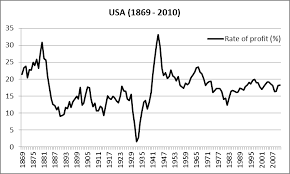 Although the empirical data for the rate of profit in the United States and other countries is by
no means perfect, in part because it is not generally precisely calculated in terms of Marxist
categories of surplus value, constant capital, variable capital, and so forth, we do now have some
reasonable estimates which are good enough for us to draw some conclusions about the theory that
there is a long-term tendency for the rate of profit to fall, and the theory that capitalist
overproduction crises are caused by preceding episodes of the falling rate of profit. The empirical
evidence, at least for the U.S., seems to rather conclusively show that both theories are simply not
correct.
Although the empirical data for the rate of profit in the United States and other countries is by
no means perfect, in part because it is not generally precisely calculated in terms of Marxist
categories of surplus value, constant capital, variable capital, and so forth, we do now have some
reasonable estimates which are good enough for us to draw some conclusions about the theory that
there is a long-term tendency for the rate of profit to fall, and the theory that capitalist
overproduction crises are caused by preceding episodes of the falling rate of profit. The empirical
evidence, at least for the U.S., seems to rather conclusively show that both theories are simply not
correct.
The graph at the right shows the variations in the
rate of profit in the U.S. over one of the longest study periods available, from 1869 to 2010. (We
will further discuss some more in a moment why it is very important to have at least approximate
data from over very long periods.) [This graph is taken from Ivan D. Trofimov,
“The secular decline in profit rates: Time series analysis of a classical hypothesis”, 8 June 2018,
Munich Personal RePEc Archive]
You will first notice that in the graph there is no
overall long-term tendency for the rate of profit to decline. However, there are several periods of
sharply declining rates of profit and also several periods of sharply increasing rates of profit.
Starting from the left edge of the graph, for the post-Civil War years of 1869-1881, there was a
rapid rise in the annual profit rate from the 20% range to around 30%. But then, starting around
1882 and continuing until about 1891 there was a major sharp decline in the rate of profit. What
was going on then? This was a prolonged period of weakness in the American economy which at the time
came to be called the “Great Depression”. (This name for that period was later forgotten when the
even worse “Great Depression of the 1930s” came along.) But note that this major decline in profits
in the 1880s and beyond from around the 30% level all the way down to a low of just 9%, was
coextensive with that prolonged period of serious economic weakness. In other words, there is better
reason to say this period of declining profits was a consequence of the depression than there
is to say that declining profits led to that prolonged depression.
There was a recovery in the profit rate from around
10% in 1892 up to about 17% in 1905, followed by a relapse to back around 10% in 1911. Then, during
the period from 1911 to 1929, average profit rates turned around and began to significantly
rise again, from around just 10% annually up to around 15%. And note that this is the period
leading up to the beginning of the Great Depression
of the 1930s. So once again, during this important 18-year period, the hypothesis that falling
rates of profit led to that greatest of all U.S. and world overproduction crises so far is
shown to be completely false.
However, starting in 1929, when the Depression
began, until the worst depths of the Depression in 1933, the rate of profit dropped like a rock
almost all the way down to 0%. Again, this shows the fall in profit rates to be the result
of the capitalist overproduction crisis, not the cause of it.
After 1933 profit rates started to recover, and
then with government preparations for World War II, and the vast government spending during the war,
the profit rate zoomed up to its greatest level ever, to a peak of about 33%. At that level the
government was simply dumping money into the laps of corporations. Of course that couldn’t continue
after the war was over, at least not at that extreme level. So profits then fell considerably, down
to the low 20s percent by 1953 and then down to about 18% around 1959, even though the
quarter-century after WW2 was a major capitalist boom
period. In other words, the very big fall in profit rates from utterly fantastic down to merely
pretty damned good, in no way interrupted that post-World War II boom.
In the mid-1960s there was another short-term rise in
the rate of profits during the Vietnam War, up to a peak of about 23%. After that time, for a number
of decades, and until the severe Great Recession of 2008-9 and
its aftermath, the overall average profit rate continued wobbling within the fairly narrow range of
13% to 20%, even though the period of the Long Slowdown in the
growth rate of GDP began in 1973. In other words, although economic growth was cut in half for
decades on end, profit rates remained fairly stable.
Those modern proponents of the falling rate of
profits theory for capitalist crises almost always use statistics only from the late 1940s on. The
reason is pretty clear: If you start from that exceptional apex of a 33% profit rate during World War
II, or even from just a few years later, then everything might appear to be down hill from there on!
This is an example of why we argue that a fair assessment of the falling rate of profit theory should
be as long term as possible so that the statistical data cannot be distorted in this way.
We should note that the graphs of average profit
rates over time look very different in different countries. And a few countries, most notably Britain,
do in fact show a long term trend, more or less steady, in the decline of profit rates, for decade
after decade. This can probably be best explained by pointing out the particularities of Britain, and
especially its long decline as an imperial power, becoming ever less able to extract super-profits
from other countries.
The first serious empirical study of the
thesis that the rate of profit has a tendency to fall over time is that by Joseph M. Gillman in
1958. Although his methods and statistics have since been criticized (as, indeed, have those of
probably all other such studies!), we quote some of his results below. We also quote below a few
summaries or conclusions by other more recent studies which also pretty much disprove the basic
notions that there is a tendency for the rate of profit to fall over time, and that such a fall
can in any way explain the development of capitalist overproduction crises. The summary of one
study we quote claims to find “weak evidence” for the long-term tendency for the rate of profit to
decline. But we should note that that study also only starts with data from 1948, and doesn’t even
mention the contrary evidence from earlier decades. —S.H. [April 3, 2023]
See also:
PROFITS—U.S. Corporate Profits
“Marx developed his economic doctrines largely on the basis of axioms and
their demonstration mostly on the basis of purely hypothetical data. This was especially
true with respect to his law of the falling tendency of the rate of profit, although his
pages abound with numerous factual and historical references....
“Marx did not have the facts against
which to test his law of the falling tendency of the rate of profit. They first had to
emerge from generations of capitalist production. But we now have a considerable accumulation
of such facts, and it seems high time that, with Francis Bacon, we counted the horse’s
teeth instead of continuing to speculate about their number. True, the available statistics
are not in the form exactly suited to the purpose. Capitalist business firms do not report,
nor do official statistical agencies process their statistics to conform to the Marxist
categories. Above all, these statistics do not allow us to separate out the factors which
affect its realization, as a full test of the law as Marx formulated it would require. But
with this precaution in mind, they can be made to serve as fair approximations for testing
the assumptions which underlie this law. [p. 31] ...
[Speaking with regard to the theory of
the rising organic composition of capital, the assumed general stability of the rate of
exploitation, and the supposed consequent falling rate of profits:] “Now we find that, while
for the measurable years before the early part of the twentieth century these theses are
fairly well sustained by the available statistical evidence, since that time, as measured
by an extension of the same evidence, they appear no longer to hold true.
“Had our investigations stopped with
1919, the case for Marx’s law would have been complete: a rising organic composition of
capital; a stabilizing tendency of the rate of surplus-value; a falling rate of profit,
corresponding inversely with a rising organic composition!
“But what of the years beginning with
1919? What has happened since then that seems to have abrogated that law? Since 1919 the
ratio c/v has tended to remain constant or even to fall. The rate of surplus-value,
if anything, has tended to rise, in spurts. And the rate of profit, rather than fall, has
tended to rise.” [p.59]
—Joseph M. Gillman, The Falling
Rate of Profit: Marx’s Law and its Significance to Twentieth-Century Capitalism, (NY:
Cameron Associates, 1958), excerpts from pages 31 & 59. [Gillman then attempts to “reformulate”
the theory of the tendency for the rate of profit to fall to account for developments in the
20th century. However, it seems to me that a “law” which doesn’t work for decades at a time
(including for a large part of the capitalist-imperialist era in the U.S.) is not much of a
law, not even much of a “tendential law”.
And note especially that the very worst economic crisis in U.S. history (so far), the Great
Depression of the 1930s, began following a nearly two-decade period when the rate of profit
was rising instead of falling (though of course it fell greatly in 1929 once the
financial crisis and Depression started). For this reason it seems completely unreasonable
to claim that the falling rate of profit in any way “led to” or “caused” or somehow “explains”
the Great Depression. —S.H.]
“The law of the tendential fall in the rate of profit has been at the center
of theoretical and empirical debates within Marxian political economy since the publication
of volume III of Capital. An important limitation of this literature is the relative
paucity of modern econometric investigations of the behavior of the rate of profit. The
central objective of this paper is to remedy this lacuna. We investigate the properties of
the profit rate series utilizing the methods of time series econometrics. The evidence
suggests that the rate of profit is non-stationary. We also specify a test of Marx’s law of
the tendential fall in the rate of profit with a novel econometric model that explicitly
accounts for the counter-tendencies and their time series properties. We find weak evidence
of a long-run downward trend in the general profit rate for the U.S. economy for the period
1948-2007.” Abstract of the article by Deepankar Basu and Panayiotis T. Manolakos, “Is There
a Tendency for the Rate of Profit to Fall? Econometric Evidence for the U.S. Economy, 1948-2007”,
Review of Radical Political Economics, Vol. 45, Issue 1, May 24, 2012. The working draft
of the paper, which makes stronger pro-falling-rate claims which were eased away from in the
final publication, is online at:
https://scholarworks.umass.edu/cgi/viewcontent.cgi?article=1098&context=econ_workingpaper
FAMILY DISCORD
As noted in the above entry, capitalism has had a severe and disruptive effect on families. One of
the relatively underappreciated results of current capitalist trends, and the long-developing new
capitalist overproduction crisis which began around 1973,
in particular, is the increasing level of discord, personal, political and social antagonisms, and
such, within families too, as well as society at large.
“What’s Ripping American Families Apart?
“At least 27 percent of Americans are
estranged from a member of their own family, and research suggests about 40 percent of Americans
have experienced estrangement at some point.
“The most common form of estrangement is
between adult children and one or both parents—a cut usually initiated by the child....
“Some kids seem to think they need to cut
off their parents just to have their own life.... In other cases, children may be blaming their
parents for the fact that they are not succeeding as they had hoped—it’s Mom and Dad who
screwed me up.
“I write about this phenomenon here because
it feels like a piece of what seems to be the psychological unraveling of America, which has
become an emerging theme of this column. Terrible trends are everywhere. Major depression rates
among youths aged 12 to 17 rose by almost 63 percent between 2013 and 2016. American suicide
rates increased by 33 percent between 1999 and 2019. The percentage of Americans who say they
have no close friends has quadrupled since 1990, according to the Survey Center on American
Life. Fifty-four percent of Americans report sometimes or always feeling that no one knows them
well, according to a 2018 Ipsos survey.
“I confess, I don’t understand what’s
causing this. But social pain and vulnerability are affecting everything: our families, schools,
politics and even our sports.
“A friend notes that politics has begun to
feel like an arena where many people can process and regulate their emotional turmoil indirectly.
Anxiety, depression and anger are hard to deal with within the tangled intimacy of family life.
But political tribalism becomes a mechanism with which people can shore themselves up, vanguish
shame, fight for righteousness and find a sense of belonging.”
—David Brooks, a bourgeois columnist,
New York Times, July 30, 2021. [Brooks may be puzzled by the causes of all the things he
points out, but to Marxists the answer is simple: bourgeois society is disintegrating.
That does mean worsening chaos and conflict, of course, and lots of people looking for easy
answers. But it also means there is hope that humanity can eventually come out of this capitalist
nightmare and build a new positive socialist, and then communist, existence for itself. —Ed.]
FANNIE MAE
A semi-official agency of the U.S. federal government engaged in issuing and guaranteeing home
mortgages. Its formal name is the Federal National Mortgage Association, but it is almost
universally referred to by its nickname “Fannie Mae”. Officially it is what is known as a
“government-sponsored enterprise” (GSE) which was set up by Congress to
support and stabilize the mortgage credit market, where mortgages and mortgage-related assets
(such as CDO’s and similar derivatives)
are bought and sold by financial capitalists. Fannie Mae is one of several officially independent
GSE’s, but is in reality a federal agency, which props up the mortgage portion of the financial
industry. It is one of the originators of the securitized
bundles of mortgages which have played such a major role in the current financial crisis.
Fannie Mae also purchases mortgage-related derivatives for its own account and issues its own
bonds to pay for them. It is, in other words, a key pillar of the financial house of cards that
constitutes the U.S. mortgage market.
Fannie Mae was first set up as a government
agency in the Great Depression of the 1930s. In 1968 it was re-chartered by Congress as a GSE,
but remained a quasi-official government agency because of its implicit government financial
guarantee. The financial panic of 2008 showed that its economic “independence” was a pure
fiction. In early September 2008, Treasury Secretary Henry Paulson announced the rescue package
for Fannie Mae and its cousin Freddie Mac, and the formal
takeover by the government of both companies.
“Fannie Mae is the nation’s largest mortgage buyer and a financial
juggernaut that affects the lives of tens of millions of home buyers. It was taken
over by the federal government on Sept. 8, 2008, along with Freddie Mac, as the two
mortgage giants struggled with deep losses and investors lost confidence in the pair.
“Many experts believe that Fannie
and Freddie are likely to remain wards of the state for years.
“And, given the alarm in some
quarters over the mounting budget deficit, these two giants and their vast obligations
are likely to remain conveniently—and controversially—off the federal books. Fannie
Mae and Freddie Mac have obligations of $3.9 trillion to investors who bought bundles
of mortgages that the companies assembled.
“Lawmakers of both parties, eager
to demonstrate their scorn for the companies, have called for their eradication. But few
policy makers are willing to take aggressive steps that might weaken the housing market.
On Dec. 24, 2009, the White House quietly disclosed that it had, in effect, given the
companies a blank check by making their federal credit line unlimited; the ceiling had
been $400 billion.” —From the New York Times website.
FANSHEN [Book]
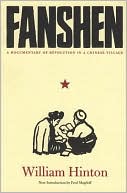 A classic book, by William Hinton, about the course of
social revolution in the Chinese village of Long Bow in Lucheng County, Shansi Province. It
describes in careful detail the efforts, often successful, sometimes not so, of the local
members of the Communist Party of China to mobilize the masses in this village to make
revolution. It often demonstrates the leadership method of the mass
line in practice.
A classic book, by William Hinton, about the course of
social revolution in the Chinese village of Long Bow in Lucheng County, Shansi Province. It
describes in careful detail the efforts, often successful, sometimes not so, of the local
members of the Communist Party of China to mobilize the masses in this village to make
revolution. It often demonstrates the leadership method of the mass
line in practice.
“Every revolution creates new words. The Chinese Revolution created a
whole new vocabulary. A most important word in this vocabulary was fanshen.
Literally, it means ‘to turn the body,’ or ‘to turn over.’ To China’s hundreds of
millions of landless and land-poor peasants it meant to stand up, to throw off the
landlord yoke, to gain land, stock, implements, and houses. But it meant much more than
this. It meant to throw off superstition and study science, to abolish ‘word blindness’
and learn to read, to cease considering women as chattels and establish equality between
the sexes, to do away with appointed village magistrates and replace them with elected
councils. It meant to enter a new world. That is why this book is called Fanshen.
It is the story of how the peasants of Long Bow Village built a new world.” —William
Hinton, on the first page of his great book.
“This is a very important book for revolutionary communists to read.
It is what first opened up my eyes as to what communists are trying to do, and how they
are trying to go about doing it.” —Scott Harrison
FARADAY, Michael (1791-1867)
British physicist and chemist most famous for his investigations into electricity, and more
specifically the relationship between magnetic and electric fields. Faraday’s Law of Induction
(formulated in 1831) states that a changing magnetic field produces an electric field and
therefore a current in a wire. This is the basic principle behind the generation of modern
electricity networks. Faraday’s Law of Electrolysis (1833) states that during electrolysis the
amount of chemical change that the current produces is proportional to the amount of electricity
used, and that the amounts of chemical changes which occur through the use of the same quantity
of electricity are proportional to their equivalent weights (and therefore proportional to their
different atomic weights).
“The son of a blacksmith, he became the leading scientist of his day, and
is remembered as one of the greatest experimentalists in the history of science....
“Born in 1791, Faraday started out
as an apprentice book-binder, reading everything that passed across his desk. A volume on
chemistry caught his imagination, and he began to attend scientific lectures, a popular
pastime in early 19th-century London. The star of the lecture circuit at the time was Sir
Humphry Davy, who plucked Faraday from obscurity to work as his laboratory assistant.
Faraday’s education continued at Davy’s workbench, and on an extended tour of Europe,
during which Faraday unwillingly stood in for Davy’s valet. Working together, the two
developed the Davy Lamp for miners.
“But Faraday quickly emerged from
under his mentor’s shadow as a scientist in his own right, corresponding with other
researchers as an equal, and conducting pioneering experiments with electricity. His
discoveries laid the foundations for the electric motor and the electrical generator, and
thus for electrification in general. Faraday and Davy soon became estranged, and no wonder.
Davy had difficulty seeing Faraday as anything more than his valet, and even tried to
block his admission to the Royal Society. Faraday eventually succeeded Davy as the British
government’s trusted adviser on scientific matters, the Royal Institution’s star lecturer,
and London’s foremost popularizer of science. In contrast to Davy, with his charisma and
flair, Faraday was a gentle, soft-spoken man whose lectures always put science, rather than
the scientist, at center stage.”
—“King Faraday”, a review of James
Hamilton’s book, Faraday: The Life [2002], in The Economist, August 3, 2002,
p. 70.
“Our physicists led lives in social worlds that covered the full
middle-class range, from lower to upper, but rarely found themselves above or below those
stations. By far the most prominent exception ... is Michael Faraday, born in a London
slum.” —William H. Cropper, Great Physicists (2001).
FASCISM
The form of capitalist society in which the bourgeoisie rules by open, terroristic
violence against the people, as opposed to bourgeois
democracy. As an extreme form of bourgeois nationalist rule, fascism often also includes
rabid forms of racism, often to the point of genocide. The most vicious and notorious example
was Nazi Germany (1933-1945).
All capitalist countries have at least some
elements of fascism, to one degree or another, and to the extent that the bourgeoisie thinks
these elements are “necessary” in order to maintain their rule. Nevertheless, we call those
countries which allow relatively more freedoms of speech, of the press, of association, and
allow at least some mass protest bourgeois democracies, while those countries which
have few if any such freedoms we call fascist.
See also:
LUMPENPROLETARIAT AND FASCISM
“Fascism is the open terrorist dictatorship of the most reactionary,
most chauvinistic, most imperialist elements of finance capital.” —Statement of the
Enlarged Executive of the Communist International, Moscow, 1933.
[Although this is still a fairly
good capsule definition of fascism, it is based a little too much on the form fascism
took in Italy and then Nazi Germany during the 1930s. Fascism is best thought of as a
form of capitalist rule, and as such it may exist even in countries which are not
themselves imperialist ones or dominated by their own finance capitalists. —S.H.]
“But how can anyone tell the truth about Fascism, unless he is willing
to speak out against capitalism, which brings it forth?” —Bertolt Brecht, “Writing
the Truth: Five Difficulties” (1935).
Principles in the MLM Conception of Fascism:
1. Fascism is one of the
two major forms of capitalist class rule, the other being bourgeois
democracy. Both fascism and bourgeois democracy are forms of the
dictatorship of the bourgeoisie.
But bourgeois democracy is a qualitatively more relaxed form of that dictatorship in
that it allows more scope for the working class and masses to express their opinions,
to protest, to organize themselves and for their organizations to operate openly
without being suppressed, and to publish and distribute newspapers and other political
literature. Bourgeois democracy also allows elections, but while we support the
existence of these elections, we also recognized that they are mostly rigged by the
bourgeoisie through their control of what they call “education” and their ownership
of nearly all the mass media.
2. Whether or not a regime
is fascist is primarily a question of how it goes about exercising its
dictatorship over other classes, and especially over the proletariat and masses.
3. How the regime treats
revolutionaries and revolutionary parties (along with the militant mass
movements they organize and lead) is especially key in determining whether a regime is
a fascist one or not. This is because it is revolutionaries who are actually most active
in making use of the rights of speaking out, protesting, assembling, organizing others,
and publishing writings promoting the real interests of the workers and masses.
4. Although terrorism
characterizes fascism, there is also plenty of terrorism directed at the “unruly masses”
by the ruling class under bourgeois democracy. It is not that terrorism against the
people only exists under fascism; it is just that it is qualitatively more extensive
and severe.
5. Fascism and bourgeois
democracy are theoretical extremes or archetypes; all actual capitalist regimes have
elements of both types of bourgeois rule. (With the possible exception of Nazi Germany
which really was close to the total fascist archetype!)
6. Regimes can be
categorized as either fascist or bourgeois democratic based on whether
they most closely approximate the fascist theoretical archetype or the bourgeois
democratic theoretical archetype.
7. Individual laws or
actions by the bourgeois state can be appropriately categorized as fascist if
they correspond to the sorts of laws or actions typical of the fascist theoretical
archetype, and whether or not they occur in a regime which we overall categorize as
fascist.
8. Since fascism vs.
bourgeois democracy is a matter of how the bourgeoisie rules, it is possible
for it to rule in different ways in different areas (as well as at different times),
and therefore to be a fascist regime in one area and a bourgeois democratic regime in
another area. Thus regions under martial law are under fascist conditions, and this is
also more apt to be the case within internal colonies and ghettos.
9. Bourgeois democracy
is unstable and periods of fascism are virtually inevitable—especially as the
bourgeoisie faces a major crisis or nears its overthrow.
10. Struggling against
fascist laws and policies of the government in a bourgeois democracy is a struggle for
reforms. We should never forget this nor confine our work mostly (or only!) to
the struggle for a purer form of bourgeois democracy; that would turn us from
communists into bourgeois democrats. But on the other hand, the struggle against
fascist laws and policies is an important and necessary part of building a
truly revolutionary struggle against capitalism in any of its forms.
Conclusion: Large areas
of the world are already appropriately called fascist from the proletarian
revolutionary point of view. Even in countries and areas where bourgeois democracy
still exists, there are often new fascist laws and policies being implemented, and
frequently there is at least a slow trend in the direction of fascism. As the world
capitalist economic crisis continues to intensify over the next decade and beyond
there will almost certainly be a further impetus toward fascism in a growing number
of countries. This is something we need to recognize, prepare for, and resist with
all our might.
—Adapted and summarized from a
more thorough discussion of fascism in the 19-page essay, “A Short Introduction to the
MLM Conception of Fascism”:
PDF
Version [335 KB];
MS Word
Version [122 KB]. —Scott Harrison
FASCISM — And National Chauvinism and Racism
Fascism, as the article above states, is in its central essence one of the two forms of the
rule of the capitalist class; namely, the form of that rule which involves the open terroristic
suppression of the working class and masses. However, it is also true that fascism, virtually
wherever it arises, is extremely national chauvinist and deeply
racist, often to the point of genocide. It is important to
understand just why this is.
First, all capitalist ruling classes are
based in one or another nation state, and they are a quite small part of the whole population
even in that one nation. For such a ruling class to cohere and continue to rule over its domain
it must develop strong internal ideologies of not only capitalist class cohesion but also
promote as many other forms and mechanisms of national unity as possible, including (normally)
ethnic and linguistic cohesion. The ruling class itself is tiny, the “one percent” as we now
say. So it is all the more important for them that they find and promote reasons beyond just
their own class interest, such as shared ethnicity, language and “race”, and often religion, to
try to unite the rest of the population in support of their rule.
That much is more or less true of all capitalist
countries at all times. However, in times of serious social crisis, whether that be major
capitalist economic crisis or war, it becomes even more pressing for the tiny ruling class to
use every means at its disposal to promote “national unity” (i.e., general unity in support of
itself as the only “legitimate” ruler of the nation).
Moreover, it becomes absolutely imperative in
times of social crisis for the ruling class to find someone else to blame for the hugely
intensifying problems and worsening condition of the broad masses. They absolutely need
scapegoats in order to keep the masses from turning against them, since their capitalist
class itself, and the capitalist-imperialist system, is the real cause of these economic, war,
environmental and other disasters. Of course the natural people for them to blame are: other
nations, and—within their own nation—those people who most strongly oppose their rule and the
people who are in some way different (because of race, ethnicity, religion, language, etc.)
from the largest part of the population.
Fascism is the form of bourgeois rule which
is necessary for the capitalist class in times of crisis, and, in turn, because it
develops in times of crisis it requires that the ruling class intensify its national
chauvinism, racism and hatred of other peoples, in order to maintain its continued rule. And
it is especially in times of crisis and when there is misery for growing sections of the
people that the ruling class must find someone else to blame, scapegoats, for the disasters
they and their system have created. They even find it necessary at times to whip up their
adherents into a frenzy and to physically attack and even murder their opponents and the
scapegoats they have identified. Fascism is indeed a horrible, despicable thing—the
capitalist-imperialist ruling class at their very worst.
FASCISM — Bourgeois Conceptions Of
The central characteristic of all bourgeois conceptions of fascism is that they do not
view either fascism or “democracy” (i.e., bourgeois democracy) as forms of rule by the
capitalist class. Instead they focus on secondary issues such as whether more than one
bourgeois party exists and is allowed to compete in “fair” elections.
“[Fascism is the system that] favors big business, strengthens the
position of heavy industries, retains enough of the profit system to permit the elite
to build personal fortunes... facilitates cartelization, and spends huge sums for
military purposes [and in which] free collective bargaining and self-government of
labor organizations is abolished.” —Legislative Reference Service of the Library of
Congress, Fascism in Action: A Documented Study and Analysis of Fascism in Europe
(Washington, DC: U.S. Government Printing Office, 1947), p. 204; quoted in Robert W.
McChesney and John Nichols, People Get Ready: The Fight Against a Jobless Economy
and a Citizenless Democracy (2016), p, 180. [These things are of course generally
true of fascism, but they are not the essence of it. —Ed.]
“But [after World War II] very quickly any momentum to directly
attack fascism disappeared, and all attention went to addressing the ‘communist’
threat. It was as if World War II had never happened. Anti-fascism was suspect, unless
the critic made it abundantly clear that communism was every bit as evil, as [U.S.
Congressman Wright] Patman did in his foreword to the 1947 fascism report. And
eventually anti-fascism just became suspect, period.” —Robert W. McChesney and John
Nichols, ibid.
[Anti-fascism is indeed highly
suspect to the capitalist ruling class, even to its bourgeois democratic proponents,
for several reasons: 1) Anti-fascism is most strongly and insistently promoted by
communists and revolutionaries; 2) Many people, and not just Marxists, do correctly
view fascism as an alternative form of capitalist rule (which deeply offends capitalist
supporters of bourgeois democracy); and 3) The bourgeoisie as a whole knows that it
is “forced” to implement some fascist measures from time to time even during periods of
overall bourgeois democracy, and it recognizes that more such measures or even outright
fascism may be “necessary” in the future in order to keep down the unruly working
class and masses during times of economic or social crisis. Therefore, the only way
that social democrats and
“progressives” can bring themselves to oppose trends
toward fascism is to themselves adopt, to a considerable degree, the wishy-washy
conception of fascism that is somewhat more acceptable to the ruling class:
i.e., the conception that fails to acknowledge that fascism is one of the two
forms of the dictatorship of the bourgeoisie. —Ed.]
FASCISM — Causes Of
Marxist-Leninists, since the days of Lenin, have always correctly argued that the capitalist
ruling class resorts to fascism when they are no longer able to rule in the old
bourgeois-democratic way. But why, exactly,
does it come to happen that they are no longer able to rule in that freer way? It is for two
reasons, the second resulting from the first: 1) It is because capitalism develops evermore
serious economic crises of overproduction; and
2) Because these economic crises lead to ever more extreme and intolerable conditions for
the proletariat and the masses, which makes them more and more “unruly”, and more and more
inclined toward revolution. To maintain their exploitative class rule, the capitalists thus
have little choice but to crack down ever more harshly on the people, and to restrict ever
more severely their political rights of free speech, free assembly, freedom to organize, and
so forth. In short, fascism is the virtually inevitable response of the bourgeoisie to the
economic crises inherent in their system in the imperialist era, and to the workers’ and
masses’ reaction to the misery those crises bring about for them.
It is true that in some cases, the “unruliness”
of the masses, or part of them, can arise for various other reasons, such as due to a rebellion
against national or ethnic oppression. Nevertheless, full-blown fascism in advanced capitalist
countries has historically been almost completely connected with capitalist economic crises, and
the masses reaction to them.
The first fascist regime, that of Mussolini in
Italy, was in reaction to the economic crisis and oppression of the workers at the end of World
War I. The major episode of fascism in Nazi Germany and so many other countries in Europe and
around the world in the 1930s was of course a result of the Great Depression, and the
determination of ruling capitalist classes to deal with the desperate masses because of that
Depression. Not only did many other European countries develop fascist regimes, but so did Japan
and many other countries. And “within a few years of the [1929] crash, 16 countries suffered
military coups or takeovers by strongmen [dictators] in Latin America alone.”
[The Economist, in a review of a book about the Great Depression, July 21, 2007, p. 83.]
After the destruction of much excess productive
capital in World War II, the capitalist world had a new quarter
century boom. During this boom period, which lasted until the early 1970s, there were only
occasional small recessions, and no major economic crises. For this reason most capitalist
countries, especially the capitalist-imperialist countries such as the United States, had no need
for fascism. Instead their international propaganda theme was always in favor of what they called
“democracy” (i.e., bourgeois democracy). Of course there were still some secondary fascist aspects
in capitalist states even in that period, such as McCarthyism
in the U.S. But overall this quarter-century post-war boom period was one of bourgeois democracy
in most capitalist countries.
However, as the long-developing new U.S. and
world overproduction crisis has gradually gotten worse—especially in the new century—there has
once again developed a new worldwide trend for more and more aspects of fascism in virtually all
capitalist countries. The plain fact is that fascism is now a major and growing aspect of
capitalism in what is hopefully its final period of existence.
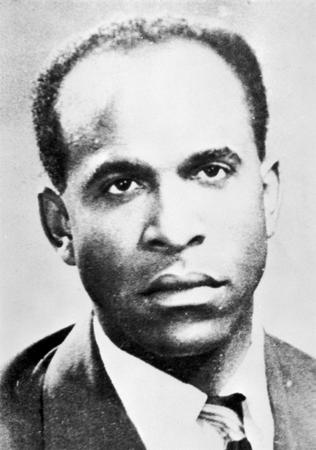 An Afro-Caribbean psychiatrist, writer and revolutionary who was born on the island of Martinique,
but who spent most of his adult life in France and Algeria. He strongly supported the Algerian
War of Independence from France and was a member of the Algerian National Liberation Front. He
was a political radical who focused on anti-colonialism and the psychopathology of colonialism.
Although he was somewhat influenced by Marxism, in the revisionist and philosophical idealist
form that it often took in France, he was never really a revolutionary Marxist. He was more
influenced by Jean-Paul Sartre and French idealist philosophy as well as the radical psychiatrist
Jacques Lacan, and anti-colonial movements such as Négritude. His most famous and influential
book was The Wretched of the Earth, which was published just before his death. In that
work, and elsewhere, Fanon strongly defended the right of colonialized peoples to use whatever
violence was necessary in struggling for their freedom.
An Afro-Caribbean psychiatrist, writer and revolutionary who was born on the island of Martinique,
but who spent most of his adult life in France and Algeria. He strongly supported the Algerian
War of Independence from France and was a member of the Algerian National Liberation Front. He
was a political radical who focused on anti-colonialism and the psychopathology of colonialism.
Although he was somewhat influenced by Marxism, in the revisionist and philosophical idealist
form that it often took in France, he was never really a revolutionary Marxist. He was more
influenced by Jean-Paul Sartre and French idealist philosophy as well as the radical psychiatrist
Jacques Lacan, and anti-colonial movements such as Négritude. His most famous and influential
book was The Wretched of the Earth, which was published just before his death. In that
work, and elsewhere, Fanon strongly defended the right of colonialized peoples to use whatever
violence was necessary in struggling for their freedom. Brazilian term for the horribly crowded and miserable slum districts in major cities that are
often constructed by the poor and homeless themselves out of whatever pieces of discarded
junk materials that are available. These slums are rapidly growing.
Brazilian term for the horribly crowded and miserable slum districts in major cities that are
often constructed by the poor and homeless themselves out of whatever pieces of discarded
junk materials that are available. These slums are rapidly growing.