FRAGGING
The killing of officers by the soldiers in their own army. Since soldiers in capitalist
countries are mostly from poor or working class families while the officers are usually
from higher social strata, and since the officers in these armies constantly lord their
authority over the ordinary soldiers in a most severe way, there are inevitable conflicts
between the two at all times. However, during wartime the situation can be more extreme;
it is the job of the officer corps to order soldiers into battle in the service of the
ruling class, which puts the lives of these soldiers at serious risk for no good purpose.
The soldiers sometimes take violent exception to this! And one form of that is to simply
turn their guns around against their own officers.
Although there are occasional fraggings
in virtually all wars, this became particularly common in the U.S. imperialist war of
aggression against Vietnam in the 1960s and 1970s. There were an officially reported 209
cases of fragging of U.S. officers in that war, but the number was probably far larger.
(It was much less embarrassing for the military to report deaths due to “enemy fire” than
it was deaths at the hands of their own soldiers!) The rebelliousness of their own army
was one of several important factors that led to the defeat of the U.S. imperialists in
that war. The name “fragging” comes from the common use of fragmentation grenades for
this purpose. The very last thing a number of U.S. imperialist officers saw in their
lives was a fragmentation grenade rolling toward them on the floor of their tent.
See also:
VIETNAM WAR—Near Collapse Of U.S.
Military
“[In Vietnam] the targets of the attacks were mostly junior field
officers. The men who tossed grenades at or shot their officers in many cases were
African Americans. They were pushed over the top by what they considered the brutal,
racist and dehumanizing treatment by white officers. Their hatred was fed by
resentment of being drafted and forced to fight in what they considered a racist,
senseless war against oppressed people.
“The growing problem of
‘fraggings’ leaped to public attention in the trial of Billy Dean Smith in 1971.
Smith ... was an African American. He was accused of killing two white officers.
Though Smith was eventually acquitted, the trial quickly turned into as much a
debate over Army racism and the waging of an unjust war as Smith’s personal guilt
or innocence.” —Earl Ofari Hutchinson, “Echoes of ‘fragging’”, San Francisco
Chronicle, March 27, 2003.
“One of us (Bob) was teaching a class at the University of
Illinois when the subject of fragging in Vietnam came up while discussing ... [a
book]. Many of the students understandably found it difficult to believe. Then a
student raised his hand and mentioned that his father had gone to West Point,
graduating in 1970, and went on to a career in the military. The student said his
father had three roommates at West Point, and that two of them had been fragged
in Vietnam within a year of their graduation.” —Robert W. McChesney and John
Nichols, People Get Ready (2016), p. 329 note 146.
FRANCE — “Demographic Winter”
This is a name for the fact that France, like a growing number of countries, has now
entered a period in which the number of deaths each year exceeds the number of births,
which (given its hostility to immigration) will consequently eventually result in an
increasingly rapid fall in its population. This is a serious situation for a capitalist
country since its economic health depends so much on ever-increasing production.
“‘The demographic winter will be long; that is a fact.’ Clément
Beaune interviewed by Le Monde How will this demographic shock transform France?
“First and foremost, it is a
collective psychological shock. In 2025, the country’s natural population balance
turned negative. For the first time in France since 1945, the number of deaths exceeded
the number of births. The population is aging and could shrink by 2070. A demographic
winter has set in—and for France, this is something new. For a long time, we lived
under the impression that we had ‘good’ demographics. It is true that, for many
decades, the French had more children than their European neighbors. We are joining
the ranks of the 21 out of 27 European countries with a negative natural population
balance. Some areas will remain dynamic, particularly in the west and along the coast.
Others will experience rapid demographic decline: fewer young people, leading to less
economic activity, fewer schools, housing difficulties, and so on. This demographic
shock is not merely a rough patch; it is a reality that must be faced.”
—As re-posted on Adam Tooze’s
Chartbook newsletter, August 18, 2026.
FRANCE — Marx and Engels On
“Marx: The Class Struggles in France 1848-50; The Eighteenth
Brumaire of Louis Bonaparte; The Civil War in France
“These three works by Marx,
each of which consists of a collection of articles or addresses, form a series in
which he analyzes the revolutionary events in France from the Revolution of 1848
to the Paris Commune in 1871.
“In his introduction to both
The Eighteenth Brumaire and The Civil War in France, Engels points
out that thanks to historical materialism Marx could grasp the character and
consequences of great historical events at the time they were still in progress.
These works are classical models of how Marxism analyzes complicated class
relations and class battles at the very time of their occurrence, so as to show
the working class the correct policy.
“They make not only very
instructive, but very exciting reading. Each can be read separately, but they are
best read as a series. Thus, The Eighteenth Brumaire opens with a summary
of the whole series of events from 1848 to 1871. What were these events?
“In February, 1848, the
regime of Louis Phillippe, the ‘Bourgeois King,’ set up when the Bourbons were
overthrown in July 1830, was itself overthrown by a mass uprising. The regime of
Louis Phillipe had represented the ‘rule of the bankers,’ of the ‘aristocracy of
finance.’ [See Marx, Capital, Vol. III, Part 5, especially chapters 27 and
36.] After its overthrow, as a result of mass pressure from the workers, a
Republic was declared and, to begin with, all the propertied classes shared power.
It was the workers who made the February 1848 Revolution, but the first act of the
bourgeoisie was to disarm them. The workers resisted and were defeated in the June
uprising of 1848. One by one, the classes which had made the revolution lost
power: first the industrialists beat the petty-bourgeoisie in June 1849, then they
themselves lost to the ‘aristocracy of finance’ who came back in power again.
“Meanwhile, taking advantage
of these dissensions among the ‘propertied classes,’ an adventurer, Louis Bonaparte,
a descendant of the Emperor Napoleon Bonaparte, relying on the support of the
masses of the oppressed peasantry, had got himself elected President of the Republic,
and by a coup d’état in 1851 (known as the ‘Eighteenth Brumaire’) made
himself absolute ruler. Shortly afterwards, he established himself as the Emperor
Napoleon III. Thus, after disarming the workers who made the 1848 revolution, the
the bourgeoisie, torn by dissensions, proved unable to rule. Louis Bonaparte and a
gang of adventurers seized power. But with Bonaparte’s regime, a big industrial
development took place in France.
“The Bonapartist ‘Second
Empire’ lasted until the Franco-Prussian War of 1870. This war was provoked by the
territorial ambitions of Bonaparte, who wanted to establish the French frontiers
on the Rhine. He was defeated by the Prussians in 1870, his Empire fell, and a
‘Government of National Defense’ was set up.
“Meanwhile, the Parisian
workers were armed for the defense of Paris. But the Government of ‘National
Defense’ was primarily concerned not to defend Paris but to disarm the workers. In
January 1871, it capitulated to the Prussians. The Government retired to Versailles.
Thereafter, war ensued between the Parisian workers and the Government at Versailles.
In March 1871, the Paris workers set up the Paris Commune. It was eventually crushed
and the workers massacred by the bourgeois government in Versailles, aided and
abetted by the foreign invaders, the Prussians.
“Such was the sequence of
events analyzed by Marx in these writings.
“Of particular importance in
these three books are:
“1. The analysis of the
progress of the revolution from 1848. The driving force of the revolution was the
working class, but the revolution put the bourgeoisie in power. The bourgeoisie
then turned against the workers, who were isolated and defeated. But in this action
the bourgeoisie turned against the revolution itself, deserted the revolution, and
themselves proved unable to rule.
“2. The biting exposure
of petty-bourgeois ‘social democracy’ contained in The Eighteenth Brumaire.
Marx shows that these ‘democrats’ were under the illusion that their own speeches
and declamations in parliament decided events, ignoring the realities of the class
struggle. This he called ‘parliamentary imbecility’ or ‘parliamentary cretinism.’
Marx shows concretely how the outlooks and ideas current in society reflect the
position of different classes.
“3. The exposure in
The Eighteenth Brumaire of the nature of the bourgeois state, as the organ
of the capitalist class rule. The triumph of the bourgeois republic, said Marx,
led in fact to ‘unlimited despotism.’ He shows that all revolutions had ‘perfected
the state power,’ but that the task of the proletarian revolution must be to break
it up.
“4. The analysis of
the position of the French peasantry. The peasantry, he shows in The Eighteenth
Brumaire, provided the chief social support on which Louis Bonaparte founded
his personal dictatorship. Nevertheless he points out in The Civil War in
France that the only hope for the mass of the peasantry lay through a workers’
government. Thus Marx and Engels began to deduce the key importance of the workers
winning the masses of peasants as allies.
“5. Marx’s treatment
of the Franco-Prussian War in The Civil War in France. He shows that, to
begin with, it was a just war on the side of the Prussians. But he gives a lead to
the German workers to oppose the war as soon as Bismarck turned it into a war of
aggression.
“6. The analysis of
the Paris Commune as ‘the political form at last discovered to work out the
economic emancipation of labor.’
“The Commune was the
dictatorship of the proletariat. ‘Do you want to know what this dictatorship looks
like? Look at the Paris Commune, that was the dictatorship of the proletariat.’
So wrote Engels in his Introduction.
“The Commune proved that the
working class cannot ‘lay hold of the existing state machinery,’ but must ‘smash
it’ and set up its own power.
“Marx and Engels analyzed the
measures taken by the Commune, and at the same time pointed out its weaknesses and
mistakes.”
—Readers’ Guide to the
Marxist Classics, prepared and edited by Maurice Cornforth, (London: 1953),
pp. 58-59.
FRANKFURT SCHOOL
This was centered around what was officially known as the Institute for Social Research,
which was founded and affiliated with the University of Frankfurt in 1923 under the
direction of Carl Grünberg. During the Nazi era it was forced to relocate to New
York, but returned home in 1949. Among its leading lights were Max Horkheimer, who was
the Director from 1931 to 1958, Walter Benjamin, Theodor Adorno and Herbert Marcuse, who
had a considerable influence on some of the leaders of the New
Left in the U.S. during the 1960s. Its leading later representative is Jürgen
Habermas. The programme of the school was supposedly to construct a “critical theory”
of Marxism, which they characteristically tried to do in academia and in a way
completely divorced from the mass revolutionary movement!
In other words, the Frankfurt School
in actual practice has been primarily a loose association of intellectual revisionists
who were influenced by Marxism to some degree, but who sought to reconstruct
it along the much more idealist and bourgeois lines which were acceptable to them.
They found a great deal to criticize in Marx and Engels, and even more to criticize in
Lenin. Later they added Mao to their list of Marxist-Leninists they didn’t much care
for.
One of their most consistent themes was
to oppose materialism. They used this sneaky approach:
they identified materialism and its defense with Stalin and his USSR in order to
discredit it with their target audience. As much as possible they tried to ignore or
deny the plain fact that all the great developers of the science of revolutionary
Marxism have been staunch and extremely consistent materialists. In particular they
tried to distort Marx’s early writings to make him out to be some sort of Hegelian
idealist! Their second sneaky trick was to absurdly claim that dialectical materialism
as it has been understood within Marxism-Leninism was actually a form of “positivism”!
And in general the Frankfurt School has focused almost entirely on the superstructure
of society, with a determination to put an idealist slant on their interpretation of it.
Like most idealists, they found Kant attractive when it comes
to epistemology. They were also enthusiastic about psychoanalysis, despite the fact that
it is mostly a pseudoscience. The psychoanalyst Erich Fromm
was one of those associated with the Frankfurt School.
The Frankfurt School rejected orthodox
Marxism as a “dogma”. It seems only fair, therefore, that we revolutionary Marxists
should reject the Frankfurt School as silly idealist revisionism!
FRATERNIZATION IN WORLD WAR I
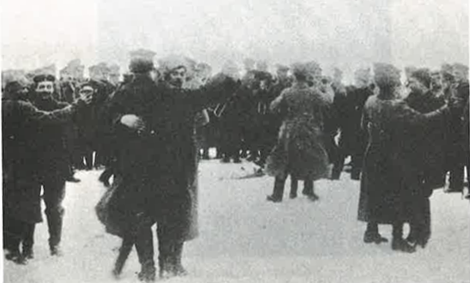 During interimperialist wars, and especially during World War I, revolutionaries often
tried—at times with considerable success—to bring an end to the fighting by appealing,
in part, to the working class soldiers themselves to stop killing each other. During that
war, for example, revolutionaries popularized this bitter definition of a bayonet: “A
weapon with a worker on each end.” The Bolsheviks in Russia were especially effective in
promoting fraternization between the Tsarist Russian army and opposing armies.
During interimperialist wars, and especially during World War I, revolutionaries often
tried—at times with considerable success—to bring an end to the fighting by appealing,
in part, to the working class soldiers themselves to stop killing each other. During that
war, for example, revolutionaries popularized this bitter definition of a bayonet: “A
weapon with a worker on each end.” The Bolsheviks in Russia were especially effective in
promoting fraternization between the Tsarist Russian army and opposing armies.
“‘Our Party will particularly support the mass fraternization of
the soldiers of all the belligerent countries that has already begun at the
front...’
“... We want fraternization on
all fronts, and we are taking pains to encourage it. When we worked in Switzerland,
we published an appeal in two languages, with French on one side and German on the
other, urging those soldiers to do the same thing we are now urging the Russian
soldiers to do. We do not confine ourselves to fraternization between German and
Russian soldiers, we call upon all to fraternize. This then is what we mean by
fraternization:
“‘... endeavoring to turn this
instinctive expression of solidarity of the oppressed into a politically-conscious
movement as well organized as possible for the transfer of all state power in all
the belligerent countries to the revolutionary proletariat.’
“Fraternization, so far, is
instinctive, and we must not deceive ourselves on this score. We must admit this in
order not to delude the people. The fraternizing soldiers are actuated not by a
clear-cut political idea but by the instinct of oppressed people, who are tired,
exhausted and begin to lose confidence in capitalist promises. They say: ‘While you
keep on talking about peace—we have been hearing it now for two and a half years—we
shall start things moving ourselves.’ This is a true class instinct. Without this
instinct the cause of the revolution would be hopeless. As you know, nobody would
free the workers if they did not free themselves. But is instinct alone sufficient?
You would not get far if you rely on instinct alone. This instinct must be
transformed into political awareness.
“In our ‘Appeal to the Soldiers
of All the Belligerent Countries’ we explain into what this fraternization should
develop—into the passing of political power to the Soviets of Workers’ and Soldiers’
Deputies.” —Lenin, “The Seventh (April) All-Russia Conference of the R.S.D.L.P.(B.)”,
April 24-29 (May 7-12), 1917, LCW 24:267-268.
“Clearly, fraternization is the revolutionary initiative of the
masses, it is the awakening of the conscience, the mind, the courage of the
oppressed classes; in other words, it is a rung in the ladder leading up to the
socialist proletarian revolution.” —Lenin, “The Significance of Fraternization”,
May 11 (April 28), 1917, LCW 24:318.
“FREE OF SOCIETY”
Lenin wrote that “One cannot live in society and be free from society.”
[“Party Organization and Party Literature”, Nov. 13, 1905, LCW 10:48.]
His point here is that no matter how free
artists, writers and other people imagine that they are, and no matter what the degree of
freedom of expression and freedom of speech, people are still—to one degree or another—the
products of the society they live in, and so are their ideas. And since we are all
now living in bourgeois society, we all have at least some bourgeois ideas, even if we are
doing our best to rebel against them.
This is something important for those of
us who want to lead the proletariat and masses in changing and revolutionizing society to
keep in mind. It is part of the reason why we must come to understand that even we
ourselves must to some degree become the targets
of the revolution!
“The materialist doctrine concerning the changing of circumstances
and upbringing forgets that circumstances are changed by men and that it is essential
to educate the educator himself. This doctrine must, therefore, divide society into
two parts, one of which is superior to society.
“The coincidence of the changing
of circumstances and of human activity or self-changing can be conceived and rationally
understood only as revolutionary practice.” —Marx, Theses on Feuerbach, III,
1845, online at:
https://www.marxists.org/archive/marx/works/1845/theses/theses.htm; in a very
slightly different translation in MECW 5:4.
“FREE MARKET”
The aspect of a capitalist economy wherein commodities are exchanged between buyers and
sellers, and the prices for these commodities are determined firstly, by the
value in them (the amount of socially necessary labor time
incorporated into their production), and secondly, by additional influences and
fluctuations around that value center of gravity based on such things as the varying
supply and demand.
The capitalists like the name “free
market”, rather than alternatives such as the “capitalist market”, or the “commodities
market”, since it suggests freedom, which is something that people view positively.
(In other words the term includes some bourgeois ideological indoctrination.) But behind
the “freedom” of this so-called “free market” is the system of production which involves
the enormous exploitation of human labor in order to produce the commodities which are
then freely sold by their expropriators (capitalist thieves) on this “free market”.
A secondary meaning of the term “free
market” is in contrast to any capitalist market which is regulated or “interfered with”
in even small ways by the capitalist government. The idea here is that any regulation of
the market (even if this is actually being done for the benefit of the capitalist class
itself!) necessarily impinges on the “freedom” of that market! (Many bourgeois ideologues,
especially those who favor laissez-faire or
neoliberal forms of capitalism, are actually too
stupid to know that some forms of regulation of the market are actually in their own
overall capitalist class interests!)
See also:
EFFICIENT MARKET HYPOTHESIS
“It is perhaps no accident that those who argue most vehemently on
behalf of an immutable and rational ‘free market’ and against government ‘intrusion’
are often the same people who exert disproportionate influence over the market
mechanism. They champion ‘free enterprise’ and equate the ‘free market’ with liberty
while quietly altering the rules of the game to their own advantage. They extol
freedom without acknowledging the growing imbalance of power in our society that’s
eroding the freedoms of most people.” —Robert Reich, former U.S. Secretary of Labor,
Saving Capitalism (2015), p. 11.
[Reich recognizes that the
so-called “free market” is not actually free, and that those who profit the most
from it are those who dominate the market through their control of government and
its supposed “regulatory” agencies. And yet, as a liberal and a dreamer, he thinks
that somehow capitalism can be reformed so that this will no longer the case! —Ed.]
FREE WILL
1. Anti-determinism; i.e., the idealist
view that cause and effect do not operate in the realm of human action.
2. The ability to act according to one’s
inclinations or desires. This is opposed to fatalism, but it is
often erroneously imagined to also be opposed to determinism.
Obviously these two senses are completely
opposed to each other with regard to the question of determinism. Sense 1 above is the
older sense that was most common a century ago, but sense 2 is more widespread today, and
reflects a more sophisticated understanding of the role of determinism in the world. When
Marxist writers such as Lenin condemn “free will” it is sense 1 that they are referring
to.
See also:
FREEDOM AND NECESSITY,
COMPATIBILISM, and
Philosophical
doggerel about free will.
“The idea of determinism, which postulates that human acts are
necessitated and rejects the absurd tale about free will, in no way destroys man’s
reason or conscience, or appraisal of his actions. Quite the contrary, only the
determinist view makes a strict and correct appraisal possible instead of attributing
everything you please to free will.” —Lenin, “What the ‘Friends of the People’ Are”
(1894), LCW 1:159.
FREEDOM
[Intro to be added... ]
“By freedom is meant, under the present bourgeois conditions of
production, free trade, free selling and buying.” —Marx & Engels, Communist
Manifesto (1848), MECW 6:499.
“‘Freedom’ is a grand word, but under the banner of freedom for
industry the most predatory wars were waged, under the banner of freedom for labor,
the working people were robbed.” —Lenin, “What Is To Be Done?” (1902), LCW 5:355.
[Lenin’s point is that there are very different conceptions of freedom
from the point of view of different social classes. —S.H.]
FREEDOM AND NECESSITY
“Hegel was the first to state correctly the relation between
freedom and necessity. To him, freedom is the insight into necessity. ‘Necessity
is blind only in so far as it is not understood.’ Freedom does not
consist in any dreamt-of independence from natural laws, but in the knowledge
of these laws, and in the possibility this gives of systematically making them
work towards definite ends. This holds good in relation both to the laws of
external nature and to those which govern the bodily and mental existence of men
themselves—two classes of laws which we can separate from each other at most only
in thought but not in reality. Freedom of the will therefore means nothing but the
capacity to make decisions with knowledge of the subject. Therefore the freer
a man’s judgment is in relation to a definite question, the greater is the
necessity with which the content of this judgment will be determined; while
the uncertainty, founded on ignorance, which seems to make an arbitrary choice
among many different and conflicting possible decisions, shows precisely by this
that it is not free, that it is controlled by the very object it should itself
control. Freedom therefore consists in the control over ourselves and over external
nature, a control founded on knowledge of natural necessity; it is therefore
necessarily a product of historical development.” —Engels, Anti-Dühring
(1878), MECW 25:105-106.
FREEDOM OF ASSEMBLY
The very important democratic right which allows people to come together to discuss
issues, to protest injustices, and to take collective action.
This freedom, as well as others, is
being continuously curtailed and further restricted even in nominal bourgeois
democracies, on various pretexts, such as the “unavailability of meeting places”, or
that it involves “trespassing on private property”, “blocking access to businesses”,
“endangers public security”, and any number of other excuses. But in reality, having
the freedoms of assembly and speech are far more important than simply having the
“right” to select one or another representative of the ruling class in phony
elections—which is about all that the bourgeoisie counts as “democracy” these days.
“Soviet power took thousands upon thousands of these best
buildings from the exploiters at one stroke, and in this way made the right of
assembly—without which democracy is a fraud—a million times more democratic
for the people.” —Lenin, “The Proletarian Revolution and the Renegade Kautsky”
(Oct.-Nov. 1918), LCW 28:248.
FREEDOM OF INFORMATION ACT
A federal law which supposedly allows the “public” to secure the release of hitherto secret
documents of the U.S. government, but which in reality still prevents the release of most
of that information (on grounds of “national security”, etc.), and which highly censors
even what little does get released. It is usually necessary to wait many years or even
many decades later for any documents to be released, and even then often in highly
redacted form. Moreover, high “clerical fees” are often
charged which prevent all but the rich from seeing very much. And worst of all, many of
the most “extremely sensitive” (i.e., most self-damaging) government documents are simply
destroyed early on and do not even remain in the archives to ever be released at all.
Despite the existence of the FOIA, the U.S. government is still basically concerned to
keep its nefarious activities permanently secret from its supposed citizens. The FOIA is
yet another mechanism of bourgeois rule that pretends to be doing something democratic
while actually doing quite the opposite.
“There is a broad misconception in America that there exists some
kind of automatic declassification system that requires the government to reveal its
secret programs after fifty years. In reality, the most damaging programs often
remain classified for as long as they can be kept secret. The Freedom of Information
Act, signed into law by President Lyndon Johnson, allows for the full or partial
disclosure of some documents, but a request must be initiated by an individual or a
group and is by no means a guarantee that information will be obtained. After the
Arthur Rudolph story broke [about one of many Nazi scientists secretly brought to
the U.S. to work on military projects], journalist Linda Hunt began reporting on
Operation Paperclip [the classified U.S.
program to bring Nazis to America] for CNN and the Bulletin of the Atomic
Scientists. She filed FOIA requests with the different military organizations
and intelligence agencies involved and received varied responses. ‘I obtained six
thousand Edgewood Arsenal documents in 1987 but it took more than a year, two
attorneys and a threatened lawsuit to get the records [released],’ says Hunt. When
she arrived at the Washington National Records Center in the late 1980s to inspect
the documents, she was told that Edgewood’s own historian had checked out seven of
the boxes and that another twelve were missing. The army later agreed to look for
the missing records and sent her a bill for $239,680 in so-called search fees (the
equivalent of $500,000 in 2013). Eventually Linda Hunt was granted access to the
documents, and in the early 1990s she published a book that unveiled many of
Operation Paperclip’s seemingly impenetrable secrets. It was now no longer possible
for the government to uphold the myth that Paperclip was a program peopled solely
by benign German scientists, nominal Nazis, and moral men.” —Annie Jacobsen,
Operation Paperclip: The Secret Intelligence Program that Brought Nazi Scientists
to America (2014), pp. 428-9.
“The CIA burns up to 10 tons of documents per day.” —Mother
Jones magazine, July/August 2007, p. 21.
FREEDOM OF THE PRESS
The right and ability of people or organizations of people to produce and distribute
newspapers or other publications which express their views and opinions. In bourgeois
society this right of course mostly belongs to the ruling capitalist class, which owns
and controls the vast majority of the newspapers, magazines, radio & TV stations, and
even the preponderance of major Internet web sites. In effect, and as has been ironically
commented, in bourgeois society the freedom of the press belongs mostly to those who
own one (the rich).
“The first freedom of the press consists in it not being a
business.” —Marx, “Debates on the Freedom of the Press”, Rheinishche Zeitung,
(May 5, 1842). This sentence has also been translated as: “The first freedom of the
press must be its emancipation from commerce” and “The primary freedom of the press
lies in not being a trade.” [This last version is the one given in MECW 1:175.] In
other words there is no true “freedom of the press” if it is only available to those
who are rich and who can afford to own one or buy its services.
“We [our party] want to establish, and we shall establish, a free
press, free not simply from the police, but also from capital, from careerism, and
what is more, free from bourgeois-anarchist individualism.
“These last words may sound
paradoxical, or an affront to the reader. What! some intellectual, and ardent
champion of liberty, may shout. What, you want to impose collective control on such
a delicate, individual matter as literary work! You want workmen to decide questions
of science, philosophy, or aesthetics by a majority of votes! You deny the absolute
freedom of absolutely individual ideological work!
“Calm yourselves, gentlemen!
First of all, we are discussing party literature and its subordination to party
control. Everyone is free to write and say whatever he likes, without any
restrictions. But every voluntary association (including the party) is also free to
expel members who use the name of the party to advocate anti-party views. Freedom
of speech and the press must be complete. But then freedom of association must be
complete too. I am bound to accord you, in the name of free speech, the full right
to shout, lie and write to your heart’s content. But you are bound to grant me, in
the name of freedom of association, the right to enter into, or withdraw from,
association with people advocating this or that view. The party is a voluntary
association, which would inevitably break up, first ideologically and then
physically, if it did not cleanse itself of people advocating anti-party views.”
—Lenin, “Party Organization
and Party Literature” (Nov. 13, 1905), LCW 10:47.
“The Soviet system is the destruction of that bourgeois falsehood
known as ‘freedom of the press’—i.e., freedom to bribe the press, freedom for the
rich, the capitalists, to buy up newspapers, freedom for the capitalists to buy up
hundreds of newspapers and in this way fabricate the so-called public opinion.
“The German Independents (when
speaking of them it is always to be understood that the Longuetists, the British
Independents, etc., etc., are included) do not admit this truth, do not spread it,
do not agitate daily for the abolition by revolutionary means of the enslavement by
capital of the press which bourgeois democrats falsely call freedom of the press.
“The Independents do not carry
on any such agitation and recognize Soviet power by the way of lip-service
(Lippenbekenntniss) alone; in actual fact they are fully weighed down by the
prejudices of bourgeois democracy.
“They cannot explain the main
thing, the expropriation of the printing works and warehouses and the supplies of
paper, because they do not understand it.”
—Lenin, “Draft (or Theses) of
the R.C.P.’s Reply to the Letter of the Independent Social-Democratic Party of Germany”
(March 1920), LCW 30:338.
FREEDOM ROAD SOCIALIST ORGANIZATION
The Freedom Road Socialist Organization is a U.S. revolutionary group, or actually,
two separate revolutionary groups since it underwent a split in March 1999 and both
halves decided to keep the same name. The somewhat larger group, it appears, which is also
known as FRSO/OSCL, has a web site at:
http://www.freedomroad.org
The other group, which has its biggest concentration in the Midwest, and which is sometimes
called “FRSO/Fight Back!” (after the name of its newspaper), has a web site at:
http://www.frso.org.
The FRSOs have their origin in other
revolutionary organizations which were formed during the 1970s. One of these was the
Revolutionary Workers’ Headquarters which was a group that split
off from the Revolutionary Communist Party in early 1978. Both FRSOs
still maintain strong elements of the seriously erroneous political line of the RWH. Both
still fail to acknowledge, even after the accumulated evidence of the passing decades, that
socialism was overthrown in China after Mao’s death. And while both groups do participate
in mass struggle (which the RCP foolishly renounces), in their activities among workers, at
least, the FRSOs both seem to strongly shy away from promoting revolutionary ideas. They
denigrate this as “red level work” which is supposedly mostly “inappropriate” at this time,
at least among the masses in general.
(Rightists, or “right opportunists”, always
fail to recognize that it is the obligation of communists to put forward revolutionary ideas
to the masses at all times! The differences in how we talk to politically
unsophisticated people, as opposed to those who already understand something of the true
nature of society and know some Marxist concepts, is not in the political line we put
forward, but merely in the terminology we use and the assumptions we make about the existing
understanding of our audience. With the unsophisticates we talk about the need for workers
to rule society; with a more sophisticated audience we talk about the same thing in terms of
the “dictatorship of the proletariat”. There is no group of working class people so
backward that we should avoid talking to them about the need for workers to rule instead of
the capitalists!)
Both FRSO groups have been extremely weak in
their discussion and elaboration of revolutionary theory, including their own precise
political lines and the principles behind them. Partly this is due to these political lines
being extraordinarily diverse among different individuals within each group. Moreover,
both FRSOs have been quite flaky in the stands they have taken on various important issues.
The FRSO/Fight Back! group, for example, supports a number of Soviet-style revisionist
parties and organizations around the world, while the FRSO/OSCL at least tacitly supported
Obama in 2008 and has been trying to promote a plan of “Left Refoundation”, which in part
looks toward a merger with other “left” organizations with dubious lines (including, for a
time, even the right-wing Trotskyites in the Solidarity organization). They seem to be
seeking an organizational solution to the political problem of how to go about
becoming a serious political force among the masses.
Both FRSO groups say that they champion the
“mass line”. But their conception of the mass line is a
strongly rightist-populist one, and involves tailing after the masses from a reformist
perspective. For more extensive discussion of this topic see the FRSO page on
MASSLINE.INFO
at:
FRENCH PHILOSOPHY
The dominant bourgeois philosophical trends and schools of thought in France during various
historical periods. At one time, during the Enlightenment,
French philosophy was the most advanced and the most materialist of any country in the world.
When combined with Marx’s materialist re-interpretation of Hegel’s dialectics, this Enlightenment
era materialist philosophy in France became a basic component part of the Marxist conception of
society and the world.
However, in the centuries since the Enlightenment,
French philosophy has become more and more idealist, and more and
more reactionary. At times this was not completely obvious because Marx was also an influence.
This led to a period when French radical philosophers and ideologists such as
Jean-Paul Sartre and Louis Althusser
were often (falsely!) viewed as representing genuine Marxist philosophy or at least a
“Western” branch of it. However, French philosophy (with its
most prominent representatives) continued its overall descent into bourgeois idealism and
ever-worsening obscurantism, including with the schools of philosophical thought (or lack of real
thought) known as phenomenology,
existentialism, structuralism,
post-structuralism, post-modernism, and
deconstructionism. Among the numerous prominent individuals
in these trends were Michel Foucault, Jean-François Lyotard,
Jacques Derrida, and Gilles Deleuze.
Strangely enough, some of these post-structuralist
and post-modernist trends tried to re-establish their obscurantist nonsense as “Marxist” or “Maoist”
philosophy. The most prominent example of this is Alain Badiou,
but there was also a whole group of lesser figures known as the “New Philosophers”, many of whom
were supposedly once briefly influenced by Maoism but then shifted strongly to the political right.
This phony “Left” representation of much of contemporary French thought has led to a very
widespread misperception among students at universities around the world that somehow French
philosophy is progressive, “Marxist”, and even “Maoist” and “revolutionary”. This is all complete
nonsense.
But finally it has now become apparent at least to
actual Marxist revolutionaries around the world (if not academics) just how anti-revolutionary and
anti-Marxist modern French philosophy really is. Curiously, the American CIA
became quite aware of this fact well before academic “Marxists” did! (See quote below.)
See also:
CONTINENTAL PHILOSOPHY
“There is a new climate of intellectual opinion in France—a spirit of
anti-Marxism and anti-Sovietism that will make it difficult for anyone to mobilize significant
intellectual opposition to US policies. Nor will French intellectuals be likely to lend their
weight, as they did before, to other West European colleagues who have become hostile to the
United States on broad issues like disarmament....
“The wide acceptance of this more
critical approach to Marxism and the Soviet Union has been accompanied by a general decline
of intellectual life in France that has undermined the political involvement of leftist
intellectuals....
“This New Left activism is likely to
increase bickering between the two leftist parties and within the Socialist Party, and it will
probably increase voter defection from both Socialist and Communist camps.”
—“France: Defection of the Leftist
Intellectuals—A Research Paper”, written by CIA analysts in late 1985, available online at:
https://www.bannedthought.net/MLM-Theory/Diamat/BourgeoisPhilosophy/CIA-France-DefectionOfTheLeftistIntellectuals-1985.pdf
and also at:
https://www.cia.gov/library/readingroom/docs/CIA-RDP86S00588R000300380001-5.pdf
FRENCH POLYNESIA
French Polynesia consists of five major groups of islands in the south-central Pacific Ocean, which
are colonial possessions of imperialist France. They include the Society Islands (Tahiti, Bora Bora,
Moorea and others), and the Marquesas, Tuamotu, Gambier & Tubuai island groups. The capital of French
Polynesia is Papeete on Tahiti.
“French Polynesia, a collection of islands and atolls covering an area roughly the
size of Western Europe, was the site of nearly 200 French nuclear tests from 1966 to 1996.”
—New York Times, “Facts of Interest”, August 1, 2024.
FRENCH REVOLUTION (of 1789)
The overthrow of the French King and aristocracy by the rising new class, the bourgeoisie
(or capitalist class), and one of the most important political events in modern history.
This is the great revolution that is meant when the phrase “the French Revolution” is used
without reference to any specific date.
After a series of wars the French state
of King Louis XVI was in serious financial difficulties, and in 1789 it convened a rare
meeting of the weak national assembly (the Estates-Generales) in an attempt to deal
with the problem. Within this assembly gathering the bourgeois leaders of the
Third Estate (everybody other than the clergy and the
nobility) demanded limits on the authority of the King and more power for themselves. This
tipped off the first stage of the revolution.
The lower classes, however, especially in
Paris itself, soon pushed the revolution in a much more radical direction. This led to the
beheading of the King in 1793, along with thousands of the nobility and their supporters,
in what is known as “the Terror” or “the Reign of Terror”. There is little doubt, however,
that this shedding of the blood of the old ruling class was necessary for the success of
the revolution. This radical phase of the revolution ended in 1794.
After several years of weak conservative
rule general Napoleon Bonaparte seized power in a coup d’état in 1799, and later
made himself Emperor.
The great French Revolution was one of
the greatest bourgeois revolutions; it marked the end of feudalism in France and the
beginning of bourgeois rule. Though there were periods of restorations of emperors and
kings, the bourgeoisie remained largely in control of French society from then until the
present time. Moreover the radical ideas from the early days of the revolution, as
epitomized in the slogan “liberty, equality and fraternity” had profound influences on
Europe as a whole and indeed the entire world.
See also:
BASTILLE DAY,
JACOBINS,
MOUNTAIN AND GIRONDE,
REIGN OF TERROR,
ROBESPIERRE
“The ever-memorable and blessed [French] Revolution... swept a thousand
years of ... villainy away in one swift tidal-wave of blood—one: a settlement of that
hoary debt in the proportion of half a drop of blood for each hogshead of it that had
been pressed by slow tortures out of that people in the weary stretch of ten centuries
of wrong and shame and misery the like of which was not to be mated but in hell. There
were two ‘Reigns of Terror,’ if we would but remember it and consider it; the one
wrought murder in hot passion, the other in heartless cold blood; the one lasted mere
months, the other had lasted a thousand years; the one inflicted death upon ten
thousand persons, the other upon a hundred millions; but our shudders are all for the
‘horrors’ of the minor Terror, the momentary Terror, so to speak; whereas, what is the
horror of swift death by the axe, compared with life-long death from hunger, cold,
insult, cruelty and heart-break? What is swift death by lightning compared with death
by slow fire at the stake? A city cemetery could contain the coffins filled by that
brief Terror which we have all been so diligently taught to shiver at and mourn over;
but all France could hardly contain the coffins filled by that older and real
Terror—that unspeakably bitter and awful Terror which none of us has been taught to
see in its vastness or pity as it deserves.” —Mark Twain, A Connecticut Yankee in
King Arthur’s Court (1889), Ch. XIII.
“When Mao Zedong was asked his assessment of the French Revolution,
the chairman replied, ‘It’s too soon to tell.’” —Bill Brazell, Wired magazine,
Feb. 1997, p. 52. [It was probably Zhou Enlai who said this rather than Mao. But of
course for every Marxist, including Mao and Zhou, and indeed for every truly
progressive person with any knowledge at all of history, the French Revolution was one
of the greatest of all historical events. But Mao (or Zhou) here is obviously taking a
long philosophical view, one that might reflect on humanity as a whole by saying that
the final verdict is not yet in. —S.H.]
FREUD, Sigmund (1856-1939)
Austrian neurologist and primary founder of psychoanalysis (see entry below).
Philosophically, Freud regarded “psychic
activity” as something independent of the brain, existing side-by-side with material
processes. This means he was a dualist, which from the point
of view of Marxism is a form of idealism. (See specifically:
psychophysical parallelism)
“Relative to this flurry of neurological and psychological
observations [in the period before Freud’s writings], clearly demonstrating that
unconscious mechanisms drive much of our lives, Freud’s own contribution appears
speculative. It would not be a huge exaggeration to say that in his work, the ideas
that are solid are not his own, while those that are his own are not solid. In
hindsight, it is particularly disappointing that Freud never tried to put his views
to an empirical test. The late nineteenth and early twentieth centuries saw the
birth of experimental psychology. New empirical methods flourished, including the
systematic collection of precise response times and errors. But Freud seemed content
with proposing metaphorical models of the mind without seriously testing them.”
—Stanislas Dehaene, Consciousness and the Brain (2014), p. 52.
“Adamancy is the word for both Sigmund Freud and Frederick Crews.
“In his new biography, Freud:
The Making of an Illusion [2017], the UC Berkeley professor emeritus castigates
the fraudulent founder of psychoanalysis for a rigid, even authoritarian personality
antithetical to science. In fact, Crews points out, others preceded Freud in the
development of psychoanalysis, but Freud not only wrote them out of history, but he
also formed a secret committee of apostles to excommunicate anyone who dared to
challenge his supremacy. Even worse, Crews can find no evidence that Freud ever
cured anyone.
“On the contrary, as soon as
Freud became renowned, he began to say that psychoanalysis cured no one. He continued
to make money (and money was very important to Freud), promising his patients relief
while writing that he was more interested in discovering the sources of mental
suffering, which most of the time could be traced to some sort of sexual trauma, a
view that originated, the biographer explains, in Freud’s own troubled childhood.
“A poor medical student who had
a lifelong aversion to blood and to conducting the sort of painstaking clinical
studies that might have overturned the dogma he developed, Freud made up much of his
evidence, often attributing his own experiences to others. Some of his patients
provided him with the repressed memories he wanted to find, others protested his
methods and conclusions and were treated as hysterics, a catchall category that has
never been satisfactorily defined.” —Carl Rollyson, in a review of Crews’ book,
“Sunday Datebook”, San Francisco Chronicle, Sept. 3, 2017, p. 50.
FREUDIAN PSYCHOANALYSIS
The pseudoscientific doctrine created and elaborated by Sigmund Freud which claims to
explain people’s deepest psychological motivations and disorders, and to provide a
therapeutic treatment for such disorders. There is no scientific evidence to support
Freudian psychoanalytic theory and practice, nor for any of its numerous variations.
The core doctrine of Freudian
psychoanalysis is the theory of the unconscious and
that there are three systems of the “psyche” (or, loosely speaking, the mind), namely,
the id, the ego, and the superego. The “id” is a Freudian term for
the completely unconscious system of personality, and is the supposed source of “psychic
energy” derived from instinctual needs and drives. The id supposedly acts on the
“pleasure principle” of increasing personal pleasure and reducing pain. “The unconscious”
is made up of ideas and feelings which are unacceptable either to society or because
they are ultimately dangerous to the existence of the person themselves. Freud claimed
these ideas and feelings are sexual in origin, and include the Oedipal desire for sexual
intercourse with your mother, and therefore a hostile challenge to your father!
The “ego”, in this doctrine, is said to
be that part of the “psyche” where consciousness and perception reside. But it is also
the area where mediation is said to occur between reality (or the “reality principle”)
and the defense mechanisms of “the unconscious”. Thus the ego is supposedly more
extensive than just that which is available to the person’s conscious awareness.
The “superego” is said to be only partly
conscious, and represents the internalization of parental rules and guidance, and the
rules of society, partly in the form of moral attitudes. These get reflected in conscious
form as feelings of guilt and shame when the rules are violated. (This is one of the
more plausible aspects of Freud’s entire doctrine; it notes the role of the conscience
in individuals, and how the conscience must first be programmed by the parents and
society at an early age.) The superego is thus said to serve as a “censor” of the needs
and drives of the “id”.
The doctrine as a whole, therefore, is
a theory of internal “psychic” conflict. Individuals who are unable to successfully
resolve these conflicts are said to have “neuroses”, and to be in need of psychoanalytic
therapy. From the point of view of treating the genuine psychological problems that
people sometimes do have, there is no evidence that Freudian psychoanalysis works any
better than any of the many other methods of treatment, nor indeed that any form of
treatment works any better than merely having people talk their problems over with
friends or other sympathetic people.
See also:
PSYCHOANALYSIS,
OVERDETERMINISM,
SUBCONSCIOUS
“FROM EACH ACCORDING TO HIS ABILITY, TO EACH ACCORDING TO HIS NEED”
This is the fundamental economic principle of communist society.
[David Barsamian, interviewing Noam Chomsky:] “I think it was you that told
me about this issue of people’s perceptions and these contradictory currents, that most
Americans believe that ‘From each according to his ability, to each according to his need’
(Marx) is part of the Bill of Rights.”
[Chomsky:] “Part of the Constitution.
That was a poll taken around 1976, the Bicentennial. There were many polls taken. Among other
things, they gave people cliché-type things and said, Which do you think are in the
Constitution? About 50% said that that’s in the Constitution because they take it to be so
obvious. It tells you something about the failure of the left to organize. If half the
population assumes that the most extreme position is not only true but must even be in the
Constitution, that indicates a big failure on the left.”
—From Noam Chomsky, Class Warfare:
Interviews with David Barsamian (Common Courage Press, 1996), p. 142. [Chomsky’s point
here is that if a view which is this extremely radical is so easily accepted by so many
people, then it should have been easy for the “left” to build a much more powerful
revolutionary movement, if it had only seriously tried to do so! —Ed.]
“FROM EACH ACCORDING TO HIS ABILITY, TO EACH ACCORDING TO HIS WORK”
This is the fundamental economic principle of socialist society, that is to say, during
the transition period from capitalism to communist society.
FROMM, Erich (1900-80)
German-American sociologist and representative of the neo-Freudian school of “cultural
psychoanalysis”. He was a social democrat associated with the
Frankfurt School of revisionist academic “Marxists”.
Fromm attempted to synthesize Freud and
the “early Marx”. Whereas Freud more strongly stressed the individual biological factors
in human development, Fromm put more of the emphasis on social factors. However, he ignored
class differences, which is hardly in keeping with the Marxist approach. Instead he looked
at the essence of human beings, and of the development of society, from an abstract
psychological viewpoint. He did recognize the transformation of humans into mere “things”
as the result of their alienation under capitalism, and the resultant irrationality and
meaninglessness of existence for many people. Fromm viewed capitalism as a mentally ill,
irrational society. But instead of promoting social revolution, he put forward a program
of “humanistic psychoanalysis” to supposedly cure individual pathologies.
Fromm joined the liberal reformist
“Socialist Party of America” in the 1950s, and viewed himself as a “socialist humanist”.
He was also active in liberal anti-war efforts, as with the SANE organization. But over
time he became less politically active. One of Fromm’s books, Marx’s Concept of Man
(1961) included some of Marx’s early writings on alienation and related topics, which
were not widely available in English before that time.
FRONTIER [Leftist magazine in India]
“The Frontier weekly was started with Samar Sen as its editor in
1968, after he was sacked as the editor of Now weekly due to its overtly leftist
leanings. In the editor’s own words ‘After discussing with many we were hopeful
that we would be able to collect Rs.60,000/- with ease. However, not more than
Rs.9,000/- was forthcoming’. Frontier was enthused by the Naxalbari rumblings but
in the 1969 State Assembly elections it supported the United Front of which the
CPI(M) was the principal constituent. However, Frontier was soon to play its role
in the Naxalite movement. Initially the Naxalites maintained an air of disdain
towards Samar Sen and therefore Frontier for its criticism of what it perceived as
the excesses of the movement like class annihilation and hyperbole. When Charu
Mazumdar professed that very soon the Red Army would march along the banks of the
river Bhagirothi, Frontier’s classic repartee was its editorial ‘If faith could
move mountains’. Today it might appear just a linguistic twist but in those charged
times one may have had to pay with one’s life for such acts of ‘indiscretion’. It
was convenience that brought Naxalites and Frontier closer. There came a time when
State repression and the collective violence of the political forces (CPI, CPI(M),
Congress) made it difficult to continue publishing Deshobroti and Liberation. Most
of the leadership and cadres were in police custody and cracks were developing in
the movement. Frontier stepped in at this juncture as a means of communication
between the scattered and underground/jailed leadership and the cadre. It played
this role from 1970 to 1977. Frontier continues to be published today.” —From the
Sanhati.com website:
http://sanhati.com/frontier_archives/ Some of these early issues of
Frontier are archived there.
FRSO, FRSO/OSCL, and FRSO/Fight Back!
See: FREEDOM ROAD SOCIALIST ORGANIZATION
Dictionary Home Page and Letter Index
MASSLINE.ORG Home Page