PRAGMATISM
An extreme empiricist conception of truth and knowledge,
akin to positivism, which originated in the early
capitalist-imperialist era in the United States, and has continued to be most popular
there—to the point where pragmatism is often appropriately said to be the leading
philosophical perspective of American imperialism.
The early proponents of pragmatism were
C. S. Peirce and William
James. Peirce, for example, adopted the suggestion of Alexander Bain, that beliefs are
merely “habits of acting” rather than representations of reality. Pragmatist ideas, or
slight variations on the theme, have been promoted by numerous other American bourgeois
philosophers since then including John Dewey and, more
recently, W.V.O. Quine and Richard Rorty. Although there are
many somewhat different definitions of ‘pragmatism’ in these authors, often including
different or conflicting definitions or statements about it by the same author, the
central idea is that a proposition is “true” if holding it is advantageous or leads to
some practical successful result. However, pragmatism does not view “practical utility”
as confirmation of a theory through practice, but rather as meeting the
subjective needs of the individual in particular cases. A good example of this was
William James’ embrace of pragmatism as a means of justifying religious ideas even though
he recognized quite well that religion could not be justified on rational grounds.
There are two big problems with the
pragmatist approach: First, that which leads to a successful result for a time may not
continue to do so; if you don’t understand the deeper reality it may lead you into
disaster in the end. And, second, pragmatism does not correctly understand the nature of
scientific theory and its relation to social and scientific practice. It sees the value
of a scientific theory exclusively in terms of its usefulness in particular practical
situations and denies that theory can raise our actual knowledge of the world to a higher
level. Pragmatism fails to understand that practice and theory mutually interpenetrate
and help promote each other. It thus very often discounts or at least downplays the need
to revise, expand, correct and employ theory as a guide to practice. It is therefore
correct to view pragmatism as profoundly anti-theoretic in its essential nature, and a
glorification of the naïve idea that we should simply do “whatever seems at the
moment to be working” without ever trying to look into things more deeply.
See also:
THEORY DRIVEN,
“SEEK TRUTH FROM FACTS”
So what is the relevance of pragmatism to all this? What is
known as “pragmatism” is actually an amorphous group of related epistemological and
methodological theories, and it would take us too far a field to fully disentangle the
whole complex. However the first part of the entry on ‘pragmatism’ from one current
philosophical dictionary will serve as an introduction:
“Pragmatism The
philosophy of meaning and truth especially associated with *Peirce and *James.
Pragmatism is given various formulations by both writers, but the core is the belief
that the meaning of a doctrine is the same as the practical effects of adopting it.
Peirce interpreted a theoretical sentence as a confused form of thought whose meaning
is only that of a corresponding practical maxim (telling us what to do in some
circumstances). In James the position issues in a theory of truth, notoriously allowing
that beliefs, including for example belief in God, are true if the belief ‘works
satisfactorily in the widest sense of the word’. On James’s view almost any belief
might be respectable, and even true, provided it works (but working is not a simple
matter for James). The apparently subjectivist consequences of this were wildly assailed
by *Russell, *Moore, and others in the early years of the 20th century….” [From: Simon
Blackburn, The Oxford Dictionary of Philosophy (1996), entry on ‘pragmatism’.]
It should already be clear from
this that pragmatism is a profoundly anti-theoretic doctrine. It says we shouldn’t
worry about what is actually or ultimately true, but only what “works”.
The fundamental trouble with this idea, however, is that we often find that what seems
to be working for a while does not continue working. For a while you can
smoke three packs of cigarettes and down a bottle of bourbon every day. But this is not
a recipe for living a long, productive and happy life. To ensure that individual
or social practice or activity will work it must be in accordance with the real
situation, and the only way to be sure that your activity is always in accord with the
real situation is to fully understand the scientific laws governing that situation.
Pragmatists don’t rely on any
deep theoretical understanding of the world in order to guide their actions. They don’t
investigate and think carefully about the situations they face. They reject that approach,
and instead rely on hunches, guesses, rules-of-thumb, prevailing superficial notions, ad
hoc methods, spur of the moment improvisations, and so forth. If they do have some
understanding of the situation they face, they don’t try to extend or deepen that
understanding.
Thus pragmatism is not only
profoundly anti-theoretic, it is also profoundly anti-scientific. (And this is true
despite the claims of being pro-science on the part of many of its adherents, such as
C. S. Peirce, William James, John Dewey and more recent philosophers such as Richard
Rorty.)
Pragmatism as a philosophy was
invented in America, and has always been much more popular here than anywhere else in
the world. It has in fact become the dominant philosophy in this country, at least for
the ruling class. According to James, “‘The true’, to put it very briefly, is only the
expedient in the way of our thinking, just as ‘the right’ is only the expedient in the
way of our behaving.” [William James, Pragmatism (1907), lecture 6. This passage
is in italics for emphasis in the original!] There is something amenable to an
imperialist and world-dominating America to think that truth and morality are merely
that which serves its own short-term and selfish interests.
But ordinary people too, and not
just in America, tend to gravitate toward pragmatism in their practice (if not in their
proclaimed philosophy).
When we approach an ordinary
problem in daily life, such as how to slice an onion without having it bring tears to
our eyes, we can do this in a haphazard, off the cuff, pragmatic sort of way, or we can
do this in a more theory-influenced and scientific way. The way just about everybody
does this sort of thing is in the half-assed, pragmatic sort of way. We may have heard
somewhere that some technique or other (such as a piece of bread or a match stick in
the mouth, or lighting a candle) may prevent the tears, and so without thinking things
out any further (let alone doing any real investigation) we might well try such an idea.
If we don’t have any tears, then we say that the method we tried “works”. Since we
didn’t carefully think about the whole situation, with a theory of what causes
the tears in mind, it does not occur to us that just perhaps we didn’t have any tears
this time for some other reason (such as that the ventilation was good). Our
“confirmation” of our off-the-cuff idea might very well be as phony as the idea
itself!
Alternately, we might try to learn
and think about what the basic problem really is (in this case that some unpleasant gas
is coming from the cut onion up to our eyes) and just how we might go about preventing
that. Various theories might come to mind. It might occur to us that if we refrigerate
the onion first that will make the offending substance evaporate less easily. Apparently
the substance is so volatile that this makes no real difference, however. So we might
try goggles, or perhaps just opening the window and starting a fan. With a correct
theory of what is causing the problem in the first place, it won’t be long until
we find some reasonable solution to it. This is the theory-guided, scientific way to
proceed. And it is the way that works best for solving not only little things like the
“onion tears” problem, but for all problems of any size and degree of seriousness.
—S.H., excerpt from “Chopping
Onions and Pragmatism”, April 12, 2007, online at
https://www.massline.org/Philosophy/ScottH/ChoppingOnions.htm
“Not all innovations draw directly on recent discoveries, of
course—the spinning wheel is a product of pragmatic problem solving—and even the
celebrated poster boy of the Industrial Revolution, the steam engine, was initially
developed predominantly through empirical knowledge and the practical intuition of
the engineers rather than theoretical considerations. And indeed, there are examples
in our history when inventors didn’t correctly understand the operating principle
behind their creation, but it worked nonetheless. The practice of canning food for
preservation, for example, was developed long before the acceptance of germ theory
and the discovery of spoilage by microorganisms.” —Lewis Dartnell, The Knowledge:
How to Rebuild Our World from Scratch (2014), pp. 290-291.
[It is of course true that a
great number of discoveries and inventions in human history have been stumbled on by
those who did not understand the scientific principles behind their discoveries. Our
criticism of pragmatism as a philosophy does not dispute this. Instead we Marxists
argue that: 1) There are scientific principles which do lie behind these discoveries;
and 2) Formulating these scientific principles and making use of them to help guide
our practice can greatly promote many further discoveries and improvements in our
efforts. Our view is that theory and practice dialectically interpenetrate and
promote each other. —S.H.]
PRAVDA [“Truth”]
The official newspaper of the Central Committee of the Russian Social-Democratic Labor
Party [Bolsheviks], later renamed the Communist Party of the Soviet Union, from the
paper’s establishment in 1912 until it was closed down by Russian President Boris Yeltsin
in 1991.
“Pravda (Truth) — Bolshevik legal daily published in
St. Petersburg. It was founded in April 1912 on the initiative of St. Petersburg
workers.
“Pravda was a mass
working-class newspaper maintained by funds collected by the workers themselves.
Articles were contributed by a large group of worker-correspondents and
worker-writers—in one year alone the paper published 11,000 items from its
worker-correspondents. The average circulation was 40,000, and occasionally it
reached 60,000 copies.
“Lenin directed the work of
the paper from abroad, writing an article almost daily; he gave his advice to the
editors and mustered the Party’s best literary forces for the paper.
“The police persecuted
Pravda systematically; in the first year of publication 41 issues were
confiscated and 36 summonses were made against the editors.
“In the course of two years
and three months Pravda was suppressed eight times but each time it again
appeared under a new name—Rabochaya Pravda (Workers’ Truth), Severnaya
Pravda (Northern Truth), Pravda Truda (Labor’s Truth), Za Pravda
(For Truth), Proletarskaya Pravda (Proletarian Truth), Put Pravda
(The Way of Truth), Rabochy (The Worker), Trudovaya Pravda (Labor
Truth). The newspaper was finally [completely] suppressed on July 8 (21),
1914, on the eve of the First World War, and publication did not begin again
until after the February Revolution. From March 5 (18), 1917, Pravda was
published as the Central Organ of the R.S.D.L.P. Lenin joined the editorial
board on April 5 (18), 1917, on his return from abroad and guided the work of
the editors. On July 5 (18), 1917, the Pravda offices were wrecked by
military cadets and Cossacks. From July to October 1917, Pravda,
persecuted by the Provisional Government, frequently changed its name and
appeared as: Listok Pravdy (Pravda’s Sheet), Proletary (The
Proletarian), Rabochy (The Worker), and Rabochy Put (Workers’s
Path). Since October 27 (November 9), 1917, the newspaper has appeared
regularly under its original name of Pravda.” —Note 13, LCW 19:564-565.
PRECARIOUSNESS OF THE PROLETARIAT
The largest part of the working class has generally led a precarious existence under
capitalism. However, in the early days of capitalism this precarious proletarian existence
was quite extreme and close to universal (see quote from Engels below). Over time this was
mitigated to a certain extent by the class struggle of the workers, the forming of trade
unions, and the need by the capitalist ruling class to try to keep the peace at home as
they more and more expanded the exploitation of the workers of other countries (especially
the “Third World”) during the modern capitalist-imperialist
era. For at least a section of the working class in the imperialist countries life became
considerably less precarious, for a time.
However, during times of serious capitalist
economic crisis—such as the present—the ruling class is forced to make major efforts to
drive the working class down again, to take back the limited and temporary gains they have
made through labor unions and reformist political struggle. Existence for the proletariat
in general, and as a whole, then becomes much more precarious again. That is what is
happening in the U.S. and the world today, even for the so-called
“middle class”.
See also:
AMERICAN DREAM,
CONTINGENT WORKERS,
“LIVING FROM PAYCHECK TO PAYCHECK”,
LUMPROLETARIANIZATION,
PRECARIAT
“The condition of the working class in England is becoming daily
more precarious.” —Engels, The Condition of the Working Class in England (1842),
first sentence; MECW, vol. 2.
“If you had to come up with $400 today for an emergency expense, could
you do it? It might not seem like a great sum at first glance, but according to the
Fed [Federal Reserve System], fully 47 percent of
Americans would need to borrow or sell something to come up with the cash. Such
financial insecurity is ‘the secret shame of middle-class Americans,’ Neal Gabler
writes in the May [2016] Atlantic.... The American Dream is premised on the idea
that if we’re willing to work hard, we’ll move up the ladder. Add a college degree to
the mix, and you’re supposed to have it made. But that no longer feels like the case
for great swaths of the country. It’s not simply because we save too little or spend
too much (though we do both). Opportunities are eroding, and nearly all the wealth
created in recent years has gone to the top 10 percent of wage earners; a middle-income
American family actually makes 7 percent less, in inflation-adjusted terms, than it
did 15 years ago. Working hard these days might very well get you a few rungs up the
ladder. But when no job is truly secure, you need a lot of luck to avoid slipping down
again.” —Carolyn O’Hara, “Editor’s Letter”, The Week [a bourgeois news magazine],
May 6, 2016, p. 3.
PRESENTATION — Methods Of
How should we generally go about presenting ideas to the masses, especially complex ideas
which require a fair amount of explanation? What methods should we use? There are various
possibilities, including the logical method, the historical method and the
simple-to-complex method. Interestingly, each of these three might be considered to
be—in one sense or another—dialectical methods, though to my mind the last one of these is
the most important dialectical method.
The logical method of presentation
presents first the most elemental ideas, the fundamental building blocks, explicates them
thoroughly, and then builds on that foundation to present further aspects of the situation.
The historical method focuses on how our understanding developed over time, from
people’s earliest and roughest ideas, to their more complete, more sophisticated, and more
correct later ideas. And the simple-to-complex method starts with simple and rough
approximations of the actual situation, then goes back over the material again and again,
getting into things in an ever deeper sort of way each time around.
Which method, then, is the most important
of the three? It depends on the audience, of course, at least to some considerable extent.
More emphasis on logical foundations is possible with a more educated and patient audience,
for example. But I maintain that the most basic and most important of all of the three
methods of presentation being discussed is that of the simple-to-complex.
Ideally, all three of these methods would
be used simultaneously, and in fact the best presentations of complex ideas do try to do
this. But the trouble is that at least to some degree the three methods conflict with each
other. Often the logical foundations of a complex situation are rather abstruse. Often a
full explication of the foundation ideas will mean that the ultimately more important
implications that arise from them will have to be postponed for much too long a time. And
too much focus on how ideas developed, though important to eventually understand, can lead
to long side-tracks about erroneous conceptions and how they had to be overcome. This is
why, in my opinion, the simple-to-complex method is the primary method, and why the other
two methods have to be accommodated or subordinated to it.
Marx, in his magnum opus Capital,
did in fact use all three methods of presentation simultaneously. His deepest method was
that of simple-to-complex. Thus he made some important simplifying assumptions in Volume I
of Capital, especially the simplification that commodities are exchanged in
capitalist society at exactly their value (i.e., at the
precise ratios corresponding to the socially necessary labor time incorporated into each
sort of commodity). This quite necessary simplifying assumption was dropped in later
volumes. Within that deepest method, Marx then used the logical method of presentation.
Thus he spent a great deal of space early on in Volume I explicating the core concept of
the commodity. And, finally, within that combined framework, he also made
considerable efforts to bring out the historical development of the concept of the
commodity, and of the other key concepts in explicating the capitalist mode of
production.
Did Marx get the balance right for these
three intertwined methods of presentation in Capital? In my opinion he got the
balance pretty closely right for one key audience—namely, well-educated people with a
strong socialist inclination and a serious determination to study socialist theory. But
experience has shown that Capital is too hard, too demanding, for many less
educated and less determined people to master. This is why classes on Capital,
and various sorts of introductions to the most important concepts in that work, are
necessary. But to say that these sorts of introductions and simplifications are necessary
at first for most people is also to agree that for many the presentation method of
simple-to-complex needs to be strengthened. Not only was this the case during Marx’s day,
it is no doubt even much more the case in the contemporary culture in advanced capitalist
countries like the United States, where—because of the Internet and other factors—many
youths are now no longer reading serious books at all.
When we become serious revolutionaries we
must more than ever resolve to buckle down and seriously study the works of the great
revolutionaries of the past who have created our present revolutionary theories. At the
same time, it is important for those of us who have acquired some of this knowledge to
help others get started in such a pursuit, by providing them with simplified written
introductions to the subject and also numerous study groups where people can learn
collectively. —S.H.
“Even after the determination of the [dialectical] method, the
critique of political economy could still be arranged in two ways—historically or
logically. Since in the course of history, as in its literary reflection, development
proceeds by and large from the simplest to the more complex relations, the historical
development of political economy constituted a natural clue, which the critique could
take as a point of departure, and then the economic categories would appear on the
whole in the same order as in the logical development. This form seems to have the
advantage of greater lucidity, for it traces the actual development, but in
fact it would thus become, at most, more popular. History often moves in leaps and
bounds and in zigzags, and as this would have to be followed throughout, it would
mean not only that a considerable amount of material of slight importance would have
to be absorbed, but also that the train of thought would frequently have to be
interrupted; it would, moreover, be impossible to write the history of political
economy without that of bourgeois society, and the work would thus be endless
because of the absence of all preliminary studies. The logical method of approach
was therefore the only suitable one. This, however, is indeed nothing but the
historical method, only stripped of the historical form and of interfering
continguencies. The point where this history begins must also be the starting point
of the train of thought, and its further progress will be simply the reflection, in
abstract and theoretically consistent form, of the course of history, a corrected
reflection, but corrected in accordance with laws provided by the actual course of
history, since each moment can be examined at the stage of development where it
reaches its full maturity, its classical form.” —Engels, writing of Marx’s method,
in a review of his Contribution to the Critique of Political Economy, 1859,
MECW 16:475.
“Of course the method of presentation must differ in form from that
of inquiry. The latter has to appropriate the material in detail, to analyze its
different forms of development, to trace out their inner connection. Only after this
work is done, can the actual movement be adequately described. If this is done
successfully, if the life of the subject-matter is ideally reflected as in a mirror,
then it may appear as if we had before us a mere a priori construction.” —Marx,
Capital, Vol. I, Afterward to the Second German Edition (Jan. 24, 1873):
International ed., p. 19; Penguin ed., p. 102.
“His [Lenin’s] speeches were like a spiral; afraid that people
wouldn’t understand him he returned to a thought he had already expressed, never
repeating it but adding something new. (Some of those who copied his manner of
speaking used to forget that a spiral is like a circle and yet unlike. A spiral
progresses.)” —Ilya Erenburg, People and Life: Memoirs of 1891-1917
(London: 1961), p. 69.
“The difference between my advanced philosophy courses for graduate
students and the undergraduate courses I teach is that—contrary to what you might
first imagine—the graduate seminars go much more slowly, cover much less
ground, and get into things much more precisely and carefully. The introductory
courses slide over many less essential issues and complications.”
—Paul Ziff, an American bourgeois philosopher. This is
a paraphrase of his comments at the beginning of one of those graduate seminars.
PRESIDENTS — United States
The top official of the United States federal government, who—in the capitalist-imperialist
era—has become the top director of not only the United States itself, but also to a very large
degree, the single-most important governor of the entire capitalist world. Quite appropriately,
in this era the office is often called the Imperial Presidency.
Though the President is formally elected, the
U.S. electoral system—especially at the Federal level—is hopelessly undemocratic. The
individuals picked for this office are always selected from a small number of the “serious”
candidates (i.e., those acceptable to the ruling class and with their powerful political and
financial backing and massive media support).
Given this basic fact, it is somewhat surprising
how really poor their final choice generally is with regard to selecting an effective and
“competent” imperialist world leader! Especially as the U.S. and world capitalist systems sink
ever deeper into intractable economic and other serious problems, their increasingly poor
choices for President, even from the point of view of their own selfish class interests, are
becoming more and more remarkable! The basic problem, of course, is that ultimately there is no
way to preserve their dying capitalist-imperialist system, so there really can be no such thing
as a truly “competent” leader for their collapsing system.
“Bad behavior is no rarity in the White House. Franklin Pierce was a
drunkard, as was Andrew Johnson (though he claimed his whisky was medicinal). Grover
Cleveland had his illegitimate child, saintly FDR his mistress; John Kennedy had, among a
nebula of starlets, the famous Fiddle and Faddle, with whom he cavorted in the White House
pool. And Bill Clinton, as the world now supposes, has a liking for oral sex with women
not his wife.
“Nor are personal weaknesses the end of it.
George Washington, Father of his Country, was involved in shady land deals. Corruption and
graft can be laid at the door of Tyler, Taylor, Grant and Arthur. Nixon covered up crimes;
Ronald Reagan tried to run an extra-legal foreign policy. ‘No man in this country is so
high that he is above the law,’ said the Supreme Court justices more than a century ago.
Brave words: but try enforcing them.
“For the president is not a man like any
other. He holds extraordinary power. He is not only the chief executive and commander-in-chief
of the armed forces; he is a patron, whose networks of clients and dependents spread wide,
and a potentate, surrounded by guards, flunkeys, limousines, adoring women. When temptation
strikes, as it usually will, hubris tells him that he can get away with it. A moral lapse,
even a misdemeanor, can probably be kept secret. Even if some breach is made in the
protective walls, and the courts take an interest, it may be too risky for the country for
the law to go after the president.” —The Economist, “Clinton and the Law: High
Crimes and Low Farce”, January 31, 1998, p. 23.
[And over the past 27 years since then
things have only gotten worse. Now with Trump in his second term he pretty much does whatever
the hell he wants, in what is more of a personal dictatorial sort of rule than ever before,
and with the courts and the Democrats apparently unwilling or unable to rein him in at all!
—Ed. (May 25, 2025)]
PRICE
[Under capitalism:] The value of a commodity expressed in money.
“Price is the converted form in which the exchange-value of commodities appears within the
circulation process.” —Marx, CCPE, p. 66. “Price is the money-name of the labor realized in
a commodity.” —Marx, Capital, vol. I, Ch. 3, sect. 1: (International, p. 101; Penguin,
pp. 195-6.)
The actual market price, however, tends to
fluctuate somewhat around its value based on variations in supply
and demand, and also deviates more systematically from its actual value from one industry
to another based on the relative amount of machinery being used (because rates of profit tend
to get equalized across industries). Prices may also systematically exceed value in industries
because of monopoly conditions. Although the prices of individual commodities deviate in
practice from their value, considered as a whole the sum of the prices of all
the commodities produced in a capitalist system normally equals the sum of the values of all
the commodities. When you go to buy something at the store you are concerned primarily with
its price, but when you want to correctly analyze and understand the capitalist system
of production you must focus first of all on the Marxist concept of value.
See also:
COST-PRICE.
[Under socialism:] Prices under socialism are set according to a state plan for production and
distribution, instead of constantly fluctuating as they do under a capitalist market system.
Prices are still set, in part, according to the law of value,
though to a gradually diminishing degree as socialism develops in the direction of communism
where goods and services are distributed free. Moreover, the socialist state will tend to
purposely lower the prices of basic necessities below their value, while initially somewhat
raising the prices of luxury goods above their value. Thus the overall long-term trend for
all prices under socialism is to fall (eventually to zero), but for the prices of goods
and services of special importance to the people (health services, food, everyday clothing,
housing, transportation, education, etc.) to fall faster and more sharply.
PRICE OF A THING WHICH HAS NO VALUE
As we quoted Marx in the above entry as saying, “Price is the money-name of the labor realized in
a commodity.” At least, this is the normal situation. Anything which embodies value, or socially
necessary labor time in a society with commodity exchanges, can and usually will also have a
price. But Marx goes on to say that the opposite is not always the case: Some things which have
a price do not have or depend upon a value in the Marxist sense
in political economy. That is to say, these special sorts of things do not embody labor, and are
not the products of labor. In Capital Marx writes:
“The price-form, however, is not only compatible with the possibility of a
quantitative incongruity between magnitude of value and price, i.e. between the magnitude of
value and its own expression in money, but it may also harbor a qualitative contradiction,
with the result that price ceases altogether to express value, despite the fact that money
is nothing but the value-form of commodities. Things which in and for themselves are not
commodities, things such as conscience, honor, etc., can be offered for sale by their holders,
and thus acquire the form of commodities through their price. Hence a thing can, formally
speaking, have a price without having a value.” —Marx, Capital, Vol. I, Chapter 3,
Penguin Classics Ed. (1990), p. 197.
Not only can the morals of some people come to have a price, but so can various social
relationships: someone might purchase a royal title, or an Indulgence from the Church (which gives
the purchaser the right to commit a sin without ending up in Hell!). Marx also mentions uncultivated
land, which has no value (because it is not the result of human labor in any form and may not produce
anything of value), but still might have a price.
However, at least in modern capitalist society, the
sorts of things which really stand out here for having a price but no (labor) value, are various kinds
of fictitious capital or other financial “instruments”, such
as derivatives like stock options. Billions of dollars are
spent annually for such things, which though they might sometimes appear to folks to be commodities
incorporating human labor, actually are nothing of the kind.
What might prove to be classic examples of things
which have a price but zero actual value (in the Marxist sense) are
cryptocurrencies like Bitcoin. The recent absurd investment
mania in this sphere far exceeds the similar speculative bubble that occurred during the
Great Tulip Bulb mania in 17th century Holland. It has been pointed
out that new Bitcoins (and many similar sorts of cryptocurrencies) have to be “mined” through the
massive use of computers and expensive electricity. Does this mean that these Bitcoins therefore do
incorporate human labor (the labor to mine them and to create or buy the facilities and electricity)?
No, because the Bitcoins themselves are not commodities which have any practical use in themselves.
Their entire price, one hundred percent of it, depends on what other people think their future price
will be. It doesn’t matter what you have to do or pay to get one. The Bitcoins themselves are useless,
are not commodities, have no intrinsic value at all, and when the final bubble for them pops, they
will have a price of zero which reflects the fact that no useful labor whatsoever is incorporated
into them. But while the speculative mania continues, Bitcoins do have a price, perhaps at times even
an enormous price of many tens of thousands of dollars each, even though they have zero value.
[Jan. 5, 2023]
“PRIMING THE PUMP”
 For the benefit of recent generations we should first say what “priming the pump” is literally,
before talking about the analogy used in Keynesian economics!
Pumping the handle on old-style mechanical pumps was once the common method used to draw water up
from a well. Once water was being pumped out, the damp leather (or similar) seal inside the pump
kept air from rushing in at the top (which would allow the partially raised water to fall all the
way back down again before the handle was pumped again). So in order to successfully raise water
from the well to the spout it was often necessary to pour a bit of water down into the pump
mechanism first. This was called “priming the pump”. Once the seal was damp, water could be raised
to the spout, and the water being raised continued to keep the seal damp, allowing yet more water
to be raised by further pumping.
For the benefit of recent generations we should first say what “priming the pump” is literally,
before talking about the analogy used in Keynesian economics!
Pumping the handle on old-style mechanical pumps was once the common method used to draw water up
from a well. Once water was being pumped out, the damp leather (or similar) seal inside the pump
kept air from rushing in at the top (which would allow the partially raised water to fall all the
way back down again before the handle was pumped again). So in order to successfully raise water
from the well to the spout it was often necessary to pour a bit of water down into the pump
mechanism first. This was called “priming the pump”. Once the seal was damp, water could be raised
to the spout, and the water being raised continued to keep the seal damp, allowing yet more water
to be raised by further pumping.
Keynes and his followers used this as an analogy
for how government deficit financing could get a weakened economy, or one in recession, going
strongly again. The problem is that this is a very weak analogy to the true economic situation.
Keynes understood that sometimes
“effective demand” was insufficient to keep the economy going,
and that therefore the government had to somehow get more money into the hands of people who would
spend it. This is the “priming” part! But he and his followers believed that once this happens the
economy should from then on be able to run for a very long time without further government deficits,
and even that government surpluses could be successfully managed that would make up for the previous
deficits. There are actually some limited circumstances where this can be true for a time. If, for
example, the reason for the weakness in the economy was primarily psychological, that people were
not going into debt to buy things because they feared they might be laid off, then a fairly short
boost to the economy might lead people to abandon their fears, and decide to take out new loans
to buy TVs, cars and houses.
But the problem in the economy eventually gets to
be much more basic than something like that; the working class and masses will eventually pile up
so much debt that they can’t obtain new loans when they apply for them. In that case, getting
government money into their hands will still allow them to buy things but only as long as the
government money keeps flowing! In this situation, government deficits still work to keep the
economy going, but only as long as they continue (and, for reasons we won’t get into at the
moment, for as long as these government deficits keep expanding at an ever faster pace).
In other words, no pump is actually being primed, and the economy will not be able to
continue on its own.
However, Keynesian economists deeply believe in this
“pump-priming” theory for several reasons:
1) They see it work on occasion (as with the
psychology example) and falsely conclude that it must always work, no matter what the situation.
2) They have the theory that the
Great Depression of the 1930s was resolved through this
means; if not through government deficits for public works, then at least through massive government
deficits accumulated during World War II. (“Military
Keynesianism”.) Actually Keynesian deficits did interrupt the Depression, but only the
massive destruction of productive capital during the war truly
ended the Depression, and kept it from resuming after the war.
3) Being bourgeois ideologists, they just can’t
believe that capitalism has any internal flaw that might keep it from working smoothly most of the
time. They imagine that all problems with the capitalist economy come from the outside and are
fairly easily dealt with if the right techniques (such as Keynesian deficit pump-priming) are
used. In other words, they don’t really understand how capitalism actually works, and its serious
and inherent internal contradictions.
See also:
MILITARY KEYNESIANISM (Chomsky quote)
PRIMITIVE ACCUMULATION
“The discovery of gold and silver in America, the extirpation, enslavement and
entombment in mines of the indigenous population of that continent, the beginnings of the
conquest and plunder of India, and the conversion of Africa into a preserve for the commercial
hunting of blackskins, are all things which characterize the dawn of the era of capitalist
production. These idyllic proceedings are the chief moments of primitive accumulation.” —Marx,
Capital, Vol. 1, Ch. 31; Penguin ed. p. 915.
“The treasures captured outside Europe by undisguised looting, enslavement and
murder, flowed back to the mother country and were turned into capital there.” —Marx, Capital,
Vol. 1, Ch. 31; Penguin ed. p. 918.
“Thus primitive accumulation, as I have already shown [Cf. the Grundrisse],
means nothing but the separation of labor and the worker from the conditions of labor, which
confront him as independent forces.” —Marx, TSV, 3:271.
“Accumulation merely presents as a continuous process what in primitive
accumulation appears as a distinct historical process, as the process of the emergence of
capital and as a transition from one mode of production to another.” —Marx, TSV, 3:272.
PRIMITIVE COMMUNAL SOCIETY (or PRIMITIVE COMMUNIST SOCIETY)
The first socioeconomic formation in human
history (and pre-history), which lasted for hundreds of thousands of years, and which is
characterized by the collective ownership of the means
of production (such as the land and nature’s bounty), an absence of social classes and
exploitation, a primitive division of labor based only on “natural” factors such as age,
sex and physical ability, more or less equal distribution of goods, and a very low level
of development of the productive forces. For the most part people in this form of society
were nomadic hunter-gatherers, without agriculture or any settled life.
It is important to note that the
people in these societies are/were not biologically “primitive” in any way (at
least during the past tens or perhaps hundreds of thousands of years), but rather their
socioeconomic system that is/was primitive, when compared to more advanced
societies.
As of the year 2000 there were very few
examples of primitive communal society still left in existence, and even those few which
did remain were influenced to various degrees by the class societies all around them. One
of the last remaining primitive communal societies (and one of the best studied) is that of
the Dobe Ju/’hoansi people of the southern region of the Kalahari Desert in Botswana and
Namibia. There are about 50,000 Dobe people, who speak a San language which includes
various click sounds, and who are nomadic hunter-gatherers subsisting on fruits, nuts,
roots and hunted animals. They live in separate social bands of
usually 25 to 50 people, with no organizational forms at any higher level. Even within
each band there is no formal political or economic organization or leadership, and even
very little specialization or division of labor (except along “natural” lines). However,
they practice a form of what cultural anthropologists call “situational authority”, where
leaders emerge and then disappear based on the varying tasks at hand. And of course there
are no social classes. As one anthropologist, Edward Fischer of Vanderbilt University,
comments: “The Dobe are noted for their fierce egalitarian ethic; when a Dobe hunter
makes a kill, he must distribute the meat among everyone in his band. Dobe society does
not distinguish between work and leisure time.” And what outsiders would consider work
(such as actual time spent gathering food or hunting) usually takes up only a modest part
of their day.
Those people who claim that “human
nature” prevents socialism or communism from ever working seem not to know that humanity
arose and has spent most of the hundreds of thousands of years of its existence in a
form of cooperative society which is based on sharing, cooperation and general
equality.
PRIMITIVE SOCIAL ORGANIZATION
The social organization in the earliest forms of human society, and especially within
primitive communal society. Although class
society (primarily capitalism, of course) now exists in almost every corner of the
world, there still exists today a few small and remote regions where pre-class, primitive
communal society persists. Moreover, the scientific investigation of such societies
began back in the 19th century when such societies existed in larger numbers.
This has allowed us to develop some general understanding of how these societies function.
It has been found that the social organization of these societies is/was very much simpler
than has developed in class society, and—in particular—nothing like a government or a
state existed.
One widespread modern summary theory is
that of the American anthropologist Elman Rogers Service (1915-96) who postulated the
following four levels of social organization (in his book Primitive Social Organization:
An Evolutionary Perspective, 1962):
Level 1 — Band: Bands are groups
of roughly 25 to 50 people, who have no higher form of social organization. While there
will probably be other similar bands nearby, sharing a common language and culture, there
is no formal organizational structure by which they relate to each other. Moreover, even
within a single band itself there is no formal structure, no established leadership. As
mentioned in the entry for PRIMITIVE COMMUNALISM above, the only
form of leadership is a “situational authority” wherein some particular person might on
this occasion or that take a temporary leadership role in some specific task (such as a
hunt). Such an absence of government and institutionalized authority is possible only
because there are no social classes, and a deeply entrenched culture of cooperation and
sharing.
Level 2 — Tribe: Tribes are groups
of a few hundred to a few thousand people. This higher population density usually requires
an increased dependence of plant food based on some form of low-intensity farming (such as
by harvesting crops which were planted but perhaps not otherwise well-tended). Because of
such primitive farming, tribes are most often sedentary at least for a few years. (The
exhaustion of the farm land might then lead to a relocation to another spot for a few
more years.) Anthropologist, Edward Fischer of Vanderbilt University, elaborates: “While
there are status differences in tribes, these differences are generally fluid; social
organization is governed by kinship ties. Tribal-level societies are led by
headmen—individuals who have a formal position of power that they occupy through achieved
status instead of inherited status. These headmen continually have to gain the support of
the people they lead in order to keep their position.” The Yanomamö people in the
Orinoco basin are one example of this social organization level. They have a slash-and-burn
form of agriculture based on plantains, sweet potatoes and tobacco, and relocate their
villages every three years.
Level 3 — Chiefdom: Thousands of
people, with a hereditary chief. There is a higher and more important level of status
distinctions than in tribal societies. Edward Fischer remarks: “Politics and economics
are built on the idea of redistributive exchange, in which gifts entail obligations that
can often be converted into political power.” More intensive agriculture is required to
support this level of society. An example is the Trobriand Islanders in New Guinea.
A chief or nobleman inherits his position from his mother’s brother, rather than from his
own father. And yams are both the economic basis and the social symbol of Trobrian
society.
Level 4 — Nation-State: Typically
millions of people in a complex class society with a strong centralized authority supported
by armed power (police and army). The first states arose in Mesopotamia around 2500 BCE.
Social organizational “level 1”, the band,
is the form of primitive communal society, and organizational “level 4” is obviously the
form in not only modern capitalist countries, but also in all other class-based socioeconomic
formations (i.e., in slave and feudal society). Levels 2 and 3 are transitional social
organization forms that bridge the gap between classless primitive communalism and the major
forms of class society in the world today.
PRINCIPAL CONTRADICTION
See also:
FUNDAMENTAL CONTRADICTION,
FUNDAMENTAL CONTRADICTION vs.
PRINCIPAL CONTRADICTION
“There are many contradictions in the process of development of a
complex thing, and one of them is necessarily the principal contradiction whose existence
and development determine or influence the existence and development of the other
contradictions.
“For instance, in capitalist society
the two forces in contradiction, the proletariat and the bourgeoisie, form the principal
contradiction. The other contradictions, such as those between the remnant feudal class
and the bourgeoisie, ... [etc.], are all determined or influenced by this principal
contradiction....
“But whatever happens, there is no
doubt at all that at every stage in the development of a process, there is only one
principal contradiction which plays the leading role.
“Hence, if in any process there are
a number of contradictions, one of them must be the principal contradiction playing the
leading and decisive role, while the rest occupy a secondary and subordinate position.
Therefore, in studying any complex process in which there are two or more contradictions,
we must devote every effort to finding its principal contradiction. Once this principal
contradiction is grasped, all problems can be readily solved. This is the method Marx
taught us in his study of capitalist society.... There are thousands of scholars and men
of action who do not understand it, and the result is that, lost in a fog, they are
unable to get to the heart of a problem and naturally cannot find a way to resolve its
contradictions.” —Mao, On Contradiction (Aug. 1937), SW 1:331-2.
PRINCIPLE
1. A comprehensive general or fundamental law,
doctrine, conclusion, hypothesis, assumption, or—for some—an outright dogma. For Marxists,
the principles governing nature and society (and how to change it) are discovered through
practice (experience) and scientific investigations in those spheres.
2. A moral principle or generalization, such
as that lying is wrong, or more rationally, that lying is generally wrong.
(See: MORAL MAXIM)
3. The laws or facts which govern the operation
of some artificial device, such as the principles governing the operation of internal combustion
engines.
“[T]he principles are not the starting point of the investigation, but
its final result; they are not applied to nature and human history, but abstracted from
them; it is not nature and the realm of man which conform to these principles, but the
principles are only valid in so far as they are in conformity with nature and history.
That is the only materialist conception of the matter, and Herr Dühring’s contrary
conception is idealistic, makes things stand completely on their heads, and fashions the
real world out of ideas, out of schemata, schemes or categories existing somewhere before
the world, from eternity—just like a Hegel.” —Engels, Anti-Dühring
(1878), MECW 25:34.
PRISON POPULATION — United States
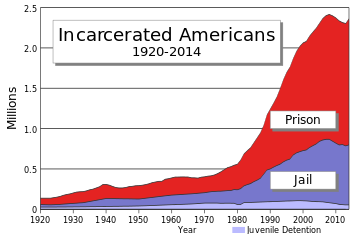 The US has the largest prison population in the world, both in absolute numbers and—with
the exception of one tiny country (the Seychelles)—also in terms of the percentage of the
population imprisoned. And indeed, in more ways than one, America is a nation of prisoners.
Although the US has just 5% of the world’s population it has nearly 25% of the world’s
prisoners. [Data from the American Friends Service Committee, Feb.
2018.]
The US has the largest prison population in the world, both in absolute numbers and—with
the exception of one tiny country (the Seychelles)—also in terms of the percentage of the
population imprisoned. And indeed, in more ways than one, America is a nation of prisoners.
Although the US has just 5% of the world’s population it has nearly 25% of the world’s
prisoners. [Data from the American Friends Service Committee, Feb.
2018.]
The US Bureau of Justice Statistics reported
that in 2013 there were 2,220,300 adults incarcerated in US federal and state prisons and
county jails, which is 1 in every 110 people. In addition to that, 4,751,400 adults were on
probation or on parole. Though the figures don’t add up exactly, it was then stated that
6,899,000 adults were under “correctional supervision” (probation, parole, jail, or prison)
in 2013, or about 2.8% of the entire US population. [Wikipedia (accessed
Feb. 10, 2018).] And the numbers of those who are either currently, or who have been
at some point in the past, in prison or under the control of the “justice system” are
vastly greater, especially for African-Americans and other minorities.
What are some of the important reasons that
the US has such an absurdly large number of people imprisoned or under criminal
“supervision”?
• The
worsening economic crisis, which is leading to much higher levels of unemployment (although
the official statistics hugely lie by claiming that ever increasing numbers of unemployed
people should not be counted as being in the work force at all!). In the chart at the above
right, notice that the massive increase in prison and jail populations started at the same
time as the first stage of the current economic crisis, known as the
“Long Slowdown”, which began around 1973.
• The
so-called “War on Drugs” is also a major reason for the
incarceration of vast numbers of people. (The NY Times reports [March 16, 2019] that
the federal prison system estimates that about 40% of its inmates “have a substance abuse
disorder”.) This is a typical bourgeois response to a situation which in reality is less of a
truly criminal problem and more of a social, educational and medical one. (The US Education
Department admitted in 2016 that state and local spending on jails and prisons has grown three
times as much as spending on public education since 1980.)
• The
“tough-on-crime” laws which opportunistic politicians began cynically promoting in the 1980s.
While they claim that such laws, which send more people to prison and for longer terms, are
designed to “protect the public” from being victimized, it has turned out that the vast majority
of people locked up under this campaign have been nonviolent offenders (and most commonly only
users of illegal drugs). Moreover, a number of studies (including the Human Rights Watch report
of 2014) have shown that “tough-on-crime” laws have not only failed to rehabilitate prisoners,
they have actually led to prisoners who—when they are finally released—are worse (more hardened
criminally and more violent) than they were before being incarcerated. I.e., these laws are
largely counterproductive.
• The
closing down of many public institutions and government support for the mentally ill which
began during the Reagan administration. This led to the “necessity” to house many of these
people in prisons.
• The
class bias of the “justice system” in favor of the wealthy, which results in many working
class and poor people being unable to post bail and stay out of jail during their typically
very long waits until trial. Add to this the inability of the poor to hire decent lawyers
to defend them at their trials.
• The
fact that many corporations make profits from an expanding prison system. Not only do more
and more prisons have to be built and maintained, many of these new prisons today are
privately run for profit.
In short, the vastly expanded US prison
populations in recent decades have been due to the failures of the capitalist system:
its worsening economic crisis which leads to more people without jobs; its pathetic and
worsening educational system which is incapable of bringing up people to think critically and
to understand such simple things as that their own welfare and happiness means avoiding harmful
drugs; its tendencies toward violence against the masses who it despises and views as its enemy;
its insistence of criminalizing personal behavior which its ideologists disapprove of; its
class economic oppression of those who cannot afford bail or good lawyers; its profit urge
which promotes the expansion of the prison system especially through more privately-owned
prisons; its inability to fully understand its own economic necessary to keep prison costs (and
the taxes to pay for them) down; and its notorious racism against Blacks and other minorities.
And here is one more reason why the Republican
wing of the ruling class especially likes the fact that so many people are in (or have
been in) prison: This disenfranchises millions who would vote against them in elections. This
effect has probably already tipped at least two presidential elections in favor of the
Republicans (George W. Bush in 2000 and Donald Trump in 2016). Despite the tax burdens, the
huge prison system in the US is in both the economic and political interests of very large and
influential sections of the capitalist ruling class.
PRISONS — Private (For-Profit)
The ideology of the capitalist ruling class strongly promotes the absurd idea that essentially
everything can be done better, and more cheaply, by private corporations rather than by
any government. Well, they are forced by reality to make a few exceptions, with regard to fire
departments and the military (although even with regard to the military they often resort to
using mercenaries and soldiers of fortune, as well as to further building up the already
enormous military-industrial complex based on the profits of private corporations which
manufacture arms). This general ideological bias has also led them to massively build up private
(corporate run) for-profit prisons. These private prisons are notorious for the mistreatment of
prisoners even compared to those prisons run by the government. One can’t help but think that
the vicious capitalist rulers of present American society approve of this intensified
horrendous treatment and degradation of prisoners for sadistic reasons as well as for the
opportunities to make huge profits at the tax-payer’s expense.
“Between 1970 and 2009—as a result of the ‘war on drugs,’ harsh
sentencing policies, and rejection of treatment and restorative justice alternatives—our
nation’s prison population jumped by a whopping 700%, outpacing both population growth and
crime rates. Now, the Trump Administration supports a ‘no-holds-barred’ approach to going
after drug crime offenders, promises a surge in the number of people incarcerated, and
redoubles the government’s partnership with for-profit prisons to ‘meet the future needs
of the federal correctional system.’
“Sending people to prison is not just
a business, but BIG business. U.S. prisons are a boon to everyone involved,
from architects ... to food vendors ... to medical services firms ... to the operators of
for-profit prisons, and they all have one thing to gain: a paycheck for keeping human
beings in cages.
“Where does that paycheck come from?
Largely from you and other taxpayers, who pay BILLIONS a year to keep people locked
up! ...
“For-Profit Prisons—NOT the
Solution
“Like many states, Arizona hires
for-profit prison companies to manage its correctional facilities. In July of 2015, a
series of riots in a privately-run prison in the town of Kingman shed further light on
the true cost of incarceration for profit.
“Incensed by years of mistreatment
by the company that managed the facility, Management and Training Corporation (MTC),
prisoners took their frustration out on the prison itself. Several cells were rendered
uninhabitable, and thousands of prisoners were evacuated to other facilities.
“AFSC [American Friends Service
Committee] released an investigative report about the riots based on interviews with
prisoners and staff. Our report revealed several contributing factors to the unrest,
which included insufficient medical care for prisoners, inadequate cooling in the
facility (where temperatures average nearly 100 degrees in July), repeated sanctions of
MTC by the state for failing to fill staff vacancies, high turnover rates for prison
guards (who are among the lowest paid in the state), and the mistreatment of prisoners
by guards who relied on pepper spray and other heavy-handed approaches to discipline
prisoners.
“AFSC’s investigation also revealed
that the only injuries occurring in the wake of the riots were a result of brutal
treatment by the State Department of Corrections’ Tactical Response Unit, which was
brought in to restore control of the prison. State guards repeatedly beat and
pepper-sprayed prisoners even after they were incapacitated, handcuffed, and lying on
the ground.
“The bottom line is this: for-profit
prisons are a dirty business. Giant prison operators—like MTC and the Corrections
Corporation of America (CCA)—are notorious for cost overruns, inadequate staff training,
and abusive conditions. They exist to make a profit, which means that they are
fundamentally at odds with the stated purpose of a ‘corrections’ department. More
prisoners mean more money. So why work to rehabilitate those who are locked up?
“In August of 2016, following many
investigative reports from numerous organizations that show for-profit prisons are
unaccountable, costly, unsafe, and a source of corruption, the U.S. Department of Justice
announced that it would end its contracts with for-profit prisons. In February of 2017,
the new administration wrongfully rescinded this decision at the expense of basic human
rights. AFSC must continue to work to stop prison privatization and promote a new prison
system that rethinks harsh sentencing laws and encourages healing and restorative justice
practices.”
—American Friends Service Committee,
excerpts from a letter about prisons in early 2018, which also talked about the detention
of “illegal immigrants” in for-profit prisons and the huge expansion of solitary
confinement. They also appropriately refer to the “United States prison-industrial
complex” by analogy with the “military-industrial complex”, since both exist—to a
considerable degree—for the purpose of funneling government tax income into the pockets
of private companies.
The AFSC is of course a liberal
religious-based organization, and only seeks to reform the evils of present-day
American capitalist society—when in fact this society is so outrageously evil that only
complete social revolution can fix it. Getting rid of for-profit prisons will not
fundamentally change the horrendous prison situation in the U.S., though it is still a
very good and humane idea. —Ed.]
PRIVATE PROPERTY
As understood by Marxists in their discussions of the capitalist system and the political economy
of capitalism, private property means mostly the private property in the means of social
production. It does not normally refer to the personal possessions of ordinary people,
such as your home, furniture, clothing, or your toothbrush(!), which are themselves not even part
of the means of production in the first place. Nor does
it even importantly refer to the means of production owned and used by a self-employed individual
craftsman in capitalist or possibly socialist society who is not (directly anyway) exploited by a
capitalist. Instead, the “private property” that Marxists are primarily concerned to confiscate
and make the property of everyone are those means of social production presently used in
workplaces owned and controlled by capitalists. The point is to make that production serve the
needs and interests of the working people and the broad masses, rather than to just make
profits for the current private owners of those factories. Of course the bulk of the private
personal property of the capitalists and their agents (e.g., their bank accounts,
mansions and their yachts), which they have obtained through the vicious exploitation of workers,
will also be confiscated and used for public purposes.
See also the sub-topics below, and:
PROPERTY and related entries, and
PLUNDER (John Taylor quote)
“The most important point in the programme of the Communists [as put
forward in the Communist Manifesto] is the abolition of bourgeois private
property. The authors of the Manifesto are careful to emphasize that this does
not mean personal property, property earned by one’s own labor. As for bourgeois property,
it is a social and not a personal force. Capital standing over against labor ‘is a
collective product, and only by the united action of many members, nay, in the last resort,
only by the united action of all members of society, can it be set in motion.’
“This proposition is of fundamental
importance. If capital is a social force, but belongs to private individuals, then its
transformation into collective, social property is an act that is historically natural and
just.” —G. N. Volkov, et al., The Basics of Marxist-Leninist Theory, (Moscow:
Progress, 1979), p. 30.
“Question 14: What kind of new social order will this have to
be? [After a proletarian revolution.]
“Answer: Above all, it will
have to take the running of industry and all branches of production in general out of the
hands of separate individuals competing with each other and instead will have to ensure
that all these branches of production are run by society as a whole, i.e., for the social
good, according to a social plan and with the participation of all members of society. It
will therefore do away with competition and replace it by association. Since the running
of industry by individuals had private ownership as its necessary consequence and since
competition is nothing but the manner in which industry is run by individual private
owners, private ownership cannot be separated from the individual running of industry and
competition. Hence, private ownership will also have to be abolished, and in its stead
there will be common use of all the instruments of production and the distribution of all
products by common agreement, or the so-called community of property. The abolition of
private ownership is indeed the most succinct and characteristic summary of the
transformation of the entire social system necessarily following from the development of
industry, and is therefore rightly put forward by the Communists as their main demand.”
—Engels, “Principles of Communism” (October 1847), MECW 6:348.
“Once the first radical onslaught [after a proletarian revolution] had
been made, the proletariat will see itself compelled to go always further, to concentrate
all capital, all agriculture, all industry, all transport, and all exchange more and more
in the hands of the State. All these measures work towards such results; and they will
become realizable and will develop their centralizing consequences in the same proportion
in which the productive forces of the country will be multiplied by the labor of the
proletariat. Finally, when all capital, all production, and all exchange are concentrated
in the hands of the nation, private ownership will automatically have ceased to exist,
money will have become superfluous, and production will have so increased and men will be
so much changed that the last forms of the old social relations will also be able to fall
away.” —Engels, “Principles of Communism” (October 1847), MECW 6:351.
“Question 20: What will be the consequences of the final abolition
of private ownership?
“Answer: Above all, through
society’s taking out of the hands of the private capitalists the use of all the productive
forces and means of communication as well as the exchange and distribution of products and
managing them according to a plan corresponding to the means available and the needs of
the whole society, all the evil consequences of the present running of large-scale
industry will be done away with. There will be an end of crises; the extended production,
which under the present system of society means overproduction and is such a great cause
of misery, will then not even be adequate and will have to be expanded much further.
Instead of creating misery, overproduction beyond the immediate needs of society will mean
the satisfaction of the needs of all, create new needs and at the same time the means to
satisfy them. It will be the condition and the cause of new advances, and it will achieve
these advances without thereby, as always hitherto, bringing the order of society into
confusion. Once liberated from the pressure of private ownership, large-scale industry
will develop on a scale that will make its present level of development seem as paltry as
seems the manufacturing system [i.e., things made by hand, without machinery —Ed.] compared
with the large-scale industry of our time. This development of industry will provide
society with a sufficient quantity of products to satisfy the needs of all. Similarly
agriculture, which is also hindered by the pressure of private ownership and the parceling
of land from introducing the improvements already available and scientific advancements,
will be given a quite new impulse, and place at society’s disposal an ample quantity of
products. Thus society will produce enough products to be able so to arrange distribution
that the needs of all its members will be satisfied.” —Engels, “Principles of Communism”
(October 1847), MECW 6:352.
“The proletarian is without property...” —Marx & Engels, Communist
Manifesto (1848), MECW 6:494. [Did Marx and Engels mean that workers have absolutely
no personal private property? That they must go around naked, for example? Of course not.
This is not the sort of property they are referring to. —Ed.]
“The distinguishing feature of Communism is not the abolition of property
generally, but the abolition of bourgeois property. But modern bourgeois private property
is the final and most complete expression of the system of producing and appropriating
products, that is based on class antagonisms, on the exploitation of the many by the few.
“In this sense, the theory of the
Communists may be summed up in the single sentence: Abolition of private property.
“We Communists have been reproached
with the desire of abolishing the right of personally acquiring property as the fruit of a
man’s own labor, which property is alleged to be the groundwork of all personal freedom,
activity and independence.
“Hard-won, self-acquired, self-earned
property! Do you mean the property of the petty artisan and the small peasant, a form of
property that preceded the bourgeois form? There is no need to abolish that; the development
of industry has to a great extent already destroyed it, and is still destroying it daily.
“Or do you mean modern bourgeois
private property?” —Marx & Engels, Communist Manifesto (1848), MECW 6:498.
“We by no means intend to abolish this personal appropriation of the
products of labor, an appropriation that is made for the maintenance and reproduction of
human life, and that leaves no surplus wherewith to command the labor of others.” —Marx &
Engels, Communist Manifesto (1848), MECW 6:499.
[Marx & Engels are here talking about
the wages workers receive from the capitalists. This enables them to buy what was at that
time just barely enough to survive and raise a miserably poor family. Under modern conditions,
a portion of the working class (primarily in the advanced capitalist or imperialist
countries) has managed to obtain—through prolonged mass struggle—a little more than that bare
minimum. In both cases, however, these wages do allow the workers and their families to buy
and to own some few pieces of personal property, including clothes and (sometimes!) some kind
of housing. And, as they state in this quote, Communists by no means intend to expropriate
these sorts of meager personal possessions or private property (as we also call it), but are
on the contrary determined to greatly expand their quantity and quality. —S.H.]
PRIVATE PROPERTY — In Communist Society
In both fully established socialist society and in a
future communist society all the
means of production (factories, mines, farms, machinery,
etc.) will of course be public property, the collective property of the people. But what about
private property? Will that still exist at all? Yes it will, but it will be a somewhat new sort
of thing, based on the changed circumstances of a very different new society.
Marx and Engels talked in numerous places about
property, its origin, and its differing nature in different forms of society—in primitive
communalism (or “primitive communism”), in slave society, under feudalism, within capitalism,
and its prospective forms in socialist society and communist society. Living in the capitalist
era, they naturally focused mostly on the bourgeois forms of
property, which were at that time almost entirely the private property of individuals
or small partnerships, though there also already existed a small number larger companies (now
called corporations) which were based on a modified narrowly-shared form of private property.
But absolutely all bourgeois property, then or now, and whether individual, partnership,
corporate, or even class-owned (as in modern state-capitalism), is actually a form of private
property and never truly public property. For this reason, in talking about bourgeois
property, it is somewhat redundant to refer to it as “bourgeois private property”. And the
essential private nature of bourgeois property also explains why Marx and Engels say in the
Communist Manifesto: “In this sense, the theory of the Communists may be summed up in
the single sentence: Abolition of private property.” [MECW 6:498]
But of course Marx and Engels also put forward
and championed the basic idea of communism, that goods and services should be produced and
distributed according to the fundamental principle: “From each according to their ability, to
each according to their needs.” And, obviously, the material portions of the food, clothing,
housing, education, health care, and so many other goods and services that communist society
will make available to individuals and families will then become their own personal possessions,
their own “private property”.
This will lead to a modified conception of
private property from that which prevails in capitalist society; one that is different from
bourgeois private property in important ways. For instance, there will no longer be any need for
(or possibility of) buying and selling these goods and services provided by society. Similarly,
personal property will no longer exist as any form of “investment”, since financial profits of
any kind will not even be possible, and no one will imagine that they need them. Indeed, money
itself, as an integral and necessary part of capitalist commodity production, will no longer
even exist! Instead, you will pick up (or have delivered to you) whatever you need, free of
any charge.
Then again, when an individual or a family
decides to permanently move to another part of the country or another part of the world, their
still-useful “personal property” that they no longer need or want, or which they can’t (or don’t
choose to) take with them (such as their apartment, house or a piece of furniture) will
automatically revert to the common pool so that someone else may request it (perhaps after some
refurbishment). Housing and other goods will still “belong to” individuals or families while
they need them, but will revert to society as a whole when they do not. Of course some
considerable amount of common sense will have to be employed here; when you go on a long
vacation you will certainly not lose your home!
In addition, some types of personal property
which exist in present capitalist society may not exist in a much more rational and economically
developed communist future. Private automobiles may not need to exist when there are extremely
good public transportation systems everywhere, for example. Public libraries and similar sorts
of lending facilities will become vastly better and much more widespread. Likely there will be
community or neighborhood power tool centers so that it will not be necessary for everyone to
personally possess each and every seldom-used power tool. (In a few places, things like this
already exist even in present society.) Thus even the very need for certain kinds of individual
possessions or private property will likely diminish considerably.
In other words, in communist society there will
certainly still be private or personal property, but at the same time the concept itself of
“private property” is bound to be considerably transformed in light of the very different nature
of that new socioeconomic system. It will still be appropriate and reasonable to describe
personal possessions as private property because of its deep analogy to what is called private
property today, even though the bourgeois aspects of today’s conception of private property will
be gone. —S.H.
See also:
PROPERTY—Versus Possessions
PROBLEM OF EVIL
An internal logical flaw in the conception of God as put forward by many religions
including Christianity. The religious doctrine is that God is omnipotent (all powerful),
omniscient (all knowing) and omnibenevolent (all good). The trouble is, given the obvious
fact that there is much evil in the world, these three characteristics are logically
incompatible and inconsistent with each other. David Hume expressed the difficulty this
way:
If evil in the world is the intention of
the Deity, then He is not benevolent.
If evil in the world is contrary to His
intention, then He is not omnipotent.
But evil is either in accordance with His
intention or contrary to it.
Therefore, either the Deity is not
benevolent, or He is not omnipotent.
Of course from the materialist point of view there is one other, much more sensible,
alternative: No “Deity” exists at all!
See also:
Philosophical doggerel about the
problem of evil.
“Standard versions of the Argument from Evil concern the evils God
fails to prevent: the pain and suffering of human beings and the sins people commit. The
most ambitious versions of the argument claim that the existence of evil is logically
incompatible with the existence of an omnipotent, omniscient, and completely benevolent
deity. In my view, this version succeeds conclusively. But I think the usual philosophical
discussions of the problem of evil are a sideshow. What interests me here is a simpler
argument, one that has been strangely neglected.
“We might start instead from the evils
God himself perpetrates. In duration and intensity, these dwarf the kinds of suffering
and sin to which the standard versions allude. For God has prescribed torment for
insubordination. The punishment is to go on forever, and the agonies to be endured by the
damned intensify, in unimaginable ways, the sufferings we undergo in our earthly lives.
In both dimensions, time and intensity, the torment is infinitely worse than all the
suffering and sin that will have occurred during the history of life in the universe.
What God does is thus infinitely worse than what the worst of tyrants have done.
“Many Christians appear to be good people,
worthy of the admiration of those of us who are non-Christians. From now on let us suppose,
for simplicity’s sake, that these Christians accept a God who inflicts infinite torment
on those who do not accept Him. Appearances notwithstanding, are those who worship the
perpetrator of divine evil themselves evil?
... “Some worshippers of the perpetrator
of divine evil are obviously evil. Some of them even think that delight in the eternal
sufferings of worldly sinners will be a component of the bliss of the saved. Many other
Christians genuinely forgive their enemies. Yet they knowingly worship the perpetrator of
divine evil. Perhaps they do not like to think about it, but they firmly believe that their
God will consign people they know, some of whom they love, to an eternity of unimaginable
agony. They do whatever they can to urge others to join them in their faith, but they are
well aware that many will not fall into line, and they think that, if that happens, the
perpetrator will be right to start the eternal torture. They endorse the divine evil.”
—David Lewis and Philip Kitcher, from
their article “Divine Evil” in the book Philosophers Without Gods, (Oxford
University Press, 2007). A somewhat longer excerpt from this essay was also published in
Harper’s Magazine, December 2007, pp. 28-30.
PRODUCTION AND DISTRIBUTION
While it is common to see statements by Marxists that production is central to the
capitalist system, while distribution is not, this was not really Marx’s own view with
regard to the fully elaborated complexity of capitalism as it actually functions (and as
opposed to more simplified explanations that serve to help get the student started in his or
her understanding of capitalism):
“A part of the surplus-value realized in profit, i.e., that part
which assumes the form of interest on capital laid out (whether borrowed or not),
appears to the capitalist as outlay, as production cost which he
has as a capitalist, just as profit in general is the immediate aim of capitalist
production. But in interest (especially on borrowed capital), this appears also as the
actual precondition of his production.
“At the same time, this reveals the
significance of the distinction between the phenomena of production and of distribution.
Profit, a phenomenon of distribution, is here simultaneously a phenomenon of production,
a condition of production, a necessary constituent part of the process of production.
How absurd it is, therefore, for John Stuart Mill and others to conceive bourgeois forms
of production as absolute, but the bourgeois forms of distribution as historically
relative, hence transitory. I shall return to this later. The form of production is
simply the form of distribution seen from a different point of view. The specific
features—and therefore also the specific limitation—which set bounds to bourgeois
distribution, enter into bourgeois production itself, as a determining factor, which
overlaps and dominates production.” —Marx, TSV, 3:83-84.
“[I]n Marx’s view, capitalism is a society which can produce but not
distribute—or, in his customary language, a society in which the productive forces constantly
struggle against the relationships of production. He concluded that if the strife between
capitalists and workers were definitively resolved in the workers’ favor, there would come
into existence a ‘classless society’—that is, a society without antagonistic classes—which
could distribute and use everything it produced. Such a society would be at peace within itself,
and from that peace there could be expected to develop new skills, new accomplishments, and
a new sort of human being.” —Barrows Dunham, Heroes & Heretics: A Political History of
Western Thought (1964), p. 417.
PRODUCTIVITY
Labor productivity is the ratio of output (quantity of commodities produced) divided by the
the number of workers (or the number of hours worked by the workers) to produce it. Thus if
a given group of workers can now produce 25% more output in an 8-hour day as compared to a
year ago, their productivity has increased by 25% over that period. Productivity can be
increased through the use of better tools and machinery, through the better organization of
labor (i.e., improving labor technique and efficiency), by increasing the amount of work
demanded from each worker per hour (speed-ups), and by increasing the number of hours the
workers must work each day. (This last method does not improve productivity/hour, but it
does improve productivity/day.)
See also:
OIL & GAS INDUSTRY—Productivity In,
“LEISURE AGE”,
GDP—Per Hour Worked
“Hitherto it is questionable if all the mechanical inventions yet made
have lightened the day’s toil of any human being. They have enabled a greater population
to live the same life of drudgery and imprisonment, and an increased number of
manufacturers and others to make fortunes. They have increased the comforts of the
middle classes [i.e., bourgeoisie]. But they have not yet begun to effect those great
changes in human destiny, which it is in their nature and in their futurity to
accomplish.” —John Stuart Mill, Principles of Political Economy (1848), Bk. IV,
ch. VI, sect. 2. [Since Mill’s day some very small proportion of the benefits due to
the great advances in the productivity of labor have sometimes been won by the working
class through their great struggles, but the vast preponderance still goes to the
capitalists.]
“Capital therefore has an immanent drive, and a constant tendency,
towards increasing the productivity of labor, in order to cheapen commodities and, by
cheapening commodities, to cheapen the worker himself.” —Marx, Capital, Vol. I,
ch. 12. (Penguin ed., pp. 436-7.)
PROFIT — Average
[Intro material to be added... ]
“To be produced, to be brought to the market, the commodity must at least fetch
that market price, that cost-price to the seller, whether its
own value be greater or smaller than that cost-price. It is a matter of indifference to the
capitalist whether his commodity contains more or less unpaid labor than other commodities, if
into its price enters as much of the general stock of unpaid labor, or the surplus product in
which it is fixed, as every other equal quantity of capital will draw from that common stock. In
this respect, the capitalists are ‘communists’. In competition, each naturally tries to
secure more than the average profit, which is only possible if others secure less. It is
precisely as a result of this struggle that the average profit is established.” —Marx, TSV 3:83.
“We have seen that the average profit of the individual capitalist, or of any
particular capital, is determined not by the surplus labor that this capital appropriates
first-hand, but rather by the total surplus labor that the total capital appropriates, from which
each particular capital simply draws its dividends as a proportional part of the total capital.
This social character of capital is mediated and completely realized only by the full development
of the credit and banking system.” —Marx, Capital, Vol. III, Part 5, Chapter 36; Penguin
ed. (1981), p. 742.
PROFITS — U.S. Corporate Profits
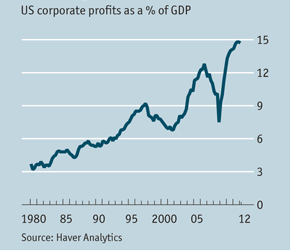 In the graph at the right it can be seen that in recent decades the profits of U.S. corporations
have not only been rapidly growing in absolute terms, but have even been growing rapidly as a
percentage of U.S. GDP. And this is despite the fact that there has been
a long slowdown in the rate of GDP growth in the U.S. (and most of the world) since the early
1970s. Corporate profits did dip somewhat during the “Dot.com” recession of 2000-2001, and again,
more sharply, in the 2007-2009 period of the “Great Recession”,
but soon recovered and then exceeded their previous levels.
In the graph at the right it can be seen that in recent decades the profits of U.S. corporations
have not only been rapidly growing in absolute terms, but have even been growing rapidly as a
percentage of U.S. GDP. And this is despite the fact that there has been
a long slowdown in the rate of GDP growth in the U.S. (and most of the world) since the early
1970s. Corporate profits did dip somewhat during the “Dot.com” recession of 2000-2001, and again,
more sharply, in the 2007-2009 period of the “Great Recession”,
but soon recovered and then exceeded their previous levels.
Note that there is no indication here of any
long-term decline in corporate profits, of the sort that Marx seemed to envision in vol. III of
Capital. And note also that a falling rate of profit did not precede any of the
four recessions which occurred during this period, and therefore cannot reasonably be said to
have caused them. The declines in profits which occurred were not only limited and
temporary, but were clearly a result of these overproduction crises rather than the
cause of them. This is some of the very extensive empirical evidence which demonstrates
beyond any serious doubt that the theory of the falling
rate of profits as the cause of capitalist economic crises is simply not correct. (See also:
Falling Rate of Profit Theory—Empirical
Investigations) The true cause of overproduction crises is instead the
overproduction of productive capital itself in relation
to the effective demand for all the commodities which that real capital can produce. (Or as Marx and
Engels both put it, in different places, the expansion of production is at a much faster pace than
the expansion of the market.) This is the more fundamental and profound theory that Marx created,
which has withstood the test of time.
“Profits have been booming in America, reaching the highest proportion of
GDP since the second world war. Given such buoyant conditions, you might imagine that
businesses are investing like crazy to take advantage of all those great opportunities.
“Not a bit of it. The ratio of business
investment to GDP has picked up since the depths of the [2008-9] financial crisis, but is
still close to the lows of previous cycles.” —Economist, Oct. 5, 2013, p. 74. [A
graph of the rapidly declining new investment by corporations despite their huge profits is
posted at INVESTMENT—Falling
Corporate Rate Of.]
“In the last quarter of 2025, corporate profits reached their highest share
of G.D.P. since record-keeping began in 1947.” —New York Times, “Corporate Profits
Are at a High, These Factors Could Sink Them”, April 20, 2026.
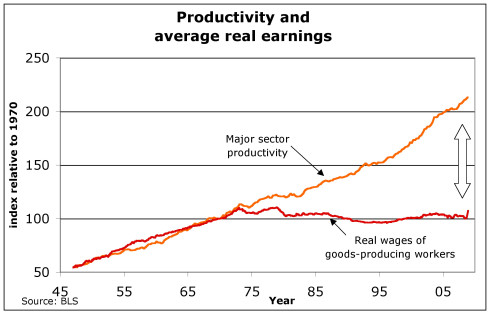 The defenders of capitalism claim that more machinery, and productivity increases in
general, are good for both the capitalists and the workers. The idea is that if the
capitalists are making bigger profits they will then be able to pay their workers more.
For some limited periods in some countries this may be true. But over all, and specifically
in the United States today, it is simply not true. Productivity gains are not
leading to higher real wages and benefits for the working class, but simply to greater
profits for capitalist corporations. This is shown in the graph at the right which plots
real wages (adjusted for inflation) as well productivity growth for the years 1947 to
2008. Note that during the
The defenders of capitalism claim that more machinery, and productivity increases in
general, are good for both the capitalists and the workers. The idea is that if the
capitalists are making bigger profits they will then be able to pay their workers more.
For some limited periods in some countries this may be true. But over all, and specifically
in the United States today, it is simply not true. Productivity gains are not
leading to higher real wages and benefits for the working class, but simply to greater
profits for capitalist corporations. This is shown in the graph at the right which plots
real wages (adjusted for inflation) as well productivity growth for the years 1947 to
2008. Note that during the 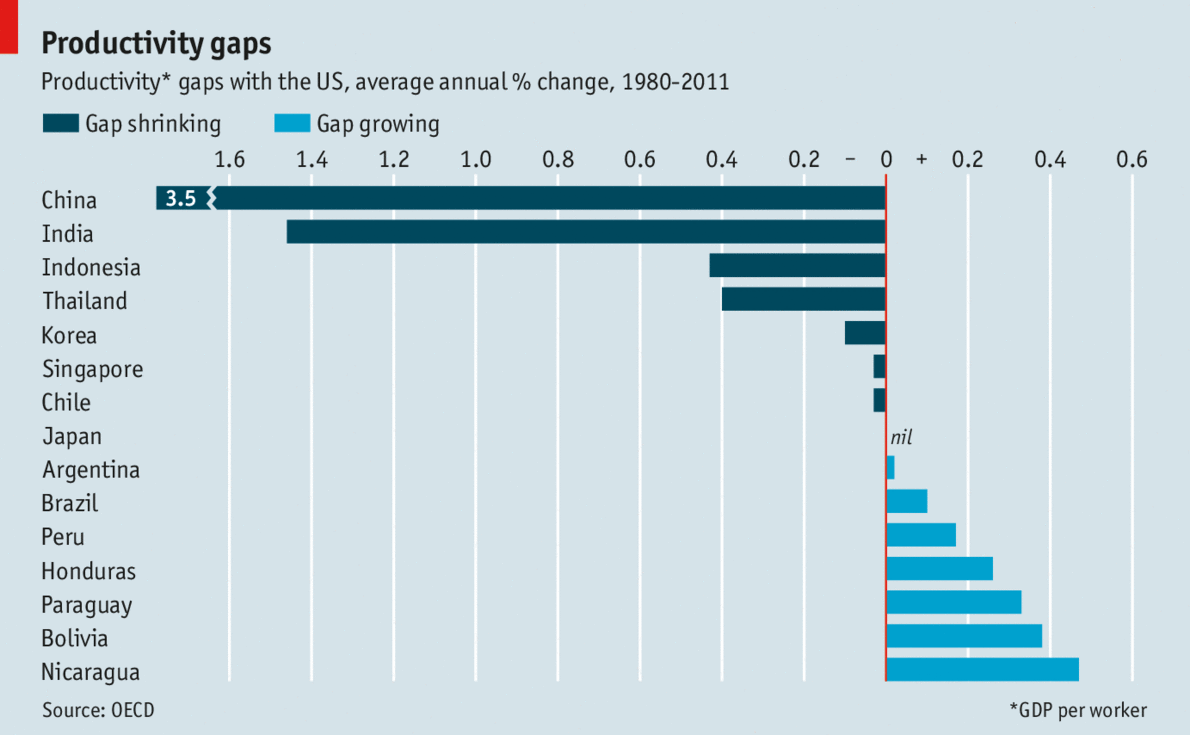 A comparison of the labor productivity of one country to another; i.e., a comparison of the
average GDP/worker in one country to the GDP/worker in another country. The country which has
lower productivity is said to have a “productivity gap” in comparison to the higher country.
Generally the country chosen as the standard for comparison is the United States, because
until recently it was still both the largest economy in the world (though China has now
surpassed it in real terms) and has one of the highest levels of productivity.
A comparison of the labor productivity of one country to another; i.e., a comparison of the
average GDP/worker in one country to the GDP/worker in another country. The country which has
lower productivity is said to have a “productivity gap” in comparison to the higher country.
Generally the country chosen as the standard for comparison is the United States, because
until recently it was still both the largest economy in the world (though China has now
surpassed it in real terms) and has one of the highest levels of productivity.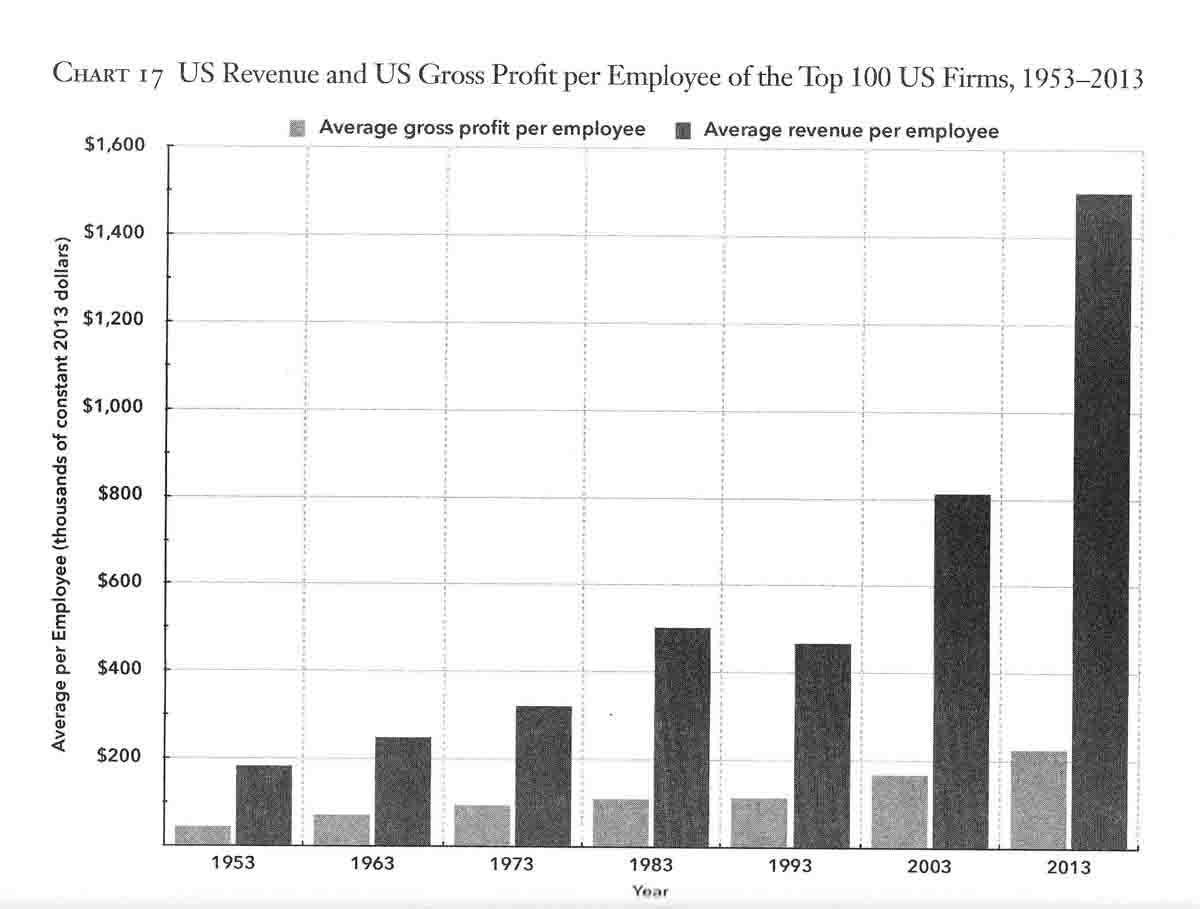 Because of the ever-increasing productivity of workers and the continual advances in machinery,
automation, and the replacement of workers by computers, the size of both corporate income and
profits per worker is growing rapidly. The graph at the right shows this for the top 100
U.S. corporations for the period from 1953 to 2013. [From: Robert W. McChesney
and John Nichols, People Get Ready: The Fight Against a Jobless Economy and a Citizenless
Democracy (2016), p. 70.]
Because of the ever-increasing productivity of workers and the continual advances in machinery,
automation, and the replacement of workers by computers, the size of both corporate income and
profits per worker is growing rapidly. The graph at the right shows this for the top 100
U.S. corporations for the period from 1953 to 2013. [From: Robert W. McChesney
and John Nichols, People Get Ready: The Fight Against a Jobless Economy and a Citizenless
Democracy (2016), p. 70.]