FEAR
“Studies have shown that fear really is [socially] contagious,
writes Eva Holland, author of Nerve: Adventures in the Science of Fear. But
that’s not necessarily a bad thing. ‘It’s a survival mechanism,’ she explains,
‘and it is designed not only to help us survive as individuals, but to help our
communities survive too.’” —Short reads, Time magazine, April 6-13, 2020,
p. 24. [But though the emotion of fear has evolved in us in order to help protect
us from real dangers, it can at times keep us from effectively fighting against
those very dangers. Fear, like all emotions, must therefore be governed by reason.
—Ed.]
“Collective fear stimulates herd instinct, and tends to produce
ferocity toward those who are not regarded as members of the herd.”
—Bertrand Russell, “The Influence of Fear”, in his book Unpopular Essays
(1950).
FEAR OF ERROR
A sad commentary on contemporary American society is that many people have beliefs and
viewpoints which they are not willing to publicly defend, at least in writing. They are
afraid of being found to be “wrong”, at least in part. They are afraid that criticism
will come their way if they publicly state their views.
Frequently I have received emails from
people who disagree with me about some issue or other, and I have sometimes suggested
that we post both sides of the disagreement and let others judge for themselves which
view is correct. But in a surprisingly large number of cases the critic refuses to do
this. The usual excuse is that their views, or at least the way that they have expressed
them, are only tentative, unpolished, and not fully elaborated. What they forget is that
my views are also all of these things, and—indeed—in reality everybody’s
views are really sort of like this. The presentation of every viewpoint can always be
further improved!
If people are going to work together
collectively to find the truth and use it to change the world, then they must be
willing to stick their necks out and try to defend their current views as best they
can—even if they themselves recognize that they are only able to do so somewhat ineptly
and very tentatively. Don’t be so afraid to be wrong that you become unable to publicly
defend what you think is right!
Is it such a horrible thing to be
criticized or corrected when we are wrong?! Isn’t it actually a good thing to discover
when we are wrong, so that we can correct those mistakes? That is the scientific Marxist
attitude towards our own mistakes and errors. Anybody who thinks at all makes mistakes,
and those who do not excessively fear those mistakes end up, because of the criticisms
and corrections by other people, with the most correct ideas and play the most positive
role in society. —S.H.
“He who says ‘Better to go without belief forever than believe a
lie!’ merely shows his own preponderant private horror of becoming a dupe.... It
is like a general informing his soldiers that it is better to keep out of battle
forever than to risk a single wound. Not so are victories either over enemies or
over nature gained. Our errors are surely not such awfully solemn things. In a
world where we are so certain to incur them in spite of all our caution, a certain
lightness of heart seems healthier than this excessive nervousness on their behalf.”
—William James, The Will to Believe (1897), p. 18-19.
[While William James invalidly
used this argument to support religious belief, as a general principle about the
fear of supporting a clear and definite point of view or of adopting a specific
position on some contentious issue the principle here is quite valid. We should
have the courage of our convictions, and always be willing to put forward our views
and defend them—even if that is not always possible to the absolute best of our
ability. Anything less is intellectual dishonesty. —S.H.]
FEAR OF THE GOVERNMENT
“When the people fear the government, there is tyranny. When the
government fears the people, there is liberty.” —Often attributed (probably
incorrectly) to Thomas Jefferson.
[While there is obviously some
validity to this political point of view, one thing that it neglects to consider is that
different and opposed social classes may well have opposite opinions of a particular
government. For example, under the present capitalist-imperialist government of the United
States, with its endless wars and blatant neglect for the health and welfare of the
workers and the masses, those masses do often have very good reason to fear and despise
that government. On the other hand, the rich and powerful—who after all control that
government—more often view it as generally acting just fine. —Ed.]
FEAR OF MISSING OUT (“FOMO”)
In bourgeois society there are sometimes new economic “opportunities” (investment schemes)
which at first seem to making lots of money for their early investors. This leads to sadness
and regret for those who missed the “great opportunity”, and develops within them a tendency
towards “FOMO”, or the “fear of missing out on great new opportunities” from that point
on.
Many middle class people have lost money in
past schemes, including major stock market declines (such as in recessions), and once burnt
are understandably reluctant to get in early the next time around. But this tends to lead
them into a FOMO funk, and thus more likely to get in late in the bubble or else to fall for
some other investment scheme that becomes popular. Some of the early sharpies and con men are
smart enough to keep a close eye on trends and thus pull out just before the new bubble pops.
But the middle class suckers often miss the early insider signs of collapse, and thus get
cheated once again.
The most common area for investment bubbles
is the stock market, but there are many others, including real estate investment, and new
schemes such as cryptocurrency bubbles. All
lead to massive financial cheating, to profits for a few and ultimately losses for the many,
and then—sadly for those who have not yet really learned their lesson—to FOMO, and another go
round in the cycle. —S.H. [Sept. 9, 2025]
FEBRUARY REVOLUTION [Russia: 1917]
The bourgeois-democratic revolution in Russia which overthrew the Tsar. This actually
occurred starting with a demonstration in honor of International Women’s Day on March
8, 1917, but Russia was still using the old church calendar which gave the month as
February. Although this revolution seemed to then develop totally spontaneously, it could
not have happened at all if there had not been many previous years of revolutionary activity.
When the moment came, the people were more than ready for it! However, even this important
event was only the first stage of the Russian Revolution.
Lenin and the Bolsheviks then helped to prepare the masses and lead them in taking the even
greater step, the world-shaking socialist October Revolution, later that same year.
“FEBRUARY 26 INCIDENT”
An unsuccessful militarist armed rebellion in Japan on February 26, 1936.
“After the occupation of northeast China [in the early 1930s],
Japanese imperialism made further inroads into north China from 1933 [on]. Aggression
abroad sharpened class contradictions in Japan. Contradictions and infighting within
Japan’s ruling circles were also growing acute. This was the background against which
the fascist landlords and the Right-wing militarists attempted to set up a military
regime by mutiny.
“On February 26, 1936, at the
instigation and orders of the Japanese militarist forces, 22 young officers led more
than 1,400 corporals and privates in an armed action. They occupied many important
government offices in the capital, including the Ministry of War and the building
of the Metropolitan Police Agency. They attacked the Prime Minister’s official
residence and the homes of elder statesmen, principal ministers and highly placed
officials. They killed the Lord Chamberlain, Minister of Finance and the
Inspector-General of Education and others. By this demonstration of force, they
confronted War Minister Kawashima with an ‘ultimatum,’ demanding the establishment
of a ‘military government.’ The action came to naught because of contention within
the warlord circles.
“After the incident, the Okada
cabinet went out, and Kouki Hirota who had close ties with the warlord circles took
office. Hirota was a member of the ‘Genkai Nada Association,’ a Right-wing
organization. In power, the Hirota cabinet intensified militarization in all fields,
pushed the arms expansion programme as never before, set up a military fascist
dictatorship, and began ruthlessly suppressing the workers’ movement and peasants’
movement. Abroad, it pursued an expansionist policy of aggression with its spearhead
directed ‘northward’ and ‘southward’ simultaneously. In July 1937, the Japanese
militarists flagrantly launched their full-scale war of aggression against China.
In December 1941, they unloosed the Pacific War which brought great disaster to the
Asian people.” —For Your Reference note,
Peking Review, #50, Dec. 11, 1970, p. 14.
“FEBRUARY 28 UPRISING” [Taiwan: 1947]
“The ‘February 28’ Uprising was an armed uprising by the people of
China’s Taiwan Province against the reactionary Kuomintang rule. On February 27, 1947,
when an anti-smuggling officer of the Taiwan State Monopoly Bureau and police were
beating up a hawker in Taipei, they were surrounded by passers-by. The police opened
fire and killed one onlooker. An angry crowd gathered before the police bureau to
state their case. The next day, the shops in Taipei were closed and the people staged
a demonstration in protest. Again they went to the police bureau demanding punishment
for the killers, restitution of damages and the abolition of the Taiwan State Monopoly
Bureau. Three more people were killed and another three demonstrators were wounded.
This incensed the people of the whole province and touched off a large-scale armed
uprising. In a few days most parts of the province were in the hands of the people who
had risen in rebellion. While setting up ‘a committee to handle the affair’ so as to
fool the people, the reactionary Kuomintang government mustered a large number of
troops to carry out suppression. On March 8 the reactionaries began to arrest and
butcher the people throughout the province, killing more than 30,000 people. The
uprising was defeated on March 13.” —Note in Peking Review, #10, March 4,
1977, p. 5.
FEDERAL BUREAU OF INVESTIGATION [FBI]
The largest and most important of the many national police forces of the United States
federal government, which besides dealing with ordinary criminal activity also:
1) Investigates and arrests foreign spies
and terrorists operating within the U.S. (though it is rather inept at doing this, as the
9/11 attacks by al Qaeda demonstrated); and
2) Investigates, harasses and sometimes
outright suppresses political activity within the U.S. which the ruling class strongly
disapproves of, even if it is legal and peaceful! This last function is far more
important than most Americans understand, and includes major programs such as
COINTELPRO (now officially “ended” but continuing
under other names). It is customary for liberals in the U.S. to condemn the “state police”
or “secret police” of fascist, revisionist, or other
open dictatorships, but to naïvely fail to recognize that the U.S. itself also
has agencies like the FBI that frequently function in the same ways.
“Among the thousands of FBI documents released, one memorandum I’ve
read sticks in my memory because of a chillingly brutal remark. The memo, dated March 9,
1968, was sent to the director of the FBI from a San Francisco-based special agent; it
mentions on the second page that ‘the young Negro’ wants something to feel proud of,
but must learn that if he becomes a revolutionary, he will be a ‘dead revolutionary.’”
—Kathleen Cleaver, Introduction to the New Edition of Mumia Abu-Jamal, We Want
Freedom: A Life in the Black Panther Party (2016), p. xxvii. [This is an open
declaration within the FBI that they feel themselves free to murder anyone, especially
an African-American, who develops revolutionary ideas. If you think the FBI exists to
“protect American democracy” then you are a total idiot. —Ed.]
FEDERAL RESERVE SYSTEM
The central bank of the United States, which was established in 1913 in response to the
very serious financial crisis in the Panic of 1907. There
are 12 Regional Federal Reserve Banks, and a Board of Governors who control the whole system.
The chairman and members of the Board of Governors are appointed by the U.S. President. The
chairman of the Federal Reserve is often considered to be the most powerful person in the
world after the U.S. President. The chairman during the Great
Recession was Ben Bernanke. The current chairman (as of
2023) is Jerome H. Powell.
The “Fed” (as it is often called for short)
intervenes in the open financial markets via its New York Federal Reserve Bank, and controls
the U.S. banking system partly in this way. Other means it uses include adjusting the bank
discount rate (the rate the Fed charges commercial banks
for short-term loans) and establishing various regulations to directly control the behavior
of financial institutions. The Federal Reserve is charged by Congress with regulating the
money supply, controlling inflation and interest rates, and generally managing the financial
aspects of the national economy. While it can often control the economy to some extent,
ultimately the economic contradictions of capitalism inevitably get out of its control, as
with the Great Recession financial/economic crisis that first became so serious in the fall of
2008.
See also:
GREENSPAN, Alan,
TARGET RATE
FEDERAL RESERVE BALANCE SHEET
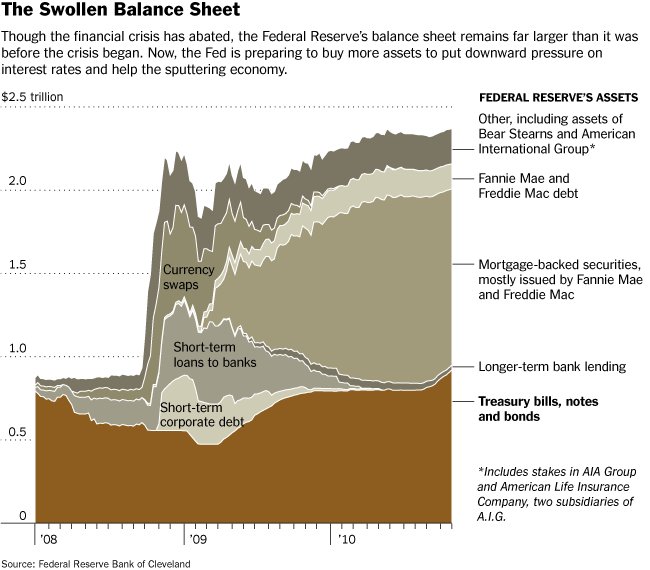 The financial assets owned by the Federal Reserve System (see above). Since the Fed buys these assets
simply by creating money out of thin air (in effect just printing it), this is also a measure of how
much money the Fed is creating and pushing into the economy through the banks and other financial
institutions via very cheap loans to them. Expanding its “balance sheet” in this way is also known as
quantitative easing, and is in effect a way of expanding the money
available in banks and the American financial system as a whole. If large amounts of that money get into
the hands of consumers it leads to rapid general inflation. Even if it remains mostly within the banks (as
it did until recently), it still tends to promote excessive financial speculation and also
asset inflation in specific parts of the economy, especially house
prices (because of the close connection of house prices to mortgage and financial derivative prices and
amounts connected with housing).
The financial assets owned by the Federal Reserve System (see above). Since the Fed buys these assets
simply by creating money out of thin air (in effect just printing it), this is also a measure of how
much money the Fed is creating and pushing into the economy through the banks and other financial
institutions via very cheap loans to them. Expanding its “balance sheet” in this way is also known as
quantitative easing, and is in effect a way of expanding the money
available in banks and the American financial system as a whole. If large amounts of that money get into
the hands of consumers it leads to rapid general inflation. Even if it remains mostly within the banks (as
it did until recently), it still tends to promote excessive financial speculation and also
asset inflation in specific parts of the economy, especially house
prices (because of the close connection of house prices to mortgage and financial derivative prices and
amounts connected with housing).
 In the graph at the far right (from around 2010) it is
apparent that the Fed drastically increased its balance sheet starting in 2008 as the financial crisis at
the beginning of the Great Recession took hold. Moreover, that
financial crisis was quite extended for about a decade, and so the Fed Balance Sheet had to remain sky
high for many years, and even further expand. Note that besides their holdings of nearly a trillion
dollars in U.S. Treasury bonds, the Fed also bought up well over a trillion dollars in
securitized mortgages in an attempt to prop up the desperately sick
housing market. This pushed the total level up to about $2.3 trillion. On Nov. 1, 2010, with the U.S.
economy still in very serious trouble with persistent high unemployment, a new round of “quantitative
easing” then got underway, which was planned to increase the Fed’s balance sheet by at least another $600
billion dollars to a total of nearly $3 trillion.
In the graph at the far right (from around 2010) it is
apparent that the Fed drastically increased its balance sheet starting in 2008 as the financial crisis at
the beginning of the Great Recession took hold. Moreover, that
financial crisis was quite extended for about a decade, and so the Fed Balance Sheet had to remain sky
high for many years, and even further expand. Note that besides their holdings of nearly a trillion
dollars in U.S. Treasury bonds, the Fed also bought up well over a trillion dollars in
securitized mortgages in an attempt to prop up the desperately sick
housing market. This pushed the total level up to about $2.3 trillion. On Nov. 1, 2010, with the U.S.
economy still in very serious trouble with persistent high unemployment, a new round of “quantitative
easing” then got underway, which was planned to increase the Fed’s balance sheet by at least another $600
billion dollars to a total of nearly $3 trillion.
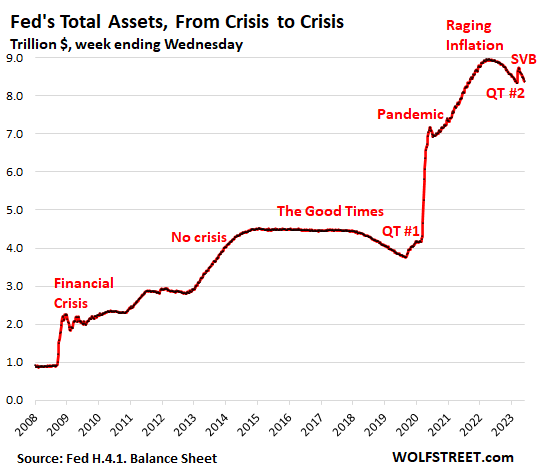
However, the massive new expansion of Federal debt and
expenditures during the first couple years of the Covid-19
pandemic raised the total on that Fed balance sheet all the way up to around $9 trillion dollars! This
did help keep the economy from collapsing during the pandemic, but in short order it also brought about
(in combination with the supply chain problems during the pandemic), not only yet more asset inflation,
but an alarming new generalized inflation for the prices of all goods and services. Although the Fed was
very slow to respond to this greater general inflation problem (because it falsely believed it would soon
disappear by itself), it did in late 2022 decide to both gradually raise interest rates off their floor
near zero percent, and also to reverse its long policy of quantitative easing (QE) and begin a new policy
of quantitative tightening (or QT), thus very recently finally
starting to shrink its balance sheet just a tiny bit. This is reflected in the nearer graphic showing the
Fed Balance Sheet as of June 1, 2023.
However, the Fed, along with the rest of the federal
government, and the ruling class as a whole, are in an irresolvable bind. To keep the economy functioning
even in its present limping way it needs to keep pumping lots of money into the economy, thus promoting
inflation. And to deal with that inflation it has to extract money from the economy, or at least stop
creating so much of it, thus leading to a slowing economy, recessions, and eventually much worst. This is
the inherent economic contradiction of the capitalist system when it has entered this current serious
stage of crisis.
FEDERAL RESERVE — Money Creation Power
Congress has granted the Federal Reserve the ability to create any amount of money out of thin air, and to
give it to the U.S. federal government, or to anyone else that it should desire to do so! In the
past (up until 2025) this power was generally used somewhat cautiously. But with the second Trump
Administration, which will soon gain complete control over the Federal Reserve, it is likely that this
power will be used in all sorts of extreme, authoritarian and otherwise outrageous ways. Greatly increased
inflation is almost certainly on the near horizon. —S.H. [Sept. 22, 2025]
The Constitution makes clear that Congress, not the president, holds the power to
authorize new government spending. But a major exception to this rule exists. In 1932, Congress gave
the Federal Reserve the power to lend money to “any individual, partnership, or corporation” during
“unusual or exigent circumstances.” The Fed used the emergency-lending provision to make a few modest
loans during the Great Depression. The power then lay dormant until the 2008 financial crisis, when
the central bank issued hundreds of billions of dollars in loans in an effort to rescue major financial
institutions on the brink of collapse. During the height of the coronavirus pandemic, the Fed went
even further, offering trillions of dollars in loans not just to big banks but to corporations, small
businesses, nonprofits, and even city governments.
Several legal experts told me that even this expansive
use of the Fed’s lending authority was relatively restrained compared with what the central bank could
do. Federal law imposes virtually no limits on what kind of institutions the Fed can lend to, how much
money it can lend, or whether the loans ever need to be paid back. Whether any party would even have
standing to sue the Fed for abusing its lending authority is unclear. As part of the 2010 Dodd-Frank
financial-reform act, Congress imposed a few restrictions, but these turned out to be vague and easily
gamable. “There are really no limits to this power,” Aaron Klein, a senior fellow at the Brookings
Institution and former Treasury official who helped draft the relevant provisions of Dodd-Frank, told
me. “The Fed can basically lend however much it wants, to whoever it wants, whenever it wants.”
[President Trump will, it seems, soon gain total control
over the Federal Reserve.] Perhaps Trump would instruct his Fed appointees to exercise that power with
restraint, lending only as needed to guide the economy through truly perilous circumstances. But little
would stop him from instead treating the bank’s lending power as a bottomless slush fund. He could direct
money to favored industries, such as crypto, or even his own businesses. He could reward media outlets
that give him favorable coverage, companies that donate to Republican campaigns, and even the budgets of
local officials who promote his agenda. If Democrats in Congress shut down the government to limit funds
for ICE, say, he could send hundreds of billions of dollars to private contractors to keep operations
moving. “It’s an infinite money pit,” Lev Menand, a professor at Columbia Law School who previously
worked for the Federal Reserve Bank of New York, told me. “There’s really nothing to stop the
administration from lending trillions of dollars to the president’s priorities.”
—Rogé Karma, “Trump Is Getting Closer to Having an ‘Infinite
Money Pit’: If the president takes over the Federal Reserve, he will have extraordinary power to reward
his friends and destroy his enemies.”, The Atlantic, September 22, 2025, online at:
https://www.theatlantic.com/economy/archive/2025/09/trump-federal-reserve-control-unchecked-power/684279/
FELLOW TRAVELER
Someone who sympathizes with and supports the ideals and program of an organized group
(such as a Communist party), but who is not a member or regular participant in the work
of the group.
“Fellow traveler” is the English translation
of a term (poputchik) apparently originally coined by Trotsky
in 1925 to refer to the vacillating intellectual supporters of the revolution within the young
Soviet Union. When the U.S.S.R. later stabilized, the term poputchik was no longer
used. However, the English term fellow traveler was commonly used in the West during
the mid-20th century, in later years most often by reactionaries, to refer to
those sympathetic to the Communist cause or to the Soviet Union, but who were not themselves
members of the Communist party. The term is seldom used within the American revolutionary
movement today.
FEMALE GENITAL MUTILATION
Female genital mutilation (FGM), which is also known as female genital cutting and female
circumcision, is the cultural practice of cutting off some or all of the external female
genitalia. There are no known health benefits to this practice, and it is actually quite
dangerous. It can lead to many health problems including recurrent infections, difficulty
urinating and passing menstrual flow, chronic pain, the development of cysts, an inability
to get pregnant, complications during childbirth and even fatal bleeding. So why is it done?
Simply for traditional reasons which reflect the subordination and oppression of women in
many societies. In 2008 several United Nations agencies finally labelled FGM as a human
rights violation, and the UN General Assembly did likewise in 2012.
In many traditional or feudal societies
(and even to some degree in capitalist society, especially early on) women have long been
considered to be the property of men, not equal human beings with equal rights. And in
many such societies, especially in northern Africa and the Middle East, sexual satisfaction
was viewed as proper for men but improper for women. Moreover, FGM was forced on women (most
of whom are young girls when the mutilation occurs) as an additional means to prevent women
from wanting to have sex. FGM predates Islam though it is now most common in Islamic
countries. The Quran [Koran] does not mention FGM, but the practice is associated with Islam
because of that religion’s focus on female chastity and the tendency toward the seclusion
of women from public society. FGM is actually illegal or restricted in most of the countries
in which it occurs, but the laws against it are poorly enforced.
Of course Marxism is totally opposed to
such an evil custom, as well as to any other form of the oppression of women.
For more information of female genital
mutilation see the Wikipedia entry (at
https://en.wikipedia.org/wiki/Female_genital_mutilation) from which much of the information
here is taken, and the UNICEF report at:
http://www.unicef.org/media/media_90033.html [This report estimates that 200 million women
have undergone the procedure, with a rate commonly of 80%-98% in many countries and regions.]
FEMINISM — Bourgeois
A perverted form of feminism which does seek to advance the rights and equality of women within
ruling class circles, but which has little or no concern for advancing the rights and welfare
of the vastly larger number of working class women and those among the masses. Thus, examples
of bourgeois feminists are those who focus mostly (or even entirely) on promoting equal
representation for women on corporate boards of directors or in ruling class political bodies
such as the Supreme Court or the U.S. Senate.
Of course we Marxists favor gender equality
everywhere, even within the bourgeoisie, but we put our own strong emphasis on promoting the
equality, rights, and welfare of working class women, and on explaining to everyone why
genuine socialist revolution is absolutely necessary to accomplish true equality for women.
“Mainstream feminism claims to represent all women, but according to
Mikki Kendall, author of Hood Feminism, it tends to focus on those who already
have most of their needs met. ‘All too often it’s not about survival but about increasing
privilege,’ she writes.” —“Critiquing a Movement”, Time magazine, March 30,
2020.
FENG YU-LAN (Or: Feng Youlan, Fung Yu-lan, Fung Yu-lin) (1895-1990)
[See also his article: “I
Discover Marxism”, in People’s China, Vol. 1, #6 (March 16, 1950), pp. 10-11, 21.
This issue is online at:
https://www.massline.org/PeoplesChina/index.htm ]
“[He] is well known in the West for his classic two-volume
History of Chinese Philosophy. He is an international figure, graduated
from Peking and Columbia universities, who has taught at the universities of
Hawaii and Pennsylvania. After the establishment of the People’s Republic, Fung,
a professor at Peking University, participated enthusiastically in Maoist efforts
at political and ideological reform, engaging in self-criticism to root out his
own bourgeois ideas and to set a good example to other Chinese intellectuals.
Eventually he became an ardent supporter of Mao Tse-tung thought and China’s
leading critic of Confucius during the anti-Confucian campaign during the early
1970s. At this time he was an intellectual consultant to Mao’s wife, Chiang Ch’ing,
and her friends, the group that later came to be called the ‘gang of four.’ Shortly
after Mao’s death in 1976, Chiang and her group fell from power and were publicly
disgraced, a disgrace in which Fung shared, bringing to a humiliating close a
brilliant philosophical career.” —John M. Koller, Oriental Philosophies,
2nd ed., (Scribner, 1985), p. 338.
FENTANYL
A synthetic opioid drug, once used as a prescription pain killer, but now one of the most
dangerous illegal street drugs, causing a very large number of deaths in the U.S. and elsewhere.
Fentanyl is as much as 100 times more powerful than naturally derived opioids such as morphine
and heroin.
In the one-year period ending in April 2021,
more than 100,000 Americans died from illegal drug overdoses; a record number so far in the still
growing U.S. opioid crisis. A majority of these
deaths were from synthetic opioids like fentanyl. [“Fentanyl Jolts Drug Epidemic”, New York
Times, Nov. 21, 2021.]
“An estimated 196 Americans are dying daily from fentanyl overdoses, which
nearly doubled from 2019 to 2021. Last year there were 107,622 overdoses in the U.S., two
thirds of them from fentanyl, according to a provisional CDC count. Fentanyl is now the
leading cause of death for Americans between 18 and 49.” —Washington Post
report, summarized in The Week, Dec. 23, 2022, p. 16. [For comparison: Although more
than twice this many people were still dying per day from Covid-19 (as of late December 2022),
these were mostly people aged over 65. —Ed.]
FERMION
[In particle physics:] A matter-type particle (as opposed to bosons,
or particles which carry force). Among the familiar fermions are protons,
neutrons and electrons.
More technically, fermions are particles of
half-integer spin which exhibit Fermi-Dirac statistics in quantum mechanics, and to which
the Pauli exclusion principle applies. There are thus both
elementary particles which are fermions (i.e.,
quarks and leptons) and also
composite particles which are fermions, such as protons, neutrons, atomic nuclei which contain
an odd number of protons and neutrons, or even entire atoms containing an odd number of protons,
electrons and neutrons.)
FEUDALISM
A term used for the last few centuries to describe the
socioeconomic formation which existed in
Europe during the Middle Ages, and also similar sorts of
societies in Asia and elsewhere which lasted into the 20th century and which
still exist in some countries today (though mixed with capitalism). Under feudalism there
are two main social classes, the serfs or peasantry, and the aristocracy or landlord class.
The landlords own the land which the serfs or peasants farm on individual small
plots, usually on a family basis. A certain proportion of the agricultural output which
the peasants produce then automatically “belongs” to the landlord. (The landlords don’t
buy it from the peasants; they just take it.) In addition, in most feudal societies a
landlord had the right to the labor of “his” peasants for a certain number of days per
year. This is called corvée labor. Peasants
were also drafted into armies controlled by the landlord ruling class. Traditionally, the
serfs or peasants were tied to the land and were not allowed to move elsewhere
without the permission of the landlord (which was seldom granted). In short, the feudal
landlords were the ruling class, and the peasants were an oppressed and exploited class,
usually left with barely enough to survive on. Feudalism was in fact only a modified form
of slavery. (The same, of course, is true of capitalism, which is often appropriately
called the system of wage slavery.)
“Many scholars use the word feudal to describe only the vassal-lord,
serf-and-manor system characteristic of medieval Europe. In this book the word is used
in a broader sense to describe a society in which a ruling class, basing its power on
the private ownership of and control over land, lived off a share of the produce
extracted from that land by a class of laboring people. The latter, though neither
slaves nor serfs, were still so closely bound to the land which they cultivated as to
make them little better than serfs of the landed proprietors. It was a society,
furthermore, in which these two classes constituted the main social forces and
determined the contours of development.” —William Hinton, Fanshen (1966), p.
26, talking about feudalism in China.
FEUERBACH, Ludwig [Pronounced: LOOD-vig FOY-er-bock] (1804-72)
German materialist philosopher and atheist who strongly impacted a generation of thinkers who
had been educated in Hegel’s philosophical idealism, including the Young
Hegelians and Marx and Engels in their youth. He was an important link between Hegel
and Marxist historical materialism. Feuerbach
was removed from teaching at Erlangen University in 1830 because of his atheist views.
His opposition to religion originally took
the form of a struggle against Hegel’s idealism, and one of Feuerbach’s contributions to
modern thought was in emphasizing the connection between religion and philosophical
idealism. His overall contribution to philosophy was his strong defense of materialism.
However, Feuerbach, in throwing out Hegel’s
idealism, also tossed out (or failed to fully appreciate) Hegel’s dialectical method. Among
other things, this may have helped lead him in the direction of radical
empiricism (or sensationalism),
which ironically was a step back toward idealism in its Kantian form.
Politically Feuerbach was a liberal democrat.
Late in life Feuerbach did join the Social Democratic Party of Germany, but he never became
a Marxist. He spent his later years living in the countryside.
Among his more important works were “Towards
a Critique of Hegel’s Philosophy” (1839), The Essence of Christianity (1841),
Principles of the Philosophy of the Future (1843), and The Essence of Religion
(1846). However, for us Marxists it is not so much Feuerbach’s own books which deserve our
attention, but rather the much more important comments by Marx and Engels on Feuerbach. These
include Marx’s brief but amazingly profound “Theses on
Feuerbach” (1845), and Engels’s book Ludwig Feuerbach
and the End of Classical German Philosophy (1886).
“FEW-SHOT” LEARNING
This is a term in contemporary (circa 2021) Artificial Intelligence
research referring to the human ability to recognize patterns, relationships, and categories,
based on just a very few examples, rather than on vast statistical evidence and
training. Generalized few-shot learning is a key goal in artificial intelligence
programs which has not yet been achieved.
In recent years AI programs have become at
least as good as human beings in recognizing, say, whether or not a photograph includes an
image of a cat, or in recognizing human faces. But this is because the programs have been
trained with an enormous amount of statistical data. But most human reasoning is based on a
different sort of analogy, which does not require extensive training nor vast amounts of data.
For example, human beings easily see the analogy between our hands and feet, in that both have
a bunch of further small appendages (fingers or toes), both are attached to limbs of the body
(arms or legs), and so forth. Thus humans can easily see that hands and feet are analogous in
an obvious way, and without extensive or statistical training. It seems that the human brain
contains what amounts to an “analogy engine” based on the extensive knowledge of semantic
meanings of words or phrases which allows us to do this. When AI programs can also do this (as
no doubt they will eventually be able to), they will have an intelligence much nearer to that
of human beings.
FEYNMAN, Richard (1918-88)
American physicist born in New York. During World War II he worked as a junior scientist on
the Manhattan Project at the Los Alamos laboratory in New Mexico, which designed and
constructed the first atomic bombs. In later years he seemed rather uneasy about having
continued his participation in that project even after the defeat of Nazi Germany. However,
he was politically rather bourgeois and backward. He became a famous teacher of physics at
Cal Tech (California Institute of Technology) beginning in 1950. Along with several other
physicists he further developed the theory of quantum electrodynamics (QED), whose initial
development had begun in the 1920s and 1930s, but which came up against some serious
difficulties including computational problems involving infinities. In 1965 he, along with
Shinichiro Tomanaga (of Japan) and Julian Schwinger, was awarded the Nobel Prize in Physics
for overcoming these difficulties. Despite his bourgeois outlook, and tendencies towards
philosophical idealism, Feynman was something of an independent
thinker in science who often had interesting or even profound things to say.
Dictionary Home Page and Letter Index
MASSLINE.ORG Home Page