GRADE POINT INFLATION
The ever increasing trend in U.S. education for grades to increase, and for the grade ‘A’ to
become ever more common. This is one of a great many indications that education as an
institution is disintegrating in contemporary America and students are actually learning
less and less, while more pretense is being made that they are learning more and more.
“A’s—once reserved for recognizing excellence and distinction—are
today the most commonly awarded grades in America.
“That’s true at both Ivy League
institutions and community colleges, at huge flagship publics and tiny liberal arts
schools, and in English, ethnic studies and engineering departments alike. Across the
country, wherever and whatever they study, mediocre students are increasingly likely
to receive supposedly superlative grades.
“Such is the takeaway of a new
report on grade inflation from Stuart Rojstaczer, a former Duke University professor,
using data he and Furman University Professor Chris Healy collected. Analyzing 70 years
of transcript records from more than 400 schools, the researchers found that the share
of A grades has tripled, from just 15 percent of grades in 1940 to 45 percent in 2013.
At private schools, A’s account for nearly a majority of grades awarded.
“These findings raise questions
not only about whether the United States has been watering down its educational
standards—and hampering the ability of students to compete in the global marketplace.
They also lend credence to the perception that campuses leave their students coddled,
pampered and unchallenged, awarding them trophies just for showing up....
“The authors attribute today’s
inflation to the consumerization of higher education. That is, students pay more in
tuition, and expect more in return—better service, better facilities and better grades.
Or at least a leg up in employment and graduate school admissions through stronger
transcripts.
“And indeed, some universities
have explicitly lifted their grading curves (sometimes retroactively) to make graduates
more competitive in the job market, leading to a sort of grade-inflation arms race.
“But rising tuition may not be the
sole driver of students’ expectations for better grades, given that high school grades
have also risen in recent decades. And rather than some top-down directive from
administrators, grade inflation also seems related to a steady creep of pressure on
professors to give higher grades in exchange for better teaching evaluations.
“It’s unclear how the clustering
of grades near the top is affecting student effort. But it certainly makes it harder to
accurately measure how much students have learned....”
—Catherine Rampell, “The college
GPA race”, Washington Post Writers Group, reprinted in the San Francisco
Chronicle, March 30, 2016.
[It should be noted that there
is not that much difference in the native intelligence of different students. And
therefore, if the educational system were doing a really good job of educating all
students, their grades would and should almost all be very good. But this is not
the situation in the U.S. today at all! In the collapsing social structure of
capitalist America at the present time, the super-abundance of high grades for students
is merely a way of covering up the failure of the system to provide even a very basic
education for growing numbers of students. —Ed.]
GRAMSCI, Antonio (1891-1937)
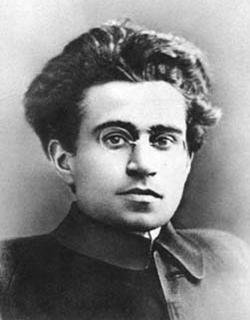 Italian Communist leader and theoretician. Raised on the impoverished island of Sardinia,
a scholarship allowed him to attend Turin University where he was a brilliant student, but
where he was also unfortunately strongly influenced by the liberal idealist philosopher,
Benedetto Croce. In 1913 he joined the Socialist Party. In 1919
he helped found the left-wing newspaper, L’Ordine Nuovo, and was active in promoting
workers’ councils (“Soviets”) in factories, which were
inspired by the Bolshevik Revolution in Russia.
He became more and more critical of the reformist ideas of the Socialist Party and helped
to form the Communist Party of Italy in 1921. Gramsci was the Italian representative at the
meeting of the Third International in Moscow in
1922, and worked for the Comintern in Moscow and Vienna in
1922-24. In 1924 he was elected to the Italian parliament and returned to Italy to became
the top leader of the CPI.
Italian Communist leader and theoretician. Raised on the impoverished island of Sardinia,
a scholarship allowed him to attend Turin University where he was a brilliant student, but
where he was also unfortunately strongly influenced by the liberal idealist philosopher,
Benedetto Croce. In 1913 he joined the Socialist Party. In 1919
he helped found the left-wing newspaper, L’Ordine Nuovo, and was active in promoting
workers’ councils (“Soviets”) in factories, which were
inspired by the Bolshevik Revolution in Russia.
He became more and more critical of the reformist ideas of the Socialist Party and helped
to form the Communist Party of Italy in 1921. Gramsci was the Italian representative at the
meeting of the Third International in Moscow in
1922, and worked for the Comintern in Moscow and Vienna in
1922-24. In 1924 he was elected to the Italian parliament and returned to Italy to became
the top leader of the CPI.
Mussolini was now in power, and he and his
Fascist regime banned the Communist Party in 1926. Gramsci himself was arrested and spent the
rest of his life in prison. Ironically, his great reputation today, especially in Left academia,
derives from his time in prison where he wrote 34 notebooks, containing over 2000 printed
pages. There are some difficulties in reading these notebooks both because they were just
Gramsci’s own notes, with multiple notebooks being worked on simultaneously, and not
something written for publication, and because of the prison authorities who prevented
him from writing in a way that might be used to “inflame the masses”. This forced Gramsci
to frequently write in an academic and obscure style, and to resort to
Aesopian language, as when he uses the phrase “modern
theory” where he simply means “Marxism”.
Gramsci’s focus in his notebooks on intellectuals and
their role in society, and on literature and culture, of course appeals to academics today,
and explains in part his continuing popularity there. His discussion of the capitalist
state is weak, certainly compared to Lenin’s firm class position
on the issue.
Since he was living in a prison in a Fascist
country, and the Communist Party was mostly suppressed, he did not think the sort of
revolutionary strategy employed by the Bolsheviks in Russia was fully appropriate there.
Instead of such a frontal assault (insurrection), he thought there was the necessity of a
long-term war of attrition, or a “war of position” (like the trench warfare of World War I),
to prepare the way for proletarian revolution. Gramsci’s much discussed notion of
hegemony seems to be related to this, the long-term struggle
between the ideological hegemony of the ruling class and a hoped for alternative ideological
hegemony of the working class forming around its revolutionary party. While in the advanced
capitalist countries there is in fact the necessity for laying the groundwork for an
eventual revolutionary uprising through patient work of organizing and education over
a long period, there is also the danger that in doing so that eventual goal of revolution
will become merely window dressing for reformism and revisionism. This perhaps shows why
academic revisionists are so attracted to Gramsci: they see this possibility not as a
danger at all, but rather more as a welcome perpetual postponement of revolution.
“Pessimism of the Intellect; Optimism of the Will” —A slogan, probably
authored by Gramsci himself, which appeared regularly on the masthead of L’Ordine
Nuovo, the newspaper he edited.
GRAVITY
The weakest of the four known forces of nature, but
the most pervasive, apparently operating at any distance, and mutually attracting all
forms of matter and also all forms of energy including light.
Newton’s Law of Universal Gravitation (c.
1687), is: F = Gm1m2/r2, where F is the
gravitational force, G is the gravitational constant, m1 and m2 are
the two masses, and r is the distance between them.
Einstein’s General Theory of Relativity
slightly revises Newton’s Law.
See also:
ACTION AT A DISTANCE,
BRAHMAGUPTA
“The theory of gravitational forces, whose main hypthesis is
the attraction of all particles of matter for one another, yields the derived law
of universal gravitation, which in turn explains, as we have seen, Kepler’s empirical
laws and a wealth of other phenomena. Since one purpose of any theory is this type of
explanation and summary, Newton’s theory strikes us as eminently satisfactory.”
—Arnold Arons, Development of Concepts of Physics (1965).
GREAT CAPITALIST MASS EXTINCTION
The currently intensifying great mass extinction of
animals and plants which is being caused primarily by the capitalist system and rule, which
values corporate profits far higher than it does the protection of nature and the environment
for the continued overall benefit of humanity.
Even most biologists imbued with bourgeois
ideology admit that we are already in a period of a great mass extinction of species, but tend
to blame this on “humanity” in general, or over-population, or governmental ignorance, etc.
In other words, even the liberals among them seldom recognize the systemic causes of this
extinction episode, let alone the central responsibility of the capitalist class for it. It is
true that excessive human population growth is secondarily to blame for this mass extinction.
But by far the most important factor is still that the ruling bourgeoisie just does not give
a damn, and while they are in control of the world they refuse to take any serious steps to
stop this ever-expanding annihilation of plant and animal species. It is already clear that
this mass extinction will very likely be one of the greatest in the entire history of the
Earth, which includes some very large die-offs many millions of years ago. Indeed, it is not
entirely clear whether our own species, Homo sapiens, will survive the capitalist
era.
“Populations of plants, insects and birds in the U.K. have dropped
precipitously in the past 40 years—more evidence that the world is in the midst of its
sixth mass extinction. The previous one wiped out the dinosaurs.” —Science
magazine, March 19, 2004; quoted in Scientific American, May 2004, p. 40.
“GREAT DECOUPLING”
“The Great Decoupling” is a term which has recently come into fashion in bourgeois economic
circles to describe the growing economic separation between the economies of the United States
and China. A major symptom of this decoupling is the trade
war between the U.S. and China which the Trump administration launched in 2018, and which—with
fits and starts and only short term interruptions and limited truces—has been continuing ever
since. This trade war will undoubtedly continue at one level or another under the new Biden
administration beginning in January 2021. In addition to the trade war, the U.S. government is now
putting more and more political and economic pressure on American multinational corporations to
move their factories out of China, and to also curtail China’s investment in the U.S. economy. In
other words, it is the U.S. bourgeoisie, with its declining and moribund economy, which of
necessity is now forcing this Great Decoupling.
Of course during the Maoist socialist era in
China, the Chinese economy was almost completely independent of that of the U.S. and the rest
of the capitalist world. When the capitalist roaders
seized power in a coup d’état after Mao’s death in 1976 this began to change. But the
major qualitative leap occurred when capitalist China was allowed by the U.S. to join the IMF,
the World Bank, and especially the World Trade Organization in
2001. The U.S. rulers figured their corporations could exploit cheap Chinese labor and have
access to the huge and growing Chinese market. What they did not understand was that the
Chinese capitalist-imperialists might well defeat them at their own game! By the time the
Great Recession broke out (2008) it was already evident that
China was less vulnerable to overproduction crises (because it had more ability after the
socialist era to greatly expand government, corporate and consumer debt); that Chinese
corporations—both private and state-owned—were out-competing U.S. and other Western corporations
both at home and abroad, and that China was quickly becoming a serious threat to the U.S.
economic domination of the world. In short, the U.S. rulers recognized they had made a serious
mistake in allowing capitalist China to compete with them, even under the rigged rules which
favored the U.S. The Obama administration sought to counter this Chinese economic threat with
its “pivot to Asia” and various trade war schemes of its own, especially by setting up
alternatives to the WTO, in both the Pacific and Atlantic areas, which excluded China. (See
especially: TRANS-PACIFIC
PARTNERSHIP) But the Trump administration recognized that this was not really a
strong enough response by U.S. capitalist-imperialism against rising Chinese capitalist-imperialism,
and decided that outright economic warfare was necessary. The current trade war is just the first
stage of this larger inter-imperialist economic struggle currently developing.
However, even this fast developing full scale
economic warfare between the U.S. and China is by no means the whole story here. In reality we
are witnessing the early stages of the splitting in two of the current
World Imperialist System. During the last 35 years
of the Cold War between the U.S. and the social-imperialist
Soviet Union, there were actually two largely independent and competing imperialist systems
in the world. With the collapse of the U.S.S.R. one of these imperialist systems collapsed, and
for a while there was only one World Imperialist System left—which was governed economically by
the IMF, World Bank, and WTO (all of which are dominated by the U.S.). But, as Lenin insistently
pointed out, the inevitable uneven development of
capitalism and capitalist-imperialism means that this sort of single unified or
“ultra-imperialist” socio-economic system simply cannot
last for long. And it is now breaking up into one still U.S.-dominated imperialist system and a
separate new imperialist system, more and more independent of the U.S., dominated by China and
probably also with Russia as a key partner. Other countries and blocs, such as the European
Union, will eventually be forced more and more to choose which competing imperialist system they
will adhere to.
So this current “Great Decoupling” is a very big
deal! It is far more important than even those bourgeois writers who are talking about it yet
understand.
GREAT DEPRESSION OF THE 1930s
A severe and prolonged economic overproduction
crisis which broke out in all the capitalist countries and which lasted the entire decade
of the 1930s in most of them.
In the U.S. the Great Depression is usually
said to have begun with the stock market and financial Crash
in the fall of 1929. However, the U.S. economy was already entering what we would now call a
recession early in 1929, and the severe conditions we now associate with the Great Depression
developed over a several year period, and didn’t reach their worst point until 1933. There
was then a small upward trend for several years because of New Deal programs and de facto
Keynesian deficits (though they weren’t yet
called that). When President Franklin Delano Roosevelt eased off on the deficit financing,
the economy again worsened in 1937-1938. As Roosevelt partially learned his lesson, and
stepped up the government spending again, the Depression eased a bit after that, but didn’t
come to a final end until World War II. For the U.S., therefore, the Depression—from start to
finish—should be dated as lasting from 1929 through at least 1940, or about 12 years.
The Great Depression was partially
mitigated (or in a few countries such as Germany completely interrupted) by the
huge Keynesian deficit spending for public works and war preparations that occurred in most
advanced capitalist countries during the 1930s. It was completely interrupted in all
the imperialist countries during World War II itself, with the truly massive deficit spending
for the war. But it was only the massive destruction of capital during World War II
that truly ended the Great Depression and prevented it from resuming after the war.
[For more on this, see my essay “False Lessons from the Great Depression”, at
https://www.massline.org/PolitEcon/ScottH/False_Lessons.htm. —S.H.]
See also sub-topics below.
GREAT DEPRESSION OF THE 1930s — The Great Unwinding (1929-1933)
Major depressions take a fair amount of time to develop. As mentioned in the general entry
above, in the spring of 1929 there was only the beginnings of a fairly mild recession. Even
after the financial Crash of 1929 (in the autumn) the
immediate condition of the overall economy was still only that of mild to moderate recession.
But over the next 4 years the crisis continued to develop and the overall economy continued
to seriously decline. Unemployment jumped up from 3.2% in 1929 to 24.9% in 1933. And during
this period more than 9,000 banks either suspended operations or completely closed down. A
large part of the entire U.S. financial system had in effect collapsed.
“The great severity of the banking crises in the Great Depression is
well known to students of the period. The percentages of operating banks which failed
in each year from 1930 to 1933 inclusive were 5.6, 10.5, 7.8, and 12.9; because of
failures and mergers, the number of banks operating at the end of 1933 was only just
above half the number that existed in 1929. Banks that survived experienced heavy
losses.” —Ben Bernanke, Essays on the Great Depression (2000), p. 44.
There was a huge amount of debt built up in the U.S. economy during the boom years of
the 1920s, and because of both increased debt and falling incomes during the Depression the
ratio of debt servicing to national income went up from 9% in 1929 to 19.8% in 1932-33. In
a 1934 survey of home owners with mortgages in 22 different cities, the default rate ranged
from a low of 21% (in Richmond, VA) to a high of 62% (in Cleveland). In more than half of
the cities the default rate was above 38%. The percentages of those behind in their rent on
rented properties was even higher. The financial status of farmers was worse still, and by
the beginning of 1933 45% of all U.S. farms were delinquent in their mortgage payments.
State and local governments were also in serious debt trouble, with 37 cities with populations
greater than 30,000 people and 3 states defaulting on their debt by March 1934. [Bernanke,
op. cit., p. 46.]
The strong deflation
during the Depression served to amplify the debt burdens (because the debt had to be repaid
in currency that had become more valuable and harder to come by). But contrary to the opinions
of some bourgeois economists this deflation was not the primary cause of these intensifying
problems during the first 4 years of the Depression. Bernanke notes that “Although the
deflation of the 1930’s was unusually protracted, there had been a similar episode as recently
as 1921-22 which had not led to mass insolvency.” [Ibid., pp. 46-47.]
The situation with corporate profits during
this period of the unwinding of the economy into deep depression is interesting. The aggregate
corporate profits before taxes were negative in 1931 and 1932, and after-tax retained profits
were negative for all the years from 1930 to 1933. However, the biggest corporations (those
with more than $50 million in assets) maintained positive profits through this entire period!
[Bernanke, ibid.]
The index of industrial production, which stood
at 114 in July 1929 gradually fell to just 53 in July 1932, then picked up just slightly for a
few months before falling back to 54 in March 1933. Thus industrial production had fallen to
less than half its level before the Depression began. [Bernanke, op. cit., pp. 48-49.]
Similar events were occurring in all the other
major capitalist countries, though—interestingly—many of them (including Britain and France)
did not have major banking crises. Most bourgeois economists are quite puzzled by this fact,
since they falsely believe that financial crises were the “cause” of the depression in “the
real economy”.
GREAT DEPRESSION OF THE 1930s — Relapse of 1937-38 in the U.S.
As mentioned in the main article above about the Great Depression, there was a weak and partial
recovery in the U.S. from 1933 until 1937, and then a relapse due to the government cutting
back on the budget deficits which had eased the crisis somewhat. This deficit financing was
inadequate to actually bring the U.S. economy back to the level it had reached before the
Depression began, and when it was cut back the economic decline once again resumed.
“The recovery from the Depression is often described as slow because
America did not return to full employment until after the outbreak of the second world
war. But the truth is the recovery in the four years after Franklin Roosevelt took office
in 1933 was incredibly rapid. Annual real GDP growth averaged over 9%. Unemployment fell
from 25% to 14%. The second world war aside, the United States has never experienced
such sustained, rapid growth.
“However, that growth was halted
by a second severe downturn in 1937-38, when unemployment surged again to 19%. The
fundamental cause of this second recession was an unfortunate, and largely inadvertent,
switch to contractionary fiscal and monetary policy. One source of the growth in 1936
was that Congress had overridden Mr Roosevelt’s veto and passed a large bonus for
veterans of the first world war. In 1937, this fiscal stimulus disappeared. In addition,
social-security taxes were collected for the first time. These factors reduced the
deficit by roughly 2.5% of GDP, exerting significant contractionary pressure.”
—Christina Romer, “Economic Focus: The Lessons of 1937”, The Economist, June
20, 2009, p. 82.
[Romer is an American bourgeois
economist and supposedly an expert on the Great Depression. Her point about how “rapid”
the “recovery” was from 1933-1936 is ridiculous! Of course it could be fairly fast
compared to the normal expansion of the economy in boom periods because most of the
idle factories still existed and it was simply a matter of putting people back to work
through government spending. Romer does mention here some of the means by which the
government deficits were reduced in 1937, but she does not mention the even more important
reason—that Roosevelt and his advisers simply did not understand the necessity of
deficits for keeping the economy going and they were actually trying to reduce
them! (This is why Roosevelt vetoed the veteran’s bonus bill.) Romer went on to
mention the “contractionary monetary policy” that the Federal Reserve began to follow in
1936, which was also a (small) factor in the ensuing relapse. But this was of much
less importance than the contractionary fiscal (deficit) policy, and it is a weakness of
her analysis that she seems to put it on a par. And although Romer’s main point in the
article is that “fiscal stimulus” (deficits) should not be withdrawn “too soon”, she
completely fails to understand that in a developing depression it cannot be withdrawn
at all! Indeed, a major part of her article stressed the importance of eventually
reducing those deficits! That is, she—along with all Keynesian-school economists—thinks
that “the pump can be primed” through fiscal
deficits, and the deficits can then be ended. Romer, along with all other bourgeois
economists, doesn’t even begin to understand that it was not Keynesian deficits
which ended the Great Depression—not even the colossal deficits during World War II
itself, but rather the massive destruction of capital on a world scale during the
war that really brought the Depression to an end and kept it from resuming after the end
of the war and the end of those huge war deficits. —S.H.]
“GREAT INFLATION, The” (In the U.S., circa 1968-1982)
A term sometimes used by American economists to refer to a period of rather high
inflation (by standards before and after) that occurred in
the U.S. from the late 1960s to the early 1980s. There were actually two bursts of inflation
during this period, with peaks in 1974 and 1980. After a long period of relatively low
inflation (below 3%/year), the Consumer Price Index for urban consumers [CPI-U] picked up
to 4% to 6% for most of the years in the 1968-1973 period, as the U.S. imperialists further
escalated their expensive war against Vietnam. In 1974 the CPI-U jumped up to 11.0%, then
eased off to the 6% to 9% range for several years. The second burst of inflation (due to
govenment deficit financing attempting to deal with
the first act of the long-developing new economic crisis) pushed the CPI-U to 11.3% in
1979, 13.5% in 1980, and 10.3% in 1981, before easing off again in succeeding years. The
phrase “double-digit” inflation comes from this period.
It took a while for the “Great Inflation”
to develop, despite the many years of government deficits during the Vietnam War and the
developing crisis. But when it did develop it was quite harmful to the U.S. economy. In
the same way the vastly larger government deficits in the new millenium (designed to combat
the new worsening stage of the economic crisis) will very likely also come back to plague
the economy. It is reasonable to expect that, before too many years, it might make the
so-called “Great Inflation” of the 1968-1982 period seem pretty trivial by comparison!
One of the unexpected consequences of the
period of partially out-of-control inflation was that many people with money to invest
(including parts of the petty bourgeoisie and “Middle Class”)
shifted a lot of their investment out of bank accounts and stocks and bonds, and into real
estate. This has driven the prices of houses up much faster than that of other commodities
and has greatly aggravated the present housing affordability crisis. Another way of looking
at it is that a lot of the inflation which took place overall was refocused into the housing
market specifically. Once the prices of homes began to jump up so fast it became even more
so the wise place “to put one’s money” for many such people, thus becoming an
asset bubble that feeds on itself. There was a partial
collapse and correction of this bubble in the Great Recession
but after a few years this housing bubble began to grow quite fast once again.
See also:
“MODERN MONETARY THEORY”
GREAT LEAP FORWARD
A mass campaign in Maoist China launched in late 1958 and designed to swiftly raise China’s
economic production and technique, especially in the countryside. While the revolutionary
fervor it arose did have a substantial positive effect in some regards, this same fervor—along
with inadequate overall supervision of the movement and serious sabotage by capitalist-roaders
within the Communist Party—led to some major short-term problems including serious famine in
some parts of the country. Local Party officials were frequently reporting bountiful harvests
when in fact the harvests were poor. Overall the GLF was not a success either economically or
politically, though it was also not quite the unmitigated total disaster that anti-Communist
writers have often claimed. It did, however, serve to partially discredit Mao and the CCP in
the eyes of the masses for a brief period. The GLF was officially ended in 1961.
“[India] had, in terms of morbidity, mortality and longevity, suffered
an excess in mortality over China of close to 4 [million] a year during the same period
[of the Great Leap Forward]… Thus, in this one geographical area alone, more deaths
resulted from ‘this failed capitalist experiment’ (more than 100 million by 1980) than
can be attributed to the ‘failed communist experiment’ all over the world since 1917.”
—Amartya Sen, Nobel Prize winning economist, quoted in Antony Black, ‘Black propaganda’,
Guardian Weekly, Feb. 24, 2000.
“GREAT MEN” [GREAT INDIVIDUALS]
“This brings us to the question of what are known as great men. The
fact that such and such a man, and he alone, should arise at a particular time in any
given country, is of course, fortuitous. But if we eliminate him, a replacement will be
called for and such a replacement will be found—tant bien que mal [for better
or for worse], but found he will ultimately be. That Napoleon, this particular Corsican,
was the military dictator rendered necessary by a French Republic bled white by her own
wars, was fortuitous; but that, in the absence of a Napoleon, someone else would have
taken his place is proved by the fact that the moment someone becomes necessary—Caesar,
Agustus, Cromwell, etc.—he invariably turns up. If it was Marx who discovered the
materialist view of history, the work of Thierry, Mignet, Guizot [French historians]
and every English historiographer prior to 1850 goes to show that efforts were being made
in that direction, while the discovery of the same view by [Lewis Henry] Morgan shows
that the time was ripe for it and that it was bound to be discovered.
“The same thing applies to all
fortuitous and seemingly fortuitous events in history.” —Engels, Letter to W. Borgius,
Jan. 25, 1894; MECW 50:266.
“In hindsight, we can usually see that if one scientist did not
discover a particular law, some other person would have done so within a few months
or years of the discovery. Most scientists, as Newton said, stood on the shoulders of
giants to see the world just a bit farther along the horizon. In fact, I give a few
examples in this book in which more than one individual discovered a law within a few
years of one another, but for various reasons, including sheer luck, history sometimes
remembers only the more famous discoverer. Readers may enjoy noting the frequency with
which this happens in the history of science.” —Clifford Pickover, Archimedes to
Hawking (2008), p. 12.
“GREAT MODERATION, The”
A term sometimes used by American bourgeois economists to refer to the period of relatively
low inflation and fairly steady (if mostly unimpressive) economic growth in the United
States which lasted for a couple decades starting around the mid-1980s. In the 1970s and
early 1980s there was a period of stagflation (the
“Great Inflation” coupled with economic stagnation), and by
that deplorable standard the economic situation in the later 1980s and 1990s was much
improved. Of course “moderation” is considered a good thing by bourgeois economists when it
comes to inflation, but not so good when it comes to GDP growth; so the term “The Great
Moderation” seems to refer mostly to the more moderate levels of inflation during that
post-stagflation period while GDP growth continued at a very modest level. Put another way,
the “Great Moderation” was the erroneous theory that from 1985 on the American economy had
put the period of wild swings in inflation and GDP growth permanently behind it.
What was the cause of “The Great Moderation”?
Why did things improve for a while? First, the government cut back on its very loose and
expansive monetary policy and restrained its Keynesian
budget deficits. Second, many American industries “restructured”, i.e., closed
unprofitable factories and cut their workforce. Not only were huge numbers of workers layed
off, but also many lower and middle-level managers were cut. All of these sorts of things
were included under the name of neoliberalism, and amounted
especially to a major new assault on the working class. In addition there was a much more
rapid increase in consumer debt, which helped spur some renewed economic growth for a while.
“The Great Moderation” included one short
burst in economic growth associated with the “New Economy” bubble of the late 1990s. But
that bubble then burst and there was a recession in 2000-2001. After a very slow and shallow
recovery, stoked especially by the rapidly growing housing and financialization bubble, a
new recession started at the end of 2007, and became a major financial crisis in the fall
of 2008. This marked the complete and final end of anything that could reasonably be called
“The Great Moderation”! True, for now inflation is still quite low, but the American and
world capitalist economies as a whole are limping along in a very wounded fashion. This
will remain the case for the coming immediate period, and will eventually collapse into a
much more serious new depression. Moreover, along the way (and because of the continuing
massive Keynesian deficit financing), there will eventually be a major return of inflation
which will far exceed the levels of the 1970s and 1980s.
GREAT PROLETARIAN CULTURAL REVOLUTION (GPCR)
A great revolutionary movement in socialist China during the Mao period which sought,
initially, just to transform the cultural and ideological sphere of society, but developed
into a full-scale social revolution wherein the revolutionary proletariat and its allies
led by Mao overthrew the revisionists and capitalist-roaders who had seized considerable
power in the government of China and within the Communist Party of China itself, and which
re-established proletarian revolutionary power for a decade.
The peak years of the Cultural Revolution
were 1966-69, but the preliminary developments started earlier, and in some respects the
GPCR continued until Mao’s death in September 1976. One important article in Peking
Review states that “In 1963, under the personal guidance of Chairman Mao, the revolution
in literature and art was launched in China, marked mainly by the reform of the dramatic
arts; this was, in fact, the beginning of the great proletarian cultural revolution.”
[“Carry the Great
Proletarian Cultural Revolution Through to the End”, Peking Review, Jan. 1,
1967, p. 8.] But the GPCR as a truly mass phenomenon began in the spring of 1966. ...
The GPCR consisted of struggle,
criticism and repudiation and of transformation: “The struggle to overthrow
those persons in authority who are taking the capitalist road, the criticism and repudiation
of the reactionary bourgeois academic ‘authorities’ and the ideology of the bourgeoisie
and all other exploiting classes, and the transformation of education, literature and art,
and all other parts of the superstructure that do not correspond to the socialist economic
base.” [ibid., p. 9].
The highest individual target of the GPCR
was Liu Shaoqi, who was appropriately labelled “China’s
Khrushchev”, and was eventually dismissed from his positions and expelled from the CCP. But
contrary to Western bourgeois analyses, the GPCR was not just about getting rid of a few
revisionists like Liu; its goal and purpose was to change Chinese socialist society so that
people like Liu could not arise and achieve high power in the Party and government in the
first place.
[More to be added... ]
See also entries below.
“The basic contradiction the great proletarian Cultural Revolution is
trying to resolve is the one between the proletariat and the bourgeoisie, between the
proletarian and bourgeois roads. The main point of the movement is to struggle against
the capitalist roaders in authority in the party.” —Mao, Sept. 24, 1966, in SW9:409.
“The great proletarian cultural revolution is in essence a great
political revolution under the conditions of socialism made by the proletariat against
the bourgeoisie and all other exploiting classes; it is a continuation of the prolonged
struggle waged by the Chinese Communist Party and the masses of revolutionary people
under its leadership against the Kuomintang reactionaries, a continuation of the class
struggle between the proletariat and the bourgeoisie.” —Mao, a comment under the heading
“Chairman Mao Tse-tung’s Latest Directive”, Peking Review, #19, May 10, 1968,
p. 2.
GREAT PROLETARIAN CULTURAL REVOLUTION — Mass Line In
What was the role of the mass line method of leadership, or
in Mao’s phrase the method of “from the masses, to the masses”, in the Great Proletarian
Cultural Revolution? Mao strived very hard to make the mass line the basic method in
the struggle, but unfortunately this turned out to be extremely difficult to do.
Constant use of the mass line was strongly
stressed from the early period of the GPCR. The article, “From the Masses, To the Masses”
(People’s Daily, July 21, 1966) begins by saying: “Comrade Mao Tse-tung has said: ‘In
all the practical work of our Party, all correct leadership is necessarily “from the masses,
to the masses”.’ This also holds good for the work of the proletarian cultural revolution.”
[Included in the pamphlet “The Great Socialist Cultural Revolution in China (6)”,
online at:
https://www.bannedthought.net/China/MaoEra/GPCR/GreatSocialistCulturalRevolutionInChina-06-1966.pdf]
During the years leading up to the GPCR, Mao’s conception of the mass line had been
seriously distorted by the capitalist roaders, and by
Liu Shaoqi and Deng Xiaoping in particular. [See: The Mass Line and the
American Revolutionary Movement, “Chapter 37: Chinese Revisionism and the Mass Line”,
online at:
http://www.massline.info/mlms/mlch37.htm] But, during the GPCR itself these
earlier rightist distortions were strongly combatted, and Mao’s conception of the essence
of the mass line as being “from the masses, to the masses” was clarified and reaffirmed, at
least in the revolutionary media.
However, the mass line method requires a
leadership body to implement it. These are the cadre who gather the ideas of the
masses on how to advance the struggle; who process those ideas in the light of existing
MLM revolutionary theory and a careful analysis of the objective situation; and who then take
these processed ideas back to the masses and use them as the focus for mass action. In
limited and very local circumstances it is actually possible for a small group, or even
conceivably one individual, to do all this! But it is essentially impossible for
individuals or small groups to gather all the potentially useful ideas in a large
region or nation; it is much less likely that an individual or small group will have the depth
of understanding of both MLM theory and the overall objective situation in the whole country
on which to properly process the ideas they do gather into the best political line for
advancing the overall revolutionary struggle; and it will almost certainly be impossible for
an individual or small group to successfully return those ideas to the broad masses in a vast
country, and be able to successfully promote them as the basis for countrywide mass action.
To do that, at least, you really do need a party or something very similar to one.
The big difficulty in the GPCR, however, was
that the Party apparatus was largely under the control and direction of the capitalist roaders.
That was the very reason that the Cultural Revolution was needed in the first place! So how
could the Party cadre be effectively used to lead the masses to combat the revisionism of that
very cadre apparatus?! This was the conundrum. Yes, there was still Mao and his close followers
at the top, if only in control of the Central Cultural Revolution Group and not the Central
Committee. And there were tendrils from the CCRG down to the masses and mass organizations.
But this was a tremendously weaker cadre apparatus than that of the Party cadre available for
use by Mao and the Party leadership during the struggle for Liberation.
What this all meant was that the Maoist method
of mass leadership, the method of “from the masses, to the masses”, could—ironically—only
be used somewhat erratically in the early years of the GPCR, despite Mao’s stress on it. A
well functioning Party is needed to effectively use the mass line on a nationwide basis, and
since the Chinese Party apparatus at that time was under the strong influence or control of
the revisionists it was anything but a “well functioning Party”. This explains, to a
considerable degree why the GPCR had to be rather anarchic at least in its early period.
There was simply no way to avoid it. Moreover, this may also be an important part of the
explanation for why the capitalist roaders could not be kept from coming back to power
immediately after Mao’s death. There were a number of inherent weaknesses in the way that the
GPCR had to be carried out in those existing circumstances (and not only the necessary
early anarchy), and therefore necessarily also some unfortunate weaknesses in the end
result.
GREAT PROLETARIAN CULTURAL REVOLUTION — Ultimate Failure Of
While Mao still lived, the GPCR was successful in preventing the capitalist roaders from
taking over completely, and managed to both push many of their top leaders like Liu Shaoqi
from power and to re-educate and revolutionize millions of Party members and ordinary
people, at least to a considerable degree. For a time it appeared that the CCP was truly
transformed, and that—for a long period at least—no revisionists could possibly rise to
power in the Party or government. But then, immediately following Mao’s death, the
staunchest anti-revisionists (including the “Gang of Four”)
were purged and arrested. There ensued a short interegnum in which the stage was set for
the return to power of Deng Xiaoping, the second most important capitalist roader after
Liu. And then Deng did in fact lead China back to capitalism.
How was it possible for this disaster to
happen? What were the weaknesses and shortcomings of the GPCR which led to its ultimate
failure? These are extremly important questions that every revolutionary Marxist must
seriously work to answer so as to prevent any similar disaster from occurring again.
[More to be added... ]
“The present Great Proletarian Cultural Revolution is only the first;
there will inevitably be many more in the future. The issue of who will win in the
revolution can only be settled over a long historical period. If things are not
properly handled, it is possible for a capitalist restoration to take place at any
time in the future.” —Mao, August 1967; SW 9:418.
GREAT PROLETARIAN CULTURAL REVOLUTION — Violence In
As revolutions go, the GPCR was relatively peaceful. But there was some violence that
occurred during the course of it, most of which was instigated among young
Red Guards by the reactionaries in order to discredit the
revolution. The 16-points guidelines laid down by Mao and the CCP Central Committee in
May 1966 explicitly stated that the method to be used was that of reason and persuasion,
and that coercion and violence were not to be used.
“The great proletarian Cultural Revolution is a revolution that
touches the souls of the people. To realize [the goals of] this revolution, [we
must] resort to peaceful, not violent, struggles.” —Mao, Sept. 5, 1966, in SW9:408.
“The most important plot and scheme of the very small number of
persons who stubbornly persist in the bourgeois reactionary line is to incite the
masses to struggle against each other. They have secretly organized and manipulated
some people and mass organizations, whom they have hoodwinked, to suppress the
revolution, protect themselves, and to provoke conflicts in which coercion or force
are used in a vain attempt to create confusion. They spread rumors, turned black
into white and shifted the blame for the evil they had done behind people’s backs
on to the proletarian revolutionaries, labelling the latter with the ‘bourgeois
reactionary line.’”
—“Carry the
Great Proletarian Cultural Revolution Through to the End”, an editorial summing
up the GPCR in 1966 and laying out its goals for 1967, Peking Review, vol. 10,
#1, Jan. 1, 1967, p. 10.
GREAT PURGES (In the Soviet Union in the late 1930s)
The massive purges directed by Stalin within the Communist Party of the Soviet Union, the Soviet
military and government, and Soviet society more generally, in the period leading up to World War
II. Apparently hundreds of thousands of people were removed from positions of authority and influence,
most of whom were then imprisoned or even shot. These purges were meant to eliminate forces within
the Soviet Union who might possibly side with the invading enemy forces in what was (correctly)
expected to eventually develop into an attack by German imperialism and become a major war to the
death between Nazi fascism and Soviet socialism.
At least in the post-World War II era, these purges
have been almost universally condemned by bourgeois historians and commentators (and not just by
Trotskyites), including by some people who are rather sympathetic to the Soviet Union. They condemn
the purges as viciously violent, totally unnecessary, and quite counter-productive, in that they are
said to have imprisoned or killed mostly innocent people and made it even more difficult to resist
and defeat the Nazi attack. Based on our limited initial investigation we believe that this criticism
is largely correct, and that a great many innocent people were imprisoned or murdered in these purges.
However, the matter still needs to be much more thoroughly investigated—and from an MLM perspective.
In the meanwhile, we urge revolutionaries to consider
the possibility that there may also have been at least some secondary and partial positive aspects to
these purges, even if it actually was mostly a serious error. It is quite possible, and even
quite likely, that a considerable number of real enemies of the Soviet socialism were also eliminated
in these purges. It has been pointed out that the Soviet Union, almost alone among the countries
overrun by the Nazis, had little in the way of a “Fifth Column” [i.e., serious active support for the
German invasion from people inside the USSR], and that the Soviet guerrilla resistance in the parts of
the country overrun by the Germans was the strongest and most persistent of any part of Europe which
the German army officially controlled. Was this just a co-incidence, or was it one actual positive
result of the purges? This is one of the questions to be more fully investigated. —S.H.
See also:
Osip PIATNITSKY
“GREAT RECESSION”
The most common name for the severe recession in the United States and the entire capitalist
world, which is generally said to have begun in the U.S. in December 2007, and intensified
in the form of a financial crisis in the fall of 2008. As the bourgeoisie measures such
things, this recession lasted 18 months and ended in June 2009. However, most of the serious
aspects of this recession (including extremely high real unemployment—not the phony
government statistics!) continued for years, and in many respects still continue. This
recession became a major episode in the most serious
overproduction crisis since the
Great Depression of the 1930s, but bourgeois ideologists
have been unable to recognize it as part of a larger and ever-more-serious overproduction
crisis let alone as the prelude to a much worse stage of that crisis which will, sooner-or-later,
further develop into a new outright depression.
Bourgeois economists say that the nadir of
the Great Recession occurred in spring of 2009, and that production (GDP) began to expand
again at that point. (The bourgeoisie generally considers recessions to be “over” if GDP begins
to expand again, even if production is still far below the peak reached before the recession
began. By this “logic”, if the economy declines by 4% and then later expands by just 1% the
recession is “over”!)
 And of course the bourgeoisie gives little importance to the unemployment rate or the general
economic condition of the people in determining when recessions supposedly “end”. In the
summer of 2012 even the official unemployment rate (which doesn’t count a large part of those
actually unemployed) was nearly double what it was when the Great Recession began. Nevertheless,
in September 2010 the National Bureau of Economic Research, which
American bourgeois economists grant the authority to decide such things, declared that this
Great Recession ended in June 2009. Any new downturn, they said, would be counted as a totally
different recession.
And of course the bourgeoisie gives little importance to the unemployment rate or the general
economic condition of the people in determining when recessions supposedly “end”. In the
summer of 2012 even the official unemployment rate (which doesn’t count a large part of those
actually unemployed) was nearly double what it was when the Great Recession began. Nevertheless,
in September 2010 the National Bureau of Economic Research, which
American bourgeois economists grant the authority to decide such things, declared that this
Great Recession ended in June 2009. Any new downturn, they said, would be counted as a totally
different recession.
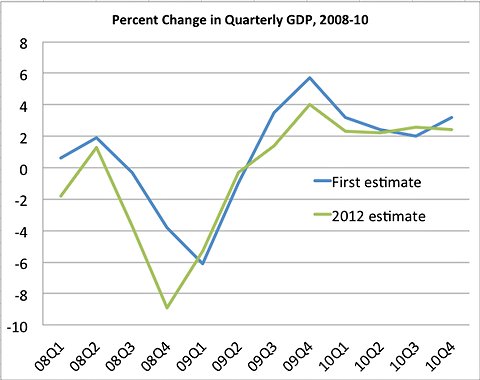
In the U.S. the Great Recession was initially
reported by the government as a decline of GDP of 3.83%. In mid-2010 the government revised
these figures, stating that GDP had actually decline by 4.15% by mid 2009. This is the deepest
GDP decline since the short but sharp recession in 1946 at the time the U.S. was converting
from war production in World War II. [Data from “The Economist”, Aug. 7, 2010,
p. 28.] The government has further revised its estimates of the changes in GDP during
the Great Recession as indicated in the graph at the right. It is now admitted that the
recession was deeper than they earlier claimed, and that the so-called “recovery” has been
weaker. Whatever they call it, it is certainly clear that this overall overproduction crisis
has not even fully developed yet.
See also below, and:
HYSTERESIS
“[In] the Great Recession some 8 million people lost their jobs; 2.5
million businesses were shuttered; and from 2007-2009, almost 4 million homes were
foreclosed on each year.” —Jim Hightower, The Hightower Lowdown, Aug. 2018, p. 2.
“The recovery [from the Great Recession] has also been the weakest of
the post-World War II era, with annual growth averaging 2.2 percent, below the 2.8
percent pace of the previous expansion and the 3.6 percent recorded in the 1991-2001
upturn. Three out of five Americans polled by Fox News in May said the U.S. was still in
recession.” —Bloomberg BusinessWeek July 5-12, 2015, p. 10.
“University of California-Berkeley economics professor Emmanuel Saez
determined that the top 1 percent of Americans captured 91 pecent of all income gains from
2009 to 2012, the initial years of recovery from the Great Recession. Saez based his
research on pretax, pre-government-benefit income, explaining, ‘That’s the key stat to
think about how the market allocates incomes in the first place. Anybody should be worried
that the recovery from the Great Recession has been so skewed in terms of market incomes.’
Justin Wolfers, a senior fellow at the Peterson Institute for International Economics, did
additional research on the later years of the recovery and determined that ‘so far all the
gains of the recovery have gone to the top 1 percent.’ All of the gains.” —Robert
W. McChesney and John Nichols, People Get Ready (2016), p. 122.
GREAT RECESSION — Ten Year Retrospective
As the tenth anniversary of the financial crisis associated with the Great Recession arrived in
the fall of 2018, many newspapers and magazines began running articles about just how serious it
all was, what a close call it was as far as possibly developing into an immediate full-scale
depression, and even admitting that many of its serious problems still continue unresolved after
an enire decade! Of course they still focus just on the financial crisis aspect of the Great
Recession and remain completely unable to understand its basic nature as merely an episode in the
long drawn-out development of a major capitalist overproduction
crisis.
“By the official statistics, 10 years after the fall of Lehman Brothers
‘the American economy has fuly recovered,’ said David Leonhardt. Look closely, however, ‘and
you can see the lingering effects of the financial crisis everywhere.’ Citizens anxious and
angry about the economy have embraced a leader who has thrown the presidency into chaos. ‘So
who are you going to believe: those statistics or your own eyes?’ The trouble is that the
measures that dominate the conversation mostly describe the ‘experiences of the affluent.’
Stocks, for example, are worth 60 percent more than when the financial crisis began in 2007.
But most shares are owned by the wealthy, and half of Americans don’t own stocks at all. The
typical household’s net worth remains about 20 percent lower than it was in 2007. Meanwhile,
the most cited unemployment figure doesn’t count the millions of Americans who have given
up looking for work. Indicators such as the unemployment rate and the stock market averages
don’t capture ‘the realities of American life,’ and by glossing over growing inequality
they’ve become increasingly misleading. We need better ones. ‘The whole point of statistics
is to describe reality. When a statistic no longer does so, it’s time to find a new one.’”
—David Leonhardt, “Economy’s Up, Well-Being is Not”, New York Times, as summarized
in The Week, Sept. 28, 2018, p. 12.
[What Leonhardt obviously does not
understand is that statistics are also used to lie about the true nature of reality.
The capitalist ruling class needs to lie to the masses all the time, and especially needs
to lie to them (and perhaps even to itself to some degree) in the midst of an ongoing
intractable economic crisis whose roots lay in the very nature of capitalism itself and how
it “works” only for the rich. —Ed.]
“GREATER ISRAEL” or “ERETZ ISRAEL”
The fully expanded state of Israel, to reach or exceed the maximum boundaries of the ancient state of
Israel referred to in the Bible. Expanding the present modern state of Israel into this “Greater
Israel” is one of the most central and unrelenting goals of the most determined Zionists.
The boundaries of ancient Israel are given in many conflicting ways in the Bible, sometimes merely as the
land around Jerusalem, and sometimes in such an expansive way that it could be viewed as including all of
present-day Israel (including the West Bank and the Gaza Strip) and all of Jordan, plus a bit of
Egypt down to the Suez canal, plus at least substantial parts of Lebanon, Syria, Iraq, and perhaps even
beyond all that! Achieving this expanded state of Israel is the dream and goal of the most rabid Zionists,
with no regard whatsoever for what this might mean for all the Palestinians, other Arabs and other peoples
now living there. It is indeed a vicious, semi-imperialist, criminal program! —S.H. [Jan. 5, 2024]
[Excerpt from the Wikipedia entry “Land of Israel” at:
https://en.wikipedia.org/wiki/Land_of_Israel (as
of Jan. 5, 2024)]
“On 14 May 1948, the day the British Mandate over
Palestine expired, the Jewish People’s Council gathered at the Tel Aviv Museum, and approved a proclamation,
in which it declared ‘the establishment of a Jewish state in Eretz-Israel, to be known as the State of Israel.’
“When Israel was founded in 1948, the majority Israeli
Labor Party leadership, which governed for three decades after independence, accepted the partition of
Mandatory Palestine into independent Jewish and Arab states as a pragmatic solution to the political and
demographic issues of the territory, with the description ‘Land of Israel’ applying to the territory of the
State of Israel within the Green Line. The then opposition revisionists, who evolved into today’s Likud party,
however, regarded the rightful Land of Israel as Eretz Yisrael Ha-Shlema (literally, the whole Land of Israel),
which came to be referred to as Greater Israel. Joel Greenberg, writing in The New York Times, relates
subsequent events this way:
“‘The seed was sown in 1977, when Menachem Begin of
Likud brought his party to power for the first time in a stunning election victory over Labor. A decade before,
in the 1967 war, Israeli troops had in effect undone the partition accepted in 1948 by overrunning the West
Bank and Gaza Strip. Ever since, Mr. Begin had preached undying loyalty to what he called Judea and Samaria
(the West Bank lands) and promoted Jewish settlement there. But he did not annex the West Bank and Gaza to
Israel after he took office, reflecting a recognition that absorbing the Palestinians could turn Israel it
into a binational state instead of a Jewish one.’
“Following the Six-Day War in 1967, the 1977 elections
and the Oslo Accords, the term Eretz Israel became increasingly associated with right-wing expansionist groups
who sought to conform the borders of the State of Israel with the biblical Eretz Yisrael.
“As of 2022, according to the Israeli demographer Arnon
Soffer, Palestinians constitute the majority of the population of Eretz Israel, 51.16% as opposed to Jews who,
depending on definitions, make up between 46-47%.”
[However, even this region Arnon Soffer refers to is a
relatively narrow definition of “Greater Israel”, and apparently only includes the parts of Palestine outside
the official boundaries of Israel, but which the Israeli military actually already controls; i.e., the West
Bank and Gaza. The grandest definition of “Greater Israel”, including at least parts of Lebanon, Syria, Iraq,
and possibly beyond, would encompass millions more Palestinians and non-Palestinian Arabs, who would then
“have to be” either expelled, oppressed or killed, in order to maintain Israel as a Zionist state run by and
for the Jews alone. —Ed.]
GREENPEACE
An international organization devoted to defending the world’s environment and to protests
against commercial whaling and the use of nuclear power. They focus on global issues, including
not only global warming, but also deforestation, pollution of the oceans, overfishing, etc.
They refuse to accept contributions from corporations, governments or political parties (to
lessen the possibilities of being co-opted). Greenpeace had its origins in the peace movement
and anti-nuclear protests in Vancouver, Canada in the early 1970s.
Greenpeace is one of the largest and most active
environmental organizations in the world. Although Greenpeace is a pacifist organization, to its
credit it is willing to risk openly and directly confronting corporations and nations to try to
stop their ever more serious harm to the environment and their ill-considered use of nuclear
power. These “direct action” activities, such as putting their own ships in the path of whaling
vessels and organizing protests against nuclear-powered warships, have earned them the enmity
of the capitalists and especially of the big imperialist powers.
In 1985, in retaliation for Greenpeace protests
against French nuclear tests on the Polynesian island of Mururoa, French military agents bombed
the Greenpeace ship Rainbow Warrior while it was in the Auckland, New Zealand harbor,
and killed a Greenpeace photographer. [For more information about this outrageous crime, see:
“The Greenpeace Affair” in A World to Win, #4 (1985), online at:
https://www.bannedthought.net/International/RIM/AWTW/1985-4/AWTW-04-Greenpeace.pdf]
But this attack on Greenpeace backfired, brought the organization international attention, and
led to its further considerable growth.
Organizations like Greenpeace will obviously
never be able to end the terrible destruction of the environment which characterizes the
capitalist era; that will require the complete overthrow of capitalism worldwide. But the work
of Greenpeace does serve to bring much more attention to this extremely serious damage that
capitalism is doing to the world.
GREENSPAN, Alan (1926- )
American bourgeois economist who served as Chairman of the Federal Reserve from 1987 to
2006. Greenspan was a longtime disciple of the notorious bourgeois philosopher of
self-interest and selfishness, Ayn Rand. He even authored
several essays in her book, Capitalism: The Unknown Ideal, including one defending
the gold standard.
As Chairman of the Fed, Greenspan mostly
promoted the expansion of credit bubbles, and all sorts of risky behavior by investors
and ordinary people. In one speech in February 2004, he promoted the very dangerous
adjustable rate mortgages (ARMs) for home buyers, that now are a
major factor in many of them losing their homes. At the time of his speech interest rates
were very low and were bound to rise later. In fact, just a few months after the speech
Greenspan himself, as head of the Fed, began massively raising interest rates, which had
the effect of hugely increasing mortgage payments for those with ARMs. The inability of
many home “owners” to keep up with their adjustable rate mortgage payments is considered
to be one of the major factors bringing the subprime
mortgage crisis to a head in 2007-2008.
In another speech, in April 2005,
Greenspan openly praised the rise of the subprime mortgage industry:
“Innovation has brought about a multitude of new products, such as
subprime loans and niche credit programs for immigrants. Such developments are
representative of the market responses that have driven the financial services
industry throughout the history of our country … With these advances in technology,
lenders have taken advantage of credit-scoring models and other techniques for
efficiently extending credit to a broader spectrum of consumers. … Where once
more-marginal applicants would simply have been denied credit, lenders are now able
to quite efficiently judge the risk posed by individual applicants and to price that
risk appropriately. These improvements have led to rapid growth in subprime mortgage
lending; indeed, today subprime mortgages account for roughly 10 percent of the
number of all mortgages outstanding, up from just 1 or 2 percent in the early 1990s.”
—Alan Greenspan, “Consumer Finance”, April 8, 2005. Federal Reserve System’s Fourth
Annual Community Affairs Research Conference. Federal Reserve Board.
This wondrous new subprime mortgage industry began to collapse in March 2007, and led
to the more general financial crisis of the fall of 2008. Thus Greenspan is appropriately
criticized for his role in the collapse of the housing bubble and for “engineering” that
housing bubble to begin with. However, it is true that if Greenspan had not engineered
that new bubble, the economy would simply have begun collapsing a few years sooner than
it did. Under capitalism it is only bubbles that keep the
economy going! Thus the basic fault here lies not with individuals like Greenspan, but
with the capitalist system of production itself.
Nevertheless, it is true that Greenspan
promoted all sorts of highly risky financial behavior that was bound to come crashing
down eventually. He never met a new type of derivative that
he didn’t like. He didn’t really believe in any form of regulation, and when potential
problems were pointed out he often recommended “self-regulation” (i.e., no regulation of
Wall Street at all). But the financial crisis in the fall of 2008 did shake him a bit.
Referring to his free-market ideology, Greenspan said: “I have found
a flaw. I don’t know how significant or permanent it is. But I have been very distressed
by that fact.” Rep. Henry Waxman (D-CA) then pressed him to clarify his words. “In other
words, you found that your view of the world, your ideology, was not right, it was not
working,” Waxman said. “Absolutely, precisely,” Greenspan replied. “You know, that’s
precisely the reason I was shocked, because I have been going for 40 years or more with
very considerable evidence that it was working exceptionally well.” [From the Wikipedia
article on Greenspan, as of 8/28/09. Greenspan went on to admit his error in opposing
the regulation of derivatives and also admitted that financial institutions were not
protecting investors as well as he expected. But what he refused to budge on was his
general faith in the “free market” and the capitalist system in general, which are
the real sources of all these financial and economic problems. Bourgeois economists
are simply unable to learn the most essential lessons!]
As for Mr [Paul] Samuelson’s friend of 50 years, Alan Greenspan, once
chairman of the Federal Reserve, “the trouble is that he had been an Ayn Rander”—a
devotee of laissez-faire capitalism. “You can take the boy out of the cult but you
can’t take the cult out of the boy,” Mr Samuelson told the Atlantic [magazine]
this summer. “He actually had [an] instruction, probably pinned on the wall: ‘Nothing
from this office should go forth which discredits the capitalist system. Greed is
good.’” [From The Economist, Dec. 19, 2009, p. 130.]
GRESHAM’S LAW
“Bad money drives out good money.” Originally put forward when there were gold and silver
coins in circulation, where the idea was that people will first spend the coins where some
of the gold or silver was shaved off, and tend to hang on to the coins in better condition.
This observation has been generalized to many modern “financial instruments” in capitalist
society, where, for example, even if two assets have the same nominal value, people will
preferentially tend to hang on to those assets which they think have the greater inherent
value.
GREYHOUNDS
An elite paramilitary commando force in Andhra Pradesh, Orissa and other states in eastern
India, which was created in 1989 in order to suppress the Naxalites
(Maoist revolutionaries). Over the past 5 years, through their ruthlessness and attacks on
the population, they have caused a temporary setback to the revolution in the one state
of Andhra Pradesh. The greyhounds are one of the highest paid police forces in all of India,
even better paid than the elite National Security Guard. Much of their success in A.P. in
the 2004-2009 period, however, has been due to a combination of violence toward the people
and secret paid informants at the village level. The Greyhound force numbers around 2,500,
and usually moves in small bands of 15-25 commandos. They are specially trained for deep
forest pursuit and combat. However, they can also be defeated by the revolutionary forces.
In July 2008, 35 elite Greyhound commandos on a motor launch were attacked and killed by
revolutionaries in Orissa state, which was a huge setback to their operations.
GROSS CAPITAL FORMATION
The amount spent during some given period (such as one year) on new fixed productive assets
in the economy. However, in current bourgeois usage this is a somewhat broader category which
includes not only new fixed productive assets (such as factories, machinery, mines,
transportation and communication facilities, etc.), but also schools, hospitals, offices
for non-productive workers, and private residential dwellings. It should always be kept in
mind that the bourgeois concept of capital differs to some degree from the Marxist
concept!
GROSS DOMESTIC INCOME (GDI)
The total wages, profits and taxes within the economy of a country or region for a given period
(often one year). In theory this is equal to the Gross Domestic Product (see entry below), but
is measured independently and often the two figures differ considerably. Many of the economists
who pay close attention to such things now believe that trends in GDI provide a better indication
than trends in GDP for the short-term direction of the overall economy.
“By the light of GDI, the American economy looks a bit more pallid.
According to the income measure, activity slowed at a 7.3% annual rate in the fourth
quarter of 2008. GDP, meanwhile, recorded a 5.4% drop. And in the third quarter of 2009 ...
GDI continued to contract while GDP notched up the increase that led many economists to
announce the end of the recession.
“The picture painted by GDI throughout
the downturn is one of an economy substantially weaker than indicated by GDP: one more in
line with the employment data and with the experience of most Americans.” —The Economist,
“Unemployment Figures: Slow Going”, March 13, 2010, p. 36.
GROSS DOMESTIC PRODUCT (GDP)
The total value (expressed in dollars or some other currency) of all the goods and services
produced and sold within an economy during a given period (usually one year).
A more formal definition of the term, as used
by the World Bank, is: “The sum of gross value added by all
resident producers in the economy plus any product taxes (less subsidies) not included in
the value of the products. It is calculated using purchaser prices and without deductions for
the depreciation of fabricated assets or for the depletion and degradation of natural
resources.”
See also:
GLOBAL GDP
GROSS DOMESTIC PRODUCT — U.S. — Distribution Of
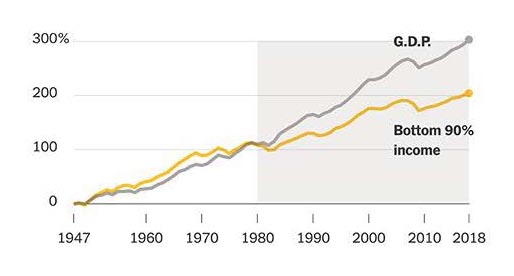 The way the ruling bourgeoisie in capitalist society figures things, the growth of GDP is all
important; the more the economy grows the better things are for everybody. But this is only really
true if that increased wealth is actually distributed to “everybody”. In reality, most of it goes
to the rich and their corporations.
The way the ruling bourgeoisie in capitalist society figures things, the growth of GDP is all
important; the more the economy grows the better things are for everybody. But this is only really
true if that increased wealth is actually distributed to “everybody”. In reality, most of it goes
to the rich and their corporations.
In the graphic on the right, prepared by the journalist
David Leonhardt (see quotation below), we see that during the post-World War II era until around 1980
the incomes of the bottom 90% of the U.S. population more or less tracked GDP growth. But for the past
40 years, since 1980, incomes of the bottom 90% have more and more failed to keep up with GDP growth.
This means that GDP growth is ever more irrelevant to the livelihood of even 90% of the U.S. population,
let alone to the lower strata of the working class and masses.
“The Commerce Department will announce the latest G.D.P. numbers on Friday, and
they’ll probably be solid. The economy seems to be growing at an annual rate of about 2 percent,
which isn’t bad for the 11th year of an expansion. [See, however, the entry on
GDP—Validity Of below. —Ed.]
“After the numbers come out, something else
will probably happen: Pundits will once again express bafflement about the apparent disconnect
between the [supposedly!] healthy American economy and the sour national mood. But there is really
no disconnect. The fault—with apologies to Shakespeare—is in our stats, not ourselves.
“Americans are dissatisfied, and have been
for years, largely because the economy as most people experience it has not been booming. G.D.P.—or
gross domestic product, the economy’s total output—keeps on rising, but it no longer tracks the
well-being of most Americans. Instead, an outsize share of economic growth flows to the wealthy.
And yet G.D.P. is treated as a totemic measure of the country’s prosperity.
“Consider the true picture: Middle-class
income growth has been sluggish for decades. The typical household is still poorer than it was
before the financial crisis began in 2007. Most alarming, average life expectancy has recently
been declining. No wonder polls show that a majority of Americans have been dissatisfied with the
country’s direction for the past 15 years in a row, a period that encompasses the entirety of the
G.D.P. expansion, the longest on record.” —David Leonhardt, “G.D.P. Is Broken, but We Can Fix It”,
N.Y. Times, Dec. 16, 2019, op-ed page.
“Economic welfare cannot be adequately measured unless the personal distribution
of income is known.” —Simon Kuznets, the economist who first developed the GDP statistic, quoted
in David Leonhardt, ibid.
GROSS DOMESTIC PRODUCT — U.S. — Declining Growth Rates Of
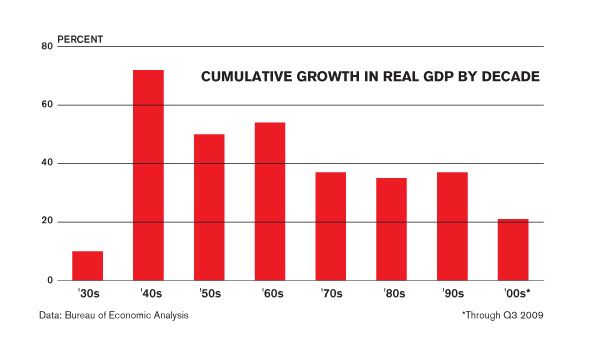 The growth rate of GDP has fallen overall in all the advanced capitalist countries ever since
the early 1970s. Roughly speaking, the growth rate has been less than half of what it was
during the previous quarter century period (the post-World War II boom).
The growth rate of GDP has fallen overall in all the advanced capitalist countries ever since
the early 1970s. Roughly speaking, the growth rate has been less than half of what it was
during the previous quarter century period (the post-World War II boom).
But in addition to this overall qualitative
drop in the growth rate of GDP, there has also been a roughly continuous fall in GDP growth from
decade to decade since the 1940s. The graph at the right shows this for the United States. This
is a result of the gradually developing capitalist overproduction crisis, which is clearly getting
more and more serious.
GROSS DOMESTIC PRODUCT — Validity Of
There are a great many reasons why GDP, as measured by capitalist governments, is actually
a wildly distorted indicator of the size of their real economies. GDP is officially the sum
total of all the goods and services produced and sold in a given period. However, in practice
governments include the sale of more and more things which are not actually newly produced
commodities in the period in question, and may not even be actual commodities in the first
place. These larger distortions occur because of the inclusion of money spent in gambling in
stock markets and for other forms of fictitious
capital. And there are many other distortions (exaggerations) in adding up GDP figues as
well.
In short GDP and GDP growth rates are all
greatly exaggerated, and have become ever more exaggerated over the years. This means
that the decline of GDP growth rates in recent decades (as shown in the entry above) is
actually even worse than the official figures indicate!
“Let us therefore ask ourselves if it is correct to define the market
as the aggregate of all sales and purchase transactions. We think that certain
qualifications should be introduced. In the capitalist world huge sums are spent on the
sale and purchase of things having no genuine value [in the Marxist sense]—securities
(fictitious capital), land, buiding sites in towns, patents, etc. It often happens that
for speculative reasons the same commodities are sold over and over again. These
transactions are purely fictitious—the seller has no commodities for sale and the buyer
does not even intend to acquire them. Such transactions are essentially only a
speculation on future prices....
“Furthermore, the bulk of
commodities is sold several times while en route from producer to consumer.” —Eugen
Varga, Politico-Economic Problems of Capitalism (1968), pp. 169-170.
“There are many problems with GDP accuracy reflecting the real trends and
real GDP that many economists have discussed at length elsewhere. My major critique is the
redefinition in 2013 that added at least 0.3% (and $500b a year) to GDP totals by simply
redefining what constituted investment. Another chronic problem is how the price index, the
GDP Deflator as it’s called, grossly underestimates inflation and thus the price adjustment
to get the 3.2% ‘real’ GDP figure reported. In this latest report, the Deflator estimated
inflation of only 1.9%. If actual inflation were higher, which it is, the 3.2% would be much
lower, which it should. There are many other problems with GDP, such as the government
including in their calculation totals the ‘rent’ that 50 million homeowners with mortgages
reputedly ‘pay to themselves’.” —Jack Rasmus, “The Facts Behind the Hype: US GDP 1st Quarter
2019 Analysis”, April 30, 2019, CounterPunch, online at:
https://www.counterpunch.org/2019/04/30/the-facts-behind-the-hype-us-gdp-1st-quarter-2019-analysis/
GROSS DOMESTIC PRODUCT PER HOUR WORKED
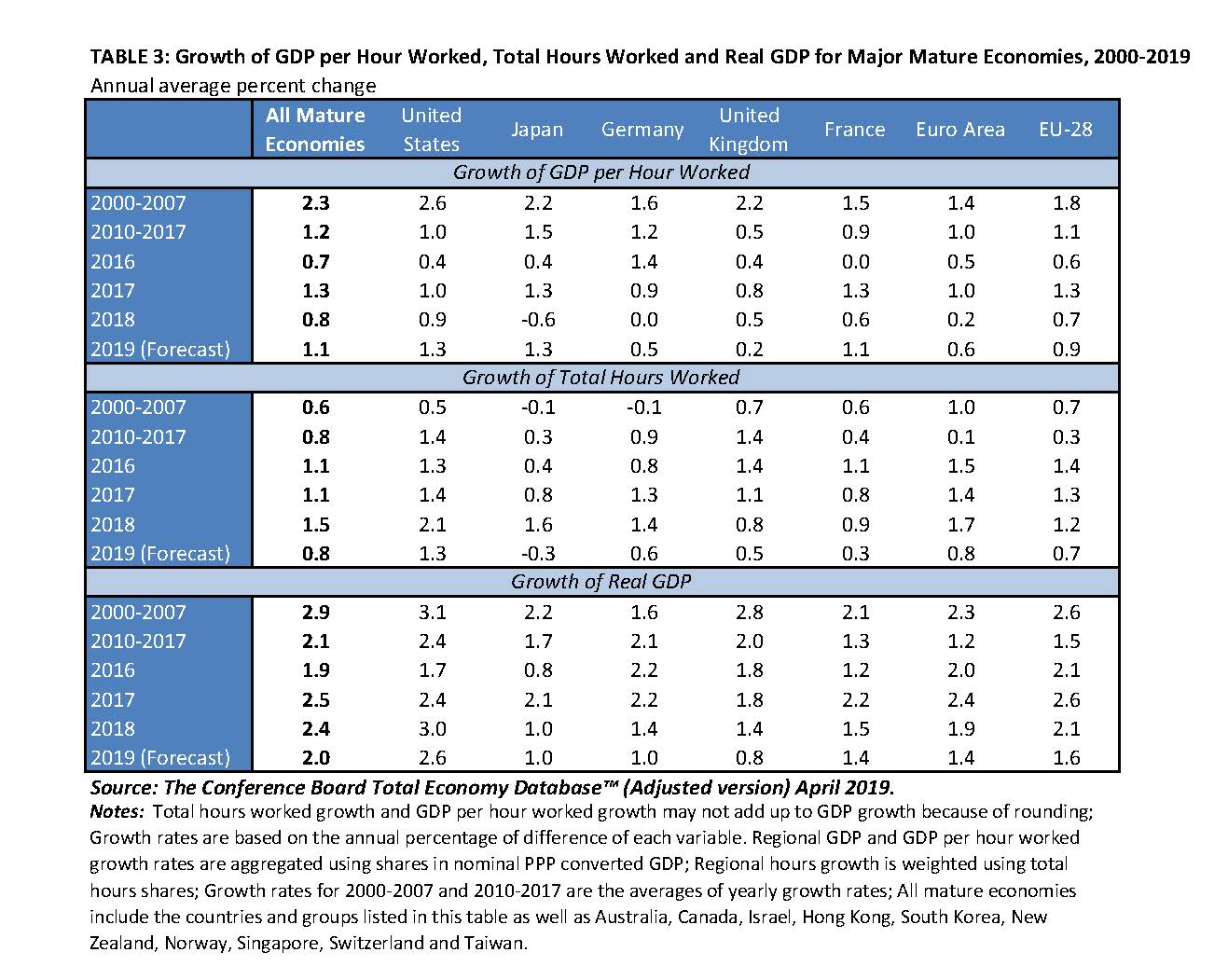 A measure of average labor productivity in an economy, which purports to measure how efficiently labor is
being used in the production process. It is defined as the GDP divided by the total hours worked by all
people engaged in production, and is usually calculated on an annual basis. However, given that the GDP
figures measured in capitalist society are themselves quite distorted (substantially exaggerated)—see the
entry above on GDP—Validity Of—the GDP per hour worked figures are also
quite exaggerated. The rates of change of GDP per hour worked from one year to the next are more
reliable since usually there are not major changes in how GDP is measured from one year to the next. There
are, however, many fluctuations up and down from year-to-year in the growth rates, and for this reason the
rate of growth (or decline) in the average GDP per hour worked is often compared for multi-year periods.
During the 2010-2017 period, for example, China’s GDP per hour worked rose at an average annual rate of
about 7%, though in 2018 it only rose at a rate of around 4% (still much faster than in “mature” capitalist
economies).
A measure of average labor productivity in an economy, which purports to measure how efficiently labor is
being used in the production process. It is defined as the GDP divided by the total hours worked by all
people engaged in production, and is usually calculated on an annual basis. However, given that the GDP
figures measured in capitalist society are themselves quite distorted (substantially exaggerated)—see the
entry above on GDP—Validity Of—the GDP per hour worked figures are also
quite exaggerated. The rates of change of GDP per hour worked from one year to the next are more
reliable since usually there are not major changes in how GDP is measured from one year to the next. There
are, however, many fluctuations up and down from year-to-year in the growth rates, and for this reason the
rate of growth (or decline) in the average GDP per hour worked is often compared for multi-year periods.
During the 2010-2017 period, for example, China’s GDP per hour worked rose at an average annual rate of
about 7%, though in 2018 it only rose at a rate of around 4% (still much faster than in “mature” capitalist
economies).
The growth rates for GDP per hour worked for OECD countries
for the past 25 years or so are available at:
https://stats.oecd.org/Index.aspx?DataSetCode=PDB_GR
GROSS DOMESTIC PRODUCT — Per Person (In PPP Terms)
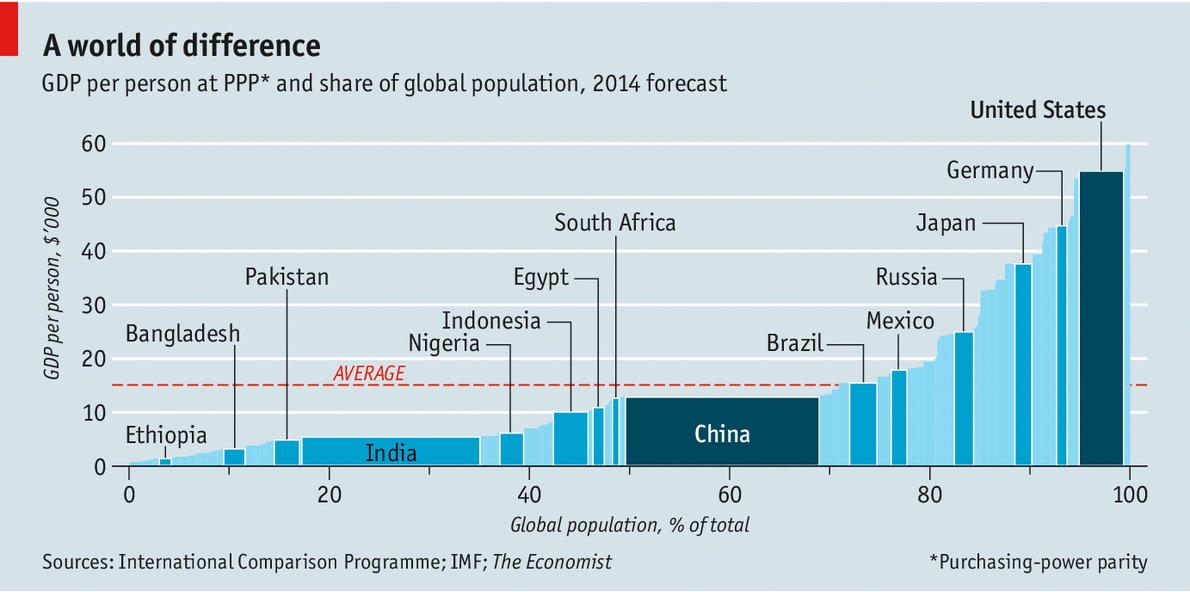 The chart on the right, from the Economist magazine, shows the levels of GDP per
person on the vertical axis along with the percentage of world population along the
horizontal axis. Thus the areas for each of the named countries corresponds to
their total GDP. The GDP figures are in Purchasing Power Parity
terms (which is the most truthful way to compare GDP from one country to another). Note
that as of 2014 China is expected to surpass the U.S. in total GDP for the first time.
The chart on the right, from the Economist magazine, shows the levels of GDP per
person on the vertical axis along with the percentage of world population along the
horizontal axis. Thus the areas for each of the named countries corresponds to
their total GDP. The GDP figures are in Purchasing Power Parity
terms (which is the most truthful way to compare GDP from one country to another). Note
that as of 2014 China is expected to surpass the U.S. in total GDP for the first time.
GROSS NATIONAL INCOME (GNI)
The World Bank Atlas (2004) defines GNI as “GDP plus net receipts of primary income
(compensation of employees and property income) from abroad.” However, strictly speaking, GNI
is actually Gross Domestic Income plus net receipts from
abroad. So in theory GNI is equivalent to GNP, though it is measured independently and may
therefore differ somewhat.
GROSS NATIONAL PRODUCT (GNP)
Gross Domestic Product together with net property income from abroad. A generation ago GNP
was used as the primary overall statistic by the U.S. government in describing its economy
and those of other nations. Since the U.S. was receiving tremendous income from abroad,
referring to GNP rather than GDP made the U.S. internal economy look better than it actually
was. However, as other countries began to receive more and more income from the property
their capitalists own in the U.S., this statistical advantage began to disappear. So the U.S.
switched over to the system that other countries were using, discussing its economy in terms
of GDP rather than GNP.
“Maximization of GNP is not a proper objective of policy. Economists
all know that, and yet their everyday use of GNP as the standard measure of economic
performance apparently conveys the impression that they are evangelistic worshippers
of GNP.” —William Nordhaus & James Tobin, 1972. These two liberal bourgeois economists
were not suggesting that GDP be used as the standard measure of economic performance
rather than GNP; they were instead proposing some broader “Measure of Economic
Welfare”. This proposal has been almost completely ignored by the bourgeois economics
profession, which has little concern for the welfare of the masses.
GSE
See: GOVERNMENT SPONSORED ENTERPRISE
Dictionary Home Page and Letter Index
MASSLINE.ORG Home Page