BOER WAR
An imperialist war by Britain against Dutch settlers (“Boers”) in southern Africa at the
beginning of the 20th century which managed to expand and secure British colonial control
over that entire region.
“Imperialism, as the highest stage of capitalism in America and Europe,
and later in Asia, took final shape in the period 1898–1914. The Spanish-American War
(1898), the Anglo-Boer War (1899–1902), the Russo-Japanese War (1904–05) and the
economic crisis in Europe in 1900 are the chief historical landmarks in the new era of
world history.” —Lenin, “Imperialism and the Split in Socialism” (Oct. 1916),
LCW 23:106.
“Great Britain’s quarrel with the Boer republics dated back many
years. When the British during the Napoleonic wars had taken over Cape Town and its
environs, the Dutch farmers there had trekked inland. In doing so, they had situated
themselves over great lodes of gold and diamonds. So enter, in time, the archintriguer
Cecil Rhodes. The object of Rhodes’s scheming was the removal of the Boers so that he
could get his hands on the most valuable mineral deposits in the world. Wealthy
already, he induced the British government to provoke a war with the Boers, a fight
he was certain the Boers would lose.
“With British forces concentrated
on the borders of the Boer republics, President Kruger met with [British] Commissioner
Milner only briefly; there was nothing to say. So on October 8, 1899, Kruger issued
an ultimatum, demanding a British withdrawal. No retreat ensuing, the Boer War began
on October 11, 1899.
“Three years later, the British
won the war, barely. Only by burning Boer farmhouses, forcing Boer women and children
into concentration camps, and bringing most of the firepower of the empire to bear
against a handful of grunting Dutch farmers did Great Britain manage to prevail.
“Even in victory, the British
government concealed from its people a telling statistic. To pay for the war, London
had had to borrow a fifth of the cost from American banks.”
—Robert Smith Thompson, The
Eagle Triumphant: How America Took Over the British Empire (2004), pp. 32-33.
BOOKS (and BOOK KNOWLEDGE)
“Merely having a library filled with books about, say mathematics,
fashion, or word origins does not make one a mathematician, a fashion designer, or an
etymologist. What counts, rather, is the degree to which the concepts in those books
are internalized by a person, thus enriching their conceptual space and turning them
into a thinker able to make new categorizations and analogies.” —Douglas Hofstadter &
Emmanuel Sander, Surfaces and Essences: Analogy as the Fuel and Fire of Thinking
(2013), p. 132.
[Likewise having a library filled
with books about Marxism does not make one a revolutionary. In revolutionary politics
the goal is indeed for us to internalize the ideas of Marx, Engels, Lenin, Mao
and many other less prominent creators of MLM theory. And that can only happen through
serious and sustained study. At the same time, of course, we go further and recognize
that mere book knowledge, no matter how well internalized it may be, is still
not enough. In addition to that we need our own participation with the masses in
struggle and at least some considerable direct investigations of our own about objective
conditions and the ideas and mood of the masses. —Ed.]
“What do we need in order to learn communism? Here a number of dangers
arise, which very often manifest themselves whenever the task of learning communism is
presented incorrectly, or when it is interpreted in too one-sided a manner.
“Naturally, the first thought that
enters one’s mind is that learning communism means assimilating the sum of knowledge that
is contained in communist manuals, pamphlets and books. But such a definition of the study
of communism would be too crude and inadequate. If the study of communism consisted solely
in assimilating what is contained in communist books and pamphlets, we might all too easily
obtain communist text-jugglers or braggards, and this would very often do us harm, because
such people, after learning by rote what is set forth in communist books and pamphlets,
would prove incapable of combining the various branches of knowledge, and would be unable
to act in the way communism really demands.
“One of the greatest evils and misfortunes
left to us by the old, capitalist society is the complete rift between books and practical
life; we have had books explaining everything in the best possible manner, yet in most cases
these books contained the most pernicious and hypocritical lies, a false description of
capitalist society.
“That is why it would be most mistaken
merely to assimilate book knowledge about communism. No longer do our speeches and articles
merely reiterate what used to be said about communism, because our speeches and articles are
connected with our daily work in all fields. Without work and without struggle, book knowledge
of communism obtained from communist pamphlets and workers is absolutely worthless, for it would
continue the old separation of theory and practice, the old rift which was the most pernicious
feature of the old, bourgeois society.”
—Lenin, “The Tasks of the Youth Leagues”
(Oct. 5-7, 1920), LCW 31:284-285.
“The old schools [under capitalism] provided purely book knowledge; they
compelled their pupils to assimilate a mass of useless, superfluous and barren knowledge, which
cluttered up the brain and turned the younger generation into bureaucrats regimented according
to a single pattern. But it would mean falling into a grave error for you to try to draw the
conclusion that one can become a Communist without assimilating the wealth of knowledge amassed
by mankind. It would be mistaken to think it sufficient to learn communist slogans and the
conclusions of communist science, without acquiring that sum of knowledge of which communism is
a result. Marxism is an example which shows how communism arose out of the sum of human
knowledge.” —Lenin, ibid., p. 286.
“In order to have a real grasp of Marxism, one must learn it not only from books,
but mainly through class struggle, through practical work and close contact with the masses of
workers and peasants. When in addition to reading some Marxist books our intellectuals have
gained some understanding through close contact with the masses of workers and peasants and
through their own practical work, we will all be speaking the same language, not only the common
language of patriotism and the common language of the socialist system, but probably even the
common language of the communist world outlook. If that happens, all of us will certainly work
much better.” —Mao, “Speech at the Chinese Communist Party’s National Conference on Propaganda
Work” (March 12, 1957); also in the first (1966) edition of Quotations of Chairman Mao
Tse-tung, p. 312.
BOURGEOIS DEMOCRACY
The form of capitalist society in which the
dictatorship of the bourgeoisie is camouflaged by mostly superficial (i.e., fundamentally
false or very limited) democratic forms. One favorite technique is to alternate rule between
two different bourgeois political parties, both of which represent the fundamental interests of
the capitalists and which differ only on secondary questions on which the capitalists themselves
are not in agreement. The masses are accorded a minor role in deciding which of these two
basically indistinguishable parties (from the proletarian point of view) shall administer
capitalist power in any given period, in order to give them the illusion that they are
controlling society.
More important than the mostly phony and
manipulated elections in bourgeois-democratic states, however, is the existence of at least some
partial rights and freedoms among the working class and masses to express their opinions, speak
out publicly, to have at least some limited freedoms of the press, freedoms to congregate and
protest, and to form organizations, and so forth. As limited as such democratic rights still
generally are, they are useful and important to the people and to the possibilities of allowing
the masses to further educate and organize themselves and to start to build a revolutionary
movement. This is why bourgeois democracy, despite its great limitations, is still qualitatively
better than the more oppressive ruling-class alternative — fascism.
However, it is certainly true that bourgeois
democracy is not only quite restricted in its partial freedoms even when it does exist, it is
also quite precarious as a whole. Whenever bourgeois rule is seriously threatened the capitalists
soon dispense with the camouflage of bourgeois democracy and shift to more open repression, to
fascism.
But it is well to remember that even during times
when the capitalist class is in firm and secure control, and the revolutionary movement has not
yet developed to any significant degree, the form that bourgeois democracy takes is by no means
full and complete. There is in fact no such thing as a “pure” bourgeois democracy. Instead, all
real-world bourgeois democracies already have at least some secondary fascist elements to them,
at least some undemocratic repressive laws, and government practices and tendencies, which
are more characteristic of fascism. For reasons such as this, Marxist revolutionaries should
never start to imagine that the promotion of bourgeois democracy is our primary goal and what
we exist for!
See also below, and:
CITIZENS—In American Bourgeois Democracy,
DIRECT DEMOCRACY,
ELECTIONS—In a Bourgeois Democracy,
“LESSER OF TWO EVILS”,
MAJORITY [Hinton quote],
POLYARCHY,
“TWO PARTY SYSTEM”
“To decide once every few years which member of the ruling class is to
repress and crush the people through parliament—this is the real essence of bourgeois
parliamentarism, not only in parliamentary-constitutional monarchies, but also in the most
democratic republics.” —Lenin, “The State and Revolution” (August-September 2017),
LCW 25:422.
“Bourgeois democracy, although a great historical advance in comparison
with medievalism, always remains, and under capitalism is bound to remain, restricted,
truncated, false and hypocritical, a paradise for the rich and a snare and deception for
the exploited, for the poor.” —Lenin, “The Proletarian Revolution and the Renegade
Kautsky” (Oct.-Nov. 1918), LCW 28:243.
“There is not a single state, however democratic, which has no
loopholes or reservations in its constitution guaranteeing the bourgeoisie the
possibility of dispatching troops against the workers, of proclaiming martial law,
and so forth, in case of a ‘violation of public order’, and actually in case the
exploited class ‘violates’ its position of slavery and tries to behave in a non-slavish
manner.” —Lenin, ibid., LCW 28:244.
“The reason why the omnipotence of ‘wealth’ is more certain in
a democratic republic is that it does not depend on the faulty political shell of
capitalism. A democratic republic is the best possible political shell for capitalism,
and, therefore, once capital has gained possession of this very best shell ... it
establishes its power so securely, so firmly, that no change of persons,
institutions or parties in the bourgeois-democratic republic can shake it.” —Lenin,
“The State and Revolution” (August-September 2017), LCW 25:393.
BOURGEOIS MEDIA
 See also:
FAKE NEWS,
MEDIA—Conservative Attitudes Towards,
NEWS SOURCES,
NEWSPAPERS,
TRUSTWORTHY NEWS SOURCES
See also:
FAKE NEWS,
MEDIA—Conservative Attitudes Towards,
NEWS SOURCES,
NEWSPAPERS,
TRUSTWORTHY NEWS SOURCES
“Five U.S. media conglomerates [now have] more communications
power than was exercised by any dictatorship and despot in history.”
—Ben Bagdikian, a liberal
bourgeois journalist and media critic, in his book The New Media Monopoly
(2004), referring to the concentration of media control in the U.S. into just
five major corporations: Time Warner, the Walt Disney Co., Murdoch’s News
Corporation, Viacom and Bertelsmann (a German company). [Of course even before
this nearly complete media concentration, the bourgeoisie already had a nearly
total class monopoly on news and opinion all along. —Ed.]
“Then there’s the tone that establishment media outlets use to
discuss government wrongdoing. The culture of US journalism mandates that reporters
avoid any clear or declarative statements and incorporate government assertions into
their reporting, treating them with respect no matter how frivolous they are. They
use what the [Washington] Post’s own media columnist, Erik Wemple, derides
as middle-of-the-road-ese: never saying anything definitive but instead
vesting with equal credence the government’s defenses and the actual facts, all of
which has the effect of diluting revelations to a muddled, incoherent, often
inconsequential mess. Above all else, they invariably give great weight to official
claims, even when those claims are patently false or deceitful.
“It was that fear-driven,
obsequious journalism that led the [N.Y.] Times, the Post, and many
other outlets to refuse to use the word ‘torture’ in their reporting on Bush
interrogation techniques, even though they freely used that word to describe the
exact same tactics when used by other governments around the world. It was also
what produced the debacle of media outlets laundering baseless government claims
about Saddam [Hussein] and Iraq to sell to the American public on a war built of
false pretenses that the US media amplified rather than investigated.” —Glenn
Greenwald, No Place to Hide: Edward Snowden, the NSA, and the U.S. Surveillance
State (2014), pp. 55-56.
“BOURGEOIS RIGHT”
A legal right to hold private property in the form of capital and/or
unfair quantities of personal private property; and largely because of this, to also possess important
social advantages, privileges and influence that others do not have. Of course bourgeois right is a notorious
characteristic of capitalist society, but it also continues to exist in a generally diminished form in
socialist society as well—that is, during the transition stage from
capitalism to communism. Only in communist society will there be absolutely no such thing as bourgeois
right.
In capitalist society bourgeois right primarily
consists of legal rights to the ownership and accumulation of property in the form of industrial, financial,
or other kinds of capital, and the privileges and social influence (including
especially political influence) that the ownership of capital provides. The greater the accumulation of
capital by an individual or family, the greater the privileges and influence. However, the accumulation of
personal private property, such as luxurious homes, lavish wardrobes, expensive art collections,
large personal bank accounts, vacation properties, expensive automobiles and even yachts, can also
considerably augment the social privileges and influence of the owners. (Indeed, to some extent
conspicuous consumption exists for just this reason in
capitalist society.)
In (genuine) socialist society there is of course no private
ownership of the means of production, and there is no private
ownership of capital in any form. (Or, in other words, “capital”, as the thing we Marxists refer to in
capitalist society, no longer exists! The means of production still exist, of course, but the social class
relationship—capital—resulting from the private ownership of that means of production no longer
exists.) For that reason, under socialism there can be no bourgeois right and no social privileges or
influence that arises out of that kind of ownership of private property. However, as long as there is
a system of equal wages for equal amounts of work (let alone differences in wages under socialism for one
reason or another) there will inevitably be differences in the accumulation of wealth by different people—even
if they are all workers! This is because equal wages for equal work does not take account of the fact that
different people have different levels of needs.
If one worker under socialism has children while another does
not, then the needs (and expenses) of the worker with children will be much greater than those of the worker
without children. They may well make the very same wages, but identical wages in this case do not lead to
equality in living standards; quite the opposite. Individuals with special needs of any other kind lead to
similar inequalities. And while one would certainly expect that the health care and welfare systems under
socialism will be vastly superior to those pathetic systems under capitalism, it is quite likely that at
least in the early days of socialism they may still not be perfect. In that case the system of equal wages
for equal work may still not completely lead to full social equality for people who have serious health
problems or who are unable to work for long periods. Then too, people in different regions may have different
needs (such as for greater clothing and high heating expenses in winter in colder areas). The system of equal
wages for equal work can in part be modified to allow for such regional differences, but it is virtually
impossible to do this perfectly for every individual in their own special circumstances.
This means that even under socialism some people will
inevitably become somewhat better off than other people; some will accumulate more personal wealth, be able to
obtain better educations for themselves and their children, develop social connections among other similar
better-off people, and begin to form the social basis for a new privileged social class. This proto-class will
in turn virtually inevitably try to become a new full-fledged bourgeoisie, once again having the legal right
to own capital, to exploit hired workers, and to control and run society in its own selfish class interests.
And in that case, instead of socialism developing into communism, it will soon revert back into total
capitalism or capitalist-imperialism!
This is why the question of bourgeois right, and how to
deal with it in socialist society is so extremely important. It is probably the deepest reason why the
socialist system is inherently unstable. Through further mass struggle socialism can in fact be advanced
and transformed into communism. But without extensive mass struggle led by a genuine MLM party, socialism can
quite easily revert back into capitalism. It has already happened in the Soviet Union and China after the
deaths of revolutionary leaders.
We have mentioned that socialist society can be somewhat moved
toward the basic principle of communist society—“From each according to their ability, to each according to
their needs”—through adjustments to the wage system, such as by raising the wages of those who have special
needs because of illness or other factors. But for the most part it is better to deal with this by creating
totally free and high quality health care for everyone, and first rate social welfare systems for unemployment,
disabilities, and other forms of social welfare. However, even these things are not good enough! (After all,
they have been established in social democratic states, and then been weakened or destroyed when the capitalists
in power decided they must do so.) Thus the ultimate way to defeat bourgeois right, and the danger of capitalist
restoration, is to eliminate the wages system completely and transform the entire economy into communism.
Even the use of money must be eliminated. Since socialism is unstable, we must transform it into communism to
achieve true social and economic stability, as well as genuine and complete social justice.
Bourgeois right is a somewhat subtle concept. This is
because it refers not only to actual property rights but generally also to the privileges and influence which
derive from those ownership rights. To help further clarify things, we provide below a number of important
quotations from Marx and Lenin.
See also:
PROPERTY — Versus Possessions
“‘Equal right,’ says Marx, we indeed have here [in socialist society]; but it is
still a ‘bourgeois right,’ which, like every right, presupposes inequality. Every
right is an application of an equal measure to different people who in fact are not
alike, are not equal to one another; that is why ‘equal right’ is really a violation of equality
and an injustice. Indeed, every man, having performed as much social labor as another, receives an
equal share of the social product (after the above-mentioned deductions). But people are not alike:
one is strong, another is weak; one is married, another is not; one has more children, another has
less, and so on. And the conclusion Marx draws is:
“[Quoting Marx:] ‘...with an equal performance
of labor, and hence an equal share in the social consumption fund, one will in fact receive more
than another, one will be richer than another, and so on. To avoid all these defects, right instead
of being equal would have to be unequal.’
“Hence, the first phase of Communism [i.e.,
socialist society] cannot yet produce [complete] justice and equality: differences, and unjust
differences, in wealth will still exist, but the exploitation of man by man will have become
impossible, because it will be impossible to seize the means of production, the factories,
machines, land, etc., as private property.”
—Lenin, “The State and Revolution”
(August-September 1917), (Peking: FLP, 1973), pp. 110-111.
“Marx not only most scrupulously takes account of the inevitable inequality of
men, but he also takes into account the fact that the mere conversion of the means of production
into the common property of the whole of society (commonly called ‘Socialism’) does not remove
the defects of distribution and the inequality of ‘bourgeois right’ which continues to prevail
as long as products are divided “according to the amount of labor performed.”
—Lenin, “The State and Revolution”, ibid.,
pp. 111-112.
“In the first phase of communist society (usually called Socialism) ‘bourgeois
right’ is not abolished in its entirety, but only in part, only in proportion to the economic
revolution so far attained, i.e., only in respect of the means of production. ‘Bourgeois right’
recognizes them as the private property of individuals. Socialism converts them into common
property. To that extent—and to that extent alone—‘bourgeois right’ disappears.
“However, it continues to exist as far as its
other part is concerned; it continues to exist in the capacity of regulator (determining factor)
in the distribution of products and the allotment of labor among the members of society. The
socialist principle: ‘He who does not work, neither shall he eat,’ is already realized; the
other socialist principle: ‘An equal amount of products for an equal amount of labor,’ is also
already realized. But this is not yet Communism, and it does not yet abolish ‘bourgeois
right,’ which gives to unequal individuals, in return for unequal (really unequal) amounts of
labor, equal amounts of products.”
“This is a ‘defect,’ says Marx, but it is
unavoidable in the first phase of Communism [i.e., socialism]; for if we are not to indulge in
utopianism, we must not think that having overthrown capitalism people will at once learn to work
for society without any standard of right; and indeed the abolition of capitalism does
not immediately create the economic premises for such a change.
“And there is no other standard than that of
‘bourgeois right.’ To this extent, therefore, there still remains the need for a state, which,
while safeguarding the public ownership of the means of production, would safeguard equality in
labor and equality in the distribution of products.”
—Lenin, “The State and Revolution”, ibid.,
pp. 112-113.
“Of course, bourgeois right in regard to the distribution of articles of
consumption inevitably presupposes the existence of the bourgeois state, for right
is nothing without an apparatus capable of enforcing the observance of the standards of
right.
“It follows that under [the first stage of]
Communism there remains for a time not only bourgeois right, but even the bourgeois state—without
the bourgeoisie!
“This may sound like a paradox or simply
a dialectical conundrum, of which Marxism is often accused by people who do not take the slightest
trouble to study its extraordinarily profound content.
“But as a matter of fact, remnants of the old
surviving in the new confront us in life at every step, both in nature and in society. And Marx did
not arbitrarily insert a scrap of ‘bourgeois’ right into Communism [or what we now refer to as
socialism —Ed.], but indicated what is economically and politically inevitable in a society emerging
out of the womb of capitalism.”
—Lenin, “The State and Revolution”, ibid.,
p. 118.
[One thing that Lenin did not mention here,
however, is that the very existence of bourgeois “right”, even in a developed socialist society,
might in itself foster the growth of bourgeois ideas more generally, and even lead to the advent
of a new bourgeoisie! This is further reason for thinking that socialism is an unstable social
formation; it must either develop all the way into full-scale communism, or else eventually fail
and revert to capitalism. —S.H.]
“In capitalist society, the economic foundation for the bourgeoisie is the capitalist
possession of the means of production. After the proletariat seizes power and basically completes the
socialist transformation of the system of ownership, does the bourgeoisie still exist? Marx, Engels
and Lenin have clearly pointed out that the existence of bourgeois right is a condition for the
existence of class differences. As long as bourgeois right exists, there will be classes and class
struggle. At the same time, the brilliant idea was also put forward that bourgeois right serves as
the soil and condition for the emergence of a new bourgeoisie. Under new historical conditions,
Chairman Mao defended and developed these brilliant thoughts. Chairman Mao said: ‘With the
socialist revolution they themselves [i.e. the capitalist roaders—Ed.] come under fire. At
the time of the cooperative transformation of agriculture there were people in the Party opposed,
and when it came to criticizing bourgeois right, they were resentful.’ Here Chairman Mao’s
instruction profoundly clarifies the relationship between the bourgeoisie and bourgeois right. It
explains the economic interests and political outlook of the inner-party bourgeoisie.”
—“A Summary of Views on the Problem of the
Inner-Party Bourgeoisie”, as reprinted (in Chinese) by the Propaganda Department, Zhongshan County
Party Committee, Communist Party of China, July 8, 1976. Partial English translation online at:
https://www.bannedthought.net/China/MaoEra/GPCR/SummaryOfViewsOnTheInner-PartyBourgeoisie-English-Partial-OCR.pdf
BOURGEOISIE — Past Revolutionary Role Of
While the bourgeoisie, or capitalist class, is today the most reactionary and
anti-revolutionary class, and the class that stands in the way of social progress, this was
not always so. In its youth the bourgeoisie led in the struggle against feudalism in Europe,
and in that long past age actually played a most revolutionary role in society.
“Modern industry has established the world market, for which the
discovery of America paved the way. This market has given an immense development to
commerce, to navigation, to communications by land. This development has, in its turn,
reacted on the extension of industry; and in proportion as industry, commerce, navigation,
railways extended, in the same proportion the bourgeoisie developed, increased its
capital, and pushed into the background every class handed down from the Middle Ages.
“We see, therefore, how the modern
bourgeoisie is itself the product of a long course of development, of a series of
revolutions in the modes of production and of exchange.
“Each step in the development of the
bourgeoisie was accompanied by a corresponding political advance of that class.” —Marx
& Engels, Manifesto of the Communist Party (1848), MECW 6:486.
“The bourgeoisie, historically, has played a most revolutionary part.
“The bourgeoisie, wherever it has got
the upper hand, has put an end to all feudal, patriarchal, idyllic relations. It has
pitilessly torn asunder the motley feudal ties that bound man to his ‘natural superiors’,
and has left remaining no other nexus between man and man than naked self-interest, than
callous ‘cash payment’. It has drowned the most heavenly ecstasies of religious fervor,
of chivalrous enthusiasm, of philistine sentimentalism, in the icy water of egotistical
calculation. It has resolved personal worth into exchange value, and in place of the
numberless indefeasible chartered freedoms, has set up that single, unconscionable
freedom—Free Trade. In one word, for exploitation, veiled by religious and political
illusions, it has substituted naked, shameless, direct, brutal exploitation.” —Marx
& Engels, ibid., MECW 6:486-7.
Dictionary Home Page and Letter Index
MASSLINE.ORG Home Page
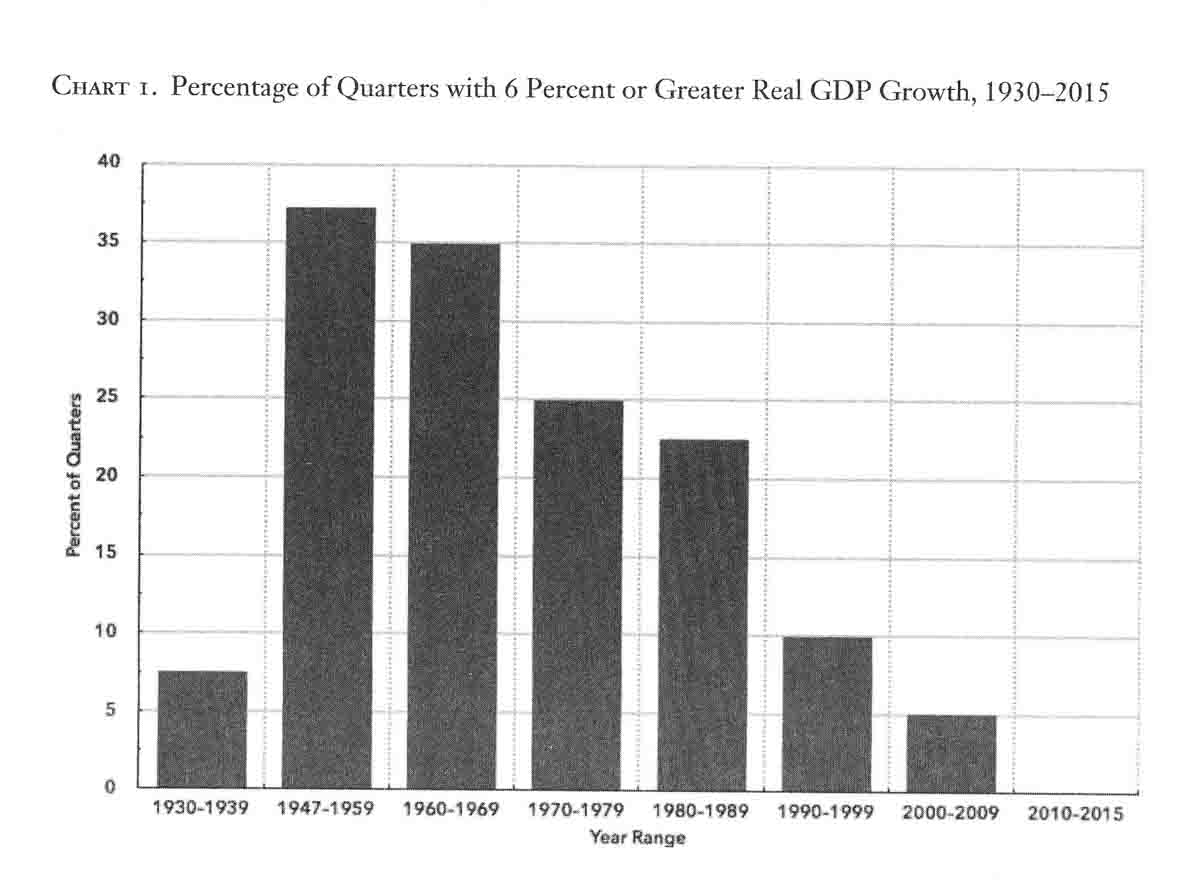 The graph at the right shows the percentage
of boom quarters in the U.S. economy from 1930 through 2015 (omitting the World War II years
which were a major aberration in the economy). For each period it shows the percentage of the
yearly quarters in which the annualized GDP growth rate was 6% or greater. Note the rapid
decline in boom quarters from the post-war highs in 1947-1969, and the fact that there have
been no boom quarters at all in the most recent period. Source: Robert W. McChesney &
John Nichols, People Get Ready: The Fight Against a Jobless Economy and a Citizenless
Democracy (2016), p. 44.
The graph at the right shows the percentage
of boom quarters in the U.S. economy from 1930 through 2015 (omitting the World War II years
which were a major aberration in the economy). For each period it shows the percentage of the
yearly quarters in which the annualized GDP growth rate was 6% or greater. Note the rapid
decline in boom quarters from the post-war highs in 1947-1969, and the fact that there have
been no boom quarters at all in the most recent period. Source: Robert W. McChesney &
John Nichols, People Get Ready: The Fight Against a Jobless Economy and a Citizenless
Democracy (2016), p. 44. In China, before the revolutions of the 20th century, there was a horrible feudal custom of
binding the feet of women to supposedly make them appear more demure in their appearance and
movement. This brutal crime against women led to major deformities and broken bones and
prevented them from walking normally. In the picture at the right there is a comparison of
the bound feet of a victim of this practice next to the feet of a normal woman. Of course
the revolution led by Mao and the Communist Party of China put a complete end to this
disgusting feudal custom.
In China, before the revolutions of the 20th century, there was a horrible feudal custom of
binding the feet of women to supposedly make them appear more demure in their appearance and
movement. This brutal crime against women led to major deformities and broken bones and
prevented them from walking normally. In the picture at the right there is a comparison of
the bound feet of a victim of this practice next to the feet of a normal woman. Of course
the revolution led by Mao and the Communist Party of China put a complete end to this
disgusting feudal custom.