BIBLE
 The book of absurd religious doctrine and supposed world history held to be “Holy” or “Sacred”, or the
“Word of God”, by Christians. Also called the “Scriptures”.
The book of absurd religious doctrine and supposed world history held to be “Holy” or “Sacred”, or the
“Word of God”, by Christians. Also called the “Scriptures”.
Among the many fanciful stories in the Bible are the
ones about the creation of the first man (“Adam”) by God; the creation of the first woman (“Eve”) by God
from one of Adam’s ribs; their utopian life in the Garden of Eden; their pursuit of wisdom against
God’s wishes; and their consequent expulsion from Eden by God. (See the WUMO cartoon at the right for
one humorous commentary on a part of this silly story.) Incredibly, a great many
fundamentalist Christians still claim to believe that every single
word in the Bible is true! (Though most non-fundamentalist Christians now have a few doubts here and
there.)
However, silliness is one thing and evil another. In a
common saying, and one of most ridiculous appellations of all time, the Bible has traditionally been
called “The Good Book” by Christians. It is actually quite the opposite of that, and is in fact a most
horrifying volume in many ways, as we detail in the quotations entry below. It has been used to “justify”
untold millions of murders in wars along with many other crimes against humanity.
“Bible: A book considered as great literature (despite page after page of unreadable
genealogical ‘begats’), considered to be the true history (despite the lack of confirming evidence and
absurdities, such as that the Earth was created in 6 days around 4000 B.C.), considered as the supreme
moral guide (despite the fact that it has been used to justify just about every atrocity ever conceived,
from burning witches at the stake to world war), and considered as the word of God (because it says so
of itself).” —S.H. (1998 or earlier).
BIBLE — A Few Quotations from a Horrible Book
Here are just a few of the great number of outrageous and disgusting statements one finds in the Christian Bible.
These are from the King James Version, which most Protestants use, and were originally collected in the Revolutionary
Worker newspaper, published by the RCP,USA, issue number 529, October 30, 1989. The full issue is online at:
https://www.bannedthought.net/USA/RCP/RW/1989/RW529-English.pdf
The Bible Upholds Slavery: Slaves must obey their masters—even the
most cruel masters: “Servants, be subject to your masters with all fear, not only to the good and gentle, but also
to the forward.” (1 Peter 2:18) [Note that while there were various categories of slaves in ancient
times, “servants” were also slaves. It may be that the King James translators tried to downplay that. —Ed.]
Wives are slaves to their husbands: “Wives submit yourselves unto
your own husbands, as unto the Lord.” (Ephesians 5:22)
Foreigners should be bought and sold as slaves: “Moreover of the
children of the strangers that do sojourn among you, of them shall ye buy, and of their families that are with you,
which they begat in your land: and they shall be your possessions.” (Leviticus 25:45)
In the Bible Women are Property of Husbands and Fathers. A man can sell
his daughter but she can’t even go out like a man slave and if her master doesn’t like her, he can sell her back—but not
to foreigners: “And if a man sell his daughter to be, a maidservant, she shall not go out as the menservants do. If
she please not her master, who hath betrothed her to himself, then shall he let her be redeemed: to sell her unto a
strange nation he shall have no power.” (Exodus 21:7-8)
Brides whose fathers cannot prove they are virgins are stoned to death:
“If any man take a wife, and go in unto her, and hate her, And give occasions of speech against her, and bring up an evil
name upon her, and say, I took this woman, and when I came to her, I found her not a maid... if this thing be true, and the
tokens of virginity be not found for the damsel: Then they shall bring out the damsel to the door of her father’s house,
and the men of her city shall stone her with stones that she die.” (Deuteronomy 22:13-21)
In the Bible Women are Punished for Being Raped: If a woman engaged to be
married is raped in the city she and the rapist are both stoned to death: “If a damsel that is a virgin be betrothed
unto an husband, and a man find her in the city, and lie with her; Then ye shall bring them both out unto the gate of that
city, and ye shall stone them with stones that they die; the damsel, because she cried not, being in the city; and the man,
because he hath humbled his neighbor’s wife.” (Deuteronomy 22:23-24)
If a man is caught raping a girl who is not engaged, the rapist must pay
the girl’s father, and the girl must marry the rapist!: “If a man find a damsel that is a virgin, which is not betrothed,
and lay hold on her and lie with her, and they be found; Then the man that lay with her shall give unto the damsel’s father
fifty shekels of silver, and she shall be his wife; because he hath humbled her, he may not put her away all his days.”
(Deuteronomy 22:28-29)
The Bible Teaches that Women are Unclean and Inferior: If you give birth
to a boy you are unclean for a week, if it’s a girl 2 weeks! “If a woman have conceived seed, and born a man child: then
she shall be unclean seven days... And she shall then continue in the blood of her purifying three and thirty days; she shall
touch no hallowed thing not come into the sanctuary... But if she bears a maid child, then she shall be unclean two weeks...
and she shall continue in the blood of her purifying threescore and six days.” (Leviticus 12:2-5)
Women are no good but they can be saved if they have babies and behave
themselves: “For Adam first formed, then Eve. And Adam was not deceived, but the woman being deceived was in the
transgression. Notwithstanding she shall be saved in childbearing if they continue in faith and charity and holiness with
sobriety.” (1 Timothy 2:13-15)
The Bible prescribes the death penalty for “Witches”: “Thou shalt not
suffer a witch to live.” (Exodus 22:18)
The Bible prescribes the death penalty for homosexuals: “If a man
also lie with mankind, as he lieth with a woman, both of them... shall surely be put to death.” (Leviticus 20:13)
And the Bible even prescribes the death penalty for children who cuss, hit,
disobey, or rebel against their parents: “If a man have a stubborn or rebellious son, which will not obey the voice of
his father or the voice of his mother... All the men of his city shall stone him with stones.” (Deuteronomy 21:18-21)
And: “For God commanded, saying Honour thy father and mother: and. He that curseth father or mother, let him die the
death.” (Matthew 15:4)
The Bible Supports Wars of Conquest: Instructions for Taking Women as
Prisoners of War: “But the women, and the little ones, and the cattle, and all that is in the city, even all the spoil
thereof, shalt thou take unto thyself; and thou shalt eat the spoil of thine enemies, which the Lord thy God hath given thee.”
(Deuteronomy 20:14)
BIG BANG THEORY (Cosmology)
The totally incredible cosmological theory that the entire universe “originated” some 13.8
billion years ago in a colossal explosion of a virtually infinitely dense point much smaller than
a single proton, which then expanded a trillion-trillionfold in less than a trillion-trillionth
of a second, and has continued to expand since then at a considerably slower speed, to create all
the matter and energy that now make up all the planets, stars, and galaxies that exist and even
the space between them. According to most versions of this theory, even time itself did not exist
before the Big Bang!
Although this theory sounds completely absurd
on the face of it, there is some partial evidence to support aspects of it, though whether
that evidence is sufficient to actually accept the theory (at least in its complete form) is
subject to serious doubt. The theory has been constructed so that it does account for the cosmic
background radiation of around the temperature (2.7° Kelvin) actually found. “Hubble’s Law”,
that galaxies very far away from our own have higher red-shifts in their spectrums than near-by
galaxies, is also interpreted as showing a Doppler shift in the light indicating that the
entire universe is expanding. And apparently the theory does “predict” (actually
retrodict) the relative amounts of hydrogen and helium
found in the universe. However, there may be other theories which can explain these facts as
well or better, such as the “tired-light” theory to explain red-shifts.
The original motivation in the development
of this Big Bang Theory by the Belgian priest and physicist Georges-Henri Lemaître
was apparently to provide “scientific proof” for the origin of the universe at some
definite time in the past (presumably at the hand of “God”). But this is by far the weakest
part of the entire Big Bang Theory; even if there was some sort of colossal explosion of
space-time and matter some billions of years ago, there must
have been some physical conditions and processes which led to it. And therefore the claim
that this “Big Bang” marked the actual “beginning” of everything (including time) cannot
possibly be correct.
There have been serious problems with the
Big Bang Theory ever since it was created, and it has therefore had to be patched several
times to keep it alive. What’s more, the patches have themselves sometimes been quite
bizarrely far-fetched. The period of “cosmic inflation”, the practically instantaneous and
incomprehensibly vast increase in size of the universe, had to be added as one
ad hoc patch. And, even so, the theory still has major
problems. (For example, while the theory has been constructed to explain the relative
proportions of hydrogen and helium it apparently cannot correctly explain the proportion of
lithium in the universe.)
Although the Big Bang Theory has near
universal acceptance by contemporary cosmologists in bourgeois society, in my view
materialists should use extreme caution before accepting the theory. And the part about the
Big Bang marking the “beginning” of the universe and the beginning of time—and “explaining
this” as the work of God!—is clearly complete religious fantasy and foolishness. —S.H.
[Feb. 14, 2016]
See also the book The Big Bang Never
Happened, by Eric Lerner (1991), and various more recent commentaries on the Big Bang
Theory on the Internet which modify some formerly central aspects of the theory, so that at
least it no longer claims that the Universe “started” with the Big Bang. As of 2026,
one of the best of these commentaries online is: Leonard Susskind, “Why the Big Bang Never
Happened”, hopefully still available on YouTube.
Related topics in this dictionary include:
“MULTIVERSE”,
PHLOGISTON THEORY,
TIRED LIGHT THEORY,
“Possibly general relativity is not the correct theory of gravity,
at least in the context of the extremely early universe. Most physicists suspect that
a quantum theory of gravity, reconciling the framework of quantum mechanics with
Einstein’s ideas about curved spacetime, will ultimately be required to make sense of
what happens at the very earliest times. So if someone asks you what really happened
at the moment of the purported Big Bang, the only honest answer would be: ‘I don’t
know.’” —Sean Carroll, a Caltech cosmologist, From Eternity to Here: The Quest
for the Ultimate Theory of Time (2010), p. 50.
BIG CHARACTER POSTER
A poster containing large Chinese characters which made them easy to read from a distance.
They played an important role during the Chinese revolution, especially during the
Great Proletarian Cultural Revolution. Although predating the
GPCR, upon their first appearance during that great mass upsurge the revisionist leaning
high Party members tried to prohibit big character posters, but Mao’s support for them and
their authors, and his general support for the masses speaking out and mass democracy,
forced the revisionists to slink away and keep quiet.
See also:
“BOMBARD THE HEADQUARTERS”
“The big-character poster is an extremely useful new type of
weapon. It can be used in cities and the countryside, in factories, co-operatives,
shops, government and other organizations, schools, army units and streets, in
short, wherever the masses are. Now that it has been used widely, people should go
on using it constantly.” —Mao, “Introducing a Co-operative” (April 15, 1958).
“BIG DATA”
A term recently introduced in the computer sphere for huge amounts of data (or “large data
sets”) which are so big or disorganized that traditional data processing applications such
as standard data base software are unable to adequately process them and extract useful
information.
The National Security
Agency (NSA) of the U.S. government, for example, seeks to capture and record every
single communication in the world (including all telephone calls, all emails, and all
other communications of any kind)—and is steadily more closely approaching that
insidious police-state goal. The difficulty for them then, is how to extract the really
useful information they seek from all that enormous mass of information which will allow
them to attack and suppress their class and national enemies. This is well illustrated by
the fact that the NSA and FBI had actually gathered considerable information about the
activities of the Al Qaida hijackers involved in the “9/11” attacks before those attacks
occurred in 2001, but were unable to extract it from the vast mass of irrelevant data
about completely innocent people and make use of it to prevent those attacks.
There are methods which have been
developed in order to extract more useful information from “big data”, including arrays
of thousands of computers running in parallel to seek out key words, and the use of
artificial intelligence programs. Techniques such as these mean that data sets which were
once too big to deal with can become more tractable. The problem for governments and
businesses, however, is that the quantities of data created in the world are growing
exponentially and it is proving extremely difficult for them, even with all their vast
resources, to keep up with it. IBM estimated that every single day in 2012 an additional
2.5 exabytes (2.5×1018 bytes) of data were created!
BIG MAC INDEX (And Judging the Comparative Size of China’s Economy)
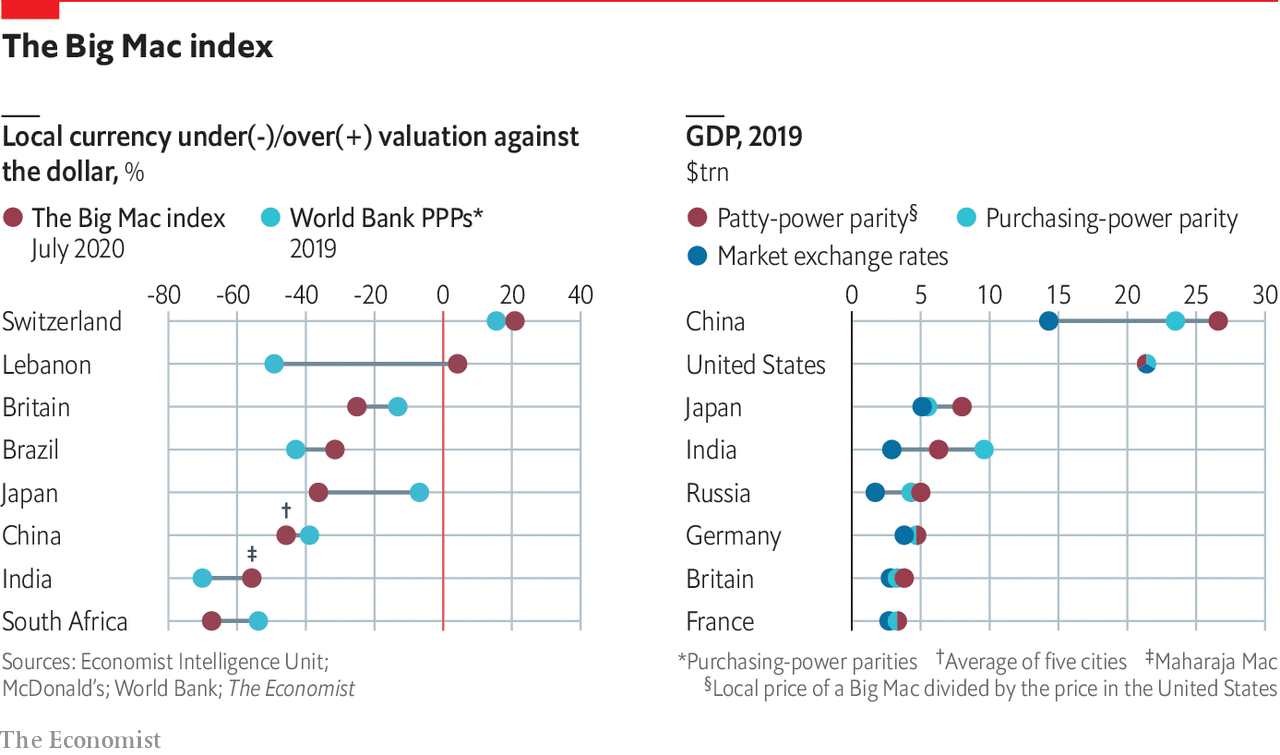
“How big is China’s economy? Let the Big Mac decide. Our index reckons
China’s economy is bigger than the World Bank thinks.
“AMERICA’S ECONOMY did not exceed China
in size until the 1880s, according to the Maddison Project at the University of Groningen.
The two now rival each other again. Because China’s workers are 4.7 times as numerous as
America’s, they need be only a fraction as productive to surpass America’s output. No fewer
than 53 countries would already have a bigger GDP than America if they were as populous as
China.
“In 2019 China’s workers produced over
99 trillion yuan-worth of goods and services. America’s produced $21.4trn-worth. Since 6.9
yuan bought a dollar last year, on average, China’s GDP was worth only $14trn when converted
into dollars at market rates. That was still well short of America’s.
“But 6.9 yuan stretches further in China
than a dollar goes in America. One example is the McDonald’s Big Mac. It costs about 21.70
yuan in China and $5.71 in America, according to prices collected by The Economist. By
that measure, 3.8 yuan buys as much as a dollar. But if that is the case, then 99trn yuan can
buy as much as $26trn, and China’s economy is already considerably bigger than America’s.
“Motivated by this logic, The
Economist has compared the price of Big Macs around the world since 1986. The result is a
rough gauge of the purchasing power of currencies. It suggests that many currencies are
undervalued, relative to the dollar, on the foreign-exchange markets (see chart). A few, such
as the Swiss franc, are overvalued. Lebanon’s pound was undervalued until inflation took off
late last year, raising local prices even as the pound remained pegged to the dollar. The Big
Mac alone jumped 38% in price.
“Every few years the World Bank embarks
on a vastly more systematic effort to gauge purchasing power by comparing thousands of prices
across the world. The results can be startling. Its survey of prices in 2011, released six
years ago, showed that China was cheaper than previously thought and its economy was therefore
much larger. Based on these estimates, the IMF calculated that its GDP overtook America’s in
2014 and was 27% bigger in 2019. [See: PURCHASING POWER
PARITY]
“Many observers, however, greeted these
estimates with skepticism. In 2010 an informal survey by a reporter at Caixin, a
financial magazine, noted that a number of items were dearer in Hangzhou than in its sister
city Boston. (It compared apples to apples, and found that the Golden Delicious variety was 37%
pricier in the Chinese city.)
“The sceptics won some vindication in May
when the World Bank released its latest price-comparison exercise. It discovered that things
were about 17% more expensive in China, relative to America, than previously thought. At a stroke,
China’s GDP fell by over $3.2trn. The estimates suggest China did not overtake America’s economy
until 2016.
“But are these new estimates any more robust
than earlier efforts? Comparing prices across the world is fraught with difficulties. An item may
be a staple in one place and a delicacy in another. The World Bank must also decide how much
weight to give each item. That depends on shopping habits, which differ—partly because prices
differ. It is easy to go around in circles.
“So it might help to check the World Bank’s
results against a cruder yardstick—like the price of a Big Mac. Our index suggests that the bank
now, if anything, underestimates the buying power of China’s currency, and therefore its economic
size. McDonald’s was once a symbol of America’s economic might. Now the Big Mac shows how its
might is being surpassed.
—The Economist, July 18, 2020.
BILLIONAIRES
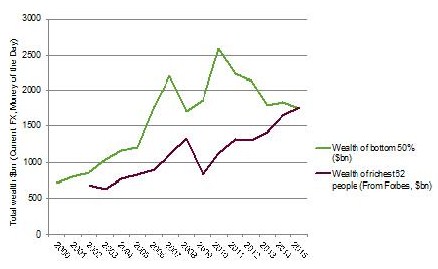 In the chart at the right we see that as of 2015 just 52 billionaires have as much wealth
as 3.6 billion people, half of all the people in the entire world! And this statistic
continues to change for the worse as the polarization of wealth continues to widen; as
recently as 2010 it was “just” the 388 richest individuals who equaled the wealth of
the bottom half of humanity.
In the chart at the right we see that as of 2015 just 52 billionaires have as much wealth
as 3.6 billion people, half of all the people in the entire world! And this statistic
continues to change for the worse as the polarization of wealth continues to widen; as
recently as 2010 it was “just” the 388 richest individuals who equaled the wealth of
the bottom half of humanity.
The wealth of these richest 52 people
has risen by 44% in the five years since 2010–in other words by more than half a trillion
dollars ($542 billion), to a total of $1,760,000,000,000. Meanwhile the wealth of the
bottom half of humanity fell by just over one trillion dollars in the same period,
a drop of 41%. [Chart and figures from the Oxfam briefing paper, “An Economy for the 1%”
(Jan. 18, 2016)].
Every year millions of people in the
world, many of them children, die of hunger or
malnutrition, and billions more live their whole lives in utter destitution. This could
be ended over night through the confiscation of all the stolen wealth of a miniscule
number of billionaires and the rest of the bourgeoisie and the reorganization of society
in the interests of the people. Of course it would take a social revolution to do
this.
“China, including Hong Kong, has surpassed America as the country
with the most billionaires, according to Hurun, a publication, and is home
to 568 billionaires compared with America’s 535. The figures for China were based
on share prices in January [2016], and take account of tumbling stock markets. India
came in third on the list with 111 billionaires. Britain and Germany were joint
fourth with 82 each, followed by Russia [with] 80.” —The Economist, Feb. 27,
2016, p. 6. [See also the entry
COMMUNIST PARTY OF CHINA—Capitalist Period about how many of these Chinese
billionaires are now actually members of the so-called Communist Party of China! —Ed.]
Bin LADEN, Osama (1957-2011)
The founder of al-Qaeda, the anti-imperialist terrorist group responsible for the September
11, 2001 attacks in the U.S. and numerous other terrorist attacks around the world. Osama
bin Laden was born into the family of billionaire Mohammed bin Awad bin Laden in Saudi
Arabia. In 1979 he joined the Mujahideen in their struggle against the
social-imperialist Soviet Union in Afghanistan. He
used his family’s wealth and connections to help expand that struggle, and in doing so won
the support and admiration of many in the Arab world. In this guerrilla war, he and his
associates were given enormous military aid and other support by the United States CIA,
which in effect helped him found his al-Qaeda organization in 1988. The CIA arranged for
the purchase of millions of dollars of arms from revisionist China to help arm bin Laden’s
group and the Mujahideen. (See:
AFGHANISTAN—Soviet War In—U.S.
Covert Activity)
After the defeat of Soviet Union in
Afghanistan in 1989, bin Laden and his al-Qaeda group began to turn their attention toward
trying to force out the much bigger imperialist presence in the Arab and Muslim world, the
United States. He was banished from Saudi Arabia in 1992, and then moved his operational
base first to Sudan, and then back to Afghanistan in 1996. From Afghanistan bin Laden
declared war on the United States and demanded that all U.S. military forces be removed
from the Muslim areas of the world.
After bin Laden’s involvement in the 1998
U.S. embassy bombings, he was placed on the FBI’s “Most Wanted” list. And after the 9/11
attacks he was clearly at the top of that list, and the FBI put a bounty of $25 million
on his head. On May 2, 2011, the U.S. sent a covert military team into Pakistan, and after
surrounding bin Laden’s unprotected home confronted and killed him. While he could have
been easily captured and brought to trial, he was instead assassinated on the direct orders
of President Barack Obama.
“‘Of course the guys [in the U.S. Seal commando team] knew the target
was bin Laden and he was there under Pakistani control,’ the retired official said.
‘Otherwise, they would not have done the mission without air cover. It was clearly and
absolutely a premeditated murder.’ A former Seal commander, who has led and participated
in dozens of similar missions over the past decade, assured me that ‘we were not going
to keep bin Laden alive – to allow the terrorist to live. By law, we know what we’re
doing inside Pakistan is a homicide. We’ve come to grips with that. Each one of us,
when we do these missions, say to ourselves, “Let’s face it. We’re going to commit a
murder.”’ The White House’s initial account claimed that bin Laden had been brandishing
a weapon; the story was aimed at deflecting those who questioned the legality of the
US administration’s targeted assassination programme. The US has consistently maintained,
despite widely reported remarks by people involved with the mission, that bin Laden
would have been taken alive if he had immediately surrendered.” —Seymour M. Hersh,
“The Killing of Osama bin Laden”, London Review of Books, Vol. 37, No. 10,
May 21, 2015, online at:
https://www.lrb.co.uk/v37/n10/seymour-m-hersh/the-killing-of-osama-bin-laden Hersh
provides extensive evidence that there was nobody defending bin Laden in his house,
that in fact he had been under secret house arrest for years by the ISI (the Pakistani
intelligence agency), that he was in ill health and did not resist, and that he was
simply outright murdered in cold blood by the U.S. Navy Seal commandos. —Ed.]
“A number of analysts have observed that bin Laden won major
successes in his war against the United States. ‘He repeatedly asserted that the
only way to drive the US from the Muslim world and defeat its satraps was by drawing
Americans into a series of small but expensive wars that would ultimately bankrupt
them,’ the journalist Eric Margolis writes. ‘The United States, first under George
W. Bush and then Barack Obama, rushed right into bin Laden’s trap.... Grotesquely
over-blown military outlays and debt addiction ... may be the most pernicious legacy
of the man who thought he could defeat the United States.’ A report from the Costs
of War Project at Brown University’s Watson Institute for International and Public
Affairs estimates that the final bill will be $3.2 to $4 trillion. Quite an
impressive achievement by bin Laden.
“That Washington was intent on
rushing into bin Laden’s trap was evident at once. Michael Scheuer, the senior CIA
analyst responsible for tracking bin Laden from 1996 to 1999, wrote, ‘Bin Laden has
been precise in telling America the reasons he is waging war on us.’ The al-Qaeda
leader, Scheuer continued, was ‘out to drastically alter US and Western policies
toward the Islamic world.’
“And, as Scheuer explains, bin
Laden largely succeeded. ‘US forces and policies are completing the radicalization
of the Islamic world, something Osama bin Laden has been trying to do with substantial
but incomplete success since the early 1990s. As a result, I think it is fair to
conclude that the United States of America remains bin Laden’s only indispensable
ally.’ Arguably, it remains so even after his death.”
—Noam Chomsky, Who Rules
the World? (2016), p. 18. [One thing Chomsky doesn’t consider here, however, is
that the U.S.—like any capitalist government—needs deficit-based government
expenditures to keep the economy functioning. Therefore, this business about
“bankrupting” the U.S. through its “War on Terror”
is more complicated than might originally appear. Massive military expenses which
cause budget deficits (“Military Keynesianism”)
actually are important props for American imperialism for a long period, though it
is also true that this speeds up the eventual day of reckoning when a severe
financial crisis will bring the American (and world) capitalist economy crashing
down. —S.H.]
BINARY ARITHMETIC
“Anticipating Gödel and Turing, Leibniz promised that through digital
computing ‘the human race will have a new kind of instrument which will increase the power
of the mind much more than optical lenses strengthen the eyes...’
“Leibniz saw binary coding as the key
to a universal language and credited its invention to the Chinese, seeing in the hexagrams
of the I Ching the remnants of ‘a Binary Arithmetic ... which I have rediscovered
some thousands of years later.’ Leibniz’s notes show the development of simple algorithms
for translating between decimal and binary notation and for performing the basic functions
of arithmetic as mechanically iterated operations on strings of zeros and ones.. ‘In Binary
Arithmetic there are only two signs, 0 and 1, with which we can write all numbers,’ he
explained. ‘I have since found that it further expresses the logic of dichotomies which is
of the greatest use.’” —George Dyson, Turing’s Cathedral: The Origins of the
Digital Universe (NY: Vintage/Random House, 2012), pp. 104-5.
[Amazingly, Gottfried Leibniz did
conceive of digital computers several hundred years before more advanced technology allowed
them to come into being. But the most intriguing thing here is his reference to the “logic
of dichotomies”. One wonders if this is what we might now consider to be dialectical
logic. However, contrary to what Leibniz seemed to suppose, all actual arithmetical
problems can be handled in any base, and in base-10 just as accurately as in base-2. This
suggests that if there is any truly different binary logic, or “dialectical logic”, or
“logic of dichotomies”, it might have to be non-homologous with arithmetic. This also brings
to mind the current experiments or speculations (?) in physics about calculations using
quantum mechanical qubits! Presumably qubits might better allow for the inclusion of the
interpenetration of opposites into dialectical logic. —S.H. (June 2, 2024).]
BIOETHICS
The application of ethics and morality to the biological and medical sciences. Although
the origin of this term is recent (c. 1971), the necessity for moral principles to be
considered and applied in this sphere was recognized even in ancient times, as with the
Hippocratic Oath, and his admonition to all physicians to “first do no harm” to their
patients. However, the great expansion of biological and medical research in the
20th century included the horrible and inhuman examples of this done in the service of
their ruling classes by Nazi doctors in Europe and Japanese doctors in China (as well as
by doctors and researchers in other imperialist countries including the U.S.). [See the
entries for BIOLOGICAL WARFARE
EXPERIMENTS below, for just a few examples of this.] Mass murders and other
outrages such as these, which led to an explosion of criticism directed at such immoral
behavior, forced the biological research and medical fields to try to regulate themselves
(with only very limited success).
 Ethics is actually a fairly simple
subject, and its central principle is just that what is good and right is that which
is in the interests of the people. (In class society, however, this must be modified;
there are different and conflicting class moralities since different classes do not share
the same basic collective interests. Thus for the revolutionary proletariat the central
ethical principle is that what is good and right is that which is in the interests of
the working class and its allies. See:
CLASS INTEREST THEORY OF ETHICS
) So, in principle, the application of ethics to biological research and medicine,
or to any other sphere, ought to be an easy and straightforward matter, which anybody
from the enlightened and revolutionary working class should be able to do.
Ethics is actually a fairly simple
subject, and its central principle is just that what is good and right is that which
is in the interests of the people. (In class society, however, this must be modified;
there are different and conflicting class moralities since different classes do not share
the same basic collective interests. Thus for the revolutionary proletariat the central
ethical principle is that what is good and right is that which is in the interests of
the working class and its allies. See:
CLASS INTEREST THEORY OF ETHICS
) So, in principle, the application of ethics to biological research and medicine,
or to any other sphere, ought to be an easy and straightforward matter, which anybody
from the enlightened and revolutionary working class should be able to do.
But, unfortunately, present day society
is not run or controlled by the revolutionary working class. This means that bioethics
in contemporary society is dominated by bourgeois and non-proletarian interests and by a
variety of ethical theories which reflect those bourgeois conceptions and interests.
Moreover, the “need” for the special professional field of “bioethics” in the first place
arises out of a combination of these obfuscating bourgeois ethical theories together with
the desire of researchers and doctors in bourgeois society to themselves dominate the
discussion about what is right and proper to do in their sphere. It is quite similar to
capitalist society also having the absurd subject of “business ethics” (which takes for
granted the right of capitalists to exploit workers) so that the capitalists themselves
(or their prostitute philosopher hirelings) can say what is moral or not. —S.H.
BIOLOGICAL WARFARE EXPERIMENTS — By Japan in the 1930s-1940s
“The Nazis were not the only nation to build death camps in the
period leading up to World War II. The Japanese, too, had their concentration camps.
The object was not, as with the Germans, the extermination of a people, but instead
was to use incarcerated common criminals and prisoners of war as guinea pigs in
biological and, to a lesser extent, chemical warfare experiments.
“The rationale was simple. The
fanatical, right-wing militarists who dominated Japanese society from the late 1920s
to the end of World War II believed that in order to achieve their goal of Japanese
domination of East Asia, they would have to rely upon exotic weapons of war such as
pathogenic and chemical arms. That was horrible enough. But those who originated the
program did not believe that these weapons could simply be developed in laboratories
and let loose against enemies on the battlefield. They had to be tried out on human
subjects.
“And so a vast network of death
factories was constructed that, by the time World War II had begun, stretched from
the remote steppes of Inner Mongolia to Singapore, and from Bangkok to Manila. The
center of this empire of death was Ping Fan, a suburb of the city of Harbin in north
China, where the architect of Japan’s chemical and biological warfare program, Lt.
Gen. Shiro Ishii, had his headquarters.
“Each factory employed at least
two thousand people, including (apart from the ordinary soldiers used to guard the
facilities) some twenty thousand physicians, microbiologists, veterinarians,
zoologists, and plant biologists.
“At a conservative estimate,
their diabolical research project of testing prospective pathogens and biological
weapons on the camps’ inmates involved between twelve and fifteen thousand men, women
and children.
“Tens of thousands of others
were killed in field tests that consisted of distributing food tainted with deadly
pathogens; lacing water wells, streams, and reservoirs with other pathogens; creating
cholera epidemics by injecting cholera into the veins of unsuspecting peasants, who
were told they were being inoculated against the disease; and spraying or dropping
various biological weapons on villages, towns, and cities from the air.
“With the exception of [a] few
lesser participants, who were brought before a show trial by the Soviet authorities,
most of the architects of Japan’s biological warfare programs were never prosecuted
for their crimes. The reason for this was that after the U.S. occupation of Japan,
American scientists eager to acquire the experimental data garnered from these
biological experiments argued successfully that their Japanese colleagues had gained
invaluable insights into how the human body reacted to certain pathogens—information
that would greatly assist American biological weapons programs. The result was that
the U.S. occupation authorities colluded in a cover-up of what had taken place....
“But leaving aside [the lack of]
prosecutions, the truth is hard enough to come by. Until the 1980s, the Japanese
government denied the crimes committed by its doctors and scientists had even taken
place. When the overwhelming weight of the evidence forced it to concede something
had indeed occurred, the Japanese authorities insisted the program had been the work
of renegade militarists. The government neither apologized nor offered compensation
to those still alive who had been exposed to the germ warfare experiments, or to the
families and heirs of those who had not survived them.”
—Sheldon H. Harris, in Crimes
of War, 2.0, ed. by Roy Gutman, et al., (NY: W.W. Norton, 2007), pp. 59-61.
BIOLOGICAL WARFARE EXPERIMENTS — By the United States
See also part of the discussion of Japanese
experiments in the entry above.
“Japanese microbiologists from the notorious Unit 731, which had
been responsible for horrendous experiments with biological weapons, first infecting
hundreds of thousands of Chinese civilians of all ages, including infants, then
vivisecting them without anesthesia during their occupation in the 1940s were not
tried like the Nazi doctors [in the Nuremberg Trials] but were recruited into the
US biological warfare research establishment at Fort Detrick in Maryland; it was not
until many years later that their crimes became public knowledge in the West. (Some
documents were released by the US government only in 2000.)” —Hilary & Steven Rose,
Genes, Cells and Brains (2014), p. 94.
BIRDS — Disappearance Of
As part of the current Great Capitalist Mass Extinction,
billions of birds are being killed, already including some entire species. This is the result of
many characteristics of the present world capitalist system, including loss of bird habitats;
pollution of the land, oceans, lakes, rivers and air; rapid climate change; etc. Moreover, in
recent decades all these trends have greatly increased.
See also:
WILDLIFE DECLINE
“A recent study collating decades of data revealed that nearly a third of
all birds—three billion creatures—have vanished from North America in the last 30 years.”
—New York Times, April 25, 2021.
BIRTHDAYS — Of Leaders
“(Stormy applause.) Comrades, I must naturally begin by thanking
you for two things: firstly, for the congratulations addressed to me today, and, secondly,
even more for having spared me congratulatory speeches. (Applause.) I think that
perhaps in this way we may gradually, not all at once, of course, devise a more suitable
method of celebrating anniversaries than the one hitherto in vogue, which has sometimes
formed the subject of remarkably good cartoons. Here is one such cartoon drawn by a
prominent artist in celebration of such a jubilee. I received it today with an extremely
cordial letter. And as the comrades have been kind enough to spare me congratulatory
speeches, I will hand this cartoon round for all to see, so as to save us in future from
such jubilee celebrations altogether.” —Lenin, “Speech Delivered at a Meeting
Organized by the Moscow Committee of the R.C.P.(B.) in Honor of Lenin’s Fiftieth Birthday”
(April 23, 1920), LCW 30:526.
[“Lenin refers to a cartoon by the
well-known artist Karrik who drew it in 1900 on the birthday of the Narodnik N. K.
Mikhailovsky. Yelena Stasova sent the cartoon to Lenin on his fifieth birthday. The drawing
depicted Marxists as children who came to congratulate Mikhailovsky. Stasova wrote on the
cartoon that at the time of Mikhailovsky’s birthday the Party had been in its childhood,
had few members, whereas it had since grown, ‘and this is the result of your work, this is
thanks to your mind and talent’.” (LCW 30, endnote 157.) However, it may well be the case
that Lenin appreciated the cartoon more for its implicit suggestion that the very celebration
of leaders’ birthdays was something rather childish! —S.H.]
BISMARCK, Otto Edward Leopold von (1815-98)
“Prime Minister of the Kingdom of Prussia (1862-1871). He was
Chancellor of the Empire and concurrently Prime Minister of Prussia when the German
Empire was founded in 1871. He fell from power in 1890. Representing the interests
of the big bourgeoisie and big landlords and carrying out a militarist ‘blood and
iron’ policy, he ruthlessly suppressed the workers’ movement at home and engaged in
aggression and expansion abroad in an effort to establish German hegemony on the
continent of Europe.” —Explanatory note accompanying an article on the Paris
Commune, Peking Review, vol. 14, #13, March 26, 1971.
BITCOIN
The original and most popular cryptocurrency based on digital
blockchain technology, and which—like all its many other cryptocurrency immitators—amounts to either
a spontaneous or purposeful Ponzi financial investment scheme and bubble.
See also:
CRYPTOCURRENCY—Collapse Of,
PRICE OF A THING WHICH HAS NO VALUE
“New data showed that seven Bitcoin mining companies alone had set up to
tap as much as 1,045 megawatts of power, or enough electricity to power all the residences
in a city the size of Houston.” —New York Times, “Bitcoin Miners in U.S. Rival
City’s Energy Use”, July 18, 2022. [With the initial collapse of the cryptocurrency bubble
which occurred in late 2022, much of this socially irrational Bitcoin mining has already shut
down. —Ed. (January 2023)]
BJP
See: BHARATIYA JANATA PARTY, and
HINDUTVA
Dictionary Home Page and Letter Index
MASSLINE.ORG Home Page