An advance force at the head of and leading a whole army, movement or social class.
VANGUARD ACTION
1. An action or activity undertaken by a
true vanguard (i.e., by a party or organization actually leading the masses in struggle) which
really does promote the larger involvement of the masses in that struggle.
2. An action or activity undertaken by a
group or organization which falsely imagines that it is functioning as the vanguard
(or supposed leadership) of the masses, and which—it is vainly hoped—will lead those broad
masses to join up with it in that action. (See:
“ADVANCED ACTIONS”—Theory Of )
Of course, only the first of these two is
properly called a “vanguard action”; the second is more like a petty-bourgeois parody of
one. To actually lead the masses in struggle a party or organization must be living and
working with those masses, must be using Mao’s leadership method of “from the masses, to the
masses” (also known as the mass line), and must be continually
drawing new members from among those masses. A true vanguard arises from the masses it seeks
to lead, and it cannot possibly lead those masses in any vanguard action unless it is deeply
a part of their life and existing struggles.
VANGUARD PARTY
1. A political party which is actually
acting as the leadership of a social class or class-based
political movement, and implicitly at least, a revolutionary class or political movement.
This is usually in specific reference to a proletarian revolutionary party, such as the Bolsheviks
in revolutionary Russia or the Communist Party of China during the Mao era.
2. A political party which only imagines
that it is doing this, or only aspires to do this, even though in reality it has little
or no influence on the social class it claims to lead, and provides little or no leadership of
that class in actual struggle. If such a party is termed a “vanguard party” it should of course
have scare-quotes around the term, as in this example, in order to indicate that it is not really
the vanguard that it claims to be! (At least not yet.)
A true vanguard party functions as an
actual vanguard (or advanced leadership body) of a social class and has no need to constantly
proclaim itself as a vanguard. The reality of the situation speaks for itself. And the very fact
that some tiny sectarian party might be constantly calling itself “the vanguard” strongly
indicates that it really is nothing of the kind.
Should a nominally Marxist party (such as the old
CPUSA during the late 1930s) that actually does provide some substantial day-to-day leadership
of the proletariat and the masses, but only in reformist struggle and in a way that never even begins
to advance that day-to-day struggle in the direction of revolution, be considered a “vanguard party”
in the Marxist sense? Of course not! In advanced capitalist countries during non-revolutionary
periods most day-to-day struggles of the working class and masses will in fact be over reformist
issues (or in warding off additional attacks from the bourgeois enemy). But if this day-to-day
struggle is combined in a thorough and serious way with extensive revolutionary educational
work, then the path of that reformist struggle can be more and more steered in the direction of
making social revolution. Under genuine vanguard revolutionary leadership, reformist struggle can
be gradually transformed into outright revolutionary struggle. The “secret” of doing this, developed
first by Marx, Engels and Lenin, is to combine leadership with revolutionary education, so
that the masses can learn through their own experiences in struggle the absolute need for, and also
the proven methods of, making revolution.
A supposed “Marxist” party which does not constantly
work to educate the working class in the meaning of, and the need for, socialist and then communist
revolution, is no real revolutionary party no matter how much leadership they provide in
day-to-day struggles. Such a party, has no true vanguard role, and actually has no real long-term
political significance whatsoever.
For Marxist-Leninist-Maoists a true vanguard party
is one that does in fact lead the working class and masses in major struggles (even if mostly
around reformist issues in non-revolutionary times), but which—because of simultaneous educational
work—also does this in a way that promotes and leads to proletarian revolution. On the other hand,
a party which subjectively does strongly favor socialism and then communism, but which has no real
desire or ability to lead the masses in actual struggle, both for their day-to-day interests
and their long-term revolutionary interests, is no vanguard party either! It is merely a
mostly irrelevant propaganda sect.
A genuine MLM communist party is a vanguard in the
sense that it is actually leading the masses in their existing struggles, and in the sense that
these struggles are seriously and consciously being re-directed toward making social revolution.
“Being powerful is like being a lady—if you have to tell people you are, then
you aren’t.” —Margaret Thatcher, quoted in the London Evening Standard (2005).
[In the very same way, if a Party has to tell people that it is the vanguard of the
working class, then it is certain that it is not. —Ed.]
“VANGUARDISM”
A pejorative term, used mostly by reformists and those opposed to Marxism-Leninism-Maoism, to
denegrate those who see the need for a revolutionary vanguard organization for the proletariat
and who are trying to create such a vanguard party.
Unfortunately, the widespread existence of tiny,
phony so-called “vanguards”, i.e., those groups who call themselves vanguards when in fact they
are nothing remotely close to the real thing, makes it easy for anti-revolutionaries to ridicule
the whole idea as “vanguardism”.
VARGA, Eugen [“Eugene”] (1879-1964)
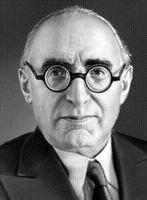 [Varga’s Hungarian given name was “Jenö”; for most of his life and while living in
the Soviet Union he was referred to by the German version of his name, “Eugen” (pronounced
oy-ghen); in the English editions of his books he is usually referred to by the English
version of his name, “Eugene”.]
[Varga’s Hungarian given name was “Jenö”; for most of his life and while living in
the Soviet Union he was referred to by the German version of his name, “Eugen” (pronounced
oy-ghen); in the English editions of his books he is usually referred to by the English
version of his name, “Eugene”.]
Varga was a Hungarian-born Soviet political
economist who became one of the most famous and influential economists for the
Comintern. He made his reputation with his prediction in the
mid-1920s of the forthcoming Great Depression. He
was also the leading proponent of the General Crisis of Capitalism
theory, both in the period between the two world wars, and also in the post-World War II
period.
Varga joined the Hungarian Social Democratic
Party in 1906, and wrote articles on economics and other topics for the socialist press. In
1918 he became Professor of Political Economy at the University of Budapest, and the next
year became the People’s Commissar of Finance and the chairman of the Supreme Economic
Council of the short-lived Hungarian Soviet Republic. When that
Hungarian revolutionary regime was overthrown
(with the connivance of right-wing social democrats), Varga fled to the Soviet Union, and began
work for the Comintern. He soon became its leading spokesman on economic matters. In the early
1920s he quickly recognized and gave emphasis to the significant economic recovery in capitalist
countries after the sharp post-World War I recession of 1920-21. But by the mid-1920s he was
emphasizing that this recovery would be short lived and that a powerful new economic crisis
would soon develop (which of course it did). According to M.C. Howard & J.E. King, in their
History of Marxian Economics (vol. I, 1989), Varga based this prediction on the
increasing organic composition of capital
and also on the prospect of reduced employment and ability of workers to consume (i.e.,
on two very different Marxist theories of economic crisis). But apparently the main thrust of
Varga’s argument was based on Marx’s central theory of
overproduction of capital (or what its opponents misleadingly
call “underconsumptionism”).
Varga wrote the economic reports for the
Congresses of the Comintern from 1921 to 1935. Many of his writings in this period were
focused on the international economic “conjuncture”, and
reflected his great efforts to determine and organize the quantitative trends in output,
investment and employment in many different countries. He especially investigated the economy
of Germany and the economic development behind rising German imperialism.
For 20 years, starting in 1927, Varga was the
chairman of the Institute of World Economics (IWE) in Moscow. In the immediate post-World War
II period he predicted a strong economic recovery in the capitalist West, and only later on
the development of a new economic crisis—just as he had successfully predicted after World War
I. It turned out that he was once again correct, but Stalin and the leadership of the Soviet
Union and the Comintern expected that the capitalist world would almost immediately fall back
into the Great Depression, which they thought had only been interrupted by World War II.
(Those who expected the immediate return of the Depression didn’t really grasp Marx’s
explanation that the basic resolution of overproduction crises comes through the destruction
of excess capital, which is exactly what had happened in World War II.) This led to Varga’s
removal from leadership of the IWE in 1947, and forced a total recantation and self-criticism
by Varga in 1949. But after Stalin’s death in 1953 Varga was rehabilitated, and even presented
the Stalin Prize in 1954 and the Order of Lenin (in both 1954 and 1959). But the new revisionist
leaders of the Soviet Union paid little attention to his predictions of eventual new economic
crises in the U.S., and were interested only in accommodation and peaceful co-existence with the
West.
Although Varga was one of the best Marxist
political economists of his era, and in general had a remarkably good record of economic
predictions, there were also some erroneous aspects and inconsistencies in his theories. For
example, the idea that there could be a post-World War II economic recovery for capitalism
was quite inconsistent with his theory in the 1930s that there was a General Crisis of
Capitalism that could only be ended through social revolution. While he did expect a major
recovery after World War II, the boom that followed the war was much bigger and longer than
even he expected. By the late 1950s and 1960s he was already predicting a new economic crisis
in world capitalism, but didn’t understand at all just how long it would take for that new
crisis to fully develop, even once it finally did begin to develop in 1973, nine years after
his death. Of course no other Marxist (let alone any non-Marxist) of that time really understood
this either.
Among Varga’s many books are
these which have been translated into English: The Decline of Capitalism (1928); The
Great Crisis and Its Political Consequences: Economics and Politics, 1928-1934 (1934);
Two Systems: Socialist Economy and Capitalist Economy (1939); The Economic
Transformation of Capitalism at the End of the Second World War (1946) [possibly not
translated into English: this was the book that got Varga in trouble with Stalin, in which
he argued that the capitalist system was somewhat more stable than had been previously
believed, and that there would not be an immediate return to the Depression after the end of
World War II]; Marxism and the General Crisis of Capitalism (1948); Twentieth Century
Capitalism (1962); and Politico-Economic Problems of Capitalism (1968). After his
death, his selected works in three volumes were published in the Soviet Union, Hungary, and
East Germany. The German edition is entitled Ausgewählte Schriften 1918-1964.
More recently an outrageously high-priced ($384) English-language work, Eugen Varga:
Selected Political and Economic Writings: From the Hungarian Revolution to Orthodox Economic
Theory in the USSR was published, (Brill Publishers, Historical Materialism Book Series,
volume 225, Dec. 2020), xxiv + 1,204 pages.
See also:
“PARTY MAXIMUM”
“The Economics Institute of the U.S.S.R. Academy of Sciences recently
conducted a discussion on Academician E. Varga’s book, On Changes in the Economy of
Capitalism as a Result of the Second World War. ... Academician Varga’s book contains
a great deal of factual material and a number of theoretical generalizations.
“However, the discussion showed that
Comrade Varga’s book contains essential shortcomings as well as questionable and erroneous
propositions with regard to a number of most important problems of present-day capitalism.
...
“The basic shortcoming of Comrade
Varga’s book consists in the fact that it does not furnish an integrated characterization
of present-day imperialism. This deficiency, as the participants in the discussion noted,
is explained primarily by the fact that the author considers the changes in the economy of
present-day capitalism as isolated phenomena unrelated to the sharpening of the general
crisis of capitalism as a result of the Second World War. The problem of the development
and deepening of the general crisis of capitalism is essentially passed over in the book.
And yet, a correct evaluation of the character and significance of the changes in
capitalist economy during the years of the Second World War and in the postwar period is
impossible without scientific analysis of the further development and of the depth of the
general crisis of capitalism. The book does not give a general picture of the growth of
parasitism and decay of capitalism, of the sharpening of the basic contradictions of the
capitalist system, of the growth in the uneven development of capitalism, and of the
sharpening of the problem of markets....
“In the post-war development of
capitalism Academician Varga distinguishes two stages, which supposedly have their own
inherent laws. ‘In the first period, approximately the first decade after the end of the
war,’ writes Academician Varga, ‘the unevenness of economic development, which occurred
during the war, will have a decisive influence upon the course of capitalist economy.’
(P. 12) The second period, the author indicates, will proceed under the sign of
‘protracted’ changes in capitalism caused by the war. These changes ‘will find their
expression in the sharpening of the basic contradiction of the capitalist system, i.e.,
the contradiction between social production and private appropriation, and first of
all in the sharpening of the problem of realization, or in other words, the problem of the
market.’ (P. 12)
“Such a posing of the question called
forth well-founded criticism from the participants in the discussion, who noted the
incorrectness of the separation between the unevenness of the development of capitalism
and the basic contradiction of the capitalist system. Comrade Varga, incorrectly, ‘postpones’
for a decade the sharpening of the basic contradiction of capitalism and the problem of the
market connected with it. This contradiction is an incessantly operating law of
capitalism....
“Reality shows how devoid of value is
Comrade Varga’s position on the postwar development of capitalism and especially his
prognosis concerning the basic contradiction of capitalism. The postwar period is
characterized by the sharpening of all the contradictions inherent in the capitalist
system—by the intensified exploitation of the workers, by the growth of unemployment, by
the sharp lowering of the living standard of the toiling masses, by the extension of the
operation of the industrial plant below production capacity, by the intensified struggle
for markets and spheres of capital investment, by the growth of militarism, etc.”
—I. Gladkov, “On Changes in the
Economy of Capitalism as a Result of the Second World War”, English translation in the
CPUSA journal,
Political Affairs, Feb. 1948, pp. 181-183; original article in Russian in the
journal Bolshevik, Moscow, No. 17, September 15, 1947.
[This strong criticism of Varga was
essentially wrong. He was quite correct in foreseeing a
post-World War II capitalist boom, though he didn’t quite dare call it that!
Moreover, he apparently didn’t note that there might also be an initial short but sharp recession
during the re-tooling period after the war. This brief but sharp crisis helped reinforce the theories
of Stalin and many others (including both Marxists and many bourgeois economists) who thought
that the world capitalist economy would slip back into the Depression of the 1930s after the
massive war spending ended. Even most Marxists did not really comprehend Marx’s explanation
that overproduction crises can be resolved through the destruction of excess productive
capital, allowing the accumulation process to start once again with renewed vigor. And as
mentioned in the main article above, even Varga did not understand how big the quarter-century
post-World War II boom would turn out to be, let alone how many long decades it would then take
to gradually sink into a new Depression (a long-drawn out process which is still incomplete).
[The Gladkov article raised some other
incorrect criticisms of Varga’s book as well, such as his partial opposition to the “anarchy of
production” theory of capitalist crises, and his acceptance of the fact that during major wars
the State direction of the economy tended to be more organized and less anarchic. Gladkov (and
Stalin, et al.), also didn’t like Varga’s quite valid assertion that the economies of the Eastern
European “People’s Democracies” were really more like state capitalism than they were genuine
socialism. He had to express some of these ideas in a cautious, tentative way, but he still
stepped on many toes! All in all, today we need to admire Varga for his perspicacity in
comparison with almost every other Marxist writer on economics in his era. —S.H.]
“The upsurge of production and the temporary absence of profound
overproduction crises in the post-war period in the highly developed countries is
primarily the result of World War II. Tens of millions of young men were taken into
the army. Millions of others were employed in military enterprises producing instruments
of destruction which were destroyed on the battlefields without any benefit to society.
Arms and military equipment constituted about one-half of all production. Items intended
for long use were not produced. New homes were not built and old ones were not repaired.
Supplies of raw materials and manufactured goods were exhausted. Fixed capital was worn
out, especially in non-military branches. Tremendous values were destroyed by aerial and
artillery bombardments. Instead of real values, monetary means were accumulated:
… deposits in savings banks, state loans in the hands of the urban population, and huge
sums in bank deposits and government securities held by the capitalists. This
extraordinary and significant expansion of the capitalist market led to an intense growth
of post-war production in such countries as the United States and Canada, which were not
theaters of war.” —Eugen Varga, Kommunist, #17 (1961). Translated into English as
“Marx’s Capital and Contemporary Capitalism”, Problems of Economics (IASP Translations
from Original Soviet Sources), vol. 4, #9, Jan. 1962, p. 62.
[This is a remarkably good and
concise description of how excess capital was destroyed in World War II, even in countries
which were not themselves bombed or overrun. Varga went on, in this article, to predict
that the post-WWII boom was drawing to a close (he was just a little premature on that)
and implied that the (Western) capitalist countries might soon return to stagnation and
depression (he was very premature about that—the development of the new crisis period
which began around 1973 has been very drawn out and only took a qualitative leap for the
worse in 2008). —S.H.]
“In a ‘testament’ written shortly before his death and published abroad
afterward, the prominent Soviet revisionist academician E. Varga deplored ‘the contrast
between the excessive material well-being of the ruling aristocracy and the extremely low
wages of the majority of the workers, employees and collective farmers.’ He sermonized the
‘bureaucratic aristocracy’ for its ‘arrogance’ and its ‘conceit,’ which drive it to ‘sell
off [the French is ‘brader’ — literally, to hold a garage or sidewalk sale] and to
appropriate for themselves the property of the state, to satisfy unbridled passions which
sometimes lead them to crime. ...’
“At the same time Varga observed that
‘the precarious material situation of the workers ... results in all kinds of
reprehensible phenomena: drunkenness, ill-treatment of spouses and children, domestic
quarrels, the refusal to work, delinquency and sometimes crimes of desperation.’ (Le Monde,
12-13, September 1971, quoted in ‘Sur la restauration du capitalisme en USSR’ by Andre
Pommier in Communisme, Paris, September-October 1974, pp. 56, 77.)
“For this revisionist, who on his
deathbed is seized by moral scruples, the working class exists only in the role of victim
of the system. He does not see their resistance, their fighting spirit, the numerous
strikes and other acts of rebellion. Thus he paints an image of the USSR that recalls the
bourgeois novelists’ depictions of Old Russia, Russia under the Tsars, with the unbridled
greed and limitless corruption of the big officials at the top and a vast panorama of
suffering, frustration and desperation below. Precisely in this parallel, however, lies the
core of truth in Varga’s deathbed confession.”
—Martin Nicolaus, Restoration of
Capitalism in the USSR (1975), chapter 23, pp. 167-168, online at:
http://www.marx2mao.com/Other/RCSU75.html
[Nicolaus’ condemnation of Varga here seems wildly off base. There is evidence
that Varga did in fact criticize and break with the Khrushchevites, though he was an old man
by this time and even so it was not safe to be open with disagreements in the new bourgeois
authoritarian circumstances. Nevertheless, Varga apparently went as far as siding with
revolutionary China in its dispute with the revisionist Soviet Union. (See the volume, When
and Why Socialism in the Soviet Union Failed (1995) online at:
https://www.bannedthought.net/USSR/MiscAntiRevisionist/WhenAndWhySocialismInTheSovietUnionFailed-KPD-1995-OCR.pdf)
Varga’s “testament” seems to indicate his complete disgust with the capitalist roaders
ruling the Soviet Union at the end of his life. See also:
“PARTY MAXIMUM” —S.H.]
VARIABLE CAPITAL
Variable capital is the value of the human labor-power purchased
by the capitalists (by hiring workers) and employed by them in the production process. It is
called “variable” capital by Marx because its value varies (actually, increases)
with its use in the capitalist production process. That is, the capitalist pays a certain amount
for the labor-power, but ends up with more value than he paid for, through the application
of that labor-power to the raw materials and other means of production. (This is the source of
surplus value.) In other words, the application of labor-power
to the raw materials leads to an increase in the amount of capital.
The rest of the capital employed in the
production process is called constant capital, because its
use does not itself lead to an increase in value or capital. Thus the value of the raw materials
used does go into the value of the final commodity, but remains a fixed amount. The same is true
for the apportioned value of the machinery (including its maintenance). So, for example, if a
machine can be used to make 10,000 widgets before it wears out, one ten-thousandth of the value
of that machine is also transfered to each widget as constant capital.
However, there is a complication here which Marx
did not explore. Machines may also be viewed as a way of re-using on many separate
occasions the labor-power that went into the construction of the machine. From this point of
view, if past labor-power is being re-used again in the present production process, then
it should also be considered as variable capital in the present production process, just
as much as the additional labor-power of the worker operating the machine is! This complicates
the analysis to some degree, but does not change the basic fact that all wealth still comes
ultimately from the application of labor to the raw materials of nature. [This topic is
discussed further in the entries related to the Labor Theory of
Value.]
VEBLEN, Thorstein Bunde (1857-1929)
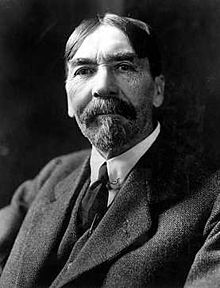 A witty, radical American economist and sociologist, very critical of capitalists and capitalism,
who was once the best known American economist, but whose works—even his most famous, The
Theory of the Leisure Class (1899)—are now not often read. He is best known for his concept
of “conspicuous consumption”, the pervasive and sometimes quite wild extravagances of the
capitalists which they use to mark their high social status and to impress others of their
kind.
A witty, radical American economist and sociologist, very critical of capitalists and capitalism,
who was once the best known American economist, but whose works—even his most famous, The
Theory of the Leisure Class (1899)—are now not often read. He is best known for his concept
of “conspicuous consumption”, the pervasive and sometimes quite wild extravagances of the
capitalists which they use to mark their high social status and to impress others of their
kind.
Within bourgeois economics, Veblen is viewed as
the leader of the “institutional economics movement”. His distinction between “institutions”
and “technology” is still called the “Veblenian dichotomy” within that sphere.
Veblen was not a Marxist, though like almost
all radicals after Marx he was considerably influenced by Marx’s ideas. Veblen was also
strongly influenced by Darwin, and especially embraced the correct idea that biological evolution
is characterized by blind, purposeless drift, which he then improperly extended to humanity and
social evolution as well. Thus he opposed the Marxist idea that there is a logic to human
history and that the eventual overthrow of capitalism is inevitable—assuming capitalism does
not destroy humanity first! Despite Veblen’s agreement with Marx about the reality and centrality
of the class struggle, he was more of a reformist by inclination. Although he attacked the
central fact of production for profit under capitalism, his views overall were more to the
liking of the Progressives of the era who sought a non-Marxist and non-revolutionary solution
to the problem of capitalism.
Nevertheless, Veblen did often criticize capitalism
and the American bourgeoisie, for which reason the ruling class is no doubt glad to see him long
gone and forgotten. As one example, he once argued that the United States had only entered World
War I near the very end of that murderous struggle in order to ensure that the transnational
interests of the U.S. industrialists could be defended against any revolutionary socialist
upheavals that the coming peace in Europe might unleash. That’s the sort of very plausible ideas
that the American ruling class does not want anybody to hear or think about.
“As increased industrial efficiency makes it possible to procure the means of livelihood with less labor, the energies of the industrious members of the community are bent to the compassing of a higher result in conspicuous expenditure, rather than slackened to a more comfortable pace. ...this want ...is indefinitely expansible, after the manner commonly imputed in economic theory to higher or spiritual wants. It is owing chiefly to the presence of this element in the standard of living that J. S. Mill was able to say that ‘hitherto it is questionable if all the mechanical inventions yet made have lightened the day’s toil of any human being.’” —Thorstein Veblen, The Theory of the Leisure Class (1899), ch. 5. [NY: Prometheus Books ed., 1998, p. 111.]
“The mechanical industry of the new order is inordinately productive.
So the rate and volume of output have to be regulated with a view to what the traffic will
bear—that is to say, what will yield the largest net return in terms of price to the
business men who manage the country’s industrial system. Otherwise, there will be
‘overproduction,’ business depression, and consequent hard times all around.... That is to
say, in no such community can the industrial system be allowed to work at full capacity
for any appreciable interval of time, on pain of business stagnation and consequent
privation for all classes and conditions of men. The requirements of profitable business
will not tolerate it. So the rate and volume of output must be adjusted to the needs of
the market, not to the working capacity of the available resources, equipment and man
power, nor to the community’s need of consumable goods.” —Veblen, The Engineers and
the Price System (1921), pp. 8-9.
[This conclusion is akin in some
ways with that of the more radical followers of Keynes, such as the
Monthly Review school. They also
suppose that capitalism will continue to function at some level of stagnation, but do not
understand why even that depressed level cannot be maintained over the long run
unless there is a periodic massive destruction of excess productive capital (along
with the cancellation of massive amounts of debt). This deep flaw in their understanding
comes from not fully comprehending the inherent source of capitalist overproduction crises
in the very extraction of surplus value itself. Thus
no amount of self-restraint or “regulation” of capitalist production will save it from
ever deeper economic crisis. —S.H.]
“Veblen’s analysis of Marxian thought was severely critical, and in some
instances devastatingly so; but if Veblen was critical of Marx for his metaphysical and
teleological bent, for his optimistic assumptions about the place of reason and human
volition in determining the rate and direction of social change, and for paying too little
attention to the diversities among and between societies, still he appreciated Marx’s
insistence on class struggle, the importance of technology as a prime mover in social
change, and Marx’s analysis of the underlying factors making for persistent tendencies
toward monopoly and depression in capitalist economies.
“In Veblen’s hands, Marxian ideas
were sometimes softened and sometimes hardened; always they were transmuted by the
particular quality of Veblen’s viewpoint, affected by his time and place.
“What Veblen named as the vested
interests, Marx called the ruling class; Veblen’s underlying population was Marx’s
proletariat. However, where Marx saw the proletariat ultimately rising up to overthrow
the ruling class, Veblen saw it as emulating the vested interests, as seeking to be like
them. Veblen had a substantially greater respect for the hold of the irrational and the
traditional on the common man than did Marx, and it was this distinction—owed in large
part to the different times and places in which they wrote and lived—that made Veblen a
pessimist and Marx an optimist.”
—Douglas Dowd, Thorstein Veblen,
(NY: Washington Square Press, 1964), pp. 24-25. [Dowd is a left social democrat, loosely
associated with the Monthly Review school. —Ed.]
VEHICLE [Contemporary Capitalist Finance]
A nominally independent or dummy corporation, set up by a mother corporation or bank, in order
to hold risky assets under another name, or in order to engage in clandestine, misleading or
fraudulent financial activity.
See also:
SPECIAL PURPOSE VEHICLE,
STRUCTURED INVESTMENT VEHICLE,
CONDUIT
VELOCITY
See also below, and:
INSTANTANEOUS VELOCITY
VELOCITY OF CIRCULATION (OF MONEY)
The velocity of money, or—spelled out more clearly—the velocity of the circulation
of money, is the speed at which money circulates in the economy, or in order words, the average
number of times a given amount of money changes hands during a given time period. Thus if the
money supply is $1 trillion, and the total amount of goods and services purchased in the
economy in one year is $10 trillion, then the velocity of circulation during that year is 10.
The velocity of circulation changes from time to time, and it used to be a closely watched
figure in the American economy. However, since the 1970s there are so many different types of
money (currency, checking accounts, savings accounts, money market accounts, easily convertable
investment funds, etc.) that it has become somewhat arbitrary to say precisely what the current
money supply is. Moreover, on any given definition of the money supply, that supply has become
highly erratic. Therefore monitoring changes in the velocity of circulation is no longer a very
useful way to keep an eye on the economy.
VENCEREMOS (Political Organization)
The Venceremos organization (not to be confused with the Venceremos
Brigade), was originally a small radical Chicano political group in the southern part of the
San Francisco Bay Area. In 1971 about a third of the Maoist organization, the
Revolutionary Union, which was then also mostly located in the Bay Area,
split off and joined Venceremos en masse. This greatly changed the character of the organization,
and turned it into a multinational group with a lot of white students and ex-students.
The leader of the faction that split from the RU
was H. Bruce Franklin, one of the RU’s founders and one of its three top leaders. According to
Franklin years later, the reason for the split was mostly that the RU back then was not a fully
multinational organization, partly because at that time it referred interested Black people to the
Black Panther Party instead. Actually, that was a very secondary issue,
which all the RU leadership was soon to agree to change, partly because of the degeneration of
the Black Panther Party itself. The real central dispute within the RU was over what basic
revolutionary strategy to adopt: 1) merging with the working class, and at the appropriate time
mass insurrection; or 2) urban guerrilla warfare led by ex-students and the
lumpenproletariat. The Franklin group favored the second
course, while the rest of the RU favored the first course. (For more on this, see:
REVOLUTIONARY UNION — 1970 Split.)
The very name “Venceremos”, Spanish for “We Will
Win”, derives from a battle cry of Che Guevara. But the connection of
this Venceremos organization to Che was much deeper than that. They were in essence proposing an
urban guerrilla warfare version of his notorious
foco strategy. However, Venceremos was much more talk than action, and
it may not have actually undertaken any guerrilla actions. But it was consciously preparing to do
so, acquiring arms and expertise in their use, and it definitely expected that armed struggle
would not be long in coming. (This is a point that Franklin now seems to deny, according to the
Wikipedia.) But their actual activity seems to have been more around reformist issues such as
working for prison reform and defending war protesters.
It seems fair to say that Venceremos was less of
a Marxist group, and more of a student-based anarchist organization, which though known for its
wild rhetoric and AK-47 logo, soon fell apart and disappeared.
VENCEREMOS BRIGADE
An organization that sends annual volunteer work brigades to Cuba as an act of political
solidarity, and for the purpose of further educating them (indoctrinating them?) in the political
outlook of the Castro government. (Not to be confused with the Venceremos organization above.)
VENDOME COLUMN
“A statue of Napoleon I was placed atop the bronze column erected in Vendome
Square in the center of Paris. Napoleon I made this column from 1,200 captured artillery
pieces to show off the victory of his wars of aggression. Called the ‘Victory Column,’ it was
a symbol of aggression and chauvinism.
“After its founding, the Paris Commune
adopted a decree on April 12, 1871 calling for the dismantling of the column. It pointed out
that it was a memorial to barbarism and a glorification of militarism. The Vendome Column was
dismantled on May 16. It was restored by the bourgeois government in 1875.” —A note
accompanying an article on the Paris Commune,
Peking Review, vol. 14, #13, March 26, 1971.
VENEZUELA — Bolivarian Revolution In
[To be added...]
See also:
BACHAQUERO,
BOLIBURGUESIA,
ENCHUFADO,
WINNING A BATTLE VS. WINNING A WAR [O’Brien Quote]
VENTILATION
Good ventilation in buildings is an important, and often insufficiently appreciated, factor in promoting
people’s health. Poor ventilation in schools and office buildings, for example, was a major factor making
the Covid-19 epidemic in the United States much worse than it would
otherwise have been. Architecture and construction practices in capitalist America often ignore or
downplay adding good ventilation to buildings because it somewhat increases costs and tends to decrease
profits.
“We would not accept drinking water that is full of pathogens and looks dirty. But we’ve been living with air that is full of pathogens and dirty.” —Lindsey Marr, an expert in airborne transmission of viruses, quoted in Apoorva Mandavilli, “Bad Ventilation Remains Threat to U.S. Students”, New York Times, National Edition, Aug. 27, 2023.
“Poorly ventilated spaces offer ideal transmission conditions for the coronavirus, and
at the height of the pandemic, schools like East High [in Denver], were a searing point of controversy.
An outbreak that began in November 2021 sickened more than 500 students—about one in five—and 65 staff
members, one of whom died.
“The pandemic led to repeated closures at tens of
thousands of schools across the nation. The shutdowns sent educational achievement tumbling, disrupted
the lives of millions of American families and set off a wave of anger, particularly among conservatives,
that has not subsided....
“But scientists who study viral transmission see
another lesson in the school closures: Had the indoor air been cleaner and safer, they may have been
avoidable. The coronavirus is an airborne threat, and the incidence of Covid was about 40 percent lower
in schools that [had] improved air quality, one study found.”
—Apoorva Mandavilli, Ibid. [The article goes on
to show how little the U.S. political and educational system has learned from all this, and have even
failed to use available money to improve the ventilation in schools. Once again it seems that this
benighted capitalist country is unable to learn from past experience, and unable to do anything right!
—Ed.]
VENTURE CAPITAL
A pooling of financial capital, usually from a number of large investors, from which investments
are made in risky (but potentially very profitable) new companies. In recent decades this has been
especially focused on seeking out and investing in new technology-based “start-ups” (new companies),
in computers, electronics, and bio-genetics. One center for venture capital operations in the U.S.
is in Silicon Valley (the southern San Francisco Bay Area). Before the 1990s venture capital was
often called “risk capital”.
VERIFIABILITY (or VERIFICATION) PRINCIPLE
See:
FALSIFIABILITY PRINCIPLE,
LOGICAL POSITIVISM,
SCHLICK, Moritz
VERSAILLES [Pronounced (in English): ver-SAI ]
A French city which is a southwestern suburb of Paris. Inside this city is the Palace of Versailles,
the provisional palace of the French Emperor which was built in the 17th and 18th centuries. At the
time of the Paris Commune, the reactionary government headed by
Thiers fled to Versailles.
VICO, Giambattista (1668-1744)
Italian philosopher of the Enlightenment.
“Giambattista Vico: Neapolitan philosopher. His great work is his
Scienza Nuova. Vico believed that history could provide knowledge no less certain than
natural science. Vico put forward the idea that history was the process of the rise and fall
of civilizations; each civilization, he thought, goes through the age of gods, the age of
heroes and the age of man, after which it declines into barbarism when the whole cycle begins
again.”
—Editor’s note in Antonio Gramsci, The
Modern Prince and Other Writings (NY: International, 1957), p. 192. [It should be mentioned
that while there are some points of interest in Vico’s writings, his cyclical conception of
history and lack of a full appreciation of the progressive developmental nature of society and
history betrays a serious lack of dialectics. —Ed.]
VIENNA CIRCLE
An influential school of logical positivism founded by
Moritz Schlick in the 1920s and based on a
neo-Kantian empiricist
outlook. It was hostile to not only religion and metaphysics, but
also ethics and abstract social principles of any kind. It took its inspiration primarily from
modern physics, Ernst Mach, and the early writings of
Ludwig Wittgenstein. (The group which eventually came to
be known as the Vienna Circle was originally called the “Ernst Mach Association”.) Among its
adherents were Otto Neurath and Rudolf
Carnap. The reactionary anti-Marxist philosopher Karl Popper was
also strongly influenced by this school.
VIETNAM — Foreign Direct Investment In
“VIETNAM SYNDROME”
One of several related conclusions or predicaments which arose from the difficulties the United
States imperialists had in carrying on their long murderous war in Vietnam (which finally ended in
U.S. defeat in 1975), including:
1. The near
collapse of the U.S. military ground forces in Vietnam, and the conclusion that the military
draft was leading to both an unreliable military invasion force and a “frighteningly massive”
anti-war movement at home—which was even developing revolutionary overtones. Thus the conclusion
that the draft had to go and the imperialist military had to be more of a professional army in the
future, and had to rely much more on advanced technology and less on ground troops.
2. The very reluctant and temporary
conclusion of the U.S. ruling class that they could not again get away with such a major
imperialist war as in Vietnam against a people determined to resist them.
In the first sense the U.S. imperialists have
not been able to overcome the Vietnam Syndrome and they are still unable to bring back the draft
and get away with sending huge numbers of ground soldiers into prolonged battle again. And they
have in fact been forced to rely on volunteer and/or professional soldiers in their imperialist
wars while expanding their use of technology (such as satellite directed
drone warfare) as fast as they can.
However, in the second more general sense the U.S.
ruling class does more or less believe they have “overcome” the Vietnam Syndrome, and this is why
they are now proceeding with one imperialist war after another in “Third
World” countries, especially in the Middle East. The first triumphant announcement of this came
from President George Bush (the First) after the “success” of his short war against Iraq in 1991:
“It’s a proud day for America. And, by God, we’ve kicked the Vietnam syndrome once and for all.”
However, this triumphalism seems to have been merely wishful thinking to a considerable degree:
None of the endless U.S. imperialist wars since Vietnam has really been able to achieve the
complete and pacified control of the specific countries or regions, which was the central aim of
those wars.
VIETNAM WAR — Near Collapse of the U.S. Military
See also:
FRAGGING,
“FUCK THE ARMY”,
“VIETNAM SYNDROME”
“On Armed Forces Day in 1970, thousands of people flooded Rowan Park in Fayetteville, North Carolina, to protest the Vietnam War. The protesters included the actress and antiwar activist Jane Fonda, and several hundred soldiers stationed at Fort Bragg, the massive base that abuts the city. Indeed, some soldiers were involved in planning the protest. And so it went at bases around the country that Saturday in May: military personnel, in uniform, protesting the war they were charged with fighting. A 1971 study commissioned by the army found, rather astonishingly, that 37 percent of enlisted personnel had engaged in some act of dissent.” —Binyamin Appelbaum, The Economists’ Hour: False Prophets, Free Markets, and the Fracture of Society (2019), p. 45.
“The morale, discipline and battleworthiness of the U.S. Armed Forces are,
with a few salient exceptions, lower and worse than at any time in this century and possibly
in the history of the United States.
“By every conceivable indicator, our
army that now remains in Vietnam is in a state approaching collapse, with individual units
avoiding or having refused combat, murdering their officers and non-commissioned officers,
drug-ridden, and dispirited where not near mutinous.
“Elsewhere than Vietnam, the situation
is nearly as serious.” —Marine Corps Colonel Robert D. Heinl, Jr., “The Collapse of the
Armed Forces”, Armed Forces Journal, June 7, 1971, online at:
https://msuweb.montclair.edu/~furrg/Vietnam/heinl.html
VIETNAM WAR — U.S. War Crimes In
One of the most horrible imperialist wars of the 20th century was the U.S. War Against Vietnam.
On the part of the Vietnamese this was a people’s war against a
foreign invader. And therefore, on the American side, it was, and could have only been, a genocidal
war against the people of Vietnam. About 3 million Vietnamese were killed in the war, and about
2 million of those were civilians murdered through bombings and in cold blood by U.S. soldiers.
This war, along with other U.S. imperialist wars over the past century, puts America in the same
league of mass murder and genocide as the German Nazis and the fascists of Imperial Japan.
See also:
MY LAI MASSACRE
[From a survey of reviews of the book by Nick Turse, Kill Anything That
Moves: The Real American War in Vietnam (2013):]
“It turns out that we only thought we
understood the Vietnam War, said Jonathan Schell in The Nation. More than four decades
after the story of the My Lai massacre alerted Americans to atrocities being committed by U.S.
soldiers, author Nick Turse has put together a comprehensive portrait of the war effort that
reveals ‘an almost unspeakable truth’: The killing of roughly 500 civilians at My Lai wasn’t
an aberration; ‘episodes of devastation, murder, massacre, rape, and torture were in fact the
norm,’ all part of a larger campaign against the Vietnamese that resulted in as many as 2
million civilian deaths. By meticulously piecing together witness interviews and newly
declassified documents, Turse has ‘once and for all’ disproved the popular idea that U.S.
war crimes were the work of ‘a few bad apples.’ The barrel itself was ‘rotten through and
through.’
“Turse, a senior fellow at the Nation
Institute, even finds an atrocity that should overshadow My Lai in memory, said Jeff Stein
in Bookforum. In 1968, an infantry division under the command of Gen. Julian Ewell
undertook ‘a six-month spree of mass murder, rape, and pillaging’ in the Mekong Delta that
pushed the unit’s ‘body count’ to nightmarish heights. One sergeant estimated at the time
that Operation Speedy Express was killing more than 1,200 people a month, most of them
civilians. This was ‘industrial killing on a mass scale,’ and Turse’s ‘grim but astounding’
book details how it grew out of senior officers’ illogical focus on using the body count as
a measure of success. And Turse doesn’t stop there. He shows how the military worked after
My Lai to keep similar stories from emerging, dropping investigations and telling witnesses
to stay quiet.
“We shouldn’t have needed a 2013 book
to tell this story, said Michael Uhl in InTheMindField.com, a veterans site. Vietnam
has used the 2 million figure for years, and enough has been written about pockets of the
war that many readers long ago extrapolated what Turse is telling us. Yet even this account
could fall on deaf ears, said John Tirman in The Washington Post. ‘There’s little
evidence that the public wants to know more about atrocities’—particularly old ones. Reading
Turse, ‘I couldn’t help wondering if, 30 years from now, we will see a similarly revealing
book about the wars in Iraq and Afghanistan.’ But I was thankful that he had made war secrets
a little harder to keep.” —The Week, March 1, 2013, p. 20.
VILLAGE COMMUNE (Russia)
[Russian term: obshchina] A limited and partial form of traditional rural collective
ownership of land in tsarist Russia. Marx had some hopes that this might form a “fulcrum” for the
transformation of the Russian countryside in a socialist direction. The Russian Narodniks took
this beyond a hope and made it a programmatic dogma. However, after Marx’s day, the further
development of capitalism and capitalist relations of production in Russia, including to some
extent in the countryside, pretty much destroyed this possibility. Both Plekhanov and Lenin viewed
any program of socialist transformation based on the rural village communes as essentially
impossible.
“... the analysis provided in Capital does not adduce reasons either for or against the viability of the rural commune [in Russia], but the special study I have made of it, and the material for which I drew from original sources, has convinced me that this commune is the fulcrum of social regeneration in Russia, but in order that it may function as such, it would first be necessary to eliminate the deleterious influences which are assailing it from all sides, and then ensure for it the normal conditions of spontaneous development.” —Marx, Letter to Vera Zasulich, March 8, 1881, MECW 46:71-72.
“The village commune in [Tsarist] Russia was a communal form of peasant
land tenure characterized by compulsory crop rotation and undivided woods and pastures. Its
principal features were collective liability (compulsory collective responsibility of the
peasants for making their payments in full and on time, and the performance of various services
to the state and the landowners), the regular reallotment of the land with no right to refuse
the allotment given, the prohibition of its purchase and sale.
“The Russian village commune dates back
to ancient times and in the course of historical development gradually became one of the
mainstays of feudalism in Russia. The landowners and the tsarist government used the village
commune to intensify feudal oppression and to squeeze redemption payment and taxes out of the
the people. Lenin pointed out that the village commune ‘does not save the peasant from turning
into a proletarian, yet in practice acts as a medieval barrier dividing the peasants, who are,
as it were, chained to small associations and to categories which have lost all “reason for
existence”’ [LCW 15:78].
“The problem of the village commune
aroused heated arguments and brought an extensive economic literature into existence.
Particularly great interest in the commune was displayed by the
Narodniks, who saw in it the guarantee of Russia’s socialist
evolution by a special path. By tendentiously selecting facts and falsifying them and employing
so-called ‘average figures’, the Narodniks sought to prove that the commune peasantry in Russia
possessed a special sort of ‘stability’, and that the peasant commune protected the peasants
against the penetration of capitalist relations into their lives, and saved them from ruin and
class differentiation. As early as the 1880s, G. V. Plekhanov had shown that the Narodnik
illusions about ‘commune socialism’ were unfounded, and in the 1890s Lenin completely refuted
the Narodnik theories. Lenin brought forward a tremendous amount of statistical material and
innumerable facts to show how capitalist relations were developing in the Russian village, and
how capital, by penetrating the patriarchal village commune, was splitting the peasantry into
two antagonistic classes, the kulaks and the poor peasants.
“In 1906 the tsarist Minister
Stolypin issued a law favoring the kulaks that allowed the peasants
to leave the commune and sell their allotments. This law laid the basis for the official
abolition of the village commune system and intensified the differentiation among the peasants.
In the nine years following the promulgation of the law, over two million peasant families
withdrew from the communes.” —Footnote 72, LCW 19:573-574.
VILLAGE COMMUNE (Russia) — Collective Responsibility In
The collective responsibility for the prompt and full payment of numerous services and obligations,
both to the state (in the form of taxes and the provision of recruits into the Tsarist army, etc.)
and the landlords (in the form of land redemption installments, etc.), was the compulsory obligation
of every member of the Russian peasant “village commune”. This form
of collective bondage remained in force even after serfdom was officially abolished in 1961, and up
until 1906 after the serious scare put into the ruling class by the 1905 Revolution.
VIOLENCE
[Intro material to be added... ]
“Socialism is opposed to violence against nations. That is indisputable.
But socialism is opposed to violence against men in general. Apart from Christian anarchists
and Tolstoyans, however, no one has yet drawn the conclusion from this that socialism is
opposed to revolutionary violence. So, to talk about ‘violence’ in general, without
examining the conditions which distinguish reactionary from revolutionary violence, means
being a philistine who renounces revolution, or else it means simply deceiving oneself and
others by sophistry.
“The same holds true of violence against
nations. Every war is violence against nations, but that does not prevent socialists from
being in favor of a revolutionary war. The class character of war—that is the
fundamental question which confronts a socialist (if he is not a renegade).” —Lenin,
“Proletarian Revolution and the Renegade Kautsky” (Oct.-Nov. 1918), LCW 28:285.
See also: WAR
VIOLENT REVOLUTION
“We are agreed on this: that the proletariat cannot conquer political power, the only door to the new society, without violent revolution.” —Engels, Letter to Gerson Trier, Dec. 18, 1889; Marx-Engels: Selected Correspondence (Moscow: Progress, 1975), p. 386; in a slightly different translation in MECW 48:423.
VIRCHOW, Rudolf (1821-1902)
German physician, scientist and politician, who was the principal founder of the science of pathology. Virchow
was progressive in many ways. He supported the attempted democratic revolution in 1848. He was the founder
of social medicine, which understands that public health is best promoted through changes in social
conditions. And he was strongly opposed to racism, even describing the notorious Aryan race theory as “Nordic
mysticism”.
However, Virchow also had his blind spots. He opposed the germ
theory of disease and the efforts by Ignaz Semmelweis to promote disinfection (including more washing of hands) by
doctors and health workers. He strongly opposed Darwin and evolutionary theory. And of course he was only a
bourgeois democrat, and not a socialist. Nevertheless, Virchow did play an overall positive role within
the crude bourgeois society of his day.
“In 1865, Rudolf Virchow, a German physician, writer, scientist and politician, criticized
the government for investing in the military instead of on education and the elimination of poverty. Virchow
is credited with the creation of Germany’s first public health programs.
“According to legend, after a particularly severe attack
by Virchow, prime minister Otto von Bismarck felt personally affronted, and sent seconds to Virchow’s
laboratory to challenge him to a duel. Bismarck’s officials found him working on Trichinella spiralis, the
smallest nematode parasite of humans and one of the most clinically important parasites in the world. The
parasite is responsible for the disease Trichinosis, which was ravaging Germany, and Virchow was working on
the best way to control it.
“‘Oh,’ said Virchow, ‘a challenge from Prince Bismarck,
eh? Well, since I am the challenged party, I suppose I have the choice of weapons. Here they are!’ He showed
his visitors two large sausages which seemed to be exactly alike. ‘One of these sausages,’ said Virchow, ‘is
filled with Trichinella spiralis—it is deadly. The other is perfectly wholesome. Externally, they cannot be
told apart. Let his Excellency do me the honor to choose whichever he wishes and eat it, and I will eat the
other one.’ The duel was quickly cancelled. The incident is informally known as The Great Sausage Duel of
1865.” —As recounted by Dr. Cesar Chelala, “Beyond Fauci: When Physicians are Victims”, CounterPunch,
Jan. 20, 2022. [However, the Wikipedia says that there are no historical German-language texts which confirm
this lovely story. It seems that Virchow simply “declined” the offer of a duel with Bismarck. How
anti-aristocratic and bourgeois of him! —Ed.]
VIRTUAL PRIVATE NETWORKS [VPNs]
VPNs are software which allows Internet users to encrypt their data and to route Internet data traffic through
servers which are remotely operated by the application’s provider. This allows VPN users to access web sites which
are otherwise blocked and are inaccessible to ordinary users. A great many countries, including China, India,
Russia and Turkey, now routinely block a host of news, political and social media web sites, for example, and the
use of VPNs allows people to access them anyway.
However, authoritarian and repressive regimes (a category which is
coming to mean more and more countries as fascist laws proliferate around the world) are now trying to block the
use of VPNs, to remove them from app stores, and to make it illegal for people to use them.
“In late October 2024, Roskomnadzor, Russia’s telecommunications and media regulator, blocked
197 virtual private networks (VPNs) that allowed users to access a host of restricted websites, including
those belonging to the British Broadcasting Corporation, Instagram, and numerous independent Russian outlets
operating in exile. While Moscow began blocking VPNs in 2021, it has intensified these efforts since launching
its full-scale invasion of Ukraine in 2022.
“Unfortunately, more people across the world are facing
restrictions like those imposed by Roskomnadzor.... Governments in at least 41 of the 72 countries examined in
Freedom House’s new report, Freedom on the Net 2024: The Struggle for Trust Online, blocked political,
social, or religious content. Social media and communications platforms were blocked in just over a third of
the countries we researched. These restrictions, which target some of the world’s most popular websites and
services as well as locally created websites, illustrate how important tools like VPNs are for facilitating
access to reliable, unbiased, and diverse sources of information.
“Because VPNs allow access to suppressed websites and can
bolster user privacy, regimes are increasingly restricting them. In late November 2023, the Turkish government,
which routinely blocks content critical of President Recep Tayyip Erdoğan, restricted access to 16 of the most
popular VPNs in the country. In Belarus, where the authorities have blocked all independent media outlets,
state-owned telecommunications operator Beltelecom blocked VPNs in May 2024. That impacted elections for the
Coordination Council, an opposition-led deliberative body forced into exile in the aftermath of President
Alyaksandr Lukashenka’s fraudulent 2020 reelection. The voting platform was only accessible to Belarusians via
VPN. Also in May, Myanmar’s ruling junta launched a new firewall that blocked a slew of VPNs, effectively
limiting users to 1,500 websites. Internet freedom in Myanmar consequently declined, leaving it tied with China
as the worst-surveyed country in our report.
“Governments have also gone beyond explicit blocking
orders, implementing new legal measures to stifle the use and promotion of VPNs. In February 2024, the Iranian
government criminalized the use of ‘unauthorized’ VPNs, including those that do not mirror its censorship
apparatus. VPNs have allowed people in Iran to visit the ever-expanding list of banned websites and social media
platforms. Likewise, ahead of Russia’s sham presidential election in March, authorities there enacted a law
criminalizing the advertisement and promotion of banned VPNs, empowering the government to charge those who
advertise these tools or instruct people how to employ them. The introduction of criminal penalties for simply
using or promoting these applications further disincentivizes their use.
“App stores increasingly face official scrutiny, too. In
July 2024, Apple removed 25 VPNs from its app store at Roskomnadzor’s request; Apple reportedly continued to
remove VPNs afterwards, taking a total of 98 apps off its store by September. Although Roskomnadzor has long
demanded that Apple and Google remove certain banned applications from their marketplaces, this marked the first
time it had ordered the removal of VPNs, an action previously taken by the Chinese government in 2017. Even as
Russian government agencies rely on VPNs to circumvent sanctions, reportedly spending at least $145 million on
government-approved VPNs in 2024, they continue to deploy roadblocks for ordinary people, impeding one of the
few remaining avenues to avoid widespread online censorship.
“To combat these restrictions, the private sector and
democratic governments should continue to support the production and adoption of circumvention and
anticensorship tools, ensuring that they are affordable, privacy-preserving, sustainable, and easy for diverse
groups of people to adopt. These actors should also resist efforts to censor VPNs.”
—Grant Baker, “Another Door Closes: Authoritarians Expand
Restrictions on Virtual Private Networks”, November 21, 2024, full article available online at:
https://freedomhouse.org/article/another-door-closes-authoritarians-expand-restrictions-virtual-private-networks
[Note that the “Freedom House” organization focuses on exposing the anti-democratic activities of countries
that the United States ruling class is contending with, and at the very least hypocritically downplays or ignores
most of the many anti-democratic actions of the U.S. itself and its close allies. —Ed.]
VIRTUAL REALITY — Could What We Take to Be the Real World Actually Be a Virtual Simulation?
[Excerpt from a letter from Scott Harrison to his nephew Shawn, July 28, 2011:]
Hi Shawn,
It seems your argument is along these lines: How can we
possibly know whether we exist as real material beings, or if we are only virtual beings in some computer
simulation (along the lines of the movie, The Matrix)?
The first thing to note is that this is not really a new
argument, even though virtual reality computer programs are a relatively new phenomenon (and are so far quite
primitive).
When I was at the University of Wisconsin 45 or 50 years
ago, the argument took this form: “How can I know that I am not just a brain in a vat somewhere, connected up
to some very powerful computer which stimulates my input neurons and makes me falsely believe in what I take to
be this reality around me? Perhaps the Earth and all the people I see in it do not really exist! Perhaps I am
not even a human being, and perhaps there never were any real human beings! Just some powerful alien who built
a computer and a vat, and captured some strange animal, removed its brain, put it in a vat, and connected it up
to that computer.”
I had a philosophy grad student friend at the U.W. who was
tremendously bothered by this argument, and worried about it for the longest time! He later became a professor
specializing in the philosophy of science. I doubt if he still thinks he might only be a brain in a vat!
Before computers existed at all, another version of the
argument went something like this: “How do I know that the material world exists at all? Yes, I have my mind,
and I seem to see and touch a world around me, other objects, and other people, but how can I be sure that these
other things and people really exist? Maybe it is all a figment of my imagination!”
(This is one version of solipsism, that only one single
person actually exists—me! All the rest of you “people” out there are mere figments of my own fertile
imagination!)
For centuries another version of this argument has gone
like this: “How do I know that I’m not just dreaming? True, when I wake up from a dream I know that I was
previously dreaming, but while having the dream I never seem to seriously consider that possibility. Maybe there
are actually two levels of dreaming, and I never do wake up from the second level...”
This was one of the sorts of arguments used by Bishop
Berkeley, the Anglican Bishop who argued that only ideas exist, either in our own minds, or in the more powerful
mind of God. (And what then was God? Only a “mind”?)
Berkeley himself was in a long line of philosophical
idealists going back to Plato, who argued that it is ideas (or “forms”) which are the true reality, and what we
take to be the physical world is only a pale reflection of these immortal forms (like shadows on the back wall
of a cave cast from the light coming through the cave entrance). Berkeley just carried this idea to a further
ridiculous extreme, dropping the “shadows” from the cave wall.
There have been a number of other variations on the theme,
variations on the idealist notion that we cannot trust our senses well enough to gradually learn—even
approximately—the true nature of the world around us.
Here are a few rather obvious things to say about these
sorts of theories in general:
1) There is no good reason whatsoever to believe any of
them. And no actual evidence whatsoever for any of them.
2) Hardly anybody, outside of an insane asylum (and a
handful of goofy philosophers like Plato & Berkeley), actually seriously believes any of them.
3) There was almost always an ulterior motive on the part
of those putting forward these theories—namely, a religious motive, and—typically, anyway—the specific motive
of trying to show that some God or gods might exist. (This raises the question as to why religious people resort
to these sorts of arguments, and the answer is of course, that they have no better arguments.)
4) If we accept any of these arguments we have to basically
throw out all of science. The explanation for the world and for those of us living in the world is one of
these goofy theories, or else it is science... take your pick. I pick science!
With regard to this 4th point we could elaborate with
respect to evolutionary science. If it is true, as biological science is now certain, that human beings and other
animals evolved in the real world, then it is obviously necessary that they must have evolved under the necessities
and pressures exerted by the real world on the lives of their ancestors. And that is to say, with regard to higher
animals, that only those who are capable of recognizing aspects of the real world (both the beneficial and the
dangerous) are capable of surviving in it.
It is true that there can be evolution in computer programs
as well (using genetic algorithms for example), but that evolution will be in accordance with more or less
arbitrary rules. The world has its own complicated laws and enormously complex history which shows a real coherency.
There is no reason for such a thing to be necessary if the world is “actually” only a virtual reality program.
(I.e., the coherence of the world is an argument for its reality.)
Moreover, the only thing that can really totally shoot down
any theory is a better theory. Science provides us with that basic theory of the world.
True, around the edges, and at the extremes, there are also
loose ends and even a few logical contradictions within science at any given time. (Relativity theory in its
current form conflicts with quantum mechanics in the special situation of black holes, for example.) But science
is not only a set of theories, principles and facts, it is also a method, a method that leads to the extension of
these theories, to the gradual resolution of its internal conflicts, and so forth. No overall fixed theory can be
better than one which does that!
Thus idealist theories like solipsism, the notion that we are
only just dreaming, or that we are actually living in a virtual world, along with any other more overt religious
theory that God or gods are in charge of the world, are simply laughable when compared with the scientific theory
of the world as a material reality. Those theories have little or no explanatory power, and are essentially useless
for any society trying to make its way in the world. Yes, they can always say (when something occurs) that “that’s
just what I dreamed” or “that’s God’s will”, but they in themselves can never allow us to build bridges, learn about
radio waves, go to moon, or—in general—learn to control the world better in our own collective interests.
Science and engineering are useful; fantasies are silly and
useless.
* * *
One interesting thing about idealist fantasies of the sort
we’ve been discussing is that they are quite recent in the evolution of humanity; probably no more than 3000 years
ago in their origin. Of course it was impossible to imagine the computer versions before computers came into
existence. But it was also impossible to imagine the Plato-type, “the world as ideas”, before humanity developed a
theory of minds. And that didn’t always exist.
We could express this amusingly: At one time humanity wasn’t
smart enough to be stupid in this particular way!
Humanity, as a whole, is still attempting to get clear on the
nature of some its own most important intellectual conceptions, such as mind and
consciousness. Many people are still quite confused and mystified about such
things, and this is the major factor promoting the various idealist fantasies that remain so popular (ghosts, gods,
etc.). We probably won’t be able to get completely rid of such fantasies while capitalism still exists, because it
is very much in the interests of the capitalist rulers that people believe in such things (along with supposedly
promised rewards for their hard lives and hard work in some future “afterlife”).
* * *
The specific version of the Matrix theory in your letter is
interesting, though incredibly far-fetched. You seem to accept that God (or the “creator” of the virtual reality) is
just a material being, albeit a very sophisticated one apparently. (Perhaps a nerd, but one hell of a programmer!)
You have the conception that we human beings and the entire
universe observable to us are just virtual objects in a virtual reality, or part of the software running on some
“hard drive”. Presumably if we “see” or “feel” some object, this is not actually the case physically; the virtual
beings which exist in the simulation are only programmed to “think” they are “seeing” or “feeling” things. If you
try to say that we really are seeing or feeling in this virtual reality, then you are blending the concept of a real
world with that of a virtual world. (Trying to have it both ways.)
Of course, as I’ve argued before, all software
is part of the same physical world as the hardware of the computer system on which it is running. (It is just a special
way of looking at a portion of the overall physical computer system.) But your conception is that the beings in this
virtual reality program are only aware of virtual entities.
But then how do you account for the fact that some of these
virtual beings (“us”) are aware of the existence of the real world programmer? And if the programmer allows its
entities to be aware of “Him”, perhaps he might allow them to be aware of the totality of the real world as well.
(I’m just kidding you here; none of this theory makes any real sense to me!)
You add at the end: “All of this is somewhat pointless to argue
because as we know, if we do live in a Matrix type reality, it is real enough that we can’t tell the difference, and
for all practical purposes we must assume and live as if the universe is the ultimate reality.” That’s not a bad
statement!
But a corollary is that we should live as if there is no virtual
world we live in, no “programmer”, and thus no “God”. There are certainly no good reasons for believing in any of these
things, and we have a fine (though still developing) scientific theory of our own to help us make our way in the only
world we know.
—Scott
VISHWA HINDU PARISHAD
See: HINDUTVA
VITALISM
[To be added... ]
See also:
ÉLAN VITAL,
Henri BERGSON
VO NGUYEN GIAP (1911-2013)
 A famous General who was one of the top Vietnamese military leaders in the defeat of both the French
imperialists, and then the American imperialist control of southern Vietnam, over a three-decade long
struggle from 1945 to 1975. He is especially famous for leading in the devasting defeat of the French
army in the key battle of Dien Bien Phu in May 1954. He, like most of the leaders of the Vietnamese
struggle was not really a true Marxist-Leninist, but rather essentially a revolutionary nationalist.
He died as a Vietnamese national hero at the age of 102 on October 4, 2013.
A famous General who was one of the top Vietnamese military leaders in the defeat of both the French
imperialists, and then the American imperialist control of southern Vietnam, over a three-decade long
struggle from 1945 to 1975. He is especially famous for leading in the devasting defeat of the French
army in the key battle of Dien Bien Phu in May 1954. He, like most of the leaders of the Vietnamese
struggle was not really a true Marxist-Leninist, but rather essentially a revolutionary nationalist.
He died as a Vietnamese national hero at the age of 102 on October 4, 2013.
“Not that he was a populist, exactly. His father had been a lettré,
a local scholar, as well as a farmer; he himself had a law degree. He was dapper, reviewing his
troops in a white suit, trilby and club tie; even in a mountain cave, diminutive and smiling, he
looked fresh as a flower. He wrote poetry, and his French was impeccable. The French, though,
could see through that to the hatred that burned beneath, ever since the deaths of both his father
and his first wife, after brutal torture, in French prisons. They called him ‘a volcano under
snow’.
“Nonetheless, he made an improbable soldier.
He had no training, and would never have become a military commander, he said, if Ho Chi Minh, the
leader of the Vietminh forces and later of North Vietnam, had not decided it for him. He first met
Ho in China, realized they had been to the same school [of experience], and idolized him, from his
tufty beard to his white rubber sandals. He called him ‘Uncle’; Ho called him ‘beautiful as a
girl’.
“In government, where he was in charge of
‘revolutionary order’ as well as the troops, the political and military progress of the revolution
were strictly coordinated. Both Dien Bien Phu and the multi-target Tet offensive of 1968 (which
he still masterminded, though he was in eastern Europe at the time) were meant to inflict massive
demoralization on the enemy, and to turn the French and American people against the war itself. In
both battles the Vietnamese too took huge casualties, which he did not dwell on. He was proud,
hot-tempered, blustered into a number of unnecessary pitched battles—but won his two wars, just
the same, demonstrating irresistibly to the rest of the colonized world that a backward peasant
country could defeat a great colonial power.
“After Ho’s death in 1969 he lost influence,
and envious colleagues pushed him aside. Some said he was an indifferent communist; he disliked
the hardline clique that ran the country, and in old age publicly attacked the party for corruption
and bauxite-mining. He remained a huge hero in Vietnam, whose re-emergence as a united and
prosperous country gave him great joy. [Despite the abandonment of even nominal ‘socialism’
starting in the late 1980s! —Ed.] Revolutionary work, he wrote once, was largely foresight: knowing
not just what the enemy might do tomorrow but also how, in future, the world was going to change.
On the bloody field of Dien Bien Phu, he saw that with absolute clarity.” —Obituary of Vo
Nguyen Giap, The Economist, October 12, 2013, page 14.
VOLCKER, Paul Adolph, Jr. (1937-2019)
An American bourgeois economist who was chairman of the U.S. Federal
Reserve System from 1979 to 1987. There was a very high level of inflation in the American economy
during this period, and Volcker is considered a hero by the U.S. ruling class for finally bringing this
inflation to an end. However, it required an extremely harmful economic recession to do this, from which
the American working class never did fully recover. (See the quotation below.) However, this fact has
not in any way concerned the bourgeoisie. Yes, serious inflation is itself a capitalist crime against
the working class; but the way that the bourgeoisie always tries to deal with it is to make the working
class suffer even more.
“Volcker carried in his pocket a card on which he kept track of union wage deals. Like many economists of both political persuasions [i.e., Democrat and Republican], he regarded unions as blackmail artists who interfered with market forces, thereby reducing economic efficiency and growth. He thought a free market would benefit everyone. ‘The prospects for sustained economic growth and increases in real wages for all Americans will improve as we achieve greater productivity and moderation in the demand for nominal wage increases,’ he said in September 1981. In fact, American workers did not recover from the Volcker shock. The median income of a full-time male worker in 1978, adjusted for inflation, was $54,392. That number was not matched or exceeded at any point in the next four decades. As of 2017, the most recent available data, the median income of a full-time male worker was $52,146.” —Binyamin Appelbaum, The Economists’ Hour: False Prophets, Free Markets, and the Fracture of Society (2019), p. 83.
VOLOSHINOV, V. N. [Valentin Nikolaevich] (1895-1936)
A Russian Marxist linguist and psychologist, best known for his book Marxism and the Philosophy
of Language (1929; English translation 1973). He was a close associate of Mikhail Bakhtin and a
key member of a group of Marxist scholars around Bakhtin in the late 1920s and early 1930s.
Voloshinov’s linguistic theories derive primarily from Wilhelm von Humbolt, Ferdinand de Saussure,
and his Russian contemporary Nikolai Marr. Voloshinov, however, criticized Saussure’s synchronic
(unhistorical) form of structuralism, and instead emphasized the
dialectical changes in language over time. He argued that different social classes give many words
and phrases quite different meanings, and that there is a continual struggle around this within
the superstructure of society. He was also an early proponent of the idea that words derive their
meaning from their various contexts. However, in his formulations and thinking—as with that of
Bakhtin and the rest of his circle—there does seem to be certain tendencies toward philosophical
idealism, or at least modes of expression suggesting such. However, probably unjustly, there were
government arrests of some members of Bakhtin’s circle in 1929, which brought the meetings of that
circle to an end. Voloshinov himself worked at the Herzen Pedagogical Institute in Leningrad until
1934 when he came down with tuberculosis. He died two years later in a sanitarium.
VOLTAIRE, François Marie Arouet de (1694-1778)
Great French writer and philosopher of the Enlightenment. He was
a deist and historian, and strong opponent of absolutism and Catholicism. One of his most famous
works is Candide, which ridicules the pro-religious claim by Leibniz
that this is “the best of all possible worlds”.
See also
Philosophical Doggerel on Voltaire.
“In truth, of all the intellectual weapons which have ever been wielded by man, the most terrible was mockery by Voltaire. Bigots and tyrants who had never been moved by the wailing and cursing of millions turned pale at his name.” —Lord Macaulay
VON MISES, Ludwig (1881-1973)
Ultra-reactionary social theorist and neoliberal bourgeois economist of the “Austrian School”.
“You have the courage to tell the masses what no politician told them: you are inferior and all the improvements in your conditions which you simply take for granted you owe to the efforts of men who are better than you.” —Ludwig von Mises, in a 1958 letter to the reactionary novelist Ayn Rand, praising her anti-egalitarian and anti-democratic novel Atlas Shrugged. [Quoted in T. Frank, Pity the Billionaire (2012), p. 147.]
VORWÄRTS [“Forward”]
A daily newspaper and central organ of the Social Democratic Party of Germany
(SPD). Wilhelm Liebknecht, a follower of Marx, was one of its editors when it first began publication
in 1876. Engels struggled against all forms of opportunism in his writings for Vorwärts.
But in the late 19th century, after Engels’ death, many opportunist and revisionist articles were
routinely published, reflecting the views then dominant in the SPD and the Second International.
In reporting about the struggles within the Russian
revolutionary movement, Vorwärts sided with the Economists and then the Mensheviks, and
did not give Lenin and his followers any opportunity to reply. During World War I the newspaper took
a social-chauvinist stand, supporting the German ruling class in the war. After the October Revolution,
it carried on extensive anti-Soviet propaganda. It was suppressed by the Nazis in 1933, but re-established
after World War II.
VPERED [“Forward”]
A journal by Russian exiles (and the loose organization around it) established by
Alexander Bogdanov and friends in 1909. He was an on-and-off
renegade from the Bolshevik faction of the Russian Social-Democratic Labor Party. This group opposed the
use of any legal tactics (even where quite possible) in the course of the Russian revolution.
See also:
OTZOVISM
Dictionary Home Page and Letter Index