PEAK OIL
The point in time when the production of natural oil supplies will reach a peak, and will
thereafter decline. Since oil is a finite natural resource, it is inevitable that “peak oil" will
arrive at some point, quite likely fairly soon.
See also:
ENERGY RETURN ON ENERGY INVESTED (EROEI)
“Exactly how soon we will come up against the finitude of fossil fuels is
a matter of fierce debate. The distinguished and inspiring Princeton professor Kenneth Deffeys...
says that the peak level of world oil production will have been passed by the time this book
is in your hands. Others, including economists with whom I think my father would have sided
on the matter, believe the peak is much further off. But I don’t think anyone doubts it will
be passed while this book remains in copyright. It is near impossible to imagine oil production
at the end of the century being more than a fraction of what it is today.” —Oliver Morton,
Eating the Sun: How Plants Power the Planet (Harper Perennial, 2008), pp. 376-377.
[It briefly appeared that “peak oil” had
in fact already arrived a decade or so ago. But then the advent of oil production through the
new technique of fracking arrived and has been widely employed.
This gave a huge boost to oil production in the U.S. and—despite the environmental damage it
brings about—is still spreading to other regions of the world. Nevertheless, while new
techniques such as fracking may postpone peak oil for a little while, they cannot possibly
prevent its arrival within a few decades at most. —Ed.]
PEASANT
A member of the social class of people who farm the land as very small landowners or else
as laborers on the land of landlords or better off peasants, and who are also politically
oppressed by the landlord class.
See also:
SERF,
FEUDALISM,
CHINA—Class Analysis Before 1949,
RUSSIA—Class Analysis at the Time
of the Revolution,
SEMI-PROLETARIAN
“I believe that some day it will be found that peasants are people. Yes,
beings in a great many respects like ourselves. And I believe that some day they will find
this out, too—and then! Well, then I think they will rise up and demand to be regarded as
part of the race, and by that consequence there will be trouble!” —Mark Twain,
Recollections of Joan of Arc. [Frontis quotation in William Hinton, Shenfan
(1983)]
PENG Dehuai (1898-1974)
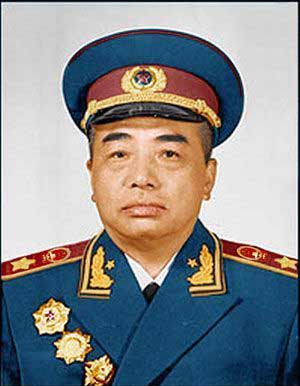 An important Chinese General who played a major role in the Chinese Revolution, but then in the end
became a pro-Soviet revisionist and was stripped of authority.
An important Chinese General who played a major role in the Chinese Revolution, but then in the end
became a pro-Soviet revisionist and was stripped of authority.
In the early years of the Revolution Peng was one of
the top generals leading the defense of the Jiangxi Soviet (liberated area). He then took part in the
famous Long March, and was one of the important supporters of Mao’s
leadership at the critical Zunyi Conference in 1935. In both the Anti-Japanese War and the Revolutionary
War against Jiang Kai-shek’s Guomindang after World War II, Peng played key military roles. And he was
in charge of the Chinese Volunteers in Korea resisting the American imperialist war there in the early
1950s. From 1954 to 1959 he was the Minister of Defense of the People’s Republic of China. But he wanted
to transform the People’s Liberation Army into a Soviet or Western-style professional army relying more
on advanced armaments than on the revolutionary motivation of the soldiers. His views in both political
and economic matters became much closer to Soviet revisionism. (For more details on some of these errors,
see the quotation below.)
“Peng Dehuai, formerly a member of the Politburo and a Vice Chair of the CPC’s
Central Military Commission, Vice Premier of the State Council, as well as Minister of Defense.
In August, 1959 at the Eight Plenary of the Eighth Committee of the Communist Party held at Lushan,
Peng Dehuai was labeled as the leading member of an anti-party clique, also consisting of Huang
Kecheng, Zhang Wentian, and Zhou Xiaodan. Peng Dehuai had led an attack against Mao and the party
center at the Lushan Conference, advocating reversion of agricultural land to family control, and
to have families take full responsibility for profits or losses, promoting a full retreat from the
entire objective of the collectivization of agriculture that had advanced from mutual aid teams in
the early 50s. Peng Dehuai also promoted a normalization of the then highly strained relations with
the Soviet Union.
“At the same time, another reactionary camp
revolved around Deng Xiaoping, Liu Shaoqi and associates such as Chen Yun, and Wu Zhipu which
advocated that ‘profit be put in command.’ When the trend of commune formation accelerated during
this time, the Liu and Deng group tried to used the communalization trend as a pretext to demand
adherence to commandist policies geared towards the accumulation of agricultural grain for profit,
a policy ‘left in form, right in essence.’ Because the party center was mobilized to deal with Peng’s
attack first (Peng supported by Huang Kecheng, Zhang Wentian, Zhou Xiaodan and others) Liu and Deng
had space to maneuver, contributing to the suffering and famine during this period.
“On Peng’s alignment to Soviet aims, see Maurice
Meisner’s Mao’s China and After, The Free Press, 1999, 266: ‘The prelude to the drama enacted
at Lushan began when Peng, in his capacity as Minister of Defense, led a Chinese military delegation
on a visit to the Soviet Union and Eastern Europe in the spring of 1959. During the course of his
travels, Peng expressed to Khrushchev and other foreign Communist leaders his displeasure (which
coincided with Soviet displeasure) over the policies of the Great Leap and the leadership of Mao. In
Peng’s view, a view shared by other military leaders, China’s domestic socioeconomic policies were
intimately related to its military policies and its relations with the Soviet Union. China’s military
security required a rational plan of economic development (to modernize the professional army that
Peng headed) as well as the sophisticated weapons and the nuclear shield provided by the Soviet Union.
The Great Leap Forward campaign threatened both, for it was undermining industrial and technological
development within China [according to Peng Dehuai, that is, though in actuality this long-term effort
to promote self-reliance in industry and technology was essential to such development. —Translators]
and undermining the Sino-Soviet alliance. And even more directly threatening to the professional army
was Maoist talk about reviving the popular militia.’”
—Translator’s note 7 to Mao’s “A Few Opinions
of Mine”, August 31, 1970, (as translated into English, July 2021), online at:
https://www.bannedthought.net/China/MaoEra/GPCR/Chinese/AFewOpinionsOfMine-1970-English.pdf
PENTAGON PAPERS
A 7,000 page set of internal assessments by the U.S. government that demonstrated that they knew their
imperialist war in Vietnam was going very poorly, and also helped show how they were consistently misleading
the American public about this and about the nature of the war. These were leaked to the press in 1971 by
defense analyst Daniel Ellsberg, and were one of many factors that led to promoting the growth of the U.S.
anti-war movement at the time.
‘Ellsberg was subsequently indicted under the archaic Espionage Act (1917, enacted
after US entered WWI), on charges of espionage, theft and conspiracy that could have meant 115 years
in prison. During his 1973 trial, Ellsberg tried to explain his actions, namely that the documents
were illegally classified to keep them not from an enemy but from the American public.
However, the Court ruled this argument “irrelevant”, Ellsberg being silenced before he could begin.
In 2014, Ellsberg wrote in The Guardian that his “lawyer, exasperated, said he ‘had never
heard of a case where a defendant was not permitted to tell the jury why he did what he did.’ The
judge responded: ‘Well, you’re hearing one now’. And so it has been with every subsequent
whistleblower under indictment”. Nevertheless, Ellsberg’s lawyer, Harvard Professor Charles Nesson,
was successful in proving that there had been illegal government wiretapping and that crucial
evidence had been withheld from the defense by the prosecution. The trial lasted four months and
ended with the dismissal of all charges. Dr. Ellsberg became the most famous whistleblower in US
history, and some people came to understand that there were necessary limits to secrecy and to what
governments were permitted to do. Far from being traitors, whistleblowers were citizens with
conscience and civic responsibility, true human rights defenders.’
—Alfred De Zayas, “Lessons Not Learned From
the Pentagon Papers”, CounterPunch, March 1, 2023, online at:
https://www.counterpunch.org/2023/03/01/lessons-not-learned-from-the-pentagon-papers/
PEOPLE, The
1. [In Marxist, especially Maoist usage:]
The proletariat and its allied classes and strata, as opposed to “the
enemy”.
2. The entire population. (When we
anti-revisionist Marxists wish to refer to the entire population we generally use phrases
such as: “the people as a whole”, or—better yet—“the whole population”.)
See also:
MASSES
“To understand these two different types of contradictions correctly
[i.e., those between the people and the enemy, and those among the people—Ed.],
we must first be clear on what is meant by ‘the people’ and what is meant by ‘the
enemy’. The concept of ‘the people’ varies in content in different countries and in
different periods of history in a given country. Take our own country for example.
During the War of Resistance Against Japan, all those classes, strata and social
groups opposing Japanese aggression came within the category of the people, while
the Japanese imperialists, their Chinese collaborators and the pro-Japanese elements
were all enemies of the people. During the War of Liberation, the U.S. imperialists
and their running dogs—the bureaucrat-capitalists, the landlords and the Kuomintang
reactionaries who represented these two classes—were the enemies of the people,
while the other classes, strata and social groups, which opposed them, all came
within the category of the people. At the present stage, the period of building
socialism, the classes, strata and social groups which favor, support and work for
the cause of socialist construction all come within the category of the people,
while the social forces and groups which resist the socialist revolution and are
hostile to or sabotage socialist construction are all enemies of the people.” —Mao,
“On the Correct Handling of Contradictions Among the People” (Feb. 27, 1957), SW
5:385.
PEOPLE, The — Bourgeois and Feudal Conceptions Of
Historically speaking, the exploitative ruling classes throughout history have had what
today should seem like a very strange conception of just who “the people” are. As Mao
noted in the quotation above, “The concept of ‘the people’ varies in content in different
countries and in different periods of history in a given country.” For ruling classes in
the past, “the people” only meant those individuals of their own class. Today, bourgeois
ruling classes have to make a pretense that “the people” means everyone, but in their own
hearts it still does not. This is the reason they still think in terms of “the better
sorts of people” (their sort), and so forth.
“The constitutional crisis [in England] of 1640 was a clash of two
fundamentally opposing views of the proper political order. The Stuart kings
struggled mightily to establish an absolutist monarchy on the French model, in
which all authority resided with the divinely sanctioned king. Parliament, meanwhile,
stood for a constitutional monarchy (though the term had not yet been coined). Even
the king, in its view, could not trample on the ancient rights of freeborn
Englishmen. Royal power must be tempered and, when necessary, resisted by ‘the
people,’ as represented in Parliament. Needless to say, parliamentary leaders never
dreamed of including the lower classes and the poor among ‘the people’ of England.
Only property owners were represented in Parliament, so only they had the right to
share power with the king. Even so, the Parliamentary party stood for a vast
expansion of the political class in England, which was precisely what the Royalists
were determined to prevent.” —Amir Alexander, Infinitesimal (2014), p.
187.
PEOPLE’S LIBERATION ARMY [China] — Democracy Within
The PLA during the Chinese Revolution and the Mao era of the People’s Republic of
China was probably one of the most democratic armies in history, and while Mao was
alive it got ever more democratic as time went on. [More intro material to be added... ]
“Democracy in the three main fields refers to the three
aspects of democratic life in the People’s Liberation Army, namely, democracy in
the political, economic and military fields. With regard to political democracy,
fighters [soldiers] are politically on an equal footing with cadres and are free
to criticize and voice their opinions against them and to put forward proposals
regarding work in the army. With regard to economic democracy, the economic
committee elected by the company’s armymen meeting assists the company leadership
in managing the company’s mess and production and supervises expenditures to
guard against corruption and waste and any violation of policies. With regard to
military democracy, in periods of training there must be mutual instruction
between cadres and fighters and among the fighters themselves, and there must be
a review of the results of the instruction and learning. In periods of fighting,
the rank and file should be aroused to discuss how to fulfil combat tasks and at
the end of an engagement to review the fighting.” —From a short glossary
accompanying an editorial from Jiefangjun Bao [Liberation Army Daily],
Peking Review, vol. 10, #3, Jan. 13, 1967, p. 10.
PEOPLE’S LIBERATION ARMY [China] — Ten Principles of Operation
Ten basic principles guiding the strategy and tactics of the PLA which were summed up
by Mao in December 1947, when the PLA was on the strategic offensive:
“1. Attack dispersed, isolated enemy forces first; attack
concentrated, strong enemy forces later.
“2. Take small and medium
cities and extensive rural areas first; take big cities later.
“3. Make wiping out the
enemy’s effective strength our main objective; do not make holding or seizing a
city or place our main objective. Holding or seizing a city or place is the
outcome of wiping out the enemy’s effective strength, and often a city or place
can be held or seized for good only after it has changed hands a number of
times.
“4. In every battle,
concentrate an absolutely superior force (two, three, four and sometimes even
five or six times the enemy’s strength), encircle the enemy forces completely,
strive to wipe them out thoroughly and do not let any escape from the net. In
special circumstances, use the method of dealing the enemy crushing blows, that
is, concentrate all our strength to make a frontal attack and an attack on one
or both of his flanks, with the aim of wiping out one part and routing another
so that our army can swiftly move its troops to smash other enemy forces. Strive
to avoid battles of attrition in which we lose more than we gain or only break
even. In this way, although inferior as a whole (in terms of numbers), we shall
be absolutely superior in every part and every specific campaign, and this
ensures victory in the campaign. As time goes on, we shall become superior as a
whole and eventually wipe out all the enemy.
“5. Fight no battle
unprepared, fight no battle you are not sure of winning; make every effort to be
well prepared for each battle, make every effort to ensure victory in the given
set of conditions as between the enemy and ourselves.
“6. Give full play to our
style of fighting—courage in battle, no fear of sacrifice, no fear of fatigue,
and continuous fighting (that is, fighting successive battles in a short time
without rest).
“7. Strive to wipe out the
enemy when he is on the move. At the same time, pay attention to the tactics of
positional attack and capture enemy fortified points and cities.
“8. With regard to attacking
cities, resolutely seize all enemy fortified points and cities which are weakly
defended. At opportune moments, size all enemy fortified points and cities
defended with moderate strength, provided circumstances permit. As for strongly
defended enemy fortified points and cities, wait till conditions are ripe and
then take them.
“9. Replenish our strength
with all the arms and most of the personnel captured from the enemy. Our army’s
main sources of manpower and matérial are at the front.
“10. Make good use of the
intervals between campaigns to rest, train and consolidate our troops. Periods
of rest, training and consolidation should not in general be very long, and the
enemy should so far as possible be permitted no breathing space.” —Mao, “The
Present Situation and Our Tasks (Excerpts)” (Dec. 25, 1947), Selected Military
Writings of Mao Tse-tung (1963), pp. 347-8.
PEOPLE’S LIBERATION FRONT OF INDIA (PLFI)
Called a “splinter group” of the Communist Party of India (Maoist) by the bourgeois media
in India. However, the CPI(Maoist) was not formed until September 2004, and the PLFI is
said to have been formed by an ex-army man Dinesh Gope and other members of his family at
least one year before that (and probably much earlier). It is active in Jharkhand state
especially, and surrounding areas.
The government and bourgeois media in
India call all other armed organizations [or what they characterize as “LWE” (Left-Wing
Extremist) organizations] as CPI(Maoist) “splinter groups”—whether or not they have ever
had any political connection or agreement with the CPI(Maoist). And most of the 17 or
more such groups in the tribal areas of west-central India (as of 2018) have never had
any such connection or agreement in basic political line with the CPI(Maoist) or its
antecedents. While some of these small groups are indeed truly revolutionary (though
apparently quite sectarian), others seem to be more like bandit groups focused merely on
extorting money from businesses, and sometimes even from the masses. And, this is true
in particular of the PLFI, as was stated by the Jharkhand Police themselves on their own
website: “Jharkhand police had in October 2012 recognized PLFI as a bigger threat to
internal security in the state than the Maoists because PLFI, police claim, does not
follow any left wing ideology and is solely running to illegally amass money.”
In December 2003 Dinesh Gope’s older brother,
Suresh Gope, was killed and Dinesh took over the leadership of the group. More recently,
another member of the family, Guddu Gope, is said to be one of its top leaders. In July
2007, Masi Charan Purty, a renegade from the CPI(Maoist), along with several of his
followers, joined the PLFI. Purty was later arrested, but some other “apolitical”
renegades from the CPI(Maoist) also joined the PLFI. So only in this highly dubious sense
can the PLFI be considered to be some sort of “splinter” from the CPI(Maoist). And even
then, only because of a few of its most disreputable elements who left the CPI(Maoist) or
were, more likely, forced out.
In any case, the PLFI has grown, and one
of the reasons for this is that the Jharkhand government actually supported it,
at least for several years! The reason for this support was that the PLFI, in addition
to its banditry, also violently attacked CPI(Maoist) cadres and supporters. Thus, in
effect, the PLFI has also functioned as a pro-government anti-communist death squad.
This has led to some outright battles between the PLFI and the CPI(Maoist). However, as
the level of banditry by the PLFI increased more and more, the Jharkhand government began
to be more cautious in its support for that group, especially after 2012.
“Ironically, the government has also been instrumental in sustaining
PLFI during its initial days, using it to counter the CPI-Maoist. However, it appears
that this strategy has backfired; today the PLFI has become one of the major terror
groups in the State. Unlike the Maoists, the PLFI has no ideology and is only concerned
with extortion and criminal activities. Hence, joining the PLFI is, and always has been,
comparatively easy. As the main source of the PLFI’s income comes from extortion and
levies, it attracts a large number of unemployed youth, who are lured by the temptation
of easy money.” —Deepak Kumar Nayak, of the pro-ruling class think tank IPCS, “Naxal
Violence: The Peoples’ Liberation Front of India (PLFI) in Jharkhand”, March 29, 2013,
online at:
http://www.ipcs.org/comm_select.php?articleNo=3861
PEOPLE’S WAR
This is a term which developed in the course of the Chinese Revolution led by Mao Zedong.
The strategy which Mao developed for this revolution was very distinctive, and a great
departure from the basic strategy used in the Russian Revolution, and other earlier
proletarian-led revolutions. Instead of a long period of preparation and then more or less
simultaneous insurrection by the working class in the major cities, Mao’s People’s War in
China involved mobilizing the peasantry in the countryside using the method of the
mass line, building up first small-scale guerrilla warfare
arising from the masses and strongly supported by them, establishing and then expanding
liberated areas, gradually developing guerrilla warfare into ever larger-scale mobile
warfare, then positional warfare and the countryside surrounding the cities, and then
finally capturing the cities primarily by attack from the outside. This basic strategy
worked with great success in China and also in some other countries such as Vietnam.
People’s War in China was successful for
a number of important reasons, including excellent overall leadership by Mao and the CCP
who were deeply integrated with the people in the rural areas. China was mostly a peasant
country with by far the largest part of its population in the countryside. Moreover, China
was a large and very backward country, and this backwardness included major difficulties
in transportation and communication. Although Chiang Kai-shek’s
Guomindang had airplanes and some other modern weapons for
the times, it was still very difficult for them to bomb the liberated areas, or to quickly
move troops around to attack the revolutionary forces. In addition to all these factors,
there was a long imperialist invasion of China by Japan which the CCP took the lead
in resisting.
It is much more difficult to create and
defend liberated areas in the countryside today, in any part of the world—even in the
remaining semi-feudal backward countries. The imperialists have access to constant
satellite and drone aircraft surveillance, and can remotely rain down rockets and bombs on
any spot on earth. More than half of the population of the world now lives in cities
(albeit often in horrible slums). This does not mean that People’s War can no longer
possibly work anywhere, but it does mean that the regions where it still might
work are being severely restricted, while the difficulties for this revolutionary strategy
are rapidly increasing. It may also mean that the strategy of people’s war, even where it
can still be used, may need to be part of a dual strategy along with simultaneously working
toward insurrection in the larger cities. Even in China today (which also now has more than
50% of its population living in cities) it is very doubtful if Mao’s pure strategy of
People’s War in the countryside could ever work again.
See also below, and:
“SANWAN REORGANIZATION” [Of the Chinese
Revolutionary Army]
PEOPLE’S WAR — As a “Universal” Revolutionary Strategy
When Mao first formulated the revolutionary strategy of People’s War for China (see
above) it was condemned by many “formula Marxist-Leninists” (and especially by Trotskyists)
as being an abandonment of Marxism-Leninism, destined to fail miserably. “Imagine, relying
so much on the peasantry in the countryside rather than the workers in the cities!” they
said. (Strangely, many of those people kept to that same tune even after the huge victory
of the Chinese Revolution in 1949!) But for decades after that success all genuine
Marxist-Leninists took the position that in many backward, semi-feudal “Third World”
countries something along the lines of Mao’s strategy of “People’s War” was appropriate,
while in the highly urbanized advanced capitalist countries the appropriate basic strategy
was still something similar to Lenin’s strategy in Russia, the “October Road”, building up
the revolutionary forces through mass struggle followed by mass insurrection and civil war
at the appropriate moment. Most seasoned Marxist-Leninist-Maoists today still hold to that
dual strategic position, depending on the precise situation of the country in question.
And in some countries, Maoists now recognize the need for some combination of those
two distinct strategies.
However, for some curious reason (perhaps
due to insufficient study of the past, and a tacit downplaying of the contributions to
revolutionary theory and practice by Marx and Lenin), some young and inexperienced Maoists
today maintain that protracted People’s War is now the only appropriate
revolutionary strategy in absolutely all countries! Many of them claim that whether
or not someone upholds the universality of People’s War is the litmus test of whether
they are a real Maoist revolutionary or a revisionist! But to many other Maoists, claims of
this sort seem to be the adoption of a new dogmatic “formulaic MLM” divorced from the actual
conditions in specific countries.
However, a major question among those who
uphold the “universality of PW” in the Maoist movement around the world today is how much
of the precise strategy and experience of the Chinese Revolution to regard as essential to
the very concept of People’s War. For example, is relying on the peasantry in the countryside
an essential aspect of People’s War? If so, then in advanced capitalist countries with
essentially no peasantry, there could be no such thing as a People’s War. Or how about the
aspect of the countryside surrounding the cities? How could that be applicable to today’s
highly urbanized countries, even in large parts of the “Third
World”?
It seems that the term People’s War has
developed both a narrow and a wide sense. In the narrow sense People’s War means something
pretty close to the strategy of the Chinese revolution, including being based on the
peasantry, rural guerrilla warfare and the countryside surrounding the cities. In the
wider sense apparently being used by those who favor the “universality” of PW, it may now
mean pretty much any revolutionary war of the people. By this standard even the Russian
Revolution itself could now be considered to have been a “People’s War”. But how useful
is it to have a term which covers nearly all possible strategies? In deciding what strategy
to use in some particular country a term which covers too wide a range of strategies would
not help clarify anything.
Even Mao himself at times seemed to talk
in terms of some wider sense of People’s War. He said, for example, that “A nation, big or
small, can defeat any enemy, however powerful, so long as it fully arouses its people, firmly
relies on them and wages a people’s war.” [Quoted in Peking Review, Feb. 28, 1969, p.
21.] On most other occasions, however, Mao more clearly had in mind something close to the
strategy of the Chinese Revolution when he referred to People’s War. And Mao also frequently
advised foreign revolutionaries not to try to blindly copy the strategy and tactics of the
Chinese Revolution.
Certainly anyone proclaiming the “universality
of PW” has an absolute obligation to say exactly what they mean by ‘People’s War’, and
explain why they insist on using that term if it is not something very close to Mao’s strategy
in the Chinese Revolution!
See also:
FOREIGN EXPERIENCE, and the careful and
thorough discussion of this topic in the excellent paper by the Mass Proletariat organization,
“Protracted People’s War is Not a Universal Strategy for Revolution” (Jan. 19, 2018), now
available online in Volume 1 of Red Pages (published by the Maoist Communist Union) at:
https://www.bannedthought.net/USA/MCU/RedPages/RedPages-01-Jan2021-rev3.pdf
“The seizure of power by armed force, the settlement of the issue by
war, is the central task and the highest form of revolution. This Marxist-Leninist
principle of revolution holds good universally, for China and for all other countries.
“But while the principle remains
the same, its application by the party of the proletariat finds expression in varying
ways according to the varying conditions. Internally, capitalist countries practice
bourgeois democracy (not feudalism) when they are not fascist or not at war; in their
external relations, they are not oppressed by, but themselves oppress, other nations.
Because of these characteristics, it is the task of the party of the proletariat in the
capitalist countries to educate the workers and build up strength through a long period
of legal struggle, and thus prepare for the final overthrow of capitalism. In these
countries, the question is one of a long legal struggle, of utilizing parliament as a
platform, of economic and political strikes, of organizing trade unions and educating
the workers. There the form of organization is legal and the form of struggle bloodless
(non-military). On the issue of war, the Communist Parties in the capitalist countries
oppose the imperialist wars waged by their own countries; if such wars occur, the
policy of these Parties is to bring about the defeat of the reactionary governments of
their own countries. The one war they want to fight is the civil war for which they are
preparing. But this insurrection and war should not be launched until the bourgeoisie
becomes really helpless, until the majority of the proletariat are determined to rise
in arms and fight, and until the rural masses are giving willing help to the proletariat.
And when the time comes to launch such an insurrection and war, the first step will be
to seize the cities, and then advance into the countryside, and not the other way
around. All this has been done by Communist Parties in capitalist countries, and it has
been proved correct by the October Revolution in Russia.
“China is different however. The
characteristics of China are that she is not independent and democratic but semi-colonial
and semi-feudal, that internally she has no democracy but is under feudal oppression and
that in her external relations she has no national independence but is oppressed by
imperialism. It follows that we have no parliament to make use of and no legal right to
organize the workers to strike. Basically, the task of the Communist Party here is not
to go through a long period of legal struggle before launching insurrection and war, and
not to seize the big cities first and then occupy the countryside, but the reverse.”
—Mao, “Problems of War and Strategy” (Nov. 6, 1938), SW 2:219-220.
“While actively leading immediate struggles, Communists in the capitalist
countries should link them with the struggle for long-range and general interests, educate
the masses in a Marxist-Leninist revolutionary spirit, ceaselessly raise their political
consciousness and undertake the historical task of the proletarian revolution. If they
fail to do so, if they regard the immediate movement as everything, determine their
conduct from case to case, adapt themselves to the events of the day and sacrifice the
basic interests of the proletariat, that is out-and-out social democracy.
“... Beyond any shadow of doubt,
Communists must win over the masses under the influence of the social democratic parties
and must win over those left and middle elements in the social democratic parties who are
willing to oppose domestic monopoly capital and domination by foreign imperialism, and
must unite with them in extensive joint action in the day-to-day struggle of the
working-class movement and in the struggle to defend world peace.
“In order to lead the proletariat
and working people in revolution, Marxist-Leninist Parties must master all forms of
struggle and be able to substitute one form for another quickly as the conditions of
struggle change. The vanguard of the proletariat will remain unconquerable in all
circumstances only if it masters all forms of struggle—peaceful and armed, open and
secret, legal and illegal, parliamentary struggle and mass struggle, etc. It is wrong
to refuse to use parliamentary and other legal forms of struggle when they can and should
be used. However, if a Marxist-Leninist Party falls into legalism or parliamentary
cretinism, confining the struggle within the limits permitted by the bourgeoisie, this
will inevitably lead to renouncing the proletarian revolution and the dictatorship of
the proletariat.” —A Proposal Concerning the General Line of the International
Communist Movement: The letter of the Central Committee of the Communist Party of China
in reply to the letter of the Central Committee of the Communist Party of the Soviet
Union of March 30, 1963 (Peking: Foreign Languages Press, 1963), p. 19-20. (The
writing of this document was closely supervised by Mao.)
PEPPER SPRAY
A chemical spray which is a strong lachrymatory agent (which irritates the eyes to cause
tears, pain and temporary blindness), and which is used by police against protesters to
infringe on their right to protest and speak out against injustices, and to help subdue
and arrest them. The compound in the spray is oleoresin capsicum, derived from exceptionally
strong chili plants. The temporary blindness is caused because the gas is so irritating it
forces the victim’s eyes to close in agony. Although commonly termed a “non-lethal weapon”
by the ruling-class authorities, it does sometimes cause death.
The FBI approved the use of pepper spray
against people even though the U.S. military had previously declared it extremely dangerous.
The FBI agent in charge of this approval process was later fired for accepting bribes from
the pepper gas manufacturer. But pepper spray remains in very widespread use by police in
the U.S. and elsewhere. (For a few more details, see the excerpts below from the Wikipedia
article on pepper spray.)
See also:
PUBLIC RELATIONS for a photo of pepper spray in use
by police against peaceful demonstrators.
“For those with asthma, taking other drugs, or subject to restraining
techniques that restrict the breathing passages, there is a risk of death. The Los
Angeles Times reported in 1995 at least 61 deaths associated with police use of
pepper spray since 1990 in the USA. The American Civil Liberties Union (ACLU) documented
27 people in police custody who died after exposure to pepper spray in California since
1993. However, the ACLU report counts any death occurring within hours of exposure to
pepper spray. In all 27 cases, the coroners’ report listed other factors as the primary
cause of death, though in some cases the use of pepper spray may have been a contributing
factor.
“The US Army concluded, in a 1993
Aberdeen Proving Ground study, that pepper spray could cause ‘[m]utagenic effects,
carcinogenic effects, sensitization, cardiovascular and pulmonary toxicity, neurotoxicity,
as well as possible human fatalities. There is a risk in using this product on a large and
varied population’. However, the pepper spray was widely approved in the US despite the
reservations of the US military scientists after it passed FBI tests in 1991. As of 1999,
it was in use by more than 2,000 public safety agencies.
“The head of the FBI’s Less-Than-Lethal
Weapons Program at the time of the 1991 study, Special Agent Thomas W. W. Ward, was fired
by the FBI and was sentenced to two months in prison for receiving payments from a pepper
gas manufacturer while conducting and authoring the FBI study that eventually approved
pepper spray for FBI use. Prosecutors said that from December 1989 through 1990, Ward
received about $5,000 a month for a total of $57,500, from Luckey Police Products, a Fort
Lauderdale, Florida-based company that was a major producer and supplier of pepper spray.
The payments were paid through a Florida company owned by Ward’s wife.”
—Wikipedia (accessed on April 15,
2016), at: https://en.wikipedia.org/wiki/Pepper_spray
[See that source for references and further information.]
PERCEPTION — and Conceiving
What we humans actually perceive with our eyes and other sense organs is constrained to a
quite considerable degree by the limited conceptual categories we already possess. It is
hard to even properly perceive a strange animal in the sea as a dugong, for
example, if you’ve never heard of a “dugong” or anything like it. It may require more
extended study of the animal and the establishment of a new “dugong” category in which to
place it.
“Countless phenomena of the objective external world are reflected
in a man’s brain through his five sense organs—the organs of sight, hearing, smell,
taste and touch. At first, knowledge is perceptual. The leap to conceptual knowledge,
i.e., to ideas, occurs when sufficient perceptual knowledge is accumulated. This
is one process in cognition. It is the first stage in the whole process of cognition,
the stage leading from objective matter to subjective consciousness. Whether or not
one’s consciousness or ideas (including theories, policies, plans or measures) do
correctly reflect the laws of the objective external world is not yet proved at this
stage, in which it is not yet possible to ascertain whether they are correct or not.
Then comes the second stage in the process of cognition, the stage leading from
consciousness back to matter, from ideas back to existence, in which the knowledge
gained in the first stage is applied in social practice to ascertain whether the
theories, policies, plans or measures meet with the anticipated success. Generally
speaking, those that succeed are correct and those that fail are incorrect....” —Mao,
“Where Do Correct Ideas Come From?” (May 1961).
“We perceive through our sensory organs, to be sure, but no less
through our concepts; in other words we perceive not just physiologically but also
intellectually. There is thus an unbreakable link between perceiving and conceiving.
On the one hand, our conceptions depend on our senses, since our concepts would be
quite different if our senses were different, but on the other hand, our perceptions
depend on our repertoire of concepts, because the latter are the filters through
which any stimulus in our environment reaches our consciousness.”
—Douglas Hofstadter & Emmanuel
Sander, Surfaces and Essences: Analogy as the Fuel and Fire of Thinking (2013),
p. 171. [This is helpful and correct, though it only covers what Mao calls the
first stage of the process of cognition. Of course they have no citation of
Mao’s ideas in their book. —Ed.]
PERFORMATIVE USE OF LANGUAGE
The use of language to perform some (usually social) act, such as: “I promise to come tomorrow”,
whose very utterance normally performs the act of promising. (Even if I fail to come tomorrow,
it is still true that I did promise to do so.) Similarly: “I find you guilty”, said by a judge;
“Here”, said by person whose name is called when a group is assembling; “I pronounce you man and
wife”, said by a justice of peace or other individual authorized to legally marry people; and so
forth. The very act of saying the appropriate words in the appropriate circumstances performs the
act in question.
The bourgeois analytic philosopher, John L.
Austin, introduced the concept of performative language around 1962.
“I have also devoted some attention to the work of the late J. L. Austin,
... in the study of ways in which words are used for purposes other than making statements
of fact. Very suggestive, in my opinion, is Austin’s book Doing Things with Words in
which he deals with what he called the ‘performative’ use of language. The basic point is
quite simple. To say ‘I will’ when getting married, for example, is not simply a statement
recording one’s mental condition at the time. It is an act, a pledge. With those words one
does not merely state a fact, but one performs an action—namely, one gets married. And
without this sort of verbal ‘performance’ there would be no marriage as a human institution.
We do things with words. And I think it important to try to follow up Austin’s analysis by
seeing how the use of language enters into more or less the whole of human social activity.
Thus I have suggested that such a basic human institution as property could not be
established without the use of language. And similarly with all, or nearly all, human
relations.” —Maurice Cornforth, Marxism and the Linguistic Philosophy, (London:
1967), p. 13.
PERMANENT REVOLUTION
1. [In a general sense used by most
Marxists, including Maoists:] The view that most capitalist societies, except for those
advanced capitalist countries with already well-established
bourgeois democratic political systems, must first
achieve democracy and afterwards socialism through two major revolutions: 1) a
bourgeois-democratic or New Democratic revolution,
followed by 2) a socialist revolution. (This is what occurred in both Russia and China.)
2. [In a similar general Marxist sense:]
The view that all revolutions, including socialist revolutions, must themselves develop
through smaller stages or steps, and that each step must be followed by another step in a
virtually continuous fashion, with perhaps only quite short pauses for the masses to catch
their breath between them.
Permanent, or uninterrupted
revolution in this sense is opposed to the idea that there must be long periods of
consolidation and quiet routine between the revolutionary steps—when, perhaps, the focus
shifts virtually entirely to the expansion of production for extensive periods. It opposes
that notion because such long periods of supposed “consolidation” in fact generally turn
out to be mere pauses before the reversals begin of the revolutionary steps
previously accomplished. Socialism, in particular, is viewed by Maoists as a long period of
unstable political and economic transition from capitalism to communism. As such,
socialist society must continuously transform itself in the direction of communism if it is
not to fall back into capitalism.
3. [In the most widely discussed sense,
especially in academia:] One or another of a variety of related views that the first
proletarian revolutionary countries must promote revolution in other countries, or even
possibly export revolution through military means to other countries, in order both to
survive themselves and in order to more rapidly bring the world revolution to complete
success. Ideas such as these have often been associated with Leon
Trotsky, but they long predate him. They have their roots in Lassalle, Marx, Franz
Mehring and then in Trotsky’s associate, Parvus, and were perhaps first put forth by
Louis Blanqui. Trotsky, however, adopted and promoted this
generally correct idea in a single-minded and often totally irrational fashion, to the point
where it is sometimes viewed as the most essential point of his doctrine.
Since Tsarist Russia was a quite backward
country, economically and politically, all the Bolsheviks—including Lenin and
Stalin—originally expected that the survival of the October Revolution would depend on early
proletarian revolutions in Germany and elsewhere. And, indeed, it was something of a miracle
that the Bolsheviks—even with very widespread mass support—were able to prevail in the civil
war and despite the foreign military intervention by many imperialist countries (including
Britain and the U.S.) which tried to suppress them. While the Bolsheviks did succeed in
liberating and holding on to most of the old Tsarist empire, their attempt to use the Red
Army to liberate Poland turned out to be a disastrous failure. But once the situation in
Russia was stabilized, and after the defeat of the attempted proletarian revolutions of that
period in Germany and other countries, the Bolsheviks really had no choice but to try to
build “socialism in one country”, while still doing as much as they could to ideologically
and organizationally support revolution in Europe and throughout the rest of the world. They
did this through the Communist International and in other ways. It was at this point that
the generally correct viewpoint that proletarian regimes should support revolution in other
countries was perverted by Trotsky into opposition to Stalin’s absolutely necessary program
of building socialism in one country—the Soviet Union. And any suggestion that revolution
should at that point be exported militarily was simply foolish in the extreme, and would
certainly have led to the overthrow of the October Revolution. (It is worth noting, however,
that when providing military aid to other revolutions did later become possible—such as in
China in the late 1920s and in a number of countries during World War II—the Soviet Union
did so.)
Other aspects of Trotsky’s version of
“permanent revolution” were also quite foolish and incorrect, such as his claim that in
other countries the democratic revolution should be combined with the socialist revolution,
and that stages within revolutions could be skipped because of the prior success of the
Bolshevik Revolution.
Although Mao and other genuinely
revolutionary Marxists sometimes used the term “permanent revolution” in the correct and
reasonable senses mentioned above (see quotes below), in most “left” political discourse
today the term still evokes the erroneous doctrines of Leon Trotsky. For that reason, it is
probably generally better to use the alternate phrase,
uninterrupted revolution instead.
“We are exponents of the theory of the transition of the revolution,
and not of the Trotskyite theory of ‘permanent revolution’. We are for the attainment
of socialism by going through all the necessary stages of the democratic republic. We
are opposed to tailism, but we are also opposed to adventurism and impetuosity.” —Mao,
“Win the Masses in Their Millions for the Anti-Japanese National United Front” (May 7,
1937), SW 1:290, online at:
https://www.marxists.org/reference/archive/mao/selected-works/volume-1/mswv1_15.htm
“I stand for the theory of permanent revolution. Do not mistake this
for Trotsky’s theory of permanent revolution. In making revolution one must strike while
the iron is hot—one revolution must follow another, the revolution must continually
advance. The Hunanese often say, ‘Straw sandals have no pattern—they shape themselves
in the making.’ Trotsky believed that the socialist revolution should be launched even
before the democratic revolution is complete. We are not like that. For example after
the Liberation of 1949 came the Land Reform; as soon as this was completed there
followed the mutual-aid teams, then the low-level cooperatives, then the high-level
cooperatives. After seven years the cooperativization was completed and productive
relationships were transformed; then came the Rectification. After Rectification was
finished, before things had cooled down, then came the Technical Revolution. In the
cases of Poland and Yugoslavia, democratic order had been established for seven or eight
years, and then a rich peasantry emerged. It may not be necessary to establish a New
Democratic government, but even so one must still unite all those forces which can be
united.” —Mao, “Speech At The Supreme State Conference” (January 28, 1958), SW 8,
online at:
https://www.marxists.org/reference/archive/mao/selected-works/volume-8/mswv8_03.htm
“We believe in permanent revolution, yet many comrades gave no thought
to the timing of the socialist revolution or to what should be done after land reform.
They closed their eyes to sprouts of socialism even after such forms had appeared. The
mutual-aid teams in Jui-chin and in the anti-Japanese bases were such sprouts.” —Mao,
“Talks at the Chengtu Conference” (March 1958), Talk of March 22nd, SW 8, online at:
https://www.marxists.org/reference/archive/mao/selected-works/volume-8/mswv8_06.htm
PERP [Capitalist Financial Gambling]
A futures contract (a type of financial
derivative which gives the holder the right to buy, or to
sell, the underlying asset, such as a share of stock or a bitcoin) which itself does not have
a settlement or expiration date (and may thus potentially exist “perpetually”). The idea of
creating such a “financial instrument” was apparently originally proposed in 1992 by the
prominent bourgeois economist, Robert Shiller.
Ordinary futures contracts are settled at a
fixed point in time. But “perps” never expire unless the owner decides to exercise the right
to purchase or sell, as the case may be. Instead of being settled on a fixed date, they require
regular payments (“funding fees”), typically every eight hours, in which traders on one side of
the market pay those on the other. If the perp has a “positive funding rate”, then if the perp
price is higher than the spot price, those betting “long” pay the funding fee to those betting
“short”; otherwise the payment goes in the other direction. These regular payments are intended
to keep the contract’s price closely tied to the spot price of the underlying financial asset.
Traders buying perps are allowed to use massive leverage, often
up to 100-times their actual monetary outlay, to control large gambling positions with small
amounts of actual investment. For reasons such as these, “perps” have become a huge area of
financial gambling within the cryptocurrency gambling
sphere in particular, since around 2020.
PERSONAL EXPERIENCE
“A political point becomes ten times more convincing if linked with
the personal experience of an audience.” —Chou Kai, “Art Goes to the Villages”,
Peking Review, #5, Jan. 28, 1966, p. 11.
“Experience is essential for the cadres, and failure is indeed the
mother of success. But it is also necessary to learn with an open mind from other
people’s experience, and it is sheer ‘narrow empiricism’ to insist on one’s own
personal experience in all matters and, in its absence, to adhere stubbornly to
one’s own opinions and reject other people’s experience.” —Mao, “Problems of
Strategy in China’s Revolutionary War” (December 1936), SW1:223.
PERSONALITY CULT
An excessive or unquestioning deference to the authority of an individual leader,
generally promoted by that person or a group led by that person. Marx, who introduced
the term, called it the “superstitious belief in authority”. Also known as the “cult of
the individual”.
See also:
CULT,
MAO—Personality Cult
“... Neither of us [Marx and Engels] cares a straw for popularity.
A proof of this is, for example, that, because of aversion to any personality cult,
I have never permitted the numerous expressions of appreciation from various
countries, with which I was pestered during the existence of the International, to
reach the realm of publicity, and have never answered them, except occasionally by
a rebuke. When Engels and I first joined the secret Communist Society we made it
a condition that everything tending to encourage superstitious belief in authority
was to be removed from the Rules.” —Marx, Letter to Wilhelm Blos, Nov. 10, 1877,
Marx-Engels: Selected Correspondence (Moscow: Progress, 1975), p. 291. [In
a slightly different translation in MECW 45:288.]
[On August 30, 1918, a woman belonging to the so-called “Left
Socialist-Revolutionary” party shot Lenin in the neck and shoulder in an assassination
attempt. Though seriously wounded, Lenin soon recovered. But the Bolshevik press
immediately not only strongly condemned the S-R’s (who had previously supported the
revolution), but also launched a campaign to promote a personality cult around Lenin.
As soon as Lenin recovered sufficiently and became aware of this cult he was totally
appalled and insisted that it be immediately stopped. And with regard to these
articles in the Party press he said to his comrade, Vladimir Bonch-Bruevich:]
“It is shameful to read... They
exaggerate everything, call me a genius, some kind of special person... All our lives
we have waged an ideological struggle against the glorification of the personality,
of the individual; long ago we settled the problem of heroes. And suddenly here again
is a glorification of the individual!” —Lenin, quoted in Nina Tumarkin, Lenin
Lives! The Lenin Cult in Soviet Russia (1983), p. 90. (Translated from
Bonch-Bruevich’s book Vospominaniia o Lenine [“Reminiscences of Lenin”],
(Moscow: 1965), pp. 337-340.)
PERU — Communist Parties
For many decades there have been multiple different Communist parties in Peru, some revolutionary, and
some revisionist and/or reformist in outlook. As of the 1980s-1990s, the situation was something like
this [as taken from the book Shining Path of Peru, ed. by David S. Palmer (2nd ed., 1994)]:
•
PCP (Partido Comunista del Perú), the Communist Party of Peru: Moscow line revisionists.
•
PCP-BR (Partido Comunista del Perú — Bandera Roja), the Communist Party of Peru — Red Flag:
Maoist, Saturnino Paredes faction.
•
PCP-PR (Partido Comunista del Perú — Patria Roja), the Communist Party of Peru — Red Fatherland:
Maoist.
•
PCP-SL (Partido Comunista del Perú — Sendero Luminoso), the Communist Party of Peru — Shining
Path: Maoist, led by Abimael Guzmán Reynoso (known as Presidente Gonzalo). However, this party
has usually just called itself the PCP to emphasize its claim to be the only authentic Communist Party
of Peru.
We believe that since the capture, imprisonment, and
eventual death of Chairman Gonzalo, the PCP-SL has itself split into two or more separate parties. We
hope that this situation will eventually become clearer.
“PETER PRINCIPLE”
A humorous but all-too-commonly-true principle which states that managers in businesses tend
“to rise to the level of their incompetence”. That is to say, if they do well (according to
the standards set by their bosses) in one position, they will get promoted to a higher
managerial position—until they reach a job which is pretty much beyond their capabilities.
At this point they no longer get promoted, and so there they stay. And over time more and
more management slots get filled up with at least somewhat incompetent managers.
The “Peter Principle” was first propounded
in the 1969 book The Peter Principle: Why Things Always Go Wrong, by Laurence J. Peter
and Raymond Hull. Its central idea is that decisions to promote managers are based on how
they are performing in their current job and not really on whether they possess the
skills and ability to do the job they are being promoted into. And there is in fact some
substantial evidence that this Peter Principle is for real. [One recent study
of employee sales performance and management at 214 firms by the bourgeois economists Alan
Benson, Danielle Li, and Kelly Shue showed this pretty clearly. See: “The Peter Principle
Isn’t Just Real, It’s Costly”, Spring 2018, NBER Working Paper No. 24343.]
Anyone who has ever worked for a large
American corporation will have had experience with such incompetent managers, and may even
have come across total dummies like the “pointy-haired boss” in the Dilbert comic strip in
newspapers, who are by no means uncommon in large corporations.
Workers today at capitalist companies have
come to almost expect this sort of incompetence on the part of at least some of their
managers. We should explain to our co-workers that this is one of the many reasons why a
proletarian revolution should definitely make it possible for us workers to do a much
better job of running the economy than the capitalists now do.
But at the same time, are there lessons here
for how socialist enterprises should be run after the revolution? Indeed there are.
One prime lesson is that socialist management should not be operated in the same way that
capitalist management is. Managers should of course be promoted from among the workers at
the factory (and not recruited from “business schools” where they are not taught anything
about what the production at the specific factory actually entails). That one change would
already get rid of a lot of total incompetence! In addition, recruiting supervisors and
managers from among the ordinary workers should not be a one-way ticket out of the working
class and into a privileged new stratum or class of bosses. Management should be rotated
in-and-out of production jobs, and workers should be rotated in-and-out of management. Then
too, management should be more of a collective thing, and should involve constant consultation
with the workers. Often it should be done by committee, including at the higher levels of the
enterprise. And, in general, if the working class is to run society, ways must be developed
so that they run factories and production not under the direction of incompetent dolts, but
rather based on their own collective experience and knowledge. The great experience of the
Chinese working class, especially in Shanghai during the Great
Proletarian Cultural Revolution should help enlighten our path forward here.
PETTY BOURGEOISIE
Literally in French, the “little bourgeoisie”. In other words, a social class between the
proletariat (working class) and the bourgeoisie (capitalist class), which (for the most part,
at least) neither hires and exploits workers, nor are themselves hired and exploited by the
capitalists. This class includes: independent artisans, handicraft workers, and self-employed
people; professional people (lawyers, doctors, etc.) who do not work for corporations but who
“hang out their own shingle” (i.e., have their own independent businesses); (very) small
businessmen and store owners, who run their businesses alone or with their families; family
farmers and part of the peasantry (in countries where the peasantry still exists); etc. Of
course the lines are quickly blurred somewhat, since many small businesses also hire one or
a few employees, if only part-time, but still do not receive the bulk of their income through
exploiting the labor of others.
In recent decades there have been trends
within Marxism (or at least within what has been called Marxism) to water down the definition
of ‘petty bourgeoisie’ and to view more and more of the proletariat as supposedly being part
of the petty bourgeoisie, partly because some sections of the working class are better paid
than others, and partly because some workers have been more indoctrinated by bourgeois or
petty bourgeois ideas than others. For an 18-page essay opposing this trend, see: “Comments
on the Term ‘Petty Bourgeoisie’” (April 2019), by Scott Harrison, online at:
https://www.massline.org/Politics/ScottH/PettyBourgeoisie-190428.pdf, and also its
sequel, “Further Discussion of the ‘Petty Bourgeoisie’”, at
https://www.massline.org/Politics/ScottH/PettyBourgeoisie-190520.pdf
Note also that a worker can be petty bourgeois
in their ideology while still being objectively part the proletariat (i.e., while still
selling their labor power to capitalists in order to exist).
“In particular, it is the petty bourgeoisie who are attracted to the
side of the big bourgeoisie and are largely subordinated to them through this
apparatus [of the state], which provides the upper sections of the peasants, small
artisans, tradesmen and the like with comparatively comfortable, quiet and respectable
jobs raising their holders above the people.” —Lenin, “The State and Revolution”
(August-September 1917), LCW 25:408. [Lenin is speaking of the situation in Russia as
of the summer of 1917, but a similar sort of thing can generally be said of the petty
bourgeois in all countries. —Ed.]
PFAS
[Shorthand for “Per- and PolyFluoroAlkyl Substances”, a large number of organic chemicals
containing fluorine.]
Yet another type of growing chemical pollution in the environment. PFAS, are also known as
“Forever Chemicals” because they continue to exist in
the environment for very long lengths of time, without breaking down. Exposure to PFAS has
been linked to a number of serious health problems, including cancer, liver disease and
kidney disease.
“PFAS, synthetic chemicals found in products like dental floss and
children’s toys, are so ubiquitous that they can be detected in the blood of almost
every person in the United States.” —New York Times, “E.P.A. Invokes
Superfund Law to Make Polluters Clean Up 2 ‘Forever Chemicals’”, April 20, 2024.
“Maine is the only state that has started to systematically test
farmland for PFAS, also known as forever chemicals because they don’t break down in the
environment, and has shuttered dozens of dairy farms found with contamination.”
—New York Times, “Facts of Interest”, February 15, 2025.
Dictionary Home Page and Letter Index
MASSLINE.ORG Home Page