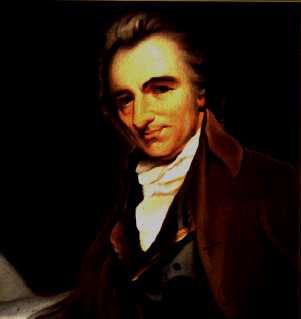
 The best and most radical leader of the American Revolution of the late 18th century,
who also participated in the Great French Revolution.
The best and most radical leader of the American Revolution of the late 18th century,
who also participated in the Great French Revolution.PACIFISM
“In [his work] Pacifism and the Workers Lenin deals with
the pacifist slogan of complete disarmament. He shows that it is unrealizable in
capitalist conditions, and that to campaign for it is therefore to avoid the real
issues of revolutionary struggle against imperialism.
“The oppressed peoples
cannot be pacifists, but must learn the use of arms and be prepared to turn them
against their oppressors. Oppressed people who cannot use arms deserve to be
treated like slaves. We cannot be pacifists, because we recognize the existence
of just wars, of wars of the oppressed against the oppressors.
“The same theme recurs in
The War Programme of the Proletarian Revolution (1916). In the first
part of this article Lenin shows that socialists are not and cannot be opposed
to all wars. For there are wars of oppressed peoples fighting for their
liberation; civil wars; and, when socialism is established, there may be wars
to defend socialist countries from imperialist attack. Oppressed peoples must
be ready to wage wars of liberation. And socialist peoples must be ready to
defend their socialist fatherland.
“In the remaining parts of
this article Lenin deals further with the working class attitude to military
training, arms and the use of arms.”
—Maurice Cornforth,
Readers’ Guide to the Marxist Classics (1953), p. 52.
PACOM
See: UNIFIED COMBATANT COMMAND
PAINE, Thomas (1737-1809)
The best and most radical leader of the American Revolution of the late 18th century,
who also participated in the Great French Revolution.
“You are more responsible than any other living person on this continent for the creation of what are called the United States of America.” —Benjamin Franklin to Tom Paine. Quoted in Robert W. McChesney and John Nichols, People Get Ready (2016), p. 156.
“[The best example of the use of something approaching the
mass line before the era of Marxism] is afforded by
the great revolutionary bourgeois democrat Thomas Paine and his famous pamphlet
Common Sense (1776). Common Sense is one of the most influential
pieces of political propaganda of all time; it played a central role in preparing
public opinion for the revolutionary war against Great Britain. Paine assembled a
great variety of arguments against the absurdity of a distant island governing a
continent, against the whole idea of Kings, and in favor of republicanism and
bourgeois democracy....
“Paine gathered his arguments
from far and wide, arguments and ideas which had long been simmering among small
numbers of the masses, and selected the most advanced and radical of these
arguments, the ones which were most effective in that situation, and combined them
into an incredibly powerful revolutionary line. This pamphlet was then circulated
in enormous numbers for the times—it was returned to the masses—and was adopted
by them as the path forward. [One man] said to Paine: ‘You have declared the
sentiments of millions. Your production may justly be compared to a landflood that
sweeps all before it. We were blind, but on reading these enlightening words the
scales have fallen from our eyes.’” —From Scott Harrison, The Mass Line and
the American Revolution, chapter 32, online at:
http://www.massline.info/mlms/mlch32.htm
PAKISTAN — Nuclear Weapons
“Pakistan, after losing a devastating war with India in 1971, began developing a uranium-enrichment program for nuclear weapons with Chinese technical support. In the early 1980s, China supplied Pakistan with a simple and sturdy bomb design, and allowed its ally to test its first nuclear weapon at a Chinese test site, Lop Nur, in May 1990. Pakistan too [like India] would extend development of its nuclear arsenal in the 1990s.” —Richard Rhodes, Twilight of the Bombs (2010), p. 6.
“At the beginning of October 1990, a representative of the Pakistani metallurgist A. Q. Khan turned up in Baghdad with a sensational offer. Khan, the so-called father of the Pakistani bomb, was prepared to sell the Iraqis a tested bomb design and support for centrifuge enrichment of uranium. The unspecified bomb design was a Pakistani derivative of the Chinese design designated CHIC-4, which was passed to Pakistan in the 1980s, when China under Deng Xiaoping was intentionally proliferating nuclear-weapons technology to the developing world; Pakistan had tested its version of CHIC-4 in China at the Lop Nur test site the previous May. Khan wanted a preliminary technical meeting with Iraqi experts to review the documents he was prepared to sell. He wanted $5 million up front and a 10 percent commission on any machines or materials the Iraqis bought. His motive, an Iraqi intelligence report judged bluntly, was ‘gaining profits for him and the intermediary.’” —Richard Rhodes, ibid., p. 34. [This deal never actually took place, partly because the Iraqis feared the offer was an American sting. Khan did later sell a “chain-reaction-ignition system” to the Iraqis, however. Rhodes adds that “Had the Iraqis bought the Pakistani design, it’s barely conceivable that they might have been able to piece together enough enriched uranium to make one bomb.” —Ed.]
“By legitimizing low-yield nuclear weapons [which themselves tend to ‘legitimize’ the use of nuclear weapons in ordinary battlefield situations —Ed.], Trump’s strategy provides cover for nations, particularly Pakistan, to mass-produce them. Pakistan is producing new nuclear weapons at a faster pace than any country in the world. Over the next five to ten years, it is estimated that Pakistan will have nearly 350 nuclear warheads, mostly of the low-yield classification.” —Robert Alvarez, “New Nuclear Policy Expands Arms Race With Russia, China”, The Washington Spectator, March 1, 2018, p. 2.
PALEOLITHIC AGE
The Old Stone Age, or the period from when human beings and our immediate ancestors
first started making crude stone tools until about 10,000 BCE, and the advent of
agriculture. Generally in reference to the social and cultural developments of Europe and
the Mediterranean area. The Upper (or Late) Paleolithic
is the period from 35,000 to 10,000 BCE. The last 2,000 years of the Paleolithic (the
“Epipaleolithic”) and the first 2,000 years of the Neolithic (the “Proto-Neolithic”) are
collectively known as the Mesolithic Age (i.e. 12,000 to 8,000 BCE).
See also:
AURIGNACIAN,
NEOLITHIC AGE
PALESTINE
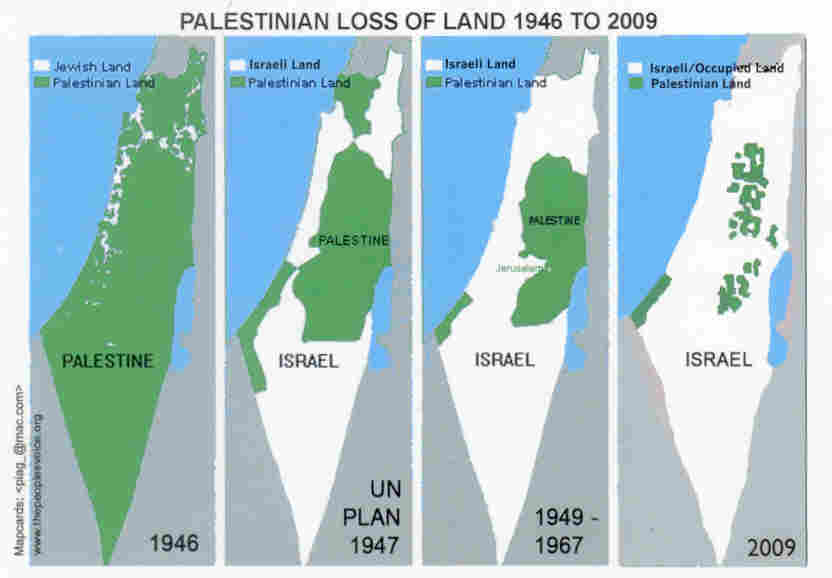 A country in the Middle East whose territory has been gradually stolen over the past century
by Zionists, with the support of first British and later American imperialism. The ethnic
cleansing of the Palestinians from their land, including through forcible expulsions, murders,
and outright mass genocide at times, continues to the present day. [More to be added...]
A country in the Middle East whose territory has been gradually stolen over the past century
by Zionists, with the support of first British and later American imperialism. The ethnic
cleansing of the Palestinians from their land, including through forcible expulsions, murders,
and outright mass genocide at times, continues to the present day. [More to be added...]
PALMER RAIDS (1919-1920)
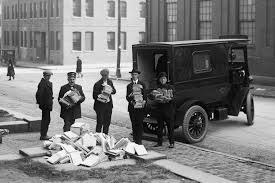
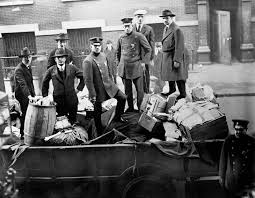 A series of U.S. government attacks on socialists, leftists and the labor movement in the period
after World War I, which were organized and directed by the U.S. Attorney General A. Mitchell
Palmer. Radical literature was seized wherever it was found, leftists and radical workers were
beaten and arrested, and socialist and radical newspapers were forcibly closed down, most of them
quite reformist social-democratic publications like the Appeal to Reason.
A series of U.S. government attacks on socialists, leftists and the labor movement in the period
after World War I, which were organized and directed by the U.S. Attorney General A. Mitchell
Palmer. Radical literature was seized wherever it was found, leftists and radical workers were
beaten and arrested, and socialist and radical newspapers were forcibly closed down, most of them
quite reformist social-democratic publications like the Appeal to Reason.
 These attacks actually began during the War,
and before Palmer, but he continued and intensified them, so the whole period of attacks has
become loosely known as the “Palmer Raids”. Note that the government did not even have the
phony “excuse” of the “War effort” during the Palmer raids of late 1919 and 1920. And the
supposed Constitutional “guarantees” of freedom of speech, freedom the press, freedom of
organization, and freedom of protest, meant absolutely nothing when the ruling bourgeoisie
decided they didn’t. No Constitutional freedoms mean a damned thing to the ruling class when
they begin to fear the masses are turning against them. This complete hypocrisy which is always
inherent in bourgeois “democracy” should never be
forgotten by Marxists and revolutionaries. What few democratic freedoms for the people that
actually exist, are always severely limited and subject to sudden cancellation.
These attacks actually began during the War,
and before Palmer, but he continued and intensified them, so the whole period of attacks has
become loosely known as the “Palmer Raids”. Note that the government did not even have the
phony “excuse” of the “War effort” during the Palmer raids of late 1919 and 1920. And the
supposed Constitutional “guarantees” of freedom of speech, freedom the press, freedom of
organization, and freedom of protest, meant absolutely nothing when the ruling bourgeoisie
decided they didn’t. No Constitutional freedoms mean a damned thing to the ruling class when
they begin to fear the masses are turning against them. This complete hypocrisy which is always
inherent in bourgeois “democracy” should never be
forgotten by Marxists and revolutionaries. What few democratic freedoms for the people that
actually exist, are always severely limited and subject to sudden cancellation.
“There are men walking about the streets of this city tonight who ought to be taken out at sunrise tomorrow and shot. There are some newspapers published in this city every day the editors of which deserve conviction and execution for treason.” —Elihu Root, a corporate lawyer and former Secretary of State, speaking at New York’s Union League Club, August 1917. Quoted by Adam Hochschild, “When Dissent Became Treason”, The New York Review of Books, Sept. 28, 2017, p. 82. [Elihu Root was such a prominent and respected member of the ruling bourgeoisie that this murderous individual was awarded the Nobel Peace Prize in 1912! —Ed.]
PALTRY GAINS
See:
ALL POWER TO THE PEOPLE! (Lenin quote)
PANAMA CANAL
The United States forcibly split off the Panama
isthmus from Colombia and made it into a separate nation so that it would be easier for U.S.
imperialism to build and control the economically important Panama Canal connecting the Atlantic
and Pacific oceans. [More about this to be added.]
“The passage of one ship through the Panama Canal is estimated to consume as much water as half a million Panamanians use in one day.” —New York Times, National Edition, “Drought Squeezes the Panama Canal, and Global Trade”, Nov. 2, 2023.
PANCHAYAT
In Hindi and related languages, literally “Assembly (yat) of Five (panch)”, where
the “five” are supposed to be wise and respected elders selected by the local community. This
is a common traditional form of local governance in India, Pakistan and Nepal. These local
assemblies settled disputes between individuals and between villages. In modern India the
gram panchayats at the village level are formal bodies which are elected every five
years.
Other types of panchayats include: khap
panchayats (or caste panchayats), which are not elected; panchayat samiti (“block”
or tehsil panchayats) at the level between the village and district); and zilla
panchayats (district level panchayats). The system of panchayat governance as a whole is
called panchayat raj.
PANCHAYAT REGIME (In Nepal)
A period of monarchic autocratic rule in Nepal from 1960 to 1990, which pretended to be based
on local and regional panchayats (see entry above).
In Nepal the autocratic dynasty of the Rana
family was formally overthrown in the 1950s but the regime continued as a nominally
constitutional monarchy. In 1959 King Mahendra reluctantly announced a new constitution,
which set up a representative parliamentary-style government based on the British model. The
bourgeois reformist Nepali Congress Party won the first election and set up an ineffective
government led by B. P. Koirala which continued its long-running squabbles with the King. In
1960, after 18 months of nominal constitutional rule, Mahendra carried out a royal coup and
dismissed the government (later arresting many hundreds of politicians and democratic activists
from various political parties, arrests which continued throughout the entire 30-year panchayat
period). In an attempt to hide his resumed autocratic rule, Mahendra declared that henceforth
Nepal would be ruled by a “partyless” panchayat system, under a new constitution he promulgated
on December 16, 1960.
This panchayat system had a pyramidal
structure, from village panchayats up to a Rastriya Panchayat (“National Parliament”).
But the King retained absolute power, with sole authority over all government bodies including
the “Council of Ministers” at the national level and the supposed “Parliament”. This regime
was also strongly nationalist and, among other things, tried to bring about the exclusive use
of the Nepalese language in the country.
King Mahendra was succeeded by his son, King
Birendra in 1972. After a long period of growing ferment against the panchayat system an
alliance of political parties (including both the Nepali Congress and the leftist
parties—including the revolutionary Marxist-Leninists) launched what came to be known as the
first Jana Andolan, or People’s Movement, in 1990.
This once again forced the King to switch over to a constitutional monarchy with an elected
parliament. However, not much had really changed in Nepali society, and the masses were as
oppressed and exploited as ever. This led to the necessity of a People’s War in Nepal,
which began in 1996.
PANDA (GIANT PANDA)
Giant Pandas are rare animals endemic to hilly bamboo forested areas of southern China.
Because of their charm and their endangered status they have become the symbol of the World
Wildlife Federation. In China itself the hunting of Giant Pandas was prohibited shortly after
the Liberation of the country (which occurred in 1949), and reserves were established and
special attention given to promoting their continued existence and welfare. Curiously enough,
they have also sometimes been the subject of rather laughable international political
contention, as the quotation below explains:
“In 1958, when the Chinese were restocking the Peking Zoo, an Austrian
animal dealer named Heini Demmer arranged to supply the zoo with some big game from
Africa. In exchange, he was to receive one giant panda, to go to a Western zoo. Demmer
came to Peking and chose a tiny panda cub named Chi-Chi. By the time he reached Europe
Demmer had received an offer of $25,000 for the cub from Chicago’s Brookfield Zoo.
“But then the Treasury Department
stepped in and announced that the U.S. trade embargo on Chinese goods extended even to
pandas. No ‘Red Chinese’ panda was to be allowed into the United States; perhaps Chi-Chi
might subvert the other zoo animals! The London Zoo, not bound by such rigid political
regulations, acquired Chi-Chi, who became its most famous resident.” —Michael Chinoy,
“Pandamonium, or Everything You Always Wanted to Know About Pandas”, New China
magazine (published by the U.S.-China People’s Friendship Association, vol. 1, #1,
Spring 1975, pp. 15-17, online at:
https://www.bannedthought.net/China/MaoEra/ContemporaryCommentary/US-China-PFA/NewChina/NewChina-V1N1-1975-Spring.pdf
“PANDA HUGGER”
A term of derision used within U.S. academia and the U.S. government for those China
experts who have a more or less benign view of China and are more hopeful about the prospects
that China will become more like the U.S. and for future U.S.-China cooperation rather than
contention (which is actually growing rapidly). This term has become more common in the last
decade as the U.S. ruling class has become more and more worried about capitalist China’s
economic and military rise, and is therefore generating much stronger criticism of those
within its own ranks who fail to view China as their ever more serious enemy.
“Michael Pillsbury, influential Pentagon advisor and former China lover, believes most Americans have China all wrong. They think of the place as an inherently gentle country intent on economic prosperity. In that camp he lumps the lower ranks of the State Department, the Central Intelligence Agency, most U.S. investors and the majority of American China scholars, whom he chides as ‘panda huggers.’ Mr. Pillsbury says his mission is to assure that the Defense Department doesn’t fall into the same trap.” —“Inside Pentagon: A Scholar Shapes Views of China”, Wall Street Journal, September 8, 2005. [This is an instructive example of how internal ruling class ideological attitudes are “brought into line” in accordance with their changing political needs, and specifically as a new Cold War against China is cranked up. —Ed.]
PANDEMIC
An epidemic occurring over a wide geographic area and affecting an
exceptionally high proportion of the population. Two extremely serious world pandemics over roughly
the past century are the so-called “Spanish Flu” pandemic of 1918-19 which killed an estimated
50 to 100 million people, and the current (2020-21) corona virus pandemic which might end up killing
a comparable number. Pandemics are caused not only by new disease outbreaks (such as from new
viruses spreading among humans) but also—especially in this scientific era—by the failure of the
government authorities in capitalist society to be familiar with that scientific knowledge and to
be concerned enough about the welfare of the people to take effective steps to control or mitigate
the disease outbreak.
See also below, and:
COVID-19,
“FLATTENING THE CURVE”
“Last Wednesday [March 11, 2020], the World Health Organization declared
the coronavirus outbreak a pandemic after it spread across six continents and more than
100 countries. A pandemic is the worldwide spread of a new disease that affects large
numbers of people. The W.H.O. had avoided using the word before Wednesday because it didn’t
want to give the impression that the disease was unstoppable. ‘Pandemic is not a word to
use lightly or carelessly,’ Dr. Tedros Adhanom Ghebreyesus, the director general of the
W.H.O. said at a news conference.”
—Jenny Gross & Mariel Padilla, “From
Pandemic to Self-Quarantine: A Glossary”, New York Times, March 17, 2020. [While the
W.H.O.’s motive for holding off this pandemic declaration was understandable given the
scientific ignorance of most bourgeois ruling classes in the world, the slowness in spreading
the loudest alarm seems to have inadvertently help make things worse by giving these
authorities a reason not take the strongest actions immediately. —Ed.]
PANDEMICS — Predictions Of
When the Covid-19 Pandemic broke out in China in late 2019,
and then quickly spread to the U.S. and around the world in early 2020, the ruling class in the U.S.
initially had no idea what was going on, let alone how to deal with it. They didn’t know what to do
because they had consciously ignored or forgotten all the great many warnings from the scientific
community that major pandemics of this sort were coming, and were in fact inevitable. The scientific
ignorance on the part of the capitalist politicians, along with their indifference to the welfare of
the people, evidenced by their refusal to make the appropriate advance preparations, was a major
murderous crime against humanity.
Here are just a few of the great many warnings by
scientists, doctors, science writers and journalists about the inevitability of future pandemics and
the urgent need for preparations—which were all largely ignored by the ruling class:
• Advertisement
for the book, Infectious Disease: A Scientific American Reader (Univ. of Chicago Press: 368
pages, 2008): “At a time when scientists warn of the potential for an influenza epidemic to rival the
deadly outbreak of 1919 and newspapers feature alarming headlines about incidences of mad cow disease,
infectious disease will be a critical area of concern and scientific study in the twenty-first
century.”
• Where will
the Next Pandemic Come From?, a symposium held by the New York Academy of Medicine’s Library, on
Feb. 23, 2016. From the announcement of the event: “Over the past 50 years, over 300 infectious diseases
have newly emerged or re-emerged in new territory where they’ve never been seen before—from Ebola to
cholera and avian influenza—and according to a recent survey, 90 percent of epidemiologists believe one
of them will cause a deadly, disruptive pandemic sometime in the next two generations. But which one?
And how?”
• Infectious
disease expert, Michael Oserholm, wrote in Foreign Affairs magazine in 2005: “This is a critical
point in our history. Time is running out to prepare for the next pandemic. We must act now with
decisiveness and purpose.” In his 2017 book, Deadliest Enemy: Our War Against Killer Germs, he
also warned that the U.S. isn’t properly prepared for a pandemic which is virtually inevitable.
• Virologist and
flu expert Robert G. Webster, asked in his 2018 book, Flu Hunter: Unlocking the Secrets of a
Virus, whether another major deadly pandemic is possible, and wrote in reply to his own question:
“The answer is yes: it is not only possible, it is just a matter of time.” He added that millions of
people could die before such a pandemic is controlled or modified. “Nature will eventually again
challenge mankind with an equivalent of the 1918 influenza virus. We need to be prepared.”
• Jeremy Konyndyk,
former director of USAID’s Office of U.S. Foreign Disaster Assistance under the Obama administration,
warned that a virus similar to the 1918 flu pandemic would eventually emerge. He wrote in Politico
in 2017 that “a major new global health crisis is a question of when, not if.” He continued: “At some
point a highly fatal, highly contagious virus will emerge—like the 1918 ‘Spanish flu’ pandemic, which
infected one third of the world’s population and killed between 50 and 100 million people,” adding that
President Trump was unprepared for such a pandemic. [It should be mentioned, however, that the Obama
administration was not at all ready for such an event either, although Trump was busy making things even
worse, as described below and in the Covid-19 Pandemic entry.
—Ed.]
• Dr. Luciana Borio
of the former White House National Security Council (NSC) team responsible for pandemics had previously
warned of a pandemic flu threat. Dr. Borio, the council’s director of medical and bio-defense preparedness,
told CNN in 2018: “The threat of pandemic flu is the number one health security concern. Are we ready to
respond? I fear the answer is no.” However, John Bolton, Trump’s National Security Adviser at the time,
later disbanded the team responsible for pandemic preparedness while reorganizing the NSC.
So it is true that some members of the bourgeoisie
(including the billionaire Bill Gates), and some officials in the U.S. government, were aware of
the threat of a pandemic. But the ruling class as a whole, through their government, and because of a
combination of ignorance and indifference, decided to cut back on even the pathetically inadequate
preparations they had previously made.
“The panel tackled nearly every major crisis facing the United States, but most
alarming was the threat of a pandemic... [T]he lack of preparedness does not bode well, said Dr.
Lucy Shapiro, head of Stanford’s Beckman Center for Molecular and Genetic Medicine.
“‘Our surge capacity (the health system’s
ability to respond to an emergency) is absolutely essential to the future we’re facing now,’ she
said. ‘It’s not just vaccines. We need face masks, food, hospital beds, oxygen, general medicine.’”
—Carolyn Jones, “Pandemic Seen as Top Threat:
Panel of experts weighs in on major crises facing U.S.”, San Francisco Chronicle, Oct. 15,
2006.
PANEL DATA [In Economics]
A “panel” or “longitudinal data set” is a collection of information where there are repeated observations
on the same entities or “units” in the panel, such as individuals, households, firms, countries, or any
other set of entities that remain stable over some time period. Thus a table which shows the average
income of people in some country for different age ranges would be an example of such a panel. The panel
data are the values which are included in the table, such as in different rows and columns.
In other words this is a very simple thing which is
often talked about in obscure, abstract, and esoteric ways in research papers in bourgeois economics.
PANICS
An older name for capitalist crises, especially the financial aspects of such crises.
See also below, and:
FINANCIAL CRISES,
CRASH OF 1929
PANIC OF 1825
One of the first significant periodic industrial crises in the capitalist system.
“By contrast [to earlier panics], the panic of 1825 reverberated around the world. It began in Britain and had all the hallmarks of a classic crisis: easy money (courtesy of the Bank of England), an asset bubble (stocks and bonds linked to investments in the emerging market of newly independent Peru), and even widespread fraud (feverish selling of the bonds of a fictitious nation called the Republic of Poyais to credulous investors).” —Nouriel Roubini & Stephen Mihm, Crisis Economics (2010), p. 21. [Note, however, that these bourgeois economists mention only the financial aspects of the crisis, which is typical of the bourgeois analyses of crises. —S.H.]
PANIC OF 1857
[To be added...]
PANIC OF 1873
A short though severe financial crisis, which however more or less marked the beginning of a
long period of economic weakness in the U.S. which is now known as the
Long Depression (1873-1896). As is always the case, this
capitalist crisis was blamed by bourgeois ideologists on factors external to the capitalist
system, including an epidemic of horse flu which harmed the transportation industry. The long
period of ensuing economic weakness was also falsely blamed on the Coinage Act of 1873 which
switched the U.S. over from a “bimetalic” (gold and silver) money standard to just a
gold standard, which somewhat hurt the silver mining
industry (but of course gave a further boost to gold mining).
PANIC OF 1893
A severe financial and economic crisis that in many ways was a continuation of the Panic of
1873 after the relatively calm period of the 1880s. Railroad construction had tailed off and
many railroad and other companies had financially overextended themselves. Some, such as the
Philadelphia and Reading Railroad went bankrupt. As the financial crisis intensified people
began cashing in their currency for gold. Foreigners, in particular, demanded gold in payment
from Americans. This led to the U.S. Treasury’s gold supply falling to the legally mandatory
minimum, at which point the government stopped exchanging gold for paper notes. (This was in
effect a temporary abandonment of the gold standard.) This,
in turn, led to further panic. Banks and other companies began going bankrupt on a large
scale.
Unemployment jumped up to between 12% and 14%
in the U.S., and in some cities reached 20% to 25%. There was a wave of evictions, and a
tightening of vagrancy laws as the well-to-do became frightened of “anarchy” among the poor
and unemployed. There were qualitatively intensified labor struggles occurring. This crisis
also took on an anti-foreigner aspect, since many of the unemployed were recent immigrants.
Similarly, there was a racist component, since large numbers of African-Americans went north
in the period after the Civil War and Reconstruction. It wasn’t until around 1896 that the
economy began to improve in a major way.
See also:
LONG DEPRESSION (1873-1896)
PANIC OF 1907
This was the last of the major financial crises in the U.S. during the transition period
from pre-monopoly capitalism to modern “monopoly
capitalism” (or capitalist-imperialism).
This panic itself mostly occurred in the center of U.S. capitalist finance, New York City.
It was tipped off for most of the usual reasons, including undue expansion of credit and
debt, considerable financial manipulation (including an attempt by the head of one of New
York’s big banks to corner the copper market), and outright fraud and thievery. But the
underlying cause lay, as virtually always, in the internal contradictions of the capitalist
mode of production and specifically in the fact (as Engels put it) that the expansion of
production proceeds faster than the expansion of the market.
Though relatively short, this panic was
quite sharp and scared the hell out of both the capitalists and the U.S. government. The
financial panic led to a recession in 1908, but it also led to the creation of the
Federal Reserve System (the U.S. central bank)
in 1913. Since “the Fed” did not yet exist in 1907 it fell to J.P. Morgan, by far the most
influential financier of the day, working together with the U.S. Treasury department, to
patch together a resolution for this particular financial crisis. Since that time, it has
been the government itself that has attempted to overall manage the capitalist economy and
deal with its perpetual financial and economic crises.
PANIC OF 1929
See: CRASH OF 1929
PANIC OF 2008
The recent financial crisis, centered in the United States but spreading worldwide, which
was developing significantly during the summer of 2008, but then was especially concentrated
during the fourth quarter of 2008 and the first quarter of 2009. This Panic is just one
episode within the current overall U.S. and world overproduction crisis, and only one of
several financial panics which will be occurring as part of that in the coming period.
See also:
GREAT RECESSION
PANOPTICON
A prison, or similar situation, in which an individual is controlled through something
approaching total surveillance. For example, the spying by Facebook or similar corporations
on their “members” which allows them to learn their likes, their views, their friends, and
thus control them through ads and “recommendations” of various sorts, can be called a
panopticon.
PANPSYCHISM
The view that all of physical reality has associated with it mental properties of
one sort or another. Thus, according to this tremendously silly theory, even nails or
rocks have some sort of crude “mind” or “mental aura” about them! Obviously this is a
dualistic theory which arises because those naïve people
who support it cannot fathom the real nature of mind and mental phenomena as being simply
high level characterizations of aspects of the internal functioning of certain complicated
computing devices (such as brains or their artificial equivalent).
See also:
ANIMISM
“The theory of panpsychism proposes that everything in existence
(even a grain of sand) possesses a tiny spark of proto-consciousness—and that these
minute elements of awareness combine to form our rich mental experiences.”
—New York Times, Book Review, “Who Do You Think You Are?”, March 22, 2026.
[Hmmm. Perhaps this means that a
big sand dune, which thus contains billions upon billions of these supposed
tiny “sparks of consciousness” should thus possess a total amount of consciousness
and reasoning power that would far exceed that of Buddha or Einstein! Maybe those
seeking enlightenment should therefore head out into the desert and spend their
remaining hours hugging a giant sand dune. —S.H.]
“One wonders if the soul of a rusty nail is destined to go to hell, while the soul of a shiny nail will ascend to heaven.” —Finney’s cogent observations on bizarre theories of the mind and soul, #17.
PARADIGM SHIFT
As popularized by Thomas Kuhn, a change from one basic
theoretical framework in some area of science to a very different theoretical framework.
In other words, a significant theoretical change in some science. For example, the
advent of relativity theory and quantum mechanics
involved some major paradigm shifts in physics.
Usually talking about paradigm
shifts in this way is not objectionable. However, Kuhn’s own more elaborated notion
of science as an endless, rather meandering and somewhat aimless, shift from one paradigm
to another, and never really approaching any real truth about the world, is obviously
a relativist, anti-materialist point of view akin to
postmodernism or
epistemological agnosticism. Thus care
should be taken not to bandy about the term ‘paradigm shift’ too carelessly.
PARADIGM CASE
A good, clear or representative example of something; thus, an example appropriate to
use as an ostensive definition of the concept (i.e. as an example to point to in order
to explain the concept). Thus the October Revolution in Russia in 1917 is a paradigm
case of a proletarian revolution, whereas the establishment of the D.P.R.K. (North
Korea) at the end of World War II (mostly by the Soviet Red Army) is by no means a good,
clear or representative case of a proletarian social revolution—if it was such a thing
at all!
PARADOX
1. A statement that is in fact both true and
false, in the same and completely identical ways;
2. “A statement that is seemingly contradictory
or opposed to common sense and yet is perhaps true” [Merriam-Webster Collegiate Dictionary,
10th ed. (1993);
3. “A self-contradictory statement that at
first seems true” [Ibid.];
4. “An argument that apparently derives
self-contradictory conclusions by valid deduction from acceptable premises” [Ibid.];
5. “Something or someone with seemingly
contradictory qualities or phases” [Ibid.];
6. A conceptual puzzlement for someone who has
not yet learned to appreciate the dialectical
contradictions (or opposing forces) within processes and things.
First, let’s be clear: There are no true
paradoxes in reality, that is to say, there are no incompatible and logically opposed realities
which are both simultaneously true (and thus both false!). Thus there are no (zero!) actual
paradoxes in sense #1! In other words, the things which are most often called paradoxes
are either misconceptions, misunderstandings, or else a very misleading way of talking about
actual dialectical contradictions. The things which are called “logical paradoxes” are really
only apparent logical paradoxes, and definitely not true logical paradoxes. —S.H. [Oct. 4,
2025]
“He who confronts the paradoxical exposes himself to reality.”
—Friedrich Dürrenmatt, 1962, (quoted in Judea Pearl, The Book of Why (2018),
p. 189).
[Despite the comments in the introductory
section above completely rejecting real logical paradoxes, I rather like Dürrenmatt’s
comment here! Although I don’t know exactly what he meant by it, resolving apparent
logical paradoxes is indeed a way of coming to understand reality. And if you take this to
be a comment promoting dialectics it makes even more sense! To understand the world, and
to understand human society, it is indeed a very good rule to look for and confront the
oppositional forces within processes. —S.H.]
“PARADOX OF THRIFT”
The supposed “conundrum” in bourgeois economics wherein the tendency of consumers to save
money during poor economic times leads to additional falling of
effective demand, and thus worsens the economic crisis,
leading to more layoffs and cuts in wages, and hence even further reluctance to spend on
the part of consumers. This is simply one aspect of the fact that people’s psychology can
intensify a boom and also intensify a recession or depression. It is not really a puzzle,
though it appears to be so to bourgeois moralists who simultaneously tell people they should
save for a rainy day and also “get out there and spend”, even if they have to borrow to do
so!
Keynes thought
that negative psychological factors such as this might keep an economy operating at only a
perpetually weak level, and this is why a burst of government deficit spending could perk
up people’s economic spirits, and get them spending freely again. This would supposedly
“prime the pump” and restore the economy to a healthy
condition. The flaw in this thinking is that problems with a capitalist economy are most
fundamentally due to objective factors (such as the fact that the workers simply
cannot be paid enough to buy back all the commodities they produce for the capitalists),
and not just psychological moods.
PARASITISM
See:
FACTORYLESS GOODS PRODUCTION,
FINANCIALIZATION
PARENTS
When the American labor leader and socialist, Eugene
V. Debs, was locked up in the Cook County Jail in Chicago during the Pullman Strike
of 1894, he received the following telegram: “Stand by your principles regardless of
consequences. Your father and mother.”
Debs was a great man. And his
parents were pretty great, too! —S.H.
[Quote and information from: Barrows
Dunham, Heroes & Heretics: A Political History of Western Thought (N.Y.: 1964),
p. 453.]
“PARETO’S LAW”
A rule of thumb in capitalist economics, first suggested by Vilfredo Pareto, which
maintains that 80% of the effects come from 20% of the input. Also called the “80-20 law”.
This “law” is said to apply in a great many different situations, such as with revenues
from a company’s product line, results from advertising efforts, and with regard to
management problems. For example, it maintains that 80% of an average company’s “problems
with employees” are caused by just 20% of the workers. This doctrine is in turn part of
the motivation for companies to try to fire or otherwise get rid of what they assume are
the relatively small number of “problem people”. Similarly this sort of thinking leads
many companies to drop many of the “under-performing” products and focus on the fewer
markets where their profits are greatest. Thus a pharmaceutical company might drop some
of its least profitable medicines in an attempt to boost average profit rates—even though
that might mean in some cases that the only source of some important medicine (which a
relatively small number of people really need) is eliminated.
PARETO OPTIMALITY or PARETO EFFICIENCY
The totally unfounded claim (dogma) among many bourgeois economists that, in principle,
the complete commodification of goods and services
will allow both the maximization of profits and the establishment of an equilibrium in
distribution that will supposedly provide the maximum benefits for everybody.
The so-called “First Theorem of Welfare
Economics” states that the equilibrium of a fully competitive economy (exclusively
employing commodity exchange) is “Pareto efficient”, or “Pareto optimized”. (Of course,
if you start with assumptions that lead to a certain bourgeois conclusion, that is—not
surprisingly—the conclusion you will then be led to.) The dogma is that this means that
there is no feasible reallocation of economic goods which can raise the welfare of one
“economic agent” without lowering the welfare of some other economic agent. Thus
according to this quintessential bourgeois theory any trade union bargaining will harm
society as a whole; any government welfare payments to the desperately poor will harm
the economic welfare of society in general.
Notice from the term “economic agent”
that this whole mode of thinking purposely rejects any reference to social classes or
social inequality. So according to this theory, in a Pareto-optimized capitalist
society even if you have just one multi-billionaire who receives 90% of all the wealth
that workers produce, it would be “inefficient” or “non-optimized” to take away any
part of that 90% and return it to the working class and the poor, because this other
“economic agent”, this poor multi-billionaire, would then have less than he did before.
It really breaks your heart.
PARIS COMMUNE
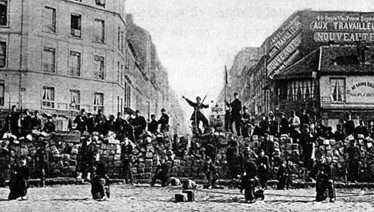 The first proletarian uprising which achieved state power for a time. The Paris Commune
was established in Paris in March 1871, and was brutally suppressed after two months. The
Commune provided both positive and negative lessons. The positive lessons included a vivid
example of the real democracy for the people possible with proletarian rule. Among the
negative lessons were the realization that the proletariat was not sufficiently organized
and conscious of its tasks, and did not act with sufficient determination against the
bourgeoisie to prevent their comeback (which led Marx to add the principle the
Dictatorship of the Proletariat to the list
of basic principles of Marxism).
The first proletarian uprising which achieved state power for a time. The Paris Commune
was established in Paris in March 1871, and was brutally suppressed after two months. The
Commune provided both positive and negative lessons. The positive lessons included a vivid
example of the real democracy for the people possible with proletarian rule. Among the
negative lessons were the realization that the proletariat was not sufficiently organized
and conscious of its tasks, and did not act with sufficient determination against the
bourgeoisie to prevent their comeback (which led Marx to add the principle the
Dictatorship of the Proletariat to the list
of basic principles of Marxism).
“Heard that the mob at Paris had rushed into the Senate and proclaimed the downfall of the dynasty, proclaiming a Republic! This was received with acclamation and the proclamation was made from the Hotel de Ville. Not one voice was raised in favor of the unfortunate Emperor! How ungrateful!” —Queen Victoria, from her private journal, Sept. 5, 1870, in Queen Victoria’s Life and Letters.
“During the Paris Commune, a short-lived revolution that shook France’s capital from March to May 1871, French soldiers killed at least 7,000 insurgents and Commune fighters executed dozens of hostages.” —New York Times, “Embers of a Lesser-Known French Revolution Glow Hot”, April 29, 2021.
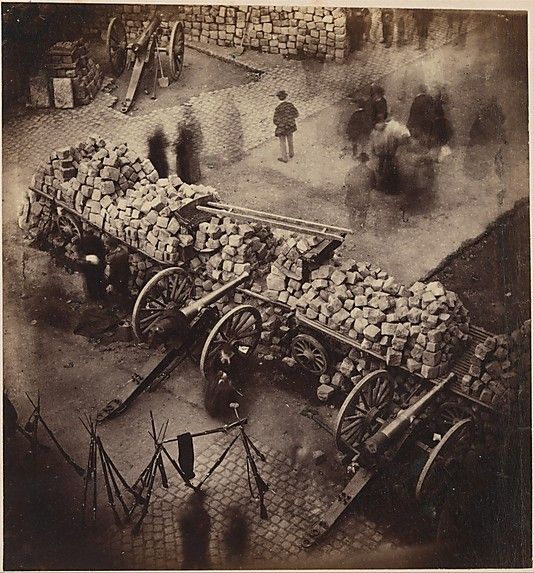
“Of late, the Social-Democratic
philistine has once more been filled with wholesome terror at the words: Dictatorship
of the Proletariat. Well and good, gentlemen, do you want to know what this dictatorship
looks like? Look at the Paris Commune. That was the Dictatorship of the Proletariat.”
—Engels, 1891 postscript to The Civil War in France, online at:
https://www.marxists.org/archive/marx/works/subject/hist-mat/civ-war-intro.htm
“It seems the Parisians are succumbing. It is their own fault, but a fault which was in fact due to their too great decency. The Central Committee and later the Commune gave Thiers, that mischievous dwarf, time to concentrate the hostile forces, firstly because they rather foolishly did not want to start a civil war—as if Thiers had not already started it by his attempt at the forcible disarming of Paris, as if the National Assembly, summoned for the sole purpose of deciding the question of war or peace with the Prussians, had not immediately declared war on the Republic! Secondly, in order that the appearance of having usurped power should not attach to them they lost precious moments (it was imperative to advance on Versailles immediately after the defeat (Place Vendôme) of the reactionaries in Paris) by the election of the Commune, the organization of which, etc., cost yet more time.” —Marx, Letter to Wilhelm Liebknecht, April 6, 1871, in Marx-Engels Selected Correspondence (1975), p. 246; slightly different translation in MECW 44:128.
“Why do the anti-authoritarians not confine themselves to crying out against political authority, the state? All Socialists are agreed that the political state, and with it political authority, will disappear as a result of the coming social revolution, that is, that public functions will lose their political character and will be transformed into the simple administrative functions of watching over the true interests of society. But the anti-authoritarians demand that the political state be abolished at one stroke, even before the social conditions that gave birth to it have been destroyed. They demand that the first act of the social revolution shall be the abolition of authority. Have these gentlemen ever seen a revolution? A revolution is certainly the most authoritarian thing there is; it is the act whereby one part of the population imposes its will upon the other part by means of rifles, bayonets and cannon — authoritarian means, if such there be at all; and if the victorious party does not want to have fought in vain, it must maintain this rule by means of the terror which its arms inspire in the reactionists. Would the Paris Commune have lasted a single day if it had not made use of this authority of the armed people against the bourgeois? Should we not, on the contrary, reproach it for not having used it freely enough?” —Engels, “On Authority” (1872), online at: https://www.marxists.org/archive/marx/works/1872/10/authority.htm
PARIS MASSACRE OF 1961
The planned and intentionally murderous attack by the French National Police in Paris on
October 17, 1961 on a peaceful demonstration of 30,000 Algerians supporting the Algerian
National Liberation Front and demanding an end to the French colonial war in Algeria which
began in 1954 and finally ended in 1962. The French imperialist ruling class denied for
decades that the massacre had even happened, and even then tried to hide just how horrendous
it had been. They finally admitted in 1998 that at least 40 people had been killed, although
the correct figure was probably at least 70 deaths and quite likely 200 or more. Many of
those murdered by the police were thrown into the Seine River to hide their bodies, and some
of them had only been beaten unconscious when they were thrown into the river to drown.
Other demonstrators, who had been arrested and taken by bus to police headquarters, were
then murdered in the headquarters courtyard.
The chief of the Paris police who ordered
and organized this massacre was Maurice Papon, who in earlier years had been a prominent
official of the pro-Nazi Vichy Regime during World War II. He cooperated with the Gestapo
in deporting at least 1,560 French Jews—including children—to German death camps between
1942 and 1944. Despite this, he became chief of the Paris branch of the National Police in
1958 and it was not until 1998 that he was finally convicted of crimes against humanity
during World War II. Moreover, it was only this trial that led to some of the secret
information about the Paris Massacre of 1961 also coming to light.
PARMENIDES OF ELEA (born c. 515 BCE)
The founder of the Eleatic School of ancient Greek
philosophy. (Plato, however, says that the founder of that school
was Xenophanes, and it seems Parmenides was influenced
by Xenophanes and may have been his pupil.) Parmenides believed and taught that despite
all appearances to the contrary, reality must be “One”, that is, an eternal, imperishable,
indivisible, motionless and perfect single entity. This may have been one of the earliest
arguments for this specific idealist conception, which has
frequently reappeared in abstract forms of religion (including Buddhism) and
mysticism. Parmenides’s most famous student was
Zeno of Elea, the propounder of paradoxes which attempted
to “logically prove” Parmenides’s peculiar idea.
“Some thinkers have carried Occam’s Razor to drastic extremes, using it to deny the existence of time, matter, numbers, holes, dollars, software, and so on. One of the earliest ultra-stingy thinkers was the ancient Greek philosopher Parmenides, whose catalogue of existing things was minimal indeed. As a student of mine memorably wrote on an exam, ‘Parmenides is the one who said, “there’s just one thing—and I’m not it.”’ I hate to say it, but that does seem to be what Parmenides was trying to tell us. No doubt it loses something in translation.” —Daniel Dennett, a bourgeois philosopher, in his book Intuition Pumps and Other Tools for Thinking (2013), p. 39.
PARODIES
Written or literary works in which the style of an author or political tendency is closely
imitated, or even further exaggerated, for comic effect or in ridicule. Thus, an often very
effective means of criticizing erroneous or reactionary political viewpoints.
“Parodies and caricatures are the most penetrating of criticisms.” —Aldous Huxley, quoted in The Week, August 16, 2002, p. 15.
PART-TIME WORK
See: CONTINGENT WORKERS,
PRECARIOUSNESS OF THE PROLETARIAT
PARTICIPATION RATE
See: LABOR FORCE PARTICIPATION
RATE
PARTICLE PHYSICS
The branch of physics concerned with sub-atomic particles and their interactions. This is
largely encompassed by quantum mechanics, and most of
the basic knowledge in this sphere is summed up in what is known as the
Standard Model.
PARTICULARITY OF CONTRADICTION
The recognition that each different process of development consists of its own distinctive
set of essential dialectical contradictions
(including generally a fundamental contradiction
and a set of related and/or sub-contradictions) and that therefore the control or resolution
of that specific process must proceed according to the methods appropriate for dealing with
that particular set of contradictions.
“The Universality and Particularity of Contradictions
“Contradiction is a universal feature
of all processes. But each particular kind of process has its own particular contradictions,
which are characteristic of it and different from those of other processes.
“This point was underlined by Mao
Tse-tung in his essay On Contradiction, which remains one of the most suggestive
analyses of the conception yet contributed to Marxist literature. He called it the
distinction between ‘the universality’ and ‘the particularity’ of contradiction.
“We can never deduce what will happen
in any particular case, or how a particular process can be controlled, from the universal
idea of contradiction. As has already been stressed, the dialectical method does not
consist in applying some preconceived scheme to the interpretation of everything, but
consists in basing conclusions only on the ‘concrete analysis of concrete conditions’.
“Each kind of process has its own
dialectic, which can be grasped only by the detailed study of that particular process....
“Thus, for example, the contradiction
between tendencies of attraction and repulsion in physical motion, and between the
interests of classes in society, are both contradictions. This is evidence of the
universality of contradiction. But each has its own distinctive character, different from
that of the other. This is evidence of the particularity of contradiction.
“We cannot learn either the laws of
physics or the laws of society if we try to deduce them from the universal idea of
contradiction. We can learn them only by investigating physical and social processes.
Physical movements and the movement of people in society are quite different forms of
movement, and so the contradictions studied by social science are different, and work out
in a different way, from those studied by physics. Social and physical processes are
similar in that each contains contradictions, but dissimilar in the contradictions each
contains.
“The contradictions characteristic
of each kind of process may be called the essential contradictions of that kind of process.”
—Maurice Cornforth, Materialism and the Dialectical Method, 4th revised ed. (1968),
(NY: International, 1971), pp. 95-96.
“Every form of motion contains within itself its own particular
contradiction. This particular contradiction constitutes the particular essence which
distinguishes one thing from another. It is the internal cause or, as it may be called,
the basis for the immense variety of things in the world.... The particular essence of
each form of motion is determined by its own particular contradiction. This holds true
not only for nature but also for social and ideological phenomena. Every form of society,
every form of ideology, has its own particular contradiction and particular essence.
“The sciences are differentiated
precisely on the basis of the particular contradictions inherent in their respective
objects of study. Thus the contradiction peculiar to a certain field of phenomena
constitutes the object of study for a specific branch of science.... [U]nless we study
the particularity of contradiction, we have no way of determining the particular essence
of a thing which differentiates it from other things, no way of discovering the particular
cause or particular basis for the movement or development of a thing, and no way of
distinguishing one thing from another or of demarcating the fields of science....
“Our dogmatists are lazy-bones. They
refuse to undertake any painstaking study of concrete things, they regard general truths
as emerging out of the void, they turn them into purely abstract unfathomable formulas,
and thereby completely deny and reverse the normal sequence by which man comes to know
truth. Nor do they understand the interconnection of the two processes in cognition—from
the particular to the general and then from the general to the particular. They
understand nothing of the Marxist theory of knowledge....
“Qualitatively different
contradictions can only be resolved by qualitatively different methods. For instance,
the contradiction between the proletariat and the bourgeoisie is resolved by the method
of socialist revolution; the contradiction between the great masses of the people and
the feudal system is resolved by the method of democratic revolution; the contradiction
between the colonies and imperialism is resolved by the method of national revolutionary
war; the contradiction between the working class and the peasant class in socialist
society is resolved by the method of collectivization and mechanization in agriculture;
contradiction within the Communist Party is resolved by the method of criticism and
self-criticism; the contradiction between society and nature is resolved by the method
of developing the productive forces. Processes change, old processes and old
contradictions disappear, new processes and new contradictions emerge, and the methods
of resolving contradictions differ accordingly....
“In order to reveal the particularity
of the contradictions in any process in the development of a thing, in their totality or
interconnections, that is, in order to reveal the essence of the process, it is necessary
to reveal the particularity of the two aspects of each of the contradictions in the
process; otherwise it will be impossible to discover the essence of the process. This
likewise requires the utmost attention in our study.
“There are many contradictions in
the course of development of any major thing. For instance, in the course of China’s
bourgeois-democratic revolution, where the conditions are exceedingly complex, there exist
the contradiction between all the oppressed classes in Chinese society and imperialism,
the contradiction between the great masses of the people and feudalism, the contradiction
between the proletariat and the bourgeoisie, the contradiction between the peasantry and
the urban petty bourgeoisie on the one hand and the bourgeoisie on the other, the
contradiction between the various reactionary ruling groups, and so on. These
contradictions cannot be treated in the same way since each has its own particularity;
moreover, the two aspects of each contradiction cannot be treated in the same way since
each aspect has its own characteristics. We who are engaged in the Chinese revolution
should not only understand the particularity of these contradictions in their totality,
that is, in their interconnections, but should also study the two aspects of each
contradiction as the only means of understanding the totality.” —Mao, excerpts from
“On Contradiction” (August 1937), SW1:320-323; online at:
https://www.marxists.org/reference/archive/mao/selected-works/volume-1/mswv1_17.htm
PARTICULARS
See: UNIVERSALS vs. PARTICULARS
PARTICULATE MATTER
Small particles of dust or other materials which float in the air and constitute a major and seriously
dangerous part of air pollution.
“A pollution called fine particulate matter, or PM2.5, refers to solid particles less than 2.5 micrometers in size, small enough to enter the bloodstream. The deadliest form of air pollution, PM2.5 leads to millions of premature deaths each year.” —New York Times, “Air Quality Deteriorates Across the Globe, Research Says”, March 20, 2024.
PARTIDO KOMUNISTA NG PILIPINAS — 1930
[Not to be confused with the revolutionary Communist Party of
the Philippines of Jose Maria Sison.]
The old revisionist “communist” party was founded
on November 6, 1930 by Crisanto Evangelista and later led by the Lava political family. It led the
adventurist Huk rebellion in the 1950s. —D.F. [April 2, 2026]
“At the time that the first line of Party leaders was incapacitated, no
reliable second line of Party leaders had yet been developed to carry on Party work.
Nevertheless, by 1935, there were already some elements who established Marxist study
groups among the petty bourgeoisie in Manila. Some of these elements had their political
education under the Right opportunist Browderite leadership.
“The Party leadership represented by
Jose Lava failed to provide the most essential reasons for engaging in armed struggle, like
a programme of armed struggle against US imperialism and its local running dogs and for
agrarian revolution among others, and equally it failed to recognize that armed struggle
under the conditions existing in the Philippines would have to be protracted. Against the
superficial reasons provided by the Lava leadership to justify the policy of striving for
a quick military victory, the Right opportunists took the line of converting the Communist
Party of the Philippines into a big open mass party for purposes of the parliamentary form
of struggle and took the narrow view that the trade unionists should automatically prevail
in the Party leadership.
“Both opposing sides failed to consider
extensively whether the Party’s headquarters and center of political gravity should be the
city or the countryside. Both Right opportunists and ‘Left’ opportunists agreed that the
Communist Party of the Philippines remain an urban Party.
“Despite its advocacy of armed
struggle, the Jose Lava leadership decided to command the People’s Liberation Army (Hukbong
Mapagpalaya ng Bayan) from the city. Although it assumed the policy of armed struggle, the
Jose Lava leadership did not lay down the correct theoretical and political basis for its
organizational and military efforts. For this reason, it inconsistently allowed Luis Taruc
as commander-in-chief of the people’s army to negotiate for amnesty with the Quirino
government.” —From:
https://www.bannedthought.net/Philippines/CPP/1960s/RectifyErrors-RebuildParty-681226.pdf
PARTY DEMOCRACY
See:
DEMOCRACY—Within Revolutionary Parties,
DANGEROUS TOOLS
PARTY DISCIPLINE
See: DISCIPLINE—Of the
Proletarian Revolutionary Party
“PARTY MAXIMUM”
A requirement within the Communist Party of the Soviet Union (Bolsheviks) during the Lenin
and early Stalin periods that relatively high-paid government officials who were also members
of the Party, should either be paid wages no higher than that of an ordinary skilled worker,
or else should donate most of their wages, salaries or other income (at one point 90%) that
exceeded a certain level (the “Party maximum”) to the Party. The understanding was that
all Party members, no matter what their position and importance, were expected to be
devoting their lives to the Revolution and not to be accumulating personal comforts and wealth.
And for this reason none of them should be allowed to become too well off while the masses were
still very poor. This was obviously a very good policy for a Party which was intent on working
whole-heartedly for the working class and masses rather than for their own interests (as
prominent people in bourgeois parties do). And it seems it was very correctly felt that one
important way to help keep the proletarian Party from turning into yet another bourgeois party
out to serve its own new class interests, instead of the interests of the masses, was to keep
its members from acquiring too many unnecessary privileges and more wealth and comfort than
ordinary workers had.
Marx, Engels and Lenin all strongly supported
the principle that in a workers’ state after a proletarian revolution, the officials in the new
government and in industry would all be paid “workmen’s wages”. Just before the October
Revolution in 1917, Lenin wrote:
“In this connection, the following measures of the [Paris] Commune,
emphasized by Marx, are particularly noteworthy: the abolition of all representation
allowances, and of all monetary privileges to officials, the reduction of the remuneration
of all servants of the state to the level of ‘workmen’s wages’. This shows
more clearly than anything else the turn from bourgeois to proletarian democracy, from the
democracy of the oppressors to that of the oppressed classes, from the state as a ‘special
force’ for the suppression of a particular class to the suppression of the oppressors by
the general force of the majority of the people—the workers and the peasants.”
—Lenin, State and Revolution
(August-September 1917), LCW25:420.
However, as Lenin explained a few months later, this goal did not turn out to be immediately fully possible after the Bolshevik Revolution. In backward Russia and its old empire, the revolutionary proletariat was not immediately ready to properly run production and run society even though it had just achieved political power! It still needed the help of bourgeois experts, and bourgeois experts had to be paid bourgeois wages if they were actually going to work effectively for the new Soviet system:
“Without the guidance of experts in the various fields of knowledge,
technology, and experience, the transition to socialism will be impossible, because
socialism calls for a conscious mass advance to greater productivity of labor compared with
capitalism, and on the basis achieved by capitalism.... And the specialists, because of the
whole social environment which made them specialists, are, in the main, inevitably
bourgeois....
“Now we have to resort to the old bourgeois
method and to agree to pay a very high price for the ‘services’ of the top bourgeois experts.
All those who are familiar with the subject appreciate this, but not all ponder over the
significance of this measure being adopted by the proletarian state. Clearly this measure is
a compromise, a departure from the principles of the Paris Commune and of every proletarian
power, which call for the reduction of all salaries to the level of the wages of the average
worker, which urge that careerism be fought not merely in words, but in deeds....
“To conceal from the people the fact that
the enlistment of bourgeois experts by means of extremely high salaries is a retreat from the
principles of the Paris Commune would be sinking to the level of bourgeois politicians and
deceiving the people. Frankly explaining how and why we took this step backward, and then
publicly discussing what means are available for making up for lost time, means educating
the people and learning from experience, learning together with the people how to build
socialism.”
—Lenin, “The Immediate Tasks of the Soviet
Government” (March-April, 1918), LCW 27:248-9.
The compromise that was actually soon settled on was to set up a two-tiered wage system for
officials in government and industry. Bourgeoise experts, for the relatively few years that they
would still be needed, would indeed have to be paid wages greatly exceeding the wages of skilled
workers. But Party members holding leadership jobs would either be paid wages no greater than
those of a skilled worker, or else (if their nominal wage along with other income, such as
from paid writings or educational work) was greater, they would be expected and required to turn
over to the Party their income greater than that of a skilled worker. This was called the “Party
Maximum” policy.
According to the Wikipedia (accessed Oct. 9,
2025), the “Party maximum”, or in Russian the партмаксимум (“partmaximum”, a contraction of the
sort that was common in the Soviet Union), was established in 1920 by a decree of the All-Russian
Central Executive Committee (ВЦИК) for all Communists who held executive positions in the Party,
industry, government and Soviet trade unions. Their salary was not supposed to exceed that of a
highly qualified industrial worker. If a Communist had other incomes, e.g., honoraria or royalties,
he had to transfer a specified percentage from the amount above the partmaximum into Party
funds. (We believe that originally that percentage was 90%, though it was reduced in several steps
later.)
However, it has been difficult to find out much
specific information about this “Party maximum” policy in different periods, its actual level in
relation to the prevailing workers’ wages, and so forth. This is in part because this policy was
first seriously eroded in several stages during the 1920s and early 1930s, and then abolished
entirely still during the Stalin era. The Wikipedia cites one source as saying the Party maximum
was formally abolished by a secret resolution of the Politburo on February 8, 1932. And, as it was
gradually eroded and then abolished in actual practice, of course little or no public mention by
Soviet authorities of the former policy was ever made again.
One person who made a very big issue of the
abandonment of this fine early CPSU(B) policy was the prominent Marxist-Leninist political economist
Eugen Varga, who died in 1964. Although the New Class within the
CPSU, which had by then come to total power in the Soviet Union, would certainly not allow any
public discussion of such a sensitive issue, Varga privately wrote down some comments on this and
related matters which he hoped might be found and published after his death. And quite fortunately
this did in fact occur. They were first published in Gerhard Duda’s book, Jenö Varga und die
Geschichte des Instituts für Weltwirtschaft und Weltpolitik in Moskau 1921-1970, and later
partially translated into English in a strangely ultra-dogmatic and idiosyncratic pro-Stalin and
anti-Maoist volume, When and Why Socialism in the Soviet Union Failed. [Available at:
http://www.bannedthought.net/USSR/MiscAntiRevisionist/WhenAndWhySocialismInTheSovietUnionFailed-KPD-1995-OCR.pdf
] Here we reprint the most relevant passages, in which Varga notes that the huge differences
of incomes and unnecessary privileges for Party members began in the 1930s and blames Stalin for this
very negative development within the CPSU and for its major contribution to the bourgeoisification
of the entire Soviet Union:
“When the ‘party maximum’ was abolished, I do not know exactly. In 1930,
when I formally transferred from the Comintern to the Communist Academy, the party maximum
still existed; it was 150 rubles at the time, and was later raised to 225 rubles. It is
interesting that none of the ‘party histories’ say even one word about the ‘party maximum’...!
“In the 1930s, the radical division of
Soviet society into strata with very different incomes began. One after the other privileged
strata — according to their importance for Stalin’s regime — were created: first the high and
higher party bureaucracy, then the officers’ corps. Much later, after the war, the scholars.”
[Varga, p. 137f.]
“The irreparable sin of Stalin is the transformation of the ‘workers state with bureaucratic distortions’ [quoting Lenin: “The Party Crisis” (19 Jan 1921), LCW 32, online at: https://www.marxists.org/archive/lenin/works/1921/jan/19.htm] into a state of the bureaucracy..., by abolishing the ‘party maximum’, by breaking up Soviet society into classes and strata with huge income differentials, making a mockery of any notion of equality and renunciation and the consequent bourgeoisification of the way of life of the strata with higher income, especially the bureaucracy. The saying of Marx that man’s social being determines his ideology is undoubtedly also valid for today’s high-income bureaucracy...” [Varga, p. 162]
As the Wikipedia article comments, the cancellation of the Party maximum requirement in the early 1930s is appropriately thought “to mark the onset of the formation of the privileged nomenklatura class of Soviet apparatchiks, whose well-being no longer depended on the well-being of subordinated workers.” I have no doubt that Stalin himself did not intend for these high wages and many other privileges granted to Soviet officials to lead to the development of a new bourgeois class in the USSR, which after his death seized total control of the country. But that is what happened. And if Stalin only had a deeper understanding of historical materialism he would have understood that this is what would inevitably happen if these high wages and privileges for so many Party members and top officials were allowed and even promoted. —S.H.
[The following passage consists of a few paragraphs in Google English
translation from the Russian language document by Mervyn Matthews (Мервин Мэтьюз), “The Formation
of a System of Privileges in the Soviet State 1992, No. 2-3, pp. 45-61.” (Становление системы
привилегий в Советском государстве 1992, № 2-3, с. 45-61.)
“The decree of March 31, 1925, which
determined the salaries of responsible workers in 106 professions in trade unions, soviet,
cooperative, economic and other organizations, testifies to the fact that the workers of the party
apparatus, beginning with the Central Committee, were divided into seven categories, the salaries
of which corresponded to the seven highest grades on the 17-grade trade union scale. The highest
rate of a responsible party worker then amounted to 175 rubles, while the average salary of an
industrial worker was approximately 50 rubles. Apparently, this, in the narrow sense, was what the
definition of the ‘party maximum’ boiled down to; if this was the case, then it was by no means
as paltry as some believe today.
“Lenin himself undoubtedly believed that his
closest subordinates should be supplied with everything they needed, as evidenced by the incident
with A.D. Tsyurupa. He held the post of People’s Commissar for Food. One July day in 1918, at a
meeting of the Council of People’s Commissars, he apparently fainted from malnutrition. Lenin,
apparently impressed by his unpretentiousness, proposed raising the salaries of the People’s
Commissars, equating them to administrative workers. Two of his subordinates were charged with
reviewing the financial situation of the People’s Commissars and members of the Commissariat Boards
and proposing a salary increase. Tsyurupa’s salary was immediately raised to 2,000 rubles per month
(a few days earlier, the official maximum for specialists had been set at 1,200 rubles). However,
this decision was annulled a few days later (probably to prevent its widespread use for a similar
salary increase), and Tsyurupa was given 5,000 rubles ‘for treatment’. Thus, a precedent was
established that was destined to be approved by future generations.
“The trend of raising party workers’ salaries
beyond the legally established limits must have continued in subsequent years; in any case, two
documents clearly emphasized that these workers had no right to any income other than from printing
and teaching, and numerous bylaws also stated that illegal earnings were unacceptable. In July 1924,
those who had obtained their salaries illegally were excluded from the legally high salary scale.
In September 1925, it was declared unacceptable to receive additional compensation for work on
various committees, and a few months later, the inclusion of additional types of work in the
aforementioned 106 professions was categorically prohibited.
“According to an earlier regulation, those
earning incomes above the permitted ‘Party maximum’ were advised to deposit the surplus into the
Party collection office. This was apparently never publicized, but it was referenced in later
decrees and reportedly remained in effect until the mid-1930s. These restrictions on the monetary
income of Party officials, however significant they may have seemed, were nothing compared to the
material benefits available to them.”
[That last sentence seems quite important:
Despite the significant wage limitations because of the “Party maximum” rule (at least in 1925!),
the material benefits available to party and government officials may often have been much more
beneficial for them, especially in those very difficult economic times. It is important to keep
in mind that it was not merely unjustly increasing wages which led the new bourgeois class arrising
within the Soviet system, but just as much—or more!—the fact that all sorts of other benefits
and privileges also accrued to this newly developing stratum that eventually developed into a new
pro-state-capitalist bourgeois class. —S.H.]
PARTY NAME
A pseudonym, or nom de guerre, adopted by a member of a revolutionary party for use
within party circles, and often for use more generally in public political work. It can be
necessary to adopt such party names when government oppression or fascist-like conditions
make the party, or any association with it, illegal. It may be a wise precaution even when a
party is still legal, because it is expected that sometime in the future it is likely to be
made illegal and its known members will then be arrested.
There is, however, a possible negative
aspect to the use of party names which must be taken into consideration. They may intensify
tendencies towards viewing revolution as a conspiracy by a small secret society, rather than
the work of the broad masses themselves. Furthermore, modern spying techniques and technology
(including DNA testing and unobtrusive iris scans) have made it vastly easier for the ruling
class to learn people’s true identities.
Some of the most famous names in the history
of social revolution have actually been party names, pseudonyms chosen originally to protect
the identity of the revolutionary. Vladimir Ilyich Ulyanov used names such as Tulin
and later Lenin. Iosef Dzugashvili used the name Koba and later
Stalin. Nguyen That Thanh later became much better known by his party name, Ho
Chi Minh.
“PARTY OF THE WHOLE PEOPLE”
During the revisionist era in the Soviet Union (mid-1950s to its collapse in 1991), the
so-called “Communist Party of the Soviet Union” (CPSU) described itself as the “party of
the whole people”. In reality no political party can truly represent opposed social classes
and their conflicting class interests, though of course all bourgeois parties claim
that they represent “everyone”. In its famous polemic against the Soviet revisionists, the
Communist Party of China commented on this topic:
“Can there be a ‘party of the entire people’? Is it possible to
replace the party which is the vanguard of the proletariat by a ‘party of the entire
people’?
“This, too, is not a question
about the internal affairs of any particular Party, but a fundamental problem
involving the universal truth of Marxism-Leninism.
“In the view of Marxist-Leninists,
there is no such thing as a non-class or supra-class political party. All political
parties have a class character. Party spirit is the concentrated expression of class
character.
“The party of the proletariat
is the only party able to represent the interests of the whole people. It can do so
precisely because it represents the interests of the proletariat, whose ideas and will
it concentrates. It can lead the whole people because the proletariat can finally
emancipate itself only with the emancipation of all mankind, because the very nature
of the proletariat enables its party to approach problems in terms of its present and
future interests, because the party is boundlessly loyal to the people and has the
spirit of self-sacrifice; hence its democratic centralism and iron discipline. Without
such a party, it is impossible to maintain the dictatorship of the proletariat and to
represent the interests of the whole people.” —A Proposal Concerning the General
Line of the International Communist Movement: The letter of the Central Committee of
the Communist Party of China in reply to the letter of the Central Committee of the
Communist Party of the Soviet Union of March 30, 1963 (Peking: Foreign Languages
Press, 1963), p. 42.
In other words, the only way to really represent the ultimate interests of the
entire population is to follow a political program now which is based on the
class interests of the proletariat, and of that class alone. Talk of a “Party
of the whole people” is a renunciation of the class perspective necessary now in order
to really satisfied the ultimate interests of the “whole people”.
See also:
“STATE OF THE WHOLE PEOPLE”
PASSAIC TEXTILE STRIKE (1926)
An important early labor strike by more than 15,000 woolen mill workers in the area of Passaic,
New Jersey, which was initiated and led in its initial phase by a “United Front Committee”
organized by the Trade Union Educational League [TUEL] of the Workers (Communist) Party, as the
CPUSA was called at that time. This was the first significant Communist-led strike in the United
States. The strike began on January 25, 1926 and the final mill on strike signed a union contract
with the United Textile Workers union on March 1, 1927.
The local police violently attacked the picket
lines, and the striking workers also endured much economic hardship and outright hunger during
the long battle. But there was also a lot of outside support for the strike, both political
and economic, much of it organized by the W(C)P. The strike dragged on for month after month,
with neither side being willing to give in. The Communist leader of the strike, Albert Weisbord,
then appealed to the conservative American Federation of Labor to help support the strikers.
The AFofL refused to do so as long as the strike was being led by Communists. So the Communists
finally decided that the issue of Communist leadership should not be allowed to make the strike
a failure, and turned over the leadership to the AFofL union, the United Textile Workers, in
September 1926. Though the strike continued for six more months it was finally at least partly
successful.
The W(C)P still had much support among the
workers and within the Local union. The national UTW then worked together with the companies
to fire Communists and sympathizers and to try to force them out of the Union. Despite this,
the strike increased the prestige and influence of the new Communist movement in the U.S. The
Party put out pamphlets and even a seven-reel silent movie about the strike, to generate support
for the strikers and for the overall working class struggle.
[Much of the information here comes
from the Wikipedia article at
https://en.wikipedia.org/wiki/1926_Passaic_textile_strike. In July 2021 there will also be
a new book coming out about this strike, The Red Thread: The Passaic Textile Strike,
by Jacob Zumoff.]
PASSING [Racial Identity]
Pretending to be, or acting as if, one were of a different “race”. Most often said of
African-Americans with relatively light skin who may be accepted as “white” and therefore
avoid the vicious and blatant racial discrimination directed at Blacks in American society.
Of course so-called races
are only social constructs in the first place! But superficial characteristics such as the
color of one’s skin tend to lead to the widespread, but quite unscientific, classification
of human beings into supposedly distinct biological races in capitalist class society. This is
further promoted by the ruling class as a way of dividing the people and maintaining their
own rule.
In the period after the failure of
Reconstruction in the U.S. following the Civil War,
passing—for those able to do so—became a common escape from racial discrimination. One
recent study documents how many Black males experienced “a change in racial classification
to white” in the U.S. starting during that period. “We provide a rich set of descriptive
evidence on the lives of black men ‘passing’ for white, such as their patterns of marriage,
children, the passing of spouses and children, migration and income.” [See:
Ricardo Dahis, Emily Nix, & Nancy Qian, “Choosing Racial Identity in the United States,
1880-1940”, NBER Working Paper No. 26465, Nov. 2019.]
One of the major political tasks to be
accomplished after the working class seizes power in a social revolution is to end all
racial discrimination, to re-educate the masses themselves about the scientific silliness
of racial categories, and to rid the world of any need to “pass” as part of any privileged
social caste or stratum.
“PASSIVE INCOME”
Income of individuals which comes not from any major participation in the work of a corporation
or other sort of company or enterprise, even in a managerial capacity, but rather simply from
trade or other business activity in which the individual is not personally involved in serious
work in a major continuing way.
But what does all that mean, really? From the point
of view of the Internal Revenue Service we are not talking here about dividend or interest income,
or “coupon clipping”, or most other sorts of financial investment income, though it may include
rental income, and the like. Instead, this is mostly a petty
bourgeois effort by people hoping to make some easy money in a side business without doing very
much work, often by setting up an Internet company. In most cases these side hustles (or very small
scale personally-owned businesses) turn out either to be not very profitable at all, or else involve
a whole lot more time and work than the person imagined, or both!
But petty bourgeois dreams are nevertheless all
the rage these days, and have particularly mushroomed during the first few years of the Covid-19
Pandemic, during which many well-educated and technically adept people spent a lot of time
unemployed or working from home. Probably millions of people will have to learn the hard way that
side gigs which bring in lots of money with almost no work are extremely few and far between!
[Jan. 31, 2023]
“Search ‘passive income’ on YouTube, TikTok or Reddit and you’ll find a wealth
of videos by people claiming they make thousands of dollars each month this way — whether they
sell courses, e-books or other products online; offer property on short-term rental platforms
like Airbnb and VRBO; or even buy and maintain vending machines in high-traffic buildings. The
allure: Theoretically, it’s easier than a traditional 9-to-5 ‘job.’
“‘We live in a passive-income-obsessed
culture,’ said John Boyd, founder of MDRN Wealth, a financial planning firm in Scottsdale, Ariz.
This preoccupation with making money effortlessly, he said, is fueled by investors in their late
20s to early 40s, who are understandably frustrated that they aren’t in the same financial
position their middle-class parents were at their age and are looking for easy ways to catch up.
But investing several thousand dollars to buy a vending machine that pays out just a few hundred
a month, or overextending yourself by taking out a 10-year mortgage to buy a rental property,
isn’t the best way to create long-term wealth or to save for retirement, Mr. Boyd said.
“While many people claim to be making passive
income, particularly on social media, only 20 percent of American households earn such income — either
through dividends, interest or rental properties, according to Census Bureau data. [Note that this
author includes dividends and interest in passive income though we don’t believe the IRS does.
—Ed.] And the median amount that those households make from those sources is $4,200 a year, according
to bureau figures.
“So, what is passive income?
“The Internal Revenue Service defines it as
trade or business activity that you don’t materially participate in, meaning you aren’t involved in
its operations on a continual and significant basis. However, the I.R.S. does consider rental real
estate activities a source of passive income as long as the property owner isn’t a real estate
professional.
“Yet there is much confusion about what qualifies.
What people often call ‘passive income’ is income that isn’t dependent on a single paycheck or employer,
said Kevin J. Brady, a vice president at Wealthspire Advisors in New York City. In some cases, without
understanding the difference, people are talking about leveraged income — putting in time and effort
in advance to earn recurring profits from selling, say, an online course or an e-book — or additional
revenue from a side hustle (that is, more work).
“Although the I.R.S. recognizes renting property
as a way to create passive income, people often underestimate the time and money needed to buy and
maintain that property. Unexpected repairs and expenses can eat into rental profits. As the property
owner, you’re on the hook to pay property taxes and insurance costs, and if the property is in another
state, you might need to pay someone to manage it.”
—Excerpt from Lisa Rabasca Roepe, “What’s Passive
Income? It’s Not What Influencers Say It Is”, New York Times, Jan. 27, 2023, online at:
https://www.nytimes.com/2023/01/27/business/passive-income-job-retirement.html
PASSIVE VOICE
The verb form in English in which the name or identity of the person or agent doing the action specified with
the verb is hidden or downplayed. Thus, for example, in place of “The boss slapped the messenger,” we might have,
“The messenger was slapped.”
Most commentators on grammar and literary style urge writers to
try to generally avoid the passive voice, which is weaker and less informative. Sometimes it is useful, however,
such as when only the action is important, and not the person performing the action, or when the receiver of the
action is more important than the doer.
The role of the passive voice in politics, however, is especially
notorious. It is often a way of letting capitalist exploiters, cops and other agents of the bourgeoisie, off the
hook, and hiding their responsibility for evil actions.
[David Barsamian, interviewing Noam Chomsky:] “You’ve made a bit of a name for yourself in
the field of linguistics and language. It’s interesting, in the current political scene, how much the passive
voice is used. There’s an article on income inequality in the New Yorker (October 16), for example,
which is replete with this. Inequality happens. There’s no agency. There’s no active voice. People are
getting poorer. No one is making them poor. It just happens.”
[Chomsky:] “Or, ‘people were killed,’ not ‘we’re killing
them.’ That’s absolutely standard. In fact, that’s the beautiful thing about the passive voice and other such
devices. It makes it look as if things happen without an agent, and that’s very useful when the agent shouldn’t
be identified because it’s too close to home. Virtually all discussions of aggression and terror take place in
this framework. But you’re right, now the idea is, something strange is just happening to the economy, which
is forcing inequality. Maybe automation or trade. Nobody really knows. We can’t do anything about it.
“But these are social decisions. They’re very easy to
trace. You know who’s making the decisions and why. Not exactly, but certainly to a very substantial extent we
know why these things are happening. You can see that they are by no means inevitable.”
—Noam Chomsky, Class Warfare: Interviews with David
Barsamian, (Common Courage Press, 1996), p. 127.
PAST MISTAKES
“The mistakes of the past must be exposed without sparing anyone’s sensibilities; it is necessary to analyze and criticize what was bad in the past with a scientific attitude so that work in the future will be done more carefully and done better. This is what is meant by ‘learn from past mistakes to avoid future ones’. But our aim in exposing errors and criticizing shortcomings, like that of a doctor curing a sickness, is solely to save the patient and not to doctor him to death.” —Mao, “Rectify the Party’s Style of Work” (Feb. 1, 1942), SW 3:50.
PATERNALISM
[In Marxist usage:] A method of political leadership (or a political system based on this
method of leadership) wherein the authorities or leaders run things on behalf of
the ordinary people, make decisions for them, and so forth, in the same way that a
father might do for his children. Even if these decisions really are for the benefit of
the people for a time, this is still a perversion of Marxism, which since its founding by
Marx and Engels, has always championed (at least in theory) a truly democratic society
where the people make their own decisions and control their own lives.
The democratic, Marxist alternative to
paternalism is the mass line method of leadership wherein
there are still leaders, but the leaders lead not by themselves deciding things
for the masses, but rather by seeking to educate the masses in their own real
interests and by helping them to organize themselves to implement and satisfy those
interests when they are ready to do so.
By far the worst sin of
Stalin (and he was guilty of other very serious crimes as
well!) was to rule the Soviet Union in a paternalistic manner. The masses were thus not
trained to run things themselves, nor to question or resist their leaders when they
seemed to be making changes that went against their interests. Thus when Khrushchev and
a new generation of leaders came to power after Stalin’s death—leaders who were now
revisionists out for their own welfare and not that of the people—the masses were
unprepared to stop them and were lost.
If the masses accept their status as
“children” who are being taken care of by others—even a supposed Marxist revolutionary
party trying to serve their interests in the way a father might—then eventually they
will be re-enslaved by a new bourgeois ruling class developing out of that once
paternalistic party. That is the foremost lesson of the triumph of revisionism in the
Soviet Union.
See also:
WILL OF THE PEOPLE
“PATH” (Political)
See:
“THOUGHT” (As a system of political ideology)
PATIENCE [Revolutionary]
Although all true revolutionaries are “impatient for revolution”, patience is an essential
requirement in virtually all aspects of revolutionary work. Even in the study of revolutionary
theory patience is required, and even in the propounding of that revolutionary theory
in the first place. Robert Albritton remarked, in his book on Marx’s economics, that “in
constructing a theory, patience is required, as it is not possible to introduce all
distinctions at once”. [Economics Transformed: Discovering the Brilliance
of Marx (2007), p. 36.] The same goes, of course, for a student’s later study of
that theory.
Patience is also required in our work in
politically educating the masses about the need for social revolution. There are many
aspects to that education, many things to learn. And not everything can be learned at the
same time. For this reason the things which we try to teach the workers and the masses
must be prioritized—that is, addressed not only on the basis of their varying intrinsic
importance, but also on the basis of what the masses are at any given time in a good position
to learn (because of the nature of the current mass struggles, etc.).
Similarly, patience is required in our
political struggle with our comrades (and in their political struggle with us!).
Coming to understand our errors is a difficult task, and it often takes time and protracted
experience to do so. For this reason it is wrong and undialectical to view every difference
among us revolutionaries as “a matter of principle” that in effect becomes a
dividing line between us. We must have enough faith
in our comrades and in the powerful educational potential of our overall movement to believe
that most of us in the movement will be able to eventually correct our mistakes. For this
reason we must be patient with our comrades, as we hope they will patient with us in our own
efforts to overcome our shortcomings (whether we are presently aware of them or not!).
Can excessive patience ever be a problem?
Of course. Sometimes the objective situation and the sufficient subjective preparation of
the masses will call for immediate mass action. In such a situation the inappropriate call
for “patience” might make us miss an important opportunity. But in general we do need to have
a lot of patience in our political work.
See also:
IMPATIENCE—Dangers Of
“Nor can we accomplish our tasks in any other field, for instance, in checking up on land distribution, or in economic construction, or culture and education, or our work in the new areas and the outlying districts, if all we do is to set the tasks without attending to the methods of carrying them out, without combating bureaucratic methods of work and adopting practical and concrete ones, and without discarding commandist methods and adopting the method of patient persuasion.” —Mao, “Be Concerned with the Well-Being of the Masses, Pay Attention to Methods of Work” (Jan. 27, 1934), SW 1:150-151.
“Fourth, in general, use the method of persuasion with cadres who have made mistakes, and help them correct their mistakes. The method of struggle should be confined to those who make serious mistakes and nevertheless refuse to accept guidance. Here patience is essential. It is wrong lightly to label people ‘opportunists’ or lightly to begin ‘waging struggles’ against them.” —Mao, “The Role of the Chinese Communist Party in the National War” (Oct. 1938), SW 2:203.
“The remolding of the intellectuals, and especially the changing of their world outlook, is a process that requires a long period of time. Our comrades must understand that ideological remolding involves long-term, patient and painstaking work, and they must not attempt to change people’s ideology, which has been shaped over decades of life, by giving a few lectures or by holding a few meetings. Persuasion, not compulsion, is the only way to convince them.” —Mao, “Speech at the Chinese Communist Party’s National Conference on Propaganda Work” (March 12, 1957), SW 5:432-433.
PATRIOTISM (In General)
Loyalty to and an emotional attachment toward the country one happens to have been born in.
As George Bernard Shaw put it, “Patriotism is your conviction that this country is superior
to all other countries because you were born in it.” Modern countries were mostly set up by
one or another rising bourgeoisie, and in the modern era are almost always run by and in the
interests of one or another bourgeois ruling class. Thus patriotism to the country they
own and run is in fact patriotism and subservience toward your own bourgeois masters.
Patriotism is used by the capitalists
to help keep the masses under control, and to make them think the country they live in
exists for their own benefit. It is used to make them think that the people of their own
country are better than those of other countries, and to raise fewer objections when other
countries are exploited or attacked. And it is used to get young men (and now also young
women) to join the rulers’ military machines and engage in murderous wars against other
peoples. Patriotism is therefore more than just a lie and a swindle; it is a vicious
bourgeois crime that ordinary people are tricked into going along with!
See also:
LYNCHINGS—Political
PATRIOTISM — Under Socialism
The revisionist rulers of the old Soviet Union once wrote:
“However, all honest-minded men and women know that the Communist Parties are the true upholders and champions of national interests, that they are staunch patriots who combine love for their country and proletarian internationalism in their struggle for the happiness of the people.” —“The Letter of the Central Committee of the C.P.S.U. to the Central Committee of the C.P.C.” (March 30, 1963), included in A Proposal Concerning the General Line of the International Communist Movement..., (Peking: Foreign Languages Press, 1963), p. 92.
Is this correct? No it is not! This revisionist position denies that there is or can be any contradiction between the national interests of one country (even under socialism!) and those of the people of the world and the world communist revolution, but this is clearly undialectical nonsense. The dedication we genuine communists have is not for our country, but for our international working class and the international communist revolution. Even under socialism, patriotism is dubious at best, and by no means the proper ideological outlook for a Marxist.
PATTERNS
See: “IMMATERIAL OBJECT”
PAULING, Linus (1901-94)
American chemist who won the Nobel Prize in Chemistry in 1954 for his important work on
chemical bonds and molecular structure, and a Nobel Peace Prize in 1962 for his opposition
to the mad U.S. government preparations for war against the Soviet Union, which threatened
to bring about a nuclear holocaust. The U.S. capitalist ruling class considered him to be a
“Communist” because of his work in favor of disarmament and peace, though he was never
anything more than a pacifist-leaning liberal.
In 1952 Pauling was refused permission to
travel to London for a scientific conference. He reported that the U.S. State Department
decision had been made “because of suspicion that I was a Communist and because my
anti-Communist statements had not been sufficiently strong.” The hypocrisy of the U.S. in
treating one of their most famous scientists this way while at the same time loudly
proclaiming their defense of “freedom” is quite apparent. And certainly ordinary people who
hold beliefs the ruling class disapproves of are often treated much worse. Pauling was later
forced to appear before the Senate Internal Security Subcommittee, which called him “the
number one scientific name in virtually every major activity of the Communist peace offensive
in this country.” And in a headline Life magazine called his 1962 Nobel Peace Prize
“A Weird Insult from Norway” (because the Norwegian Parliament selects the winners of that
prize). [Some information in this article has been taken from the Wikipedia entry on
Pauling.]
PAX AMERICANA
A period of “peace” (or so-called “peace”) enforced by the overpowering military domination
of the world (or a large part of it) by American imperialism, and only under the terms it
dictates. This is often a “polite” or euphemistic way of referring to US imperialism by
those who do not wish to acknowledge its true vicious
capitalist-imperialist nature.
PAYBACK TIME [Capitalist Finance]
The time it takes to recover the entire cost of an investment in the form of additional
profits. Capitalists of course seek to make this period as short as possible, but in this
modern period of high financialization of capitalism
many corporations are no longer willing to invest in more conservative ways because of the
longer payback times involved (of say 7 years or more). Thus many corporations now have
internal guidelines that require very short expected payback times (sometimes as low as 18
or 24 months) before proposed investments will even be approved by higher management. Often
the only “investment opportunities” with such low expected payback times are financial
speculations, rather than investments in new factories.
“PAYCHECK TO PAYCHECK”
See: LIVING PAYCHECK TO
PAYCHECK
PC
1. Personal Computer.
2. Politically Correct.
3. [In the context of the Philippines:]
The Philippine Constabulary (government police force).
Dictionary Home Page and Letter Index